Same Case, Different Verdicts: Why Was Uniswap Acquitted While Tornado Cash Was Not?

marsbitОпубликовано 2026-03-03Обновлено 2026-03-03

Введение

In a landmark ruling, the New York Southern District Court dismissed a class-action lawsuit against Uniswap and its founder, Hayden Adams, holding them not liable for scam tokens traded on the platform. The court, presided over by Judge Katherine Polk Failla, compared the case to holding a self-driving car developer responsible for crimes committed using the vehicle, emphasizing that open-source developers should not bear responsibility for misuse by third parties. This decision contrasts sharply with the legal outcome for Tornado Cash developers. Despite the same judge being involved, Tornado Cash co-developer Roman Storm was convicted for operating an unlicensed money-transmitting business, while another developer, Alexey Pertsev, received a prison sentence in the Netherlands for money laundering. The U.S. Treasury had previously sanctioned Tornado Cash for allegedly facilitating over $7 billion in money laundering, including for North Korean hackers. The divergent rulings highlight a key regulatory stance: decentralization is permissible, but privacy tools enabling illicit activities face strict scrutiny. The author suggests that while Uniswap’s legal victory aligns with principles of developer immunity for open-source code, Tornado Cash’s case underscores that protocols knowingly aiding crime, especially at a state level, won’t be tolerated. The piece concludes by questioning if Uniswap, despite its legal win, should take more proactive steps to screen for scams to prot...

Original Author: Eric, Foresight News

At 3 a.m. Beijing time on March 3, a class action lawsuit demanding that Uniswap and its founder Hayden Adams be held responsible for scam tokens on Uniswap was dismissed by the U.S. District Court for the Southern District of New York. Brian Nistler, General Counsel of the Uniswap Foundation, called it a "landmark ruling for DeFi."
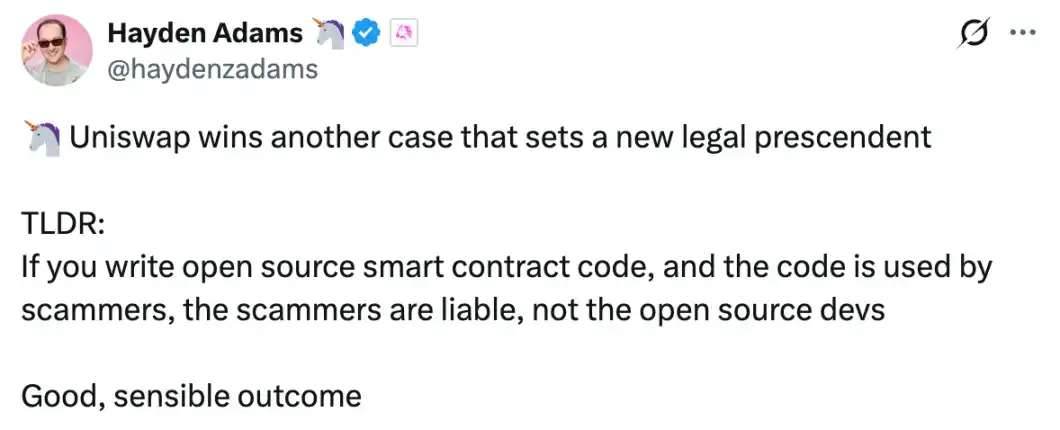
Hayden Adams also tweeted, "If you write open-source smart contract code and that code is used by scammers, the scammers are responsible, not the open-source developer. This is a reasonable and just outcome."

For Web3 developers, this is undoubtedly good news. But what is less known is that the judge who made this "just ruling" is the same person who, during the tenure of the former SEC chairman, found the developers of the mixer Tornado Cash guilty.

The Finalized Verdict

Nearly four years have passed since the class action lawsuit against Uniswap was filed and today's final resolution.

In April 2022, Uniswap users, represented by Nessa Risley, filed a class action lawsuit in court, accusing defendants including Paradigm, a16z, Uniswap, and its founder Hayden Adams of violating federal securities laws by issuing and selling unregistered securities, including UNI, in the form of tokens on Uniswap. The defendants were accused of failing to register Uniswap as an exchange or broker-dealer under applicable securities laws and failing to provide investors with registration statements for the securities they issued and sold.

This lawsuit was initiated by the law firms Kim&Serritella and Barton, representing users who traded EtherumMax, Bezoge, MatrixSamurai, Alphawolf Finance, RocketBunny, and BoomBaby.io tokens on Uniswap between April 5, 2021, and April 4, 2022.

The phrase "unregistered securities" had extraordinary destructive power for the crypto industry at the time, but this lawsuit unexpectedly quickly tilted in Uniswap's favor.

Presiding Judge Katherine Polk Failla, while agreeing that the so-called "scam tokens" were indeed securities, ruled that Uniswap did not need to be held responsible for them. Failla believed that the decentralized nature of Uniswap meant the protocol had no control over which tokens were listed on the platform or who could interact with it. "The case is more like holding the developer of a self-driving car responsible for traffic violations or bank robberies committed by third parties using the car."

Based on this, Failla dismissed the federal securities law charges in August 2023. The plaintiffs then appealed, and the Second Circuit Court of Appeals affirmed the dismissal of the federal part in 2025 but remanded the state law part for retrial.

Subsequently, the plaintiffs amended their complaint and sued again. This time, the investors who lost money accused Uniswap and other defendants of aiding and abetting fraud and misrepresentation, profiting from transactions involving scam tokens, and violating fraud laws in multiple states.

After another review by the same judge, Failla, the amended claims were dismissed again, with no further amendments allowed, bringing the case to a complete end.

The judge's reasoning this time was largely the same as before: Uniswap was not aware of the scam tokens, and even if it were, it did not provide substantial assistance. It also did not meet the definition of fraudulent behavior under any state law. Regarding unjust enrichment, Uniswap did not obtain direct benefits, and the speculative indirect benefits from such scam projects expanding the user base were too tenuous.
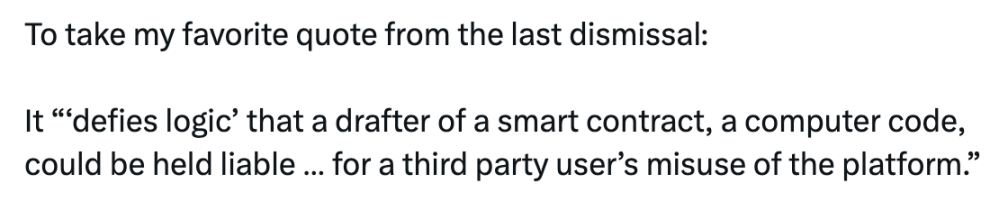
In a tweet, Brian Nistler stated, quoting a sentence from the previous ruling, that it "defies logic" to hold the drafters of smart contracts responsible for the abusive behavior of third-party users on the platform.

The Different Outcome for Tornado Cash

Facing the same judge, Roman Storm of Tornado Cash met a different fate.

Tornado Cash was first added to the sanctions list by the U.S. Treasury Department's Office of Foreign Assets Control (OFAC) on August 8, 2022, accused of helping criminals, including North Korean hackers, launder over $7 billion. Two days after being added to the sanctions list, Dutch police arrested Alexey Pertsev, one of the core developers of Tornado Cash.

On May 14, 2024, a Dutch court found Alexey Pertsev guilty of money laundering and sentenced him to 64 months in prison. The court believed that Pertsev was aware that the platform he developed and operated was used for crime but did not stop it, subjectively acquiescing to Tornado Cash being used as a money laundering tool. Alexey Pertsev is still appealing, but there have been no recent developments.

Seven months before Alexey Pertsev was found guilty, the U.S. Department of Justice sued two other developers, Roman Storm and Roman Semenov, in the Southern District of New York. Roman Storm was previously arrested in Washington State, while Roman Semenov remains at large.
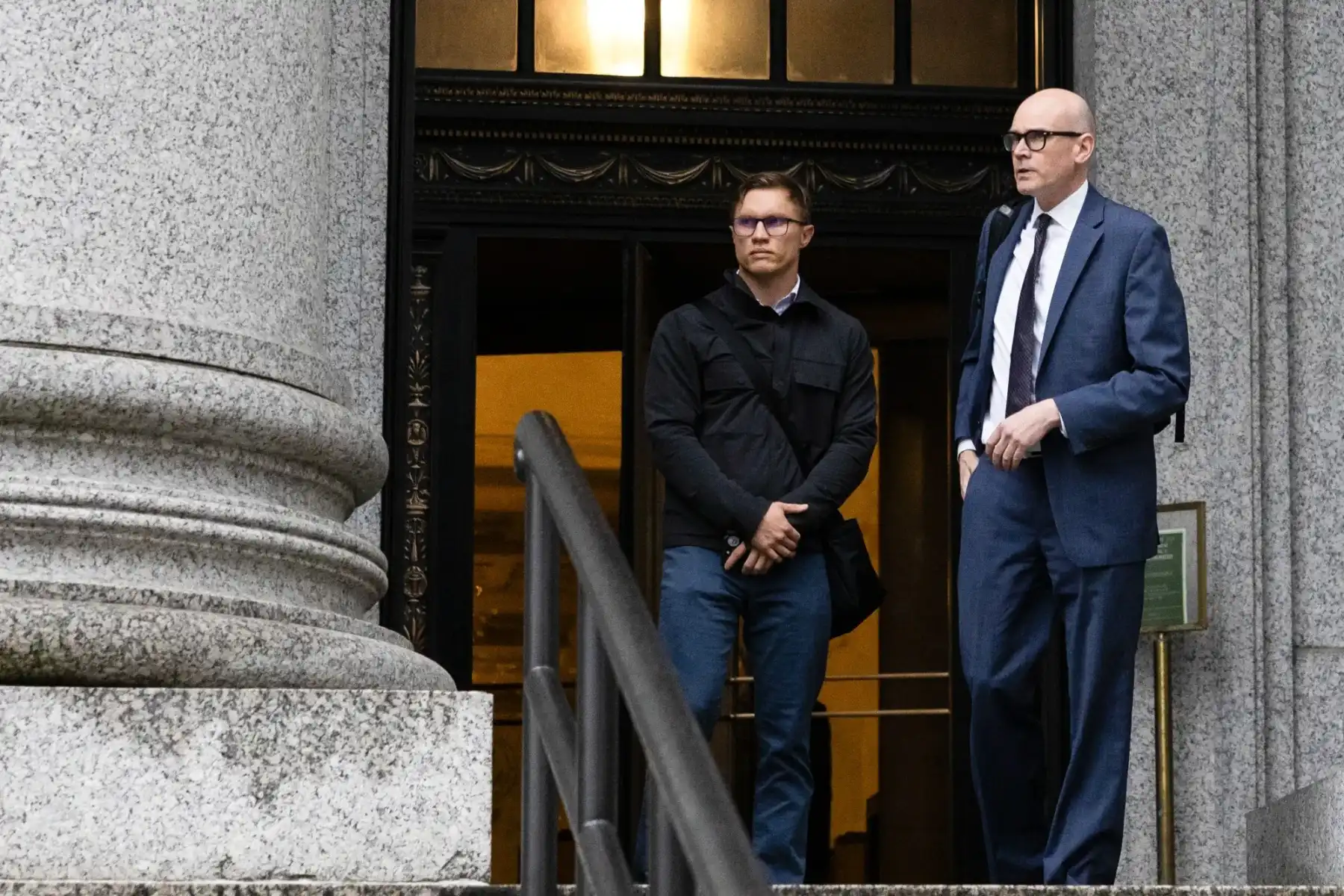
Roman Storm in court

Although an appeal later determined that OFAC's sanctions against Tornado Cash were an overreach and invalid, Roman Storm still found himself in the defendant's seat last July. After a trial presided over by Judge Katherine Polk Failla, the jury found Roman Storm guilty of "conspiracy to operate an unlicensed money transmitting business," but no formal sentencing has been announced yet.
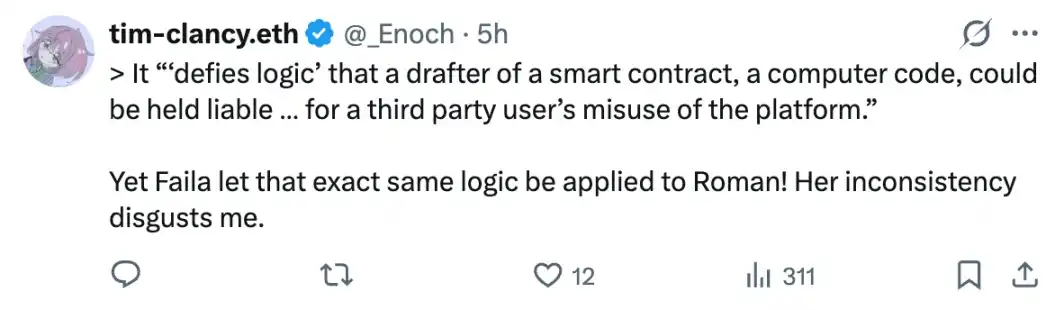
Under Brian Nistler's tweet celebrating Uniswap's victory, a comment by Sigil developer tim-clancy.eth criticizing Failla's contradictory rulings (the verdict against Roman Storm was actually made by a jury) received the most likes among all comments.

Decentralization Is Allowed, but Privacy Is Not

I am not a professional lawyer, but putting aside political factors and from a simple emotional perspective, I can roughly understand why Uniswap and Tornado Cash had different outcomes.

The core reason is that Tornado Cash's developers should have been well aware that a mixer would inevitably be used for money laundering. This clearly reveals the regulatory attitude: decentralization is acceptable, but it must be traceable. Tether once faced the same dilemma, so it later began cooperating with money laundering investigations and added freezing functionality.

Perhaps Roman Storm, behind bars, would feel unjust upon learning of today's verdict, but he should realize that even in a crypto-friendly U.S. under Trump, platforms helping North Korean state-level hackers launder money cannot be tolerated. With the current strength of Crypto, it is still not enough to对抗 national power.

Web3 practitioners sympathize with Tornado Cash's developers and cheer for Uniswap's victory. In our eyes, the two protocols are not fundamentally different; in fact, Tornado Cash is even superior in privacy protection. Uniswap's addition of front-end blocking of sanctioned addresses in 2022 once sparked some debate. Now, it seems that permissionlessness within the existing legal framework may be the only way for decentralized protocols to survive.

But that said, did Uniswap really have no responsibility at all in these scam incidents?

Strictly logically speaking, as the judge's analogy suggests, you cannot hold Mercedes responsible for a bank's losses just because a robber used a Mercedes to rob the bank. But on a commercial level, we tend to believe that giants should provide protection within their capabilities. Current security tools can already identify a large number of potential scam projects in advance. For these established projects that have benefited greatly from Web3's development, simple screening is not troublesome.

Doing their part to protect investors is not a mandatory obligation, but it is a responsibility that ordinary investors hope Uniswap and others will actively shoulder.


Связанные с этим вопросы

QWhat was the outcome of the class action lawsuit against Uniswap and its founder Hayden Adams?

AThe class action lawsuit was dismissed by the U.S. District Court for the Southern District of New York. The judge ruled that Uniswap and its founder were not responsible for the scam tokens traded on the platform, as the protocol's decentralized nature meant it had no control over which tokens were listed or who interacted with it.

QWho was the judge presiding over both the Uniswap case and the Tornado Cash case involving Roman Storm?

AThe judge presiding over both cases was Katherine Polk Failla of the U.S. District Court for the Southern District of New York.

QWhy was Tornado Cash developer Roman Storm found guilty, while Uniswap was not held liable?

ARoman Storm was found guilty of conspiracy to operate an unlicensed money transmitting business because Tornado Cash mixer was used for money laundering, including by North Korean hackers. The court believed the developers were aware of its illicit use. In contrast, Uniswap was deemed a neutral, decentralized protocol with no control over user actions, similar to an autonomous vehicle developer not being liable for misuse by third parties.

QWhat does the article suggest is the key difference in regulatory treatment between Uniswap and Tornado Cash?

AThe article suggests that regulatory tolerance exists for decentralized protocols like Uniswap that are transparent and compliant (e.g., blocking sanctioned addresses), but not for privacy-focused tools like Tornado Cash that enable illicit activities such as money laundering, especially on a scale involving state actors like North Korean hackers.

QWhat responsibility does the article imply Uniswap should have, despite its legal victory?

AThe article implies that while Uniswap has no legal obligation, it has a moral or commercial responsibility to use available security tools to screen and prevent scam projects on its platform, given its influence and benefits from the Web3 ecosystem, to protect ordinary investors.

Похожее

Продажа блочного пространства умерла: публичные блокчейны должны найти новый способ существования

Статья "Продажа блок-пространства мертва: публичным блокчейнам нужно найти новый путь" утверждает, что традиционная бизнес-модель публичных блокчейнов, основанная на продаже пространства в блоках, больше не работает. Из 14 криптокомпаний, заработавших более $200 млн за два года, только Hyperliquid является блокчейном, чей месячный доход ($58 млн) в 100 раз превышает доход Arbitrum ($430 тыс.). Чтобы выжить, блокчейны должны превращаться в продуктовые студии, агрегаторы приложений или вертикальные SaaS-решения, отходя от роли нейтральной инфраструктуры. В статье также разбираются три ключевых события: 1. **Взлом Ostium**: Атака на LP-пулы протокола привела к потере более 40% TVL ($23,7 млн) из-за уязвимости в офф-чейн инфраструктуре, поставляющей цены. Это подчеркивает критическую важность контроля для протоколов, работающих с офф-чейн активами. 2. **Будущее опционов**: Чтобы достичь массового принятия, мощные возможности опционов должны быть абстрагированы от сложной терминологии и представлены через понятные продукты: структурированные продукты, vaultы для получения дохода, бинарные опционы и прогнозные рынки. 3. **На радаре**: Отмечаются тренды, такие как фиксированные займы (Yearn's Flex), смена стратегии Base после неудач с социальными токенами, запуск перпетуальных контрактов на индекс доллара (Plether) и фокус Starknet на приватности и защите от квантовых угроз.

marsbit18 мин. назад

Продажа блочного пространства умерла: публичные блокчейны должны найти новый способ существования

marsbit18 мин. назад

Заметки подкаста|Диалог с управляющим активами GSR: Чтобы определить, настоящий ли этот крипто-ралли, просто взгляните на процентные ставки по кредитам на Aave

Заметки из подкаста: интервью с управляющим директором по управлению активами GSR Энди Бэром. В центре обсуждения — текущий крипторынок и его перспективы. Бэр описывает рынок как находящийся в состоянии «нерешительности» (ambivalence), где краткосрочные отскоки быстро теряют импульс. Для оценки истинной силы восстановления он предлагает три ключевых сигнала: 1. **Процентные ставки в DeFi (особенно на Aave):** Текущие ставки по USDC (~3,75%) близки к безрисковой ставке (SOFR), что указывает на отсутствие ажиотажного спроса на кредитное плечо. Устойчивый рост начнется, когда ставки резко вырастут, отражая всплеск спроса на заемные средства. 2. **Формирование консенсуса о «пике жесткости» ФРС:** Рынкам необходим четкий сигнал о том, где закончится цикл повышения ставок при новом председателе Кевине Уорше. Пока этой ясности нет, трудно ожидать устойчивого бычьего тренда. 3. **Закон CLARITY:** Его принятие до 7 августа, которое сейчас оценивается Polymarket менее чем в 40%, стало бы для рынка позитивным сюрпризом и могло бы дать импульс для роста. Бэр также отмечает, что фонды ETF не являются долгосрочным капиталом, а корпоративные казначейства (DAT) пока неактивны в покупках. Вместе с сокращением предложения стейблкоинов это лишает рынок структурных покупателей. В итоге, для подтверждения подлинности роста следует следить не только за макростатистикой (например, CPI), но и за цепной активностью, прежде всего за ставками кредитования в DeFi.

marsbit28 мин. назад

Заметки подкаста|Диалог с управляющим активами GSR: Чтобы определить, настоящий ли этот крипто-ралли, просто взгляните на процентные ставки по кредитам на Aave

marsbit28 мин. назад

Отправляй сообщения и переводи монеты? Telegram этим летом «встроит» криптокошелек для 1 млрд пользователей

Создатель Telegram Павел Дуров объявил о запуске летом этого года собственного встроенного некастодиального криптокошелька Gram для более чем 1 млрд пользователей приложения. Кошелек позволит совершать мгновенные переводы без комиссий. В отличие от текущего сервиса @wallet, которым управляет сторонняя компания, новый кошелек будет родной функцией Telegram, где пользователи будут самостоятельно контролировать свои приватные ключи. После анонса цена токена GRAM (ранее Toncoin) выросла примерно на 8%, хотя все еще значительно ниже исторических максимумов. Это событие знаменует возвращение Дурова к проекту TON после урегулирования с SEC в 2020 году и является частью его дорожной карты «Make TON Great Again». Запуск происходит в период усиления конкуренции между суперприложениями в сфере платежей: X Money Илона Маска развивает фиатные переводы, а Meta изучает интеграцию стейблкоинов. Telegram делает ставку на криптонативное решение, используя свою огромную аудиторию и близость к криптосообществу. Однако остаются неясными ключевые детали, такие как техническая реализация «нулевых комиссий», поддержка активов помимо GRAM, а также конкретные сроки запуска, помимо обещания «летом».

marsbit1 ч. назад

Отправляй сообщения и переводи монеты? Telegram этим летом «встроит» криптокошелек для 1 млрд пользователей

marsbit1 ч. назад

Предложение Hyperliquid HIP-4 подпитывает стейкинг HYPE по мере роста долгосрочных перспектив

Протокол Hyperliquid (HYPE) представил предложение HIP-4, направленное на создание разрешенных рынков прогнозов и расширение функционала за пределы вечных фьючерсов до базового инфраструктурного уровня для ончейн-приложений. Для запуска новых рынков разработчикам необходимо застейкать 500 000 токенов HYPE. Меры по обеспечению качества рынков призваны трансформировать Hyperliquid из создателя продуктов в инфраструктуру для сторонних разработчиков. Уверенность в долгосрочных перспективах проекта растет, что подтверждается увеличением позитивного настроя вокруг HYPE и активным стейкингом. Крупный трейдер предпочел застейкать токены на сумму около $15,5 млн вместо фиксации прибыли. Общий объем застейканных токенов достиг почти 439 млн, что составляет около 43.9% от общего предложения, укрепляя безопасность сети и сокращая ликвидное предложение. Рыночная структура также демонстрирует силу: открытый интерес превысил $11 млрд при сбалансированных ставках финансирования и ограниченных ликвидациях, что указывает на взвешенный подход трейдеров. Укрепление фундаментальных показателей, таких как рост доходов и TVL, поддерживает оптимистичный прогноз. Успешная реализация обновлений и дальнейшее внедрение пользователями будут ключевыми факторами для поддержания текущего импульса роста.

ambcrypto1 ч. назад

Предложение Hyperliquid HIP-4 подпитывает стейкинг HYPE по мере роста долгосрочных перспектив

ambcrypto1 ч. назад

Через 7 месяцев после краха Huiwang: крупная перетасовка среди платформ-гарантов в Юго-Восточной Азии

За семь месяцев после краха платформы гарантийных платежей Huiwang в Юго-Восточной Азии началась крупная перетасовка на рынке. Такие платформы, как XinBi (Newpay), Linghang (Tiger), Jinbei (Jinbo), Dali (Tiancheng) и Fuli Lai, активно заполняют образовавшийся вакуум, обслуживая теневой бизнес, включая отмывание денег, онлайн-азартные игры, мошенничество в «промышленных парках» и даже торговлю людьми. По данным аналитиков, общий объем средств, проходящих через эти платформы, исчисляется миллиардами долларов США. Крах Huiwang, связанного с камбоджийской группой Prince и конфискацией США 150 000 BTC, не остановил индустрию, а привел к ее реструктуризации и росту новых игроков, которые действуют еще более скрытно. Эксперты подчеркивают, что эти платформы, иногда называемые «азиатским Alipay», являются не законными финансовыми сервисами, а ключевым элементом инфраструктуры для преступной деятельности в регионе.

Odaily星球日报1 ч. назад

Через 7 месяцев после краха Huiwang: крупная перетасовка среди платформ-гарантов в Юго-Восточной Азии

Odaily星球日报1 ч. назад

Торговля

Спот
活动图片




