Robinhood Founder Vlad Tenev on the Great Wealth Transfer, Tokenization, and Gen Z's Investment Future

marsbitОпубликовано 2026-03-18Обновлено 2026-03-18

Введение

In a Bankless interview, Robinhood CEO Vlad Tenev discusses the future of finance, driven by generational wealth transfer, tokenization, and Gen Z's investing behavior. He reveals that Gen Z are serious long-term investors, starting retirement planning as early as age 19 on average. Tenev addresses the $70-90 trillion "Great Wealth Transfer," emphasizing Robinhood's strategy to serve both younger generations and older asset owners through products like banking services and trust accounts. He predicts 24/7 markets and asset tokenization will become standard, with Robinhood already offering tokenized stocks in the EU. Robinhood is building a hybrid CeFi/DeFi infrastructure, including its own Layer 2 chain, to improve accessibility and utility for real-world assets. Tenev dismisses the notion that young investors are solely driven by "financial entertainment," highlighting data showing 40% of platform assets are in passive investments. Other key points include: the social value of prediction markets as "truth machines," plans for a Robinhood Social feature, the potential of AI-powered financial agents, and efforts to democratize access to private equity investments. He also discusses regulatory challenges and the strategic focus on global expansion if U.S. clarity remains limited.

Written by: Bankless

Compiled by: Plain Language Blockchain
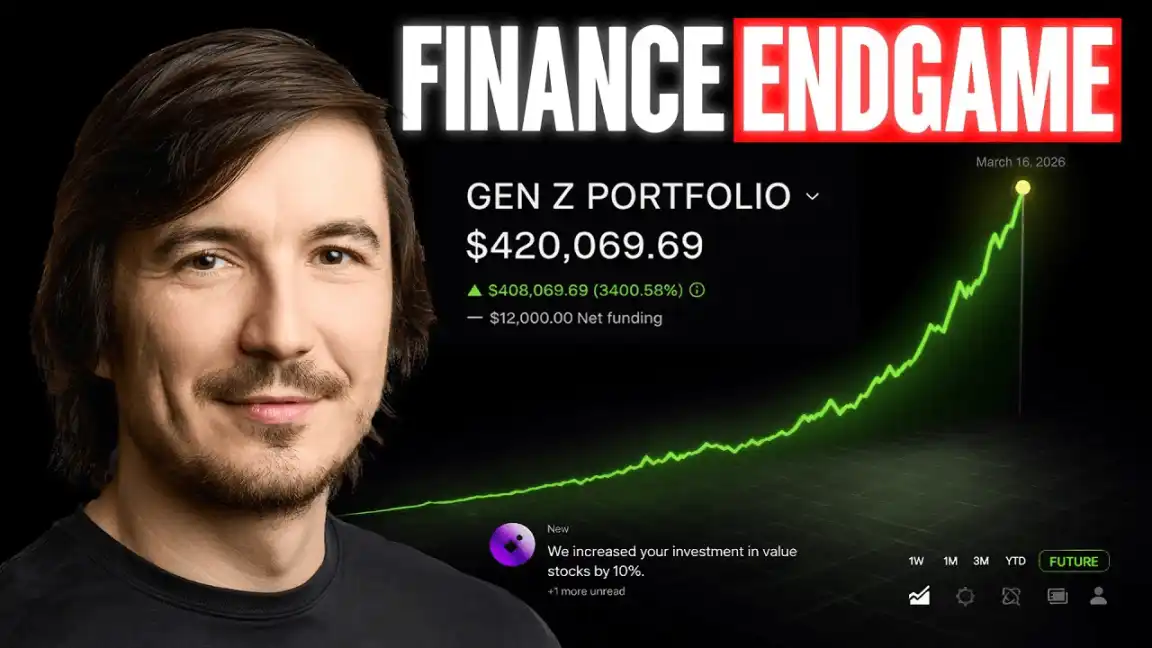
Do you think Generation Z (Gen Z) are just "financial nihilists" squandering their youth on TikTok and blindly speculating in the crypto market? The data from Robinhood founder Vlad Tenev will completely颠覆 your perception. In the latest Bankless interview, Vlad revealed an astonishing fact: Gen Z are the most hardcore long-termists in history, starting to plan for retirement at an average age of 19.

As the序幕拉开 for the $70 trillion "Great Wealth Transfer," this financial giant at the center of the storm is playing a big game: from 24/7 tokenized US stock trading, to plans allowing retail investors to get early access to unicorns like SpaceX and Stripe, to the即将改变游戏规则的 AI financial agents. Vlad not only responded to质疑 about "financial entertainment," but also deeply拆解ed how Robinhood is reshaping traditional banking through a DeFi architecture. This is not just an interview about trading tools, but a roadmap to the future of finance in 2040.

The $70 Trillion "Great Wealth Transfer"

Host: Let's start with the "Great Wealth Transfer." Over the next few decades, as the Baby Boomer and Silent Generations pass their assets down to Gen X, Millennials, and Gen Z, an estimated $70 to $90 trillion in assets are expected to transfer generations in the US. This is the largest wealth transfer in history. To what extent does this massive opportunity guide Robinhood's strategy?

Vlad: We think about it quite a bit. Many companies have started talking about this, but we truly turned it into concrete fintech action, dating back to when we launched Robinhood's banking services at our Gold event last year. Robinhood's core philosophy is: whether individual or institutional, domestic or international, Robinhood should be the place where all your money and assets get the best service. We believe we have a huge opportunity when inheritance events occur for the older generation. We not only serve the younger generation receiving the wealth but also aim to attract the current asset holders—the parents and grandparents—through rich products and features. Through credit and banking services, we can access a large amount of liquid assets held in checking and savings accounts. This year we also launched custodial accounts and trust accounts. We are not just waiting for people to inherit; we are working to make the older generation realize that using other outdated financial platforms today is a disadvantage. This puts us in a favorable position for the peak of the wealth transfer expected in about 8 to 10 years.

Finance in 2040: 24/7 Markets and Asset Tokenization

Host: What will finance look like in 2040? What will remain the same, and what will be彻底改变? Will we have 24/7/365 markets? What role will AI play?

Vlad: I believe 24/7/365 markets are inevitable. We launched 24-hour stock trading in 2022, and now the whole industry is following suit. The technology is ready, and weekend trading will happen sooner than imagined. Tokenization is another core driver. Last year we launched tokenized versions of thousands of US stocks in the EU, even including token giveaways for private companies like OpenAI and SpaceX. It's still early, but I think by the end of this year, tokenized stocks will begin to surpass traditional brokerage accounts in terms of trading advantages. If you can solve the 24/7 liquidity problem for private equity, then basically all assets can achieve全天候 trading.

Tech Stack: The Fusion of CeFi and DeFi

Host: Your Layer 2 chain, Robinhood Chain, just launched on testnet. How do you position this tech stack you are building? Are you challenging the NYSE, or building a new entry point into the crypto world?

Vlad: The tech stack is divided into two parts. One part is the CeFi component, which is the tradability of stock tokens on centralized exchanges like Bitstamp; the other part is the DeFi aspect, where we want users to be able to participate in DeFi protocols on Robinhood Chain or other chains through non-custodial wallets. We don't see ourselves as catching up to traditional providers; this is more like a completely new species. In the crypto ecosystem, many tokens lack underlying utility, but when you bind technological power to real-world assets (RWA) with real fundamental utility, the experience undergoes a qualitative change. As for the US market, although the regulatory environment is changing, the US itself already has a mature structure close to 24/5, so the marginal benefits of tokenization might be less apparent in the short term compared to the EU. But as the technology proves its superiority overseas, it will eventually be移植回 the US.

DeFi Strategy and "Truth Machine" Prediction Markets

Host: Companies like Coinbase and BlackRock are moving towards DeFi. What is Robinhood's decentralized finance strategy? Also, regarding the recently hot "prediction markets," do you think they are good or bad for society?

Vlad: Our strategy is "full-stack." We need to onboard a large number of customers through the Robinhood App and Wallet, while also building infrastructure like Robinhood Chain. The activity on the testnet has exceeded my expectations; developers are very interested. The future core lies in "Curation"—how to help customers filter through thousands of on-chain products to find high-quality choices that match their risk profile. Regarding prediction markets, I believe they are very beneficial to society. They are not just trading venues but "truth machines." The business model of traditional news media sometimes delays the truth in exchange for traffic, while prediction markets fill the primal need people have for "real information."

Host: Will Robinhood strengthen its media and content属性? For example, becoming the homepage for prediction markets, or adding social elements.

Vlad: Absolutely. We are about to launch Robinhood Social. We have a massive amount of assets, and prediction markets will be "first-class citizens" among them. Through user-generated content (UGC), we can capture breaking news faster than manual curation. At the same time, our media division, Sherwood Media, is also outputting high-quality content and integrating prediction market data. In terms of execution, we partner with Kalshi and ForecastX, and in the future, through the acquired Bitstamp, we will also have our own trading venue to provide customers with the optimal experience.

Debunking the Myth of "Financial Entertainment"

Host: Many people believe the younger generation engages in finance for entertainment, even带有 "financial nihilism," thinking they are speculating and gambling. As a platform, how do you view this trend?

Vlad: I have a rather "spicy" take: I don't believe entertainment drives most financial activity. The reality is, no one wants to discuss the boring but important parts on social media. On Twitter, no one posts "my Robinhood retirement account grew again," because it's not sexy and doesn't go viral. But the data tells us that 40% of the assets on the platform are in passive instruments (like ETFs, cash). Even the most active options traders typically have larger passive investment portfolios. People just operate in different accounts for different purposes.

Host: That's a powerful counter-narrative. So Gen Z isn't financially irresponsible, but actually more savvy?

Vlad: Exactly. As I just mentioned, they open accounts very early. Part of the reason is the convenience of access—just a few clicks on Robinhood to open an account. Another part is economic incentives, like our 3% match contribution for Gold members' retirement accounts. Furthermore, young people today are more likely to be independent contractors or gig economy participants, making it harder to rely on traditional employer 401k plans, so they need to actively manage their future more. Currently, our retirement assets have exceeded $25 billion, and the growth is astounding.

Trump Accounts and the Future "Gen Beta"

Host: Let's talk about groups younger than 19. The Trump Accounts mentioned in the recent "Fairness for All Act" have attracted attention; the government would provide a $1000 initial investment fund for newborns. Why do you rate this so highly?

Vlad: This is the first mechanism I can think of that truly "gives money back to the future." Current policies mostly involve debt that mortgages the future. Trump Accounts are automated; they teach children the value of long-term investment. By age 18 or 30, benefiting from compound interest, this money could grow to hundreds of thousands or even millions of dollars. Although newborns won't directly operate phones, these accounts are managed by parents, and we will focus on building a "kids' investment experience" focused on financial education and literacy.

Financial Super App and the Future of Payments

Host: Everyone is running towards a "financial super app." Will Robinhood pack all functions into one app? Also, why haven't you implemented peer-to-peer (P2P) payments between users yet?

Vlad: We will adopt a flexible strategy. The main app will evolve to be more highly personalized, tailored to you like a social media feed. At the same time, we will also retain standalone professional apps, like a dedicated banking app or non-custodial wallet, connected through unified identity verification. Regarding payments, we've experimented. But we found Robinhood users are primarily credit-driven, not the群体 that primarily relies on借记卡 for early paycheck access. Currently, the P2P experience on Venmo and Cash App is already good; we don't want to just pile on mediocre, commoditized features unless we can make significant improvements. Right now, our priority is moving the remaining banking features onto the platform.

Stablecoins and Regulation

Host: What is your view on stablecoins as banking products?

Vlad: Stablecoins face two challenges: First, FDIC insurance. US consumers highly value fund safety, especially after the 2023 banking crisis; the de-pegging risk of stablecoins leaves people wary. Second, competition from cashback on payments. Currently, you can't get 3% cashback like with credit cards when paying with stablecoins. Stablecoins are currently useful for large B2B or cross-border payments, but for consumer scenarios like splitting a bill for pizza, more ecosystem maturity is needed.

Host: Regarding the Clarity Act (crypto regulation bill), how reliant are you on its passage?

Vlad: The Clarity Act can clarify what is a security and what is a commodity, which would save us a lot of legal and compliance costs. More importantly, it can prevent policy flip-flops due to administrative changes. Regardless of whether the bill passes, we will push forward with Robinhood Chain because it is global and permissionless. If clarity is high in the US, we'll push the US market; if clarity is low, we'll prioritize developing international business.

The Next Growth Areas: AI and Private Equity

Host: Looking ahead, what is Robinhood's third big opportunity?

Vlad: There are several directions. First is the launch of Social features; second is the popularization of prediction markets. But the biggest transformation might come from AI. We are thinking: how could an "AI agent," like a family office, run your entire financial life? From automatically managing savings to executing complex trading strategies. Additionally, we are also addressing the issue of retail investors being unable to access growth stocks (like Stripe, SpaceX) through Robinhood Ventures. We allow retail participation in IPOs through IPO Access and use our own capital to invest in late-stage private rounds. In the future, we hope even seed-round financing could include retail investors.

Host: Thank you, Vlad, for sharing. Robinhood has always been a leader in democratizing finance. The above does not constitute financial advice; cryptocurrencies are risky. Thank you for listening to Bankless.


Связанные с этим вопросы

QWhat is the 'Great Wealth Transfer' and how is Robinhood positioning itself for it?

AThe 'Great Wealth Transfer' refers to the projected $70-90 trillion in assets that will be passed down from the Baby Boomer and Silent generations to Gen X, Millennials, and Gen Z in the coming decades. Robinhood is positioning itself by not only serving the younger generations who will inherit the wealth but also by attracting the current asset holders (parents and grandparents) through products like credit and banking services, custodial accounts, and trust accounts. The goal is to become the primary platform for all financial services, making them aware that using outdated platforms is a disadvantage.

QAccording to Vlad Tenev, what are the key drivers for the future of finance by 2040?

AVlad Tenev identifies two key drivers for the future of finance by 2040: 24/7/365 markets and asset tokenization. He believes round-the-clock trading is inevitable and that tokenization is a core driver, noting that tokenized stocks in the EU are on track to surpass traditional brokerage accounts in trading advantages by the end of the year. Solving the 24/7 liquidity problem for private equity would essentially allow all assets to trade continuously.

QHow does Robinhood's strategy for DeFi and its new Robinhood Chain differ from traditional financial infrastructure?

ARobinhood's strategy is 'full-stack,' combining both CeFi and DeFi components. The CeFi component involves making tokenized stocks tradable on centralized exchanges like Bitstamp. The DeFi component aims to let users engage with DeFi protocols through non-custodial wallets on the Robinhood Chain or other chains. Vlad Tenev positions this not as competing with traditional suppliers like the NYSE but as creating a new species of financial infrastructure that combines real-world assets (RWA) with crypto utility, leading to a qualitatively different experience.

QWhat is Vlad Tenev's response to the criticism that Gen Z's engagement in finance is driven by 'entertainment' or 'financial nihilism'?

AVlad Tenev strongly disputes the narrative that Gen Z's finance activity is primarily driven by entertainment. He argues that the 'boring but important' aspects of investing, like passive ETF and cash holdings, don't get discussed on social media because they aren't 'sexy' or viral. Data shows that 40% of assets on the Robinhood platform are in passive instruments. He states that Gen Z is actually more financially responsible, opening investment accounts very early (average age 19) due to ease of access and economic incentives, and are often proactive in managing their future, especially as independent workers.

QWhat are some of the next big growth opportunities for Robinhood, as mentioned by Vlad Tenev?

AThe next big growth opportunities for Robinhood include: 1) The launch of its Social feature and the proliferation of prediction markets. 2) The transformative potential of AI, specifically exploring how an 'AI agent' could autonomously manage a user's entire financial life, from savings to executing complex trading strategies. 3) Democratizing access to private equity for retail investors through initiatives like Robinhood Ventures and IPO Access, aiming to eventually allow散户 investment even in seed-round funding for companies like Stripe and SpaceX.

Похожее

Dialogue with Morgan Stanley Executive: Wall Street Isn't Rejecting Bitcoin, It's Just Waiting for the Right Time

In a podcast interview, Amy Oldenburg, Head of Digital Asset Strategy at Morgan Stanley, discusses Wall Street's evolving stance on Bitcoin, explaining the bank's measured approach and the road ahead. Oldenburg, with 26 years at Morgan Stanley, traces her perspective to witnessing transformative tech cycles and her experience in emerging markets, where she observed the need for alternative financial systems like mobile money (e.g., M-Pesa). This background informs her view of Bitcoin's value proposition. She clarifies that Morgan Stanley is "client-driven." Regulatory hurdles, particularly as a bank holding company under Federal Reserve oversight, initially slowed their entry. While the firm couldn't act as quickly as independent asset managers, persistent client demand and a changing regulatory environment led to offerings like their low-fee Bitcoin ETP (MSBT). They are now gradually rolling out spot Bitcoin trading on their E*Trade platform. Regarding advisor adoption, Oldenburg cites a "lack of education" as the primary barrier. Morgan Stanley recommends a 0-2% allocation for more conservative portfolios and 2-4% for aggressive ones, but price volatility and confusion about its place in asset allocation persist. She notes competition for investor attention from AI and commodities. Addressing Bitcoin's price stagnation despite institutional buying, Oldenburg points to a confluence of factors: competing investment narratives (AI, quantum computing) and the complex financial landscape. She suggests a catalyst for Bitcoin as a neutral reserve asset might require a "slow-burn crisis" that exposes fragility in traditional systems. For wider bank adoption, including holding Bitcoin on balance sheets, she identifies the need for regulatory clarity to reduce punitive capital treatment and for the asset to be usable as collateral within financial ecosystems. Looking ahead, Oldenburg predicts steady, moderate adoption growth through 2030 rather than an explosive "J-curve." She emphasizes the importance of differentiating Bitcoin from other crypto assets and expresses concern that the core cypherpunk ethos of self-custody is being diluted as traditional finance enters the space. She concludes that the digital asset field remains in its early stages with significant innovation, like AI agents and micropayments, still to come.

marsbit5 мин. назад

Dialogue with Morgan Stanley Executive: Wall Street Isn't Rejecting Bitcoin, It's Just Waiting for the Right Time

marsbit5 мин. назад

10% Position Limit Proposed: UK Retail Authorized Funds to Gain Indirect Exposure to Crypto Assets

The UK Financial Conduct Authority (FCA) is consulting on a proposal (CP26/17) that would allow retail funds, including UCITS and most Non-UCITS Retail Schemes (NURS), to invest up to 10% of their total assets in cryptoasset exchange-traded notes (crypto ETNs). This would enable indirect exposure to cryptoassets for mainstream investors through regulated funds. The rule maintains the existing prohibition on funds holding underlying cryptocurrencies like Bitcoin or Ethereum directly. The proposal introduces a strict 10% cap, positioning crypto ETNs as a potential satellite holding within diversified portfolios. Funds must ensure these investments align with their stated objectives and risk profiles. Notably, the cap does not apply to Qualified Investor Schemes (QIS) for professional clients, while Long-Term Asset Funds (LTAFs) would be prohibited from holding crypto ETNs. This move builds on the FCA's 2025 decision to permit retail trading of crypto ETNs on UK regulated exchanges. However, significant compliance burdens fall on fund managers, who must conduct thorough due diligence, assess liquidity, and provide clear risk disclosures to investors. The FCA emphasizes that even a small allocation can significantly impact a fund's risk profile. The policy's practical impact remains uncertain. Widespread adoption depends on whether asset managers deem the potential benefits worth the operational costs, disclosure requirements, and reputational risks. The consultation is open for feedback until July 13, 2026. Ultimately, the proposal represents a cautious, incremental step toward integrating cryptoassets into the regulated fund landscape, rather than a broad opening.

Foresight News34 мин. назад

10% Position Limit Proposed: UK Retail Authorized Funds to Gain Indirect Exposure to Crypto Assets

Foresight News34 мин. назад

Public Version of Mythos Officially Launched: Analyzing the Advantages and Limitations of AI Smart Contract Auditing

Publicly available Mythos, Anthropic's AI model, has officially launched, demonstrating both significant potential and limitations in smart contract security auditing. The article analyzes its capabilities through real-world cases. AI excels in identifying subtle, low-level vulnerabilities through pattern recognition and large-scale code screening. A key example is detecting a storage slot collision between a custom rewards mapping and a third-party library's ReentrancyGuard, a vulnerability easily missed in manual audits. In the recent Zcash incident, AI also rapidly discovered a critical soundness bug that had remained hidden for years. However, AI currently struggles with complex, interconnected scenarios. When tested on the Curve LlamaLend sDOLA exploit, which involved manipulating prices across multiple protocols (Curve pools, lending markets) to trigger liquidations, Fable 5 failed to identify the core cross-protocol attack vector. These scenarios require a deep understanding of DeFi economic models and multi-contract interactions. In conclusion, while AI tools like Mythos significantly boost efficiency in finding standardized, syntactic vulnerabilities, they cannot yet replace expert analysis for complex, business-logic, and cross-protocol attacks. An effective audit workflow combines AI's speed for initial screening with human expertise for in-depth, holistic analysis.

marsbit39 мин. назад

Public Version of Mythos Officially Launched: Analyzing the Advantages and Limitations of AI Smart Contract Auditing

marsbit39 мин. назад

Trade.xyz's Rebase Refusal Sparks Controversy, On-Chain Pre-IPO Market Faces Major Pricing Test

The debate surrounding Trade.xyz's refusal to adjust its SPCX (SpaceX pre-IPO) perpetual contract pricing amid updated share count revelations highlights a key challenge for on-chain pre-IPO markets. While several centralized exchanges (CEXs) paused and repriced their contracts after SpaceX's filing showed a ~10% increase in total shares, Trade.xyz maintained its market-driven pricing logic, which tracks expected per-share price sentiment rather than fundamental valuation metrics like market cap. This discrepancy triggered cross-platform arbitrage and caused leveraged long positions on Trade.xyz to suffer significant losses, as the platform's HIP-3 architecture lacks a native "Rebase" mechanism to neutrally adjust all user positions following such corporate actions. The incident underscores the difficulty for decentralized perpetual exchanges (Perp DEXs) to implement Rebase—a process CEXs handle by centrally pausing markets and adjusting ledger data. On-chain, this requires complex smart contract modifications, increasing gas costs, complexity, and potential attack surfaces. While some DEXs have managed similar adjustments, Trade.xyz's current design does not natively support it, though the team is reportedly exploring solutions for future events like stock splits. Ultimately, the controversy serves as a critical case study for the nascent on-chain pre-IPO sector, raising questions about price discovery reliability, transparent rule disclosure, and the readiness of DeFi infrastructures to handle traditional corporate actions as real-world assets (RWAs) gain traction.

marsbit47 мин. назад

Trade.xyz's Rebase Refusal Sparks Controversy, On-Chain Pre-IPO Market Faces Major Pricing Test

marsbit47 мин. назад

Торговля

Спот
Фьючерсы
活动图片




