Ripple Chiseled a Crack in the Wall, But Swift Tore Down the Entire Wall

深潮Опубликовано 2025-12-23Обновлено 2025-12-23

Введение

At the Sibos 2025 conference, Swift announced a major evolution of its financial infrastructure by integrating a blockchain-based shared ledger to support tokenized assets and enable secure, real-time, and interoperable global transactions. The new system, built on Consensys' Ethereum Layer 2 network Linea, uses zk-EVM rollup technology to reduce costs and settlement times while meeting banking security standards. Over 30 major banks, including JPMorgan and Citibank, are participating in the pilot. The article reflects on Ripple’s long-standing effort to challenge traditional cross-border payments using XRP and RippleNet, which has seen adoption in retail and corporate remittances despite earlier regulatory challenges. However, Swift’s move represents a broader and more systemic shift. Unlike Ripple’s XRP-dependent model, Swift’s ledger is asset-agnostic, supporting CBDCs, stablecoins, and fiat currencies, and leverages its existing network of over 11,000 institutions. This transition marks a convergence of traditional and decentralized finance, enabling 24/7 settlement, reducing reliance on pre-funded accounts, and potentially freeing up trillions in trapped capital. By adopting a neutral, interoperable, and highly scalable blockchain framework, Swift is positioned to redefine global value transfer—moving from a legacy telegraphic model to a digitally-native, mathematically-verified system.

Author: Sanqing, Foresight News

During the Sibos 2025 conference in Frankfurt, Swift's Chief Business Officer Thierry Chilosi and Standard Chartered Bank's Global Head of Transaction Banking, Michael Spiegel, discussed a major transformation in global finance. As tokenization moves from pilot programs to reality, Swift officially announced the addition of a blockchain-based shared ledger to its infrastructure, aiming to achieve trusted and interoperable digital finance on a global scale. This ledger will serve as a secure, real-time transaction record between financial institutions, using smart contracts to validate transaction sequences and execute agreed-upon rules. It is designed to complement existing systems and seamlessly bridge traditional finance with tokenized assets.
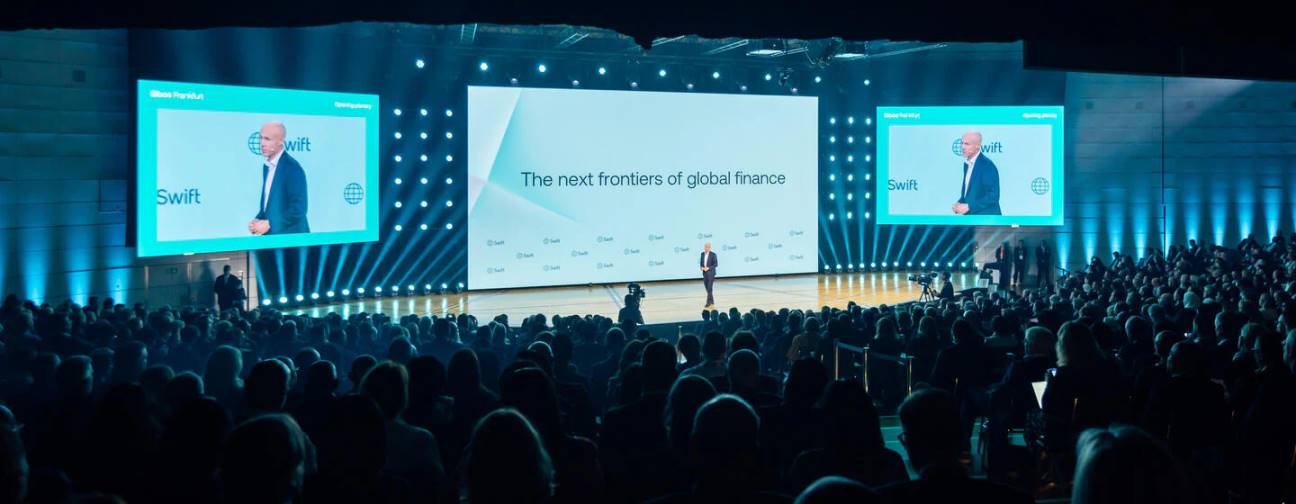
Image Source: Swift Official Website

Although Swift did not explicitly state the technical platform when initially announcing this major development to the banking industry, Consensys CEO Joe Lubin revealed at the Token2049 conference in Singapore that Swift is leveraging the Ethereum Layer 2 network Linea to build its new payment settlement platform. By adopting Linea's zk-EVM rollup technology, Swift can significantly reduce costs and latency while meeting the financial industry's stringent requirements for 24/7 real-time settlement and security. Currently, over 30 top financial institutions, including JPMorgan Chase, Bank of America, and Citibank, are preparing to participate in the pilot of this new blockchain-based payment rail built on Linea.

Ripple's In-Depth Efforts and Current Status

Before discussing Swift, we must revisit the pioneer that challenged the old system for over a decade: Ripple.

In 2012, Ripple emerged with the XRP Ledger (XRPL), with the core goal of replacing the inefficient Swift correspondent banking model. During this period, Ripple successfully built the global payment network RippleNet, connecting over 300 financial institutions. In fragmented markets like Southeast Asia, its On-Demand Liquidity (ODL) service demonstrated that XRP, as a bridge currency, could reduce cross-border settlement times from several days to just 3 to 5 seconds.

By 2020, affected by the U.S. SEC lawsuit, Ripple faced a blockade and stagnation in the U.S. market due to securities allegations. However, its global scale continued to expand. By 2022, its business had reached over 40 payment markets, with total payment volume doubling to approximately $30 billion.

In 2023, Ripple saw a turning point when a court ruled that XRP itself is not a security, marking a milestone victory for Ripple and the industry.

In August 2025, with the SEC completely abandoning its appeal, the five-year legal battle came to an end. The full clarification of its status led to the approval of an XRP spot ETF, marking its official entry into mainstream institutional asset allocation portfolios.

Today, Ripple is conducting cross-border payment and receipt businesses in multiple real-world scenarios, ranging from retail remittances (To C) to enterprise-level payments (To B).

In the retail sector, Japan's SBI Remit uses XRP to bridge real-time remittance channels to the Philippines, Vietnam, and Indonesia, significantly reducing the pre-funding costs for overseas workers. Santander Bank offers transparent real-time transfers to its customers through the One Pay FX app. Meanwhile, the Southeast Asian payment platform Tranglo has significantly improved the efficiency of peso and baht conversions with the support of Ripple ODL.

At the enterprise level, American Express and PNC Bank use RippleNet to optimize B2B trade settlements and international payment collection experiences.

Additionally, in national infrastructure, Ripple is collaborating with over 20 countries, including Palau, Montenegro, and Bhutan, to develop CBDC platforms, applying blockchain technology to the issuance and清算 systems of sovereign currencies.

Why Did Swift Choose Linea?

When giants in the industry布局 the Ethereum ecosystem, they have shown a high degree of consistency in their preference for Layer 2 technology: Coinbase's Base chain is built on OP Stack, while Robinhood announced earlier this year the launch of Robinhood Chain based on Arbitrum technology to support the tokenization and 24/7 trading of RWA.

This preference stems from L2's ability to leverage Ethereum's security while meeting high-performance demands through a modular architecture. Swift's choice of Linea over OP or Arbitrum lies in the core difference in underlying validation logic.

OP and Arbitrum use Optimistic Rollup, which operates on the logic of assuming transactions are valid by default and only verifying them if challenged. Asset withdrawals typically require a multi-day challenge period, which is a significant time cost for financial清算追求流动性.

Linea, on the other hand, uses zk-EVM, which provides instant validity proofs mathematically. For Swift and its partner banks, which need to process massive value settlements, zk-EVM not only offers faster finality but also ensures compliance verification while protecting transaction privacy.

Swift's choice of Linea embodies the first principle of capital operation: maximizing flow velocity.

Capital will flow like a fluid from low-velocity systems (requiring large amounts of idle准备金预存 in Nostro/Vostro accounts), high-friction systems (layers of correspondent bank fees), and slow-settlement systems (settlement taking days) of the traditional telegraphic instruction era to high-velocity, low-friction, fast-settlement blockchain digital systems.

Swift processes approximately $150 trillion in global payments annually. If it can achieve atomic-level reconciliation and 24/7 real-time settlement through Linea's technology stack, it means that trillions of dollars in准备金 currently积压 in the global financial system to hedge against清算 delays will be released and reinjected into the real economy.

As Consensys CEO Joe Lubin stated at the Token 2049 conference in Singapore, this is not merely a technological upgrade but the true convergence of TradFi and DeFi, marking the global value transfer protocol's official transition from the "Telegraphic Instruction Era" to the "Mathematical Verification Era."

The Significance of Swift Embracing Blockchain

As the global financial backbone network handling approximately $150 trillion in annual transaction volume, Swift's decision to build its ledger on Linea, an Ethereum Layer 2, signifies that blockchain technology will become the heart of mainstream finance.

Swift will eliminate fragmentation between different tokenized networks through unified technical standards, breaking down the long-standing barrier between TradFi and DeFi and implanting the efficiency genes of decentralized finance into the traditional清算 system.

Through a 24/7 operational real-time shared ledger, global financial institutions will no longer be limited by the cumbersome manual reconciliation and time-zone delays of the correspondent banking model. The massive amounts of idle capital currently积压 in correspondent bank accounts to hedge against清算 risk will be effectively released. This will enable the speed of capital flow to truly match the demands of the modern economy, ushering in a new era of global value transfer that is more transparent, lower cost, and更具互操作性.

Ripple struggled for a decade to build a new city based on the XRP Ledger outside the old system. However, the scale of financial institutions it currently connects appears势单力薄 compared to Swift's存量 network, which covers over 11,000 institutions across more than 200 countries.

The core threat from Swift lies in its "asset neutrality." Unlike Ripple's ODL model, which heavily relies on XRP as a bridge currency, Swift's blockchain ledger is designed to support multiple assets, including fiat currencies, stablecoins, and CBDCs.

Banks within the Swift system can achieve instant settlement by upgrading their existing rails without bearing the volatility risk of a single asset. This combination of "存量优势 (incumbent advantage) + technical compliance" is giving Ripple its most bone-chilling challenge since its inception.


Связанные с этим вопросы

QWhat is the core technological difference between Swift's chosen Linea and other Layer 2 solutions like Optimistic Rollups?

AThe core difference lies in the underlying verification logic. Linea uses zk-EVM (Zero-Knowledge Ethereum Virtual Machine), which provides instant validity proofs for transactions. In contrast, Optimistic Rollups (like OP and Arbitrum) assume transactions are valid by default and only verify them if a challenge is issued, which introduces a multi-day withdrawal delay. For high-value financial settlements requiring speed and finality, zk-EVM's instant cryptographic verification is superior.

QHow did the resolution of Ripple's legal battle with the SEC in 2025 impact its business?

AThe resolution, with the SEC dropping its appeals in August 2025, provided full legal clarity for Ripple. This landmark victory led to the approval of an XRP spot ETF, marking its formal entry into the asset allocation lists of mainstream financial firms and solidifying its legitimacy in the market.

QWhat specific problem is Swift's new blockchain-based shared ledger designed to solve in global finance?

AIt is designed to solve the inefficiencies of the traditional correspondent banking model, including slow settlement times (taking days), high costs from intermediary fees, and the need for large amounts of pre-funded capital (Nostro/Vostro accounts) to hedge against settlement risk. The ledger enables secure, real-time, 24/7 settlement, releasing trapped capital and improving interoperability.

QWhy is Swift's approach considered a greater threat to Ripple than simply competing with its technology?

ASwift's threat stems from its 'asset neutrality' and immense existing network. Unlike Ripple's ODL model, which relies heavily on the XRP token as a bridge currency, Swift's ledger is designed to support multiple assets including fiat currencies, stablecoins, and CBDCs. This allows Swift's vast network of over 11,000 banks to upgrade for instant settlement without exposure to the volatility of a single asset, leveraging its massive existing infrastructure.

QName one retail and one corporate use case where Ripple's technology is currently being implemented.

ARetail: Japan's SBI Remit uses XRP to provide real-time remittance channels to the Philippines, Vietnam, and Indonesia. Corporate: American Express utilizes RippleNet to optimize its B2B trade settlement processes.

Похожее

South Korean Exchanges 'Battle' Regulators, Challenging the Boundaries of Enforcement and Legislation

South Korea's cryptocurrency industry is engaged in a rare, direct confrontation with regulators. The Financial Intelligence Unit (FIU), the primary anti-money laundering (AML) watchdog, has recently imposed heavy penalties on major exchanges like Upbit and Bithumb for alleged violations involving unregistered overseas VASPs and AML procedures. However, exchanges are now actively challenging these actions in court and through industry associations. In a significant shift, the Seoul Administrative Court ruled in favor of Upbit's operator, Dunamu, overturning part of an FIU-ordered business suspension. The court found the FIU's penalty criteria and justification insufficiently clear. Similarly, the court suspended the enforcement of a six-month business suspension against Bithumb pending a final ruling, citing potential irreversible harm to the exchange. Beyond legal battles, the industry is contesting proposed legislative amendments. The Digital Asset eXchange Alliance (DAXA) strongly opposes a draft rule that would mandate Suspicious Transaction Reports (STRs) for all crypto transfers over 10 million KRW (~$6,800). DAXA argues this "poison pill" clause violates legal principles and would overwhelm the STR system, increasing reports from 63,000 to an estimated 5.45 million annually for major exchanges, thereby crippling effective AML monitoring. This conflict highlights a structural tension in South Korea's crypto governance: comprehensive digital asset laws are still developing, while regulators rely heavily on AML enforcement. The industry's move from passive compliance to active legal and legislative challenges signifies a new phase, pressing for clearer rules and more proportionate enforcement. While short-term disputes may intensify, this clash could ultimately lead to a more mature and sustainable regulatory framework for South Korea's vibrant crypto market.

marsbit47 мин. назад

South Korean Exchanges 'Battle' Regulators, Challenging the Boundaries of Enforcement and Legislation

marsbit47 мин. назад

After 50x Storage Surge, Justin Sun Always Looks to the Next Decade

Sun Yuchen, known for his controversial stunts like a $30 million lunch with Warren Buffett (canceled due to a kidney stone) and eating a $6.2 million duct-taped banana, is often overshadowed by a significant fact: his decade-long track record of spotting major investment trends. In 2016, he famously advised young people to invest in Bitcoin, Nvidia, Tesla, and Tencent instead of buying property. A hypothetical $20,000 investment in Nvidia and Tesla from that list would now be worth over 50 million RMB. His latest major call was on November 6, 2025, predicting a "50x storage opportunity" tied to the AI boom, which materialized with Sandisk's stock surging nearly 50-fold by 2026. Looking ahead, Sun now focuses on the next frontier: Physical AI. He identifies four key areas: 1. **Embodied AI/Robotics**: He sees this reaching its "iPhone moment," with companies like UBTech and Galaxy General leading in commercialization. 2. **Drones**: Viewed as the first commercially viable form of Physical AI, revolutionizing sectors from warfare (e.g., AeroVironment's Switchblade) to logistics. 3. **Spatial Computing**: Beyond VR, it's about AI understanding physical space, a foundational technology for robotics and autonomous systems, exemplified by Apple's Vision Pro. 4. **Space Exploration**: After a 2025 suborbital flight with Blue Origin, Sun advocates for space as the ultimate frontier, discussing blockchain's potential role in space asset management and data transactions. His investment philosophy involves betting on entire, inevitable trends rather than single companies. For robotics, he sees Tesla (the body/manufacturer) and Nvidia (the brain/AI platform) as complementary plays. In defense drones, he highlights companies making tanks obsolete (AeroVironment) and those augmenting fighter jets (Kratos). For space, he participated in Blue Origin's flight and anticipates SpaceX's potential IPO to redefine the sector's valuation. Sun Yuchen's vision frames the next two decades not as a revolution in information flow (like the internet), but in the fundamental operation of the physical world through AI-powered robots, autonomous systems, and spatial intelligence, ultimately extending human and AI activity into space. While many still focus on conventional assets, he continues to look toward the next technological horizon.

marsbit1 ч. назад

After 50x Storage Surge, Justin Sun Always Looks to the Next Decade

marsbit1 ч. назад

The Billionaires Behind the Most Expensive Midterm Election in History

"The Most Expensive Midterm Elections and Their Billionaire Backers" This analysis details the unprecedented scale of spending in the 2026 midterm elections, highlighting the key billionaire donors shaping the political landscape. Jeff Yass, founder of Susquehanna International Group, has contributed over $81 million, ranking third among individual donors behind George Soros ($102.6M) and Elon Musk ($84.8M). Yass is a major donor to Trump's MAGA Inc. and supports school choice and various candidates. Overall, federal committees have raised over $4.7 billion this cycle, with political ad spending projected to reach $10.8 billion. Republican-aligned groups are significantly out-raising their Democratic counterparts. "Dark money" from undisclosed sources continues to grow. The core stakes involve control of Congress and policy direction for Trump's final term. Donors are also motivated by specific issues: Sergey Brin and Chris Larsen are funding opposition to a proposed California wealth tax and supporting crypto-friendly policies. Other top donors include OpenAI's Greg Brockman and his wife Anna ($50M total to MAGA Inc. and an AI-focused PAC), Richard Uihlein ($45.3M to conservative causes), venture capitalists Marc Andreessen and Ben Horowitz (each over $44M to crypto/AI PACs and MAGA Inc.), Miriam Adelson ($42.6M to GOP leadership PACs), Paul Singer ($33.9M), and Diane Hendricks ($25.8M to MAGA Inc.). The article notes that the peak fundraising period is still ahead, with major primaries approaching.

marsbit1 ч. назад

The Billionaires Behind the Most Expensive Midterm Election in History

marsbit1 ч. назад

The Largest IPO in History Is Approaching, Surpassing SpaceX, 28 Years of AI Self-Iteration, Countdown to Intelligence Explosion

"Anthropic Nears Trillion-Dollar IPO, Fueled by Explosive Growth and 2028 'Intelligence Explosion' Warning Anthropic is considering a deal valuing the AI company near $1 trillion, potentially leading to one of the largest IPOs ever and surpassing SpaceX. Its revenue has skyrocketed, with Annual Recurring Revenue (ARR) reaching $45 billion in May 2026—a 500% increase in just five months. This vertical growth curve is attributed to its key products, Claude Code and Cowork, dominating AI coding and enterprise collaboration. Beyond commercial success, co-founder Jack Clark issued a pivotal warning in an interview: there is a greater than 50% chance that by the end of 2028, AI systems will achieve recursive self-improvement—the ability to autonomously build a 'better version' of themselves, initiating an 'intelligence explosion.' This prophecy underpins the company's astronomical valuation, as the market prices in the potential for transformative and disruptive AI. Further signaling its ambition, Anthropic formed a $1.5 billion joint venture with Goldman Sachs and Blackstone, aiming to disrupt traditional consulting firms like McKinsey by deploying Claude AI for complex strategic work. This move tests AI's capacity to replace high-level cognitive labor, a precursor to its predicted autonomous evolution. The narrative presents a dual future: unprecedented economic opportunity alongside significant risks like economic restructuring and security threats. Anthropic's meteoric rise and Clark's 2028 prediction frame the coming years as a countdown to a potential technological singularity."

marsbit1 ч. назад

The Largest IPO in History Is Approaching, Surpassing SpaceX, 28 Years of AI Self-Iteration, Countdown to Intelligence Explosion

marsbit1 ч. назад

Торговля

Спот
Фьючерсы

Популярные статьи

Как купить ACN

Добро пожаловать на HTX.com! Мы сделали приобретение AITECH CLOUD NETWORK (ACN) простым и удобным. Следуйте нашему пошаговому руководству и отправляйтесь в свое крипто-путешествие.Шаг 1: Создайте аккаунт на HTXИспользуйте свой адрес электронной почты или номер телефона, чтобы зарегистрироваться и бесплатно создать аккаунт на HTX. Пройдите удобную регистрацию и откройте для себя весь функционал.Создать аккаунтШаг 2: Перейдите в Купить криптовалюту и выберите свой способ оплатыКредитная/Дебетовая Карта: Используйте свою карту Visa или Mastercard для мгновенной покупки AITECH CLOUD NETWORK (ACN).Баланс: Используйте средства с баланса вашего аккаунта HTX для простой торговли.Третьи Лица: Мы добавили популярные способы оплаты, такие как Google Pay и Apple Pay, для повышения удобства.P2P: Торгуйте напрямую с другими пользователями на HTX.Внебиржевая Торговля (OTC): Мы предлагаем индивидуальные услуги и конкурентоспособные обменные курсы для трейдеров.Шаг 3: Хранение AITECH CLOUD NETWORK (ACN)После приобретения вами AITECH CLOUD NETWORK (ACN) храните их в своем аккаунте на HTX. В качестве альтернативы вы можете отправить их куда-либо с помощью перевода в блокчейне или использовать для торговли с другими криптовалютами.Шаг 4: Торговля AITECH CLOUD NETWORK (ACN)С легкостью торгуйте AITECH CLOUD NETWORK (ACN) на спотовом рынке HTX. Просто зайдите в свой аккаунт, выберите торговую пару, совершайте сделки и следите за ними в режиме реального времени. Мы предлагаем удобный интерфейс как для начинающих, так и для опытных трейдеров.

276 просмотров всегоОпубликовано 2026.04.28Обновлено 2026.04.28

Как купить ACN

Что такое HPP

И. Введение в проектСозданный как уровень 2 на Arbitrum и развивающий проверенное наследие Aergo, HPP предоставляет инфраструктуру, необходимую современным AI-приложениям — масштабируемую, бездоверительную и готовую к корпоративному использованию.II. Информация о криптовалюте1) Основная информацияНазвание: Протокол Домашней Вечеринки (HPP)III. Связанные ссылкиОфициальный сайт:https://www.hpp.io/Белая книга:https://www.hpp.io/assets/HPP%20Whitepaper_ENG_vF_20250725-Bb-xX5Yd.pdfБлокчейн-эксплорер:https://explorer.hpp.io/Социальные сети:Twitter: https://x.com/aergo_ioMedium: https://medium.com/aergoTelegram: https://t.me/aergoofficial%22Примечание: Введение в проект основано на материалах, опубликованных или предоставленных официальной командой проекта, и предназначено только для справки и не является инвестиционным советом. HTX не несет ответственности за любые прямые или косвенные убытки, возникшие в результате.

143 просмотров всегоОпубликовано 2026.04.29Обновлено 2026.04.29

Что такое HPP

Как купить HPP

Добро пожаловать на HTX.com! Мы сделали приобретение House Party Protocol (HPP) простым и удобным. Следуйте нашему пошаговому руководству и отправляйтесь в свое крипто-путешествие.Шаг 1: Создайте аккаунт на HTXИспользуйте свой адрес электронной почты или номер телефона, чтобы зарегистрироваться и бесплатно создать аккаунт на HTX. Пройдите удобную регистрацию и откройте для себя весь функционал.Создать аккаунтШаг 2: Перейдите в Купить криптовалюту и выберите свой способ оплатыКредитная/Дебетовая Карта: Используйте свою карту Visa или Mastercard для мгновенной покупки House Party Protocol (HPP).Баланс: Используйте средства с баланса вашего аккаунта HTX для простой торговли.Третьи Лица: Мы добавили популярные способы оплаты, такие как Google Pay и Apple Pay, для повышения удобства.P2P: Торгуйте напрямую с другими пользователями на HTX.Внебиржевая Торговля (OTC): Мы предлагаем индивидуальные услуги и конкурентоспособные обменные курсы для трейдеров.Шаг 3: Хранение House Party Protocol (HPP)После приобретения вами House Party Protocol (HPP) храните их в своем аккаунте на HTX. В качестве альтернативы вы можете отправить их куда-либо с помощью перевода в блокчейне или использовать для торговли с другими криптовалютами.Шаг 4: Торговля House Party Protocol (HPP)С легкостью торгуйте House Party Protocol (HPP) на спотовом рынке HTX. Просто зайдите в свой аккаунт, выберите торговую пару, совершайте сделки и следите за ними в режиме реального времени. Мы предлагаем удобный интерфейс как для начинающих, так и для опытных трейдеров.

77 просмотров всегоОпубликовано 2026.04.29Обновлено 2026.04.29

Как купить HPP

Обсуждения

Добро пожаловать в Сообщество HTX. Здесь вы сможете быть в курсе последних новостей о развитии платформы и получить доступ к профессиональной аналитической информации о рынке. Мнения пользователей о цене на A (A) представлены ниже.

活动图片