Revealed as Soon as Today: The Entire Internet Awaits the 'Version Answer' from the 24-Year-Old 'AI Stock Prodigy'

Odaily星球日报Опубликовано 2026-05-18Обновлено 2026-05-18

Введение

The online investment community is eagerly awaiting the Q1 2026 13F filing from the "Situational Awareness" fund, led by 24-year-old Leopold Aschenbrenner, known as an "AI stock-picking prodigy." His fund's assets reportedly exploded from $225 million in Q4 2024 to $5.5 billion by Q4 2025, making its quarterly disclosures a major market signal. The filing, due by May 15th, is now three days late. Analysts suggest three possibilities: 1) A routine delay with SEC processing, meaning the report could be published imminently. 2) The fund has applied for "confidential treatment" from the SEC, allowing it to hide new, large positions it is still accumulating—a move that would spark intense speculation. 3) The fund's holdings fell below the $100 million reporting threshold, though this is considered highly unlikely given its recent size. The reason for the delay will become clear within days. If it's a standard delay, the portfolio will be revealed shortly. If it's confidential treatment, the hunt will be on to decipher what major AI-related asset Aschenbrenner is secretly building a position in.

Original | Odaily Planet Daily (@OdailyChina)

Author | Azuma (@azuma_eth)

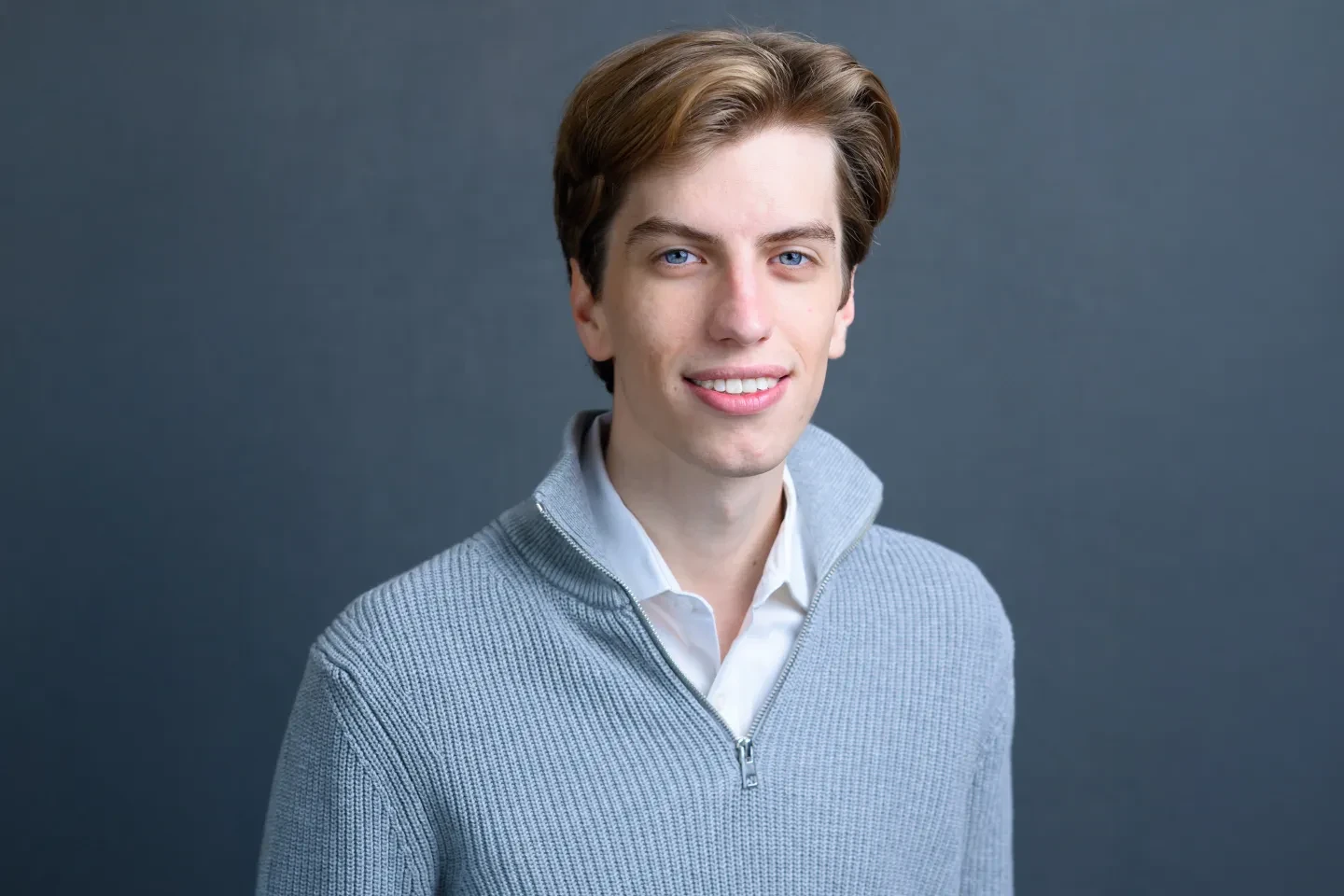
Remember Leopold Aschenbrenner? The 24-year-old 'AI prodigy' we introduced in the article "SBF's Junior, Who Turned $225 Million into $5.5 Billion in One Year".

Leopold Aschenbrenner worked at FTX's Future Fund in 2022 and stayed with the team until FTX's collapse. In 2024, Leopold Aschenbrenner wrote a 165-page mega-paper titled "Situational Awareness: The Decade Ahead" and in the same year founded a fund of the same name, Situational Awareness LP, where he serves as Chief Investment Officer.

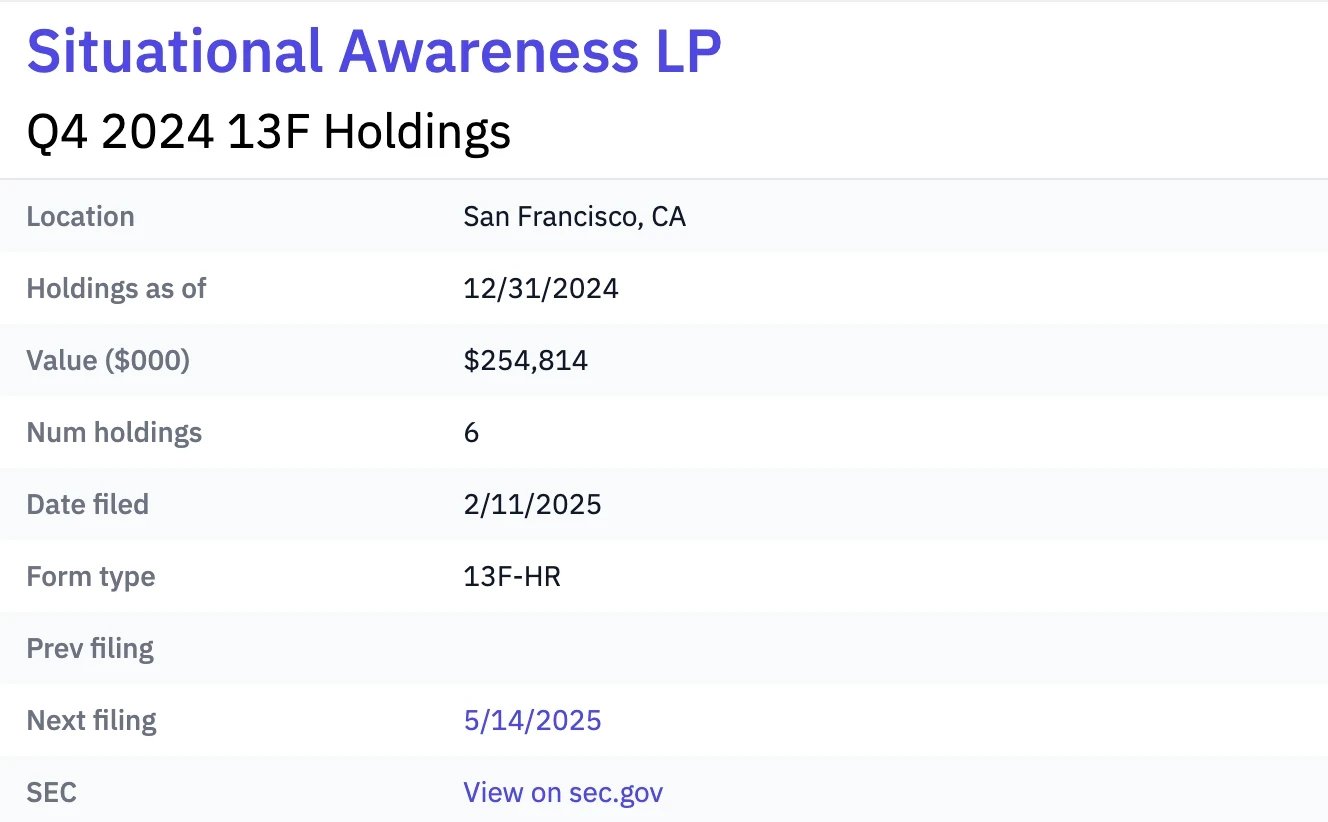
Situational Awareness LP focuses on investment opportunities in the AI industry chain. The fund's publicly disclosed holdings were 'only' $225 million in Q4 2024, but in the Q4 2025 holdings disclosure released this February, this figure had skyrocketed to $5.5 billion. This explosive investment return performance has also made Leopold Aschenbrenner and Situational Awareness LP highly renowned, becoming one of the most watched AI investment trends on the internet.

Now, Situational Awareness LP is approaching the critical window for a new round of holdings disclosure (13F). Since last week, the entire internet has been collectively waiting, anticipating the fund's 'version answer' on how to position for AI at present, but as of this writing, Situational Awareness LP's disclosure has still not arrived.

13F refers to the quarterly disclosure documents mandated by the U.S. Securities and Exchange Commission (SEC) for funds with assets under management exceeding $100 million. SEC requires that funds meeting the disclosure threshold must submit this document within 45 days after the end of each calendar quarter. The fund must focus on disclosing its holdings in U.S. listed stocks, call/put options, convertible bonds, and specific ETF positions at the end of the previous quarter.

It is already May 18th, three days past the Q1 2026 disclosure deadline of May 15th. Over the past few days, several sovereign wealth funds, university endowments, and traditional financial institutions have disclosed their Q1 13F holdings reports, but the market is still waiting for Situational Awareness LP's disclosure.

Based on various market analyses, the following three situations may have affected Situational Awareness LP's 13F disclosure progress.

The first possibility is that Situational Awareness LP may have submitted the file to the SEC after 5:30 PM on May 15th itself. Since that day was a Friday, the SEC did not have time to process it, so the document would need to be published on the SEC's website the following Monday before the public can see it.

This is the mainstream view in the market. If this is the case, we are expected to see Situational Awareness LP's 13F filing later today (or tomorrow at the latest).

The second possibility is that Situational Awareness LP applied for confidential treatment from the SEC. This is a legal mechanism provided by the SEC, allowing large funds to delay the public disclosure of their holdings information that is still being accumulated, with delays lasting up to a year in some cases.

Generally, funds apply for confidential treatment for only one reason — they are building a position large enough that if the market learns about it prematurely, it would move the price against them before they finish accumulating. If this is the reason this time, it means Leopold Aschenbrenner is quietly accumulating a significant asset and temporarily does not want the market to know. This would undoubtedly warrant more attention from the market.

The third possibility is almost impossible, which is that Situational Awareness LP significantly reduced its holdings in the past quarter and has dropped its holding size below the 13F disclosure threshold ($100 million). However, considering the fund held $5.5 billion last quarter, this scenario is extremely unlikely.

In summary, we just need to wait patiently for another 1 to 2 days to learn the real reason for Situational Awareness LP's delayed disclosure this time.

If it's the first case, we will bring you an analysis of the changes in holdings as soon as the 13F is released. If it's the second reason, the entire internet will truly be on edge — what exactly is Leopold Aschenbrenner hoarding? That will be the moment for all kinds of investigative experts to shine.

Связанные с этим вопросы

QWho is the main subject of the article and what is his fund called?

AThe main subject is Leopold Aschenbrenner. He is the 24-year-old 'AI stock god' who founded and serves as the Chief Investment Officer of the Situational Awareness LP fund.

QWhat was the growth in Situational Awareness LP's publicly disclosed holdings from Q4 2024 to Q4 2025?

AThe fund's publicly disclosed holdings grew explosively from $225 million in Q4 2024 to $5.5 billion in Q4 2025.

QWhat is a 13F filing, and what triggers the requirement to file it?

AA 13F filing is a mandatory quarterly report required by the U.S. SEC for investment managers with over $100 million in assets under management. It discloses their holdings of U.S. exchange-traded stocks, options, convertible notes, and certain ETFs.

QWhat are the three possible reasons discussed in the article for the delay in Situational Awareness LP's Q1 2026 13F filing?

A1. Late submission on the Friday deadline (May 15th), with SEC processing expected on the following Monday. 2. The fund applied for confidential treatment to hide a large, ongoing position. 3. The fund's holdings fell below the $100 million reporting threshold, which is considered highly unlikely.

QWhy would a fund apply for confidential treatment on a 13F filing, according to the article?

AA fund would apply for confidential treatment to delay public disclosure of a large position they are still accumulating. This prevents the market from moving the price against them before they finish building the position.

Похожее

Agents Take Over Traffic Distribution Power: What Are Tencent, ByteDance, and Alibaba Competing For?

In the race to dominate the AI era's entry point, China's tech giants—Tencent, ByteDance, and Alibaba—are aggressively deploying AI Agents to control the future of traffic distribution. Alibaba is pursuing a dual-track "closed loop + openness" strategy. Its Qianwen app is evolving into a super-Agent integrated across its ecosystem (Taobao, Alipay, etc.) to handle complex tasks like travel planning. Concurrently, it is opening its platform to external brands (Luckin Coffee, KFC) and has launched a B2B Agent platform, "Wukong," targeting enterprise automation. Its other flagship, Quark, aims to be an "AI super search box" for information and tasks. ByteDance is executing an omnipresent "sprawl strategy." Its Doubao app boasts over 300 million monthly active users and is evolving into a default AI entry point for daily life, with plans for paid versions and e-commerce integration. Its core weapon is the Kouzi platform, a visual "AI assembly factory" for developers to build custom Agents. ByteDance is also pushing hardware integration, collaborating on AI phones and developing smart glasses to embed Doubao everywhere. Tencent is playing its long-held "ultimate card" by quietly embedding an AI Agent directly into WeChat. This Agent, accessible via a swipe, can understand user commands and automatically execute tasks by calling upon WeChat's millions of mini-programs (e.g., finding and ordering coffee). This leverages WeChat's unparalleled 1.4-billion-user ecosystem to position the app as an AI-powered "service operating system," a move that could dramatically reshape the competitive landscape. The core battleground is shifting from competing for "user screen time" to competing to be the "default execution layer" for user intent. The business model is evolving from an "attention economy" to an "intent economy," where the Agent that can most efficiently fulfill a user's need gains control over service access and token flow. This represents a fundamental change in how users connect with digital services, making the fight for the Agent入口 (entry point) a pivotal moment for redefining industry leadership in the AI age.

marsbit39 мин. назад

Agents Take Over Traffic Distribution Power: What Are Tencent, ByteDance, and Alibaba Competing For?

marsbit39 мин. назад

From Banning Doubao to Embracing Honor: Why Did WeChat Suddenly 'Change Its Face'?

The article explores the sudden shift in WeChat's strategy towards AI assistants from mobile phone manufacturers, transitioning from strict opposition to active collaboration. For over a year, WeChat fiercely resisted attempts by phone AI assistants (like ByteDance's Doubao in late 2025) to control its features via GUI automation ("simulated clicking"), citing security and data control concerns. This stance created a significant barrier for system-level AI integration. Now, Tencent has initiated A2A (Agent-to-Agent) partnerships with major phone brands like Honor, Xiaomi, OPPO, and vivo. This model allows a phone's system AI (e.g., Honor's YOYO) to parse a user's voice command and send a structured request directly to WeChat's own internal AI agent via secure APIs. WeChat then executes the action (e.g., sending a message) and returns the result. The article attributes Tencent's "change of face" to strategic pressure. While leading in social app usage, Tencent trails rivals like ByteDance and Alibaba in standalone AI app popularity. WeChat, with its vast mini-program ecosystem, is Tencent's key asset for an AI comeback. The upcoming WeChat AI agent aims to handle tasks like booking and payments within the app. However, phone system assistants remain the primary AI entry point for most users. The A2A collaboration allows Tencent to extend WeChat's AI reach to this crucial system layer while maintaining control over its core functions and data. For phone manufacturers, embracing A2A is a pragmatic move. The GUI route proved unviable due to WeChat's blocks. A2A offers a compliant path to integrate a vital service, enhancing their AI assistants' usefulness. It allows them to focus on developing their own AI ecosystems for other services while cooperating on WeChat access. The collaboration is framed as a mutual, strategic necessity: Tencent gains a distribution channel, and manufacturers gain a key functionality. The partnership relies on a "dual authorization" mechanism for security, requiring both user and app consent for each action. While questions about long-term data privacy practices remain, experts note A2A is more secure and compliant than GUI automation. Ultimately, this cooperation is seen as a tentative, calculated truce. Tencent's long-term goal is to make WeChat an AI-powered "service OS." Phone manufacturers aim to make their system AI the central user interface. Their paths may converge or clash in the future, but for now, the A2A deal represents the opening chapter in the battle for the AI-era user入口, driven by necessity and strategic calculus on both sides.

marsbit2 ч. назад

From Banning Doubao to Embracing Honor: Why Did WeChat Suddenly 'Change Its Face'?

marsbit2 ч. назад

Торговля

Спот
Фьючерсы

Популярные статьи

Неделя обучения по популярным токенам (2): 2026 может стать годом приложений реального времени, сектор AI продолжает оставаться в тренде

2025 год — год институциональных инвесторов, в будущем он будет доминировать в приложениях реального времени.

1.8k просмотров всегоОпубликовано 2025.12.16Обновлено 2025.12.16

Неделя обучения по популярным токенам (2): 2026 может стать годом приложений реального времени, сектор AI продолжает оставаться в тренде

Обсуждения

Добро пожаловать в Сообщество HTX. Здесь вы сможете быть в курсе последних новостей о развитии платформы и получить доступ к профессиональной аналитической информации о рынке. Мнения пользователей о цене на AI (AI) представлены ниже.

活动图片