Red Alert: Bank of Japan's 25bp Rate Hike Imminent, Are US Stocks and Crypto Set for a Repeat of the 2024 Flash Crash?

marsbitОпубликовано 2026-06-11Обновлено 2026-06-11

Введение

Japanese central bank likely to raise interest rates by 25 basis points to 1.0% in June, its highest level since 1995, with market probability at 98%. This move, driven by persistent inflation risks from energy costs and a weak yen, risks triggering a "carry trade" unwind. Investors who borrowed cheap yen to invest in higher-yield assets like US stocks and crypto may be forced to sell, potentially causing significant volatility. An estimated $500 billion in yen-funded positions remains vulnerable. This could mirror the August 2024 flash crash, where a yen surge triggered a global stock sell-off and a sharp Bitcoin drop. High-valuation AI and tech stocks are particularly sensitive to tighter global liquidity and rising energy costs. Cryptocurrencies, as high-beta assets, face amplified risk from higher leverage costs and competing for scarcer market liquidity. Analysts warn of short-term pressure on risk assets, advising caution regarding leverage amid heightened volatility.

Original | Odaily Planet Daily (@OdailyChina)

Author | Qin Xiaofeng (@QinXiaofeng 888 )
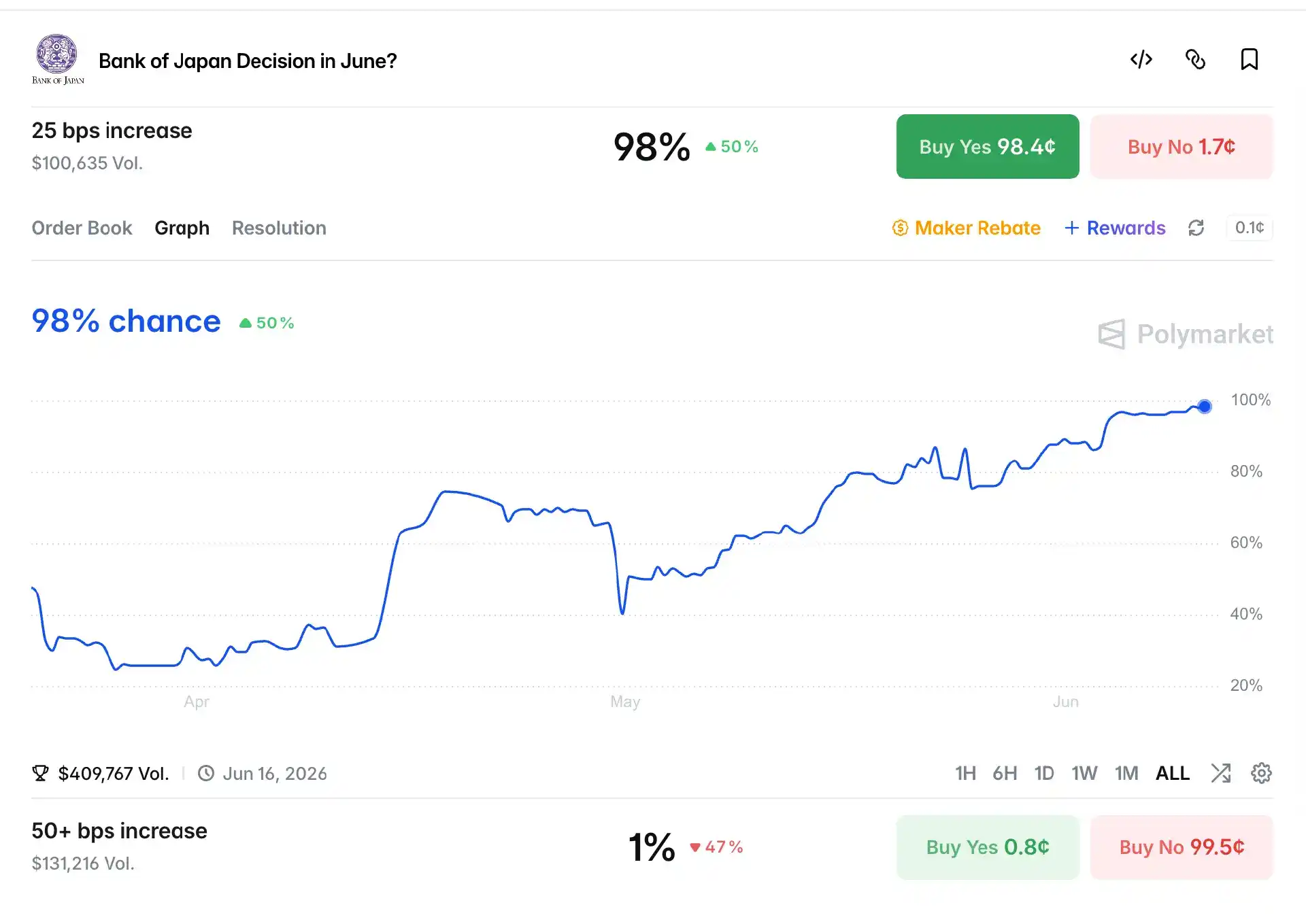
According to Nikkei News, the Bank of Japan (BoJ) is expected to raise its short-term policy rate from 0.75% to 1.0% during the monetary policy meeting on June 15-16, which would be the highest policy rate level since 1995. Currently, market pricing for a rate hike is extremely high, with the probability of a "25bp (basis point) hike" on PolyMarket surging from 25% in early April to 98%.
With a BoJ rate hike imminent, a large number of investors engaged in yen carry trades may be forced to sell overseas assets, convert back to yen, and repay loans, triggering a chain reaction and amplifying volatility in global risk assets—the flash crash in August 2024 serves as a classic example, where a sharp yen appreciation led to a short-term plunge in global stock markets, with Bitcoin plummeting nearly $20,000 in a single day, a maximum drop of 15%.

Odaily Planet Daily will analyze the macro backdrop and transmission mechanism of the BoJ rate hike, and focus on assessing the risk impact on AI tech stocks and cryptocurrencies for readers' reference.

1. Inflation Risks Drive BoJ Rate Hike

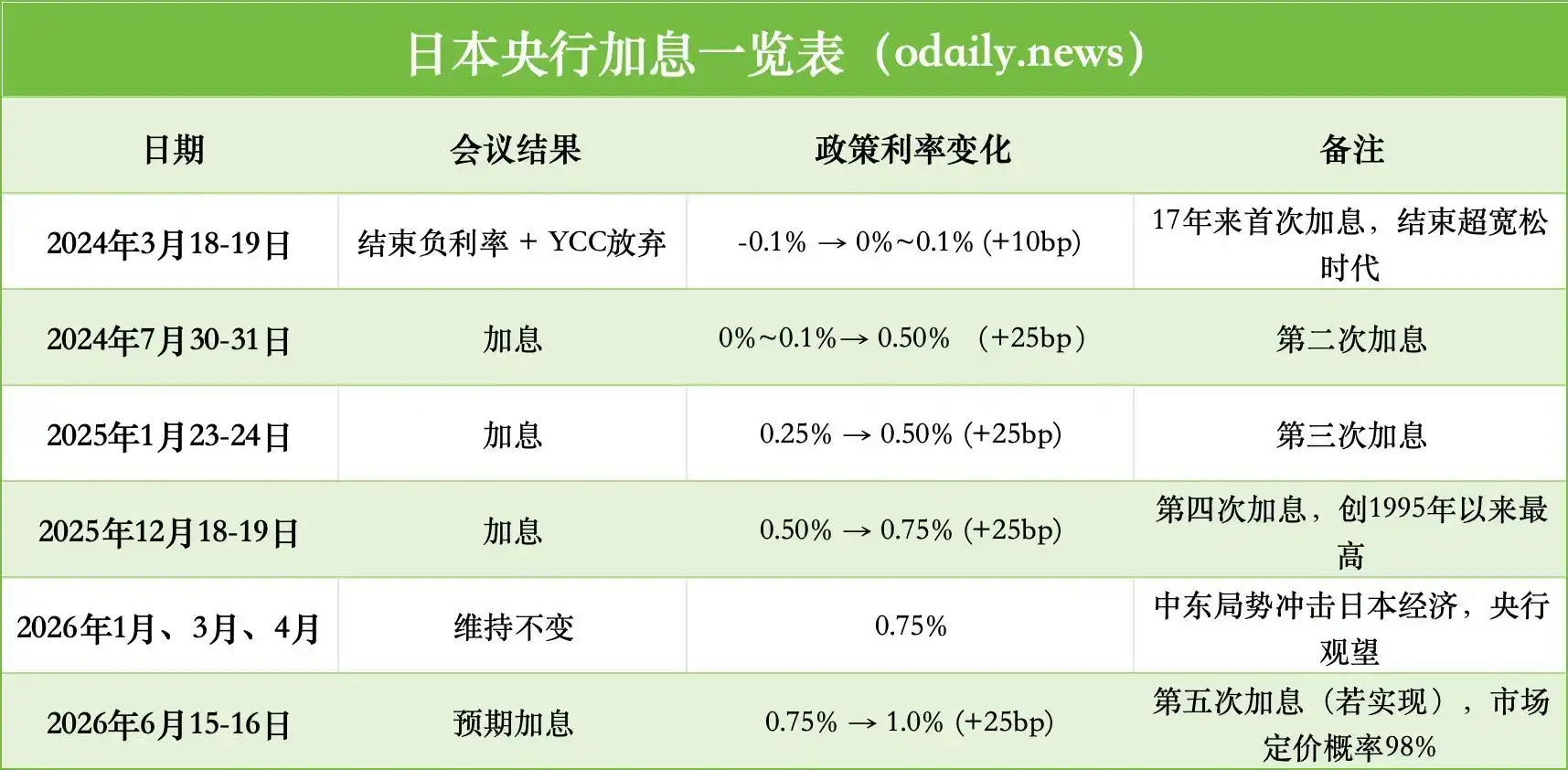
Over the past two years, hawkish voices within the BoJ have grown increasingly strong, culminating in the end of a 17-year negative interest rate policy in March 2024, raising the policy rate from -0.1% to a range of 0% to 0.1%, marking the first rate hike in this cycle. In July 2024, the BoJ hiked rates again by 15bp to 0.25% and announced a gradual balance sheet reduction; in January and December 2025, it raised rates by 25bp each, bringing the rate to 0.75%; rates remained unchanged in the first three meetings of 2026. The following outlines the BoJ's rate hikes in several meetings:
After keeping rates unchanged for half a year, why is the BoJ now eager to embark on a new round of rate hikes? This hike primarily stems from two aspects.

First, energy shocks and imported inflation pressure. As oil price volatility occurred due to Middle East conflicts in the first half of the year, Japan, highly dependent on imported energy, saw a significant rise in import costs. The Corporate Goods Price Index (CGPI) rose 6.3% year-on-year in May, the fastest pace since 2023, with petroleum products up 9.6% and utilities up 8.5%. The BoJ expects core CPI for fiscal 2026 to rise to 2.5-3.0%, far above the established 2% target.

Second, a weak yen exacerbates imported inflation. The current USD/JPY exchange rate continues to hover around the 158-160 high, nearing historically extreme weakness. The sharp depreciation of the yen directly weakens the import purchasing power of Japanese companies, leading to a significant increase in import costs for commodities such as energy and raw materials, further pushing up domestic prices. Although Japan's Ministry of Finance has repeatedly intervened in the foreign exchange market, the effects have been limited and unsustainable. This situation is forcing the BoJ to tighten monetary policy (i.e., raise rates) at the June meeting to avoid runaway inflation expectations.

In a speech on June 3, BoJ Governor Kazuo Ueda explicitly shifted the narrative towards fighting inflation, emphasizing that if upside risks to prices outweigh downside risks to the economy, the pros and cons of a rate hike must be discussed.

Reuters, citing three informed sources, reported that unless the Middle East conflict escalates sharply, the BoJ will raise rates in June and may slow the pace of bond portfolio reduction to maintain market stability. Bloomberg and institutions like ING maintain similar judgments and expect the BoJ to hike a total of 50bp in 2026.

This series of changes marks Japan's shift from the "world's last lender" to a normalizing central bank, posing a direct challenge to global assets reliant on cheap yen financing.

2. Unwinding Yen Carry Trades, Sustained Liquidity Tightening

The Bank of Japan's prolonged maintenance of ultra-loose monetary policy has made yen carry trades a key component of global liquidity over the past decade. Investors borrow yen at near-zero interest rates and invest in high-yielding assets like US stocks, tech stocks, emerging markets, and cryptocurrencies to earn interest differentials and capital gains.

The BoJ's upcoming rate hike will directly increase yen financing costs and could trigger yen appreciation (USD/JPY decline), forcing leveraged investors to unwind positions, creating a positive feedback loop: yen appreciation leads to expanding exchange rate losses → rising financing costs → forced investor deleveraging → large-scale selling of risk assets → further decline in asset prices → triggering more stop-losses → intensifying unwinding pressure.

Historically, every BoJ policy tightening signal has triggered severe market volatility.

On July 31, 2024, the BoJ hiked rates by 15bp to 0.25% and announced gradual balance sheet reduction, coupled with weak US employment data, triggering severe global market turbulence. At that time, South Korea's two major stock indices (KOSPI and KOSDAQ) plunged simultaneously, triggering circuit breakers; Japanese stocks crashed, with the Nikkei 225 plummeting 12.4% in a single day, accumulating a weekly loss of over 20%, the worst performance since 1987; global stock markets fell in tandem, with US stocks and tech stocks adjusting synchronously, and the VIX fear index soaring. Crypto also suffered heavy losses, with Bitcoin and ETH plunging over 30% in just a week, and leveraged liquidations surging.

According to Morgan Stanley estimates, although a significant number of positions have been gradually unwound since 2024, there are still approximately $500 billion in outstanding yen-funded positions in the market. Although the market has priced in some risks in advance, these positions still pose a significant hidden danger. Morgan Stanley warns that a rapid yen appreciation could trigger chain unwinding during periods of thin liquidity, especially impacting high-leverage assets severely.

J.P. Morgan's Global Head of Market Strategy, Dubravko Lakos-Bujas, and FX strategist Meera Chandan both pointed out that the policy divergence between the BoJ and the Federal Reserve will increase the instability of carry trade unwinding, potentially leading to a valuation reassessment of global risk assets.

3. Global Risk Assets Take a Hit, US Stocks and Crypto Not Spared

The AI-driven tech frenzy was the main theme for US stocks in the first half of 2026, with chip stocks like Nvidia and Broadcom and hyperscale cloud service providers leading the Nasdaq to repeatedly hit new highs.

However, entering June, significant rotation and pullbacks emerged in the market, particularly on June 5, when US stocks experienced their most severe single-day pullback of 2026 so far. The Nasdaq plunged 4.18%, marking its largest single-day drop since April 2025; the S&P 500 fell 2.64%, ending a nine-week winning streak; the Dow fell 1.35%, the Philadelphia Semiconductor Index plummeted over 10%, with core AI stocks like Nvidia, Broadcom, Micron, and Marvell leading the declines. (Recommended reading: "Nasdaq Drops 4.2% in a Day, Did 'Black Friday' Puncture the US Stock Bubble?")

The US stock market pullback is due to macro factors like geopolitical tensions and Fed policy uncertainty, but an undeniable factor is also the potential impact of the BoJ's impending rate hike.

First, liquidity tightening will directly hit high-valuation growth stocks. AI companies have massive capital expenditure scales and are highly dependent on cheap financing. Unwinding yen carry trades will reduce inflows of global risk-seeking capital, with high-beta tech stocks bearing the brunt. Semiconductor leaders like Nvidia and Broadcom, as well as hyperscalers like Meta and Microsoft, have extremely high valuation sensitivity and are highly susceptible to selling. Investing.com analysis points out that high-valuation growth sectors are most sensitive to changes in global liquidity; once carry trade unwinding begins, rapid deleveraging often occurs.

Second, rising energy costs will significantly compress AI profit margins. Middle East conflicts pushing up oil prices lead to a sharp increase in data center power and cooling costs, forming a "stagflationary" macro environment alongside BoJ rate hikes, severely testing the sustainability of the AI business model.

BitMex founder Arthur Hayes explicitly warned in his latest article "Reality Test": "The energy reality is testing the market's current 'dreaming' state." High oil prices not only raise operating costs but may also slow the growth of corporate token usage, further dampening AI-related revenue expectations.

Lastly, mega IPO supply shocks and political regulatory risks. Giants like SpaceX, Anthropic, and OpenAI plan to list intensively in the second half of 2026, with valuations often at hundreds of times sales; lock-up expirations will bring massive supply pressure. Meanwhile, Trump may shift to an anti-AI stance for midterm elections, increasing regulatory uncertainty.

As the highest-beta global risk asset, cryptocurrencies are even more precarious. On one hand, the BoJ rate hike brings rising global financing costs, directly increasing the cost of leveraged crypto trading, forcing large-scale liquidation of crypto leveraged positions; on the other hand, in competing for liquidity with AI, AI capital expenditure has already absorbed substantial market funds, leaving crypto lagging behind, and BoJ action will further tighten marginal liquidity.

Yahoo Finance analyst Lockridge Okoth stated that the 98% probability of a rate hike could trigger the next liquidity shock for Bitcoin. Investing.com analysis points out that yen appreciation and BTC weakness often move in high synchrony, a typical signal of rising global risk aversion.

Arthur Hayes has also emphasized in multiple analyses that the dynamics of yen carry trades remain one of the key variables affecting Bitcoin liquidity, reminding investors to pay attention to short-term liquidity shocks triggered by policy signals. In recent articles, Arthur Hayes emphasized the need to be wary of the combined impact of short-term energy costs and monetary policy risks; BTC/ETH may adjust alongside risk assets in the short term, with the long-term outlook depending on liquidity restarting.

Conclusion:

The rekindled concerns over a BoJ rate hike are not an isolated event but a signal of marginal tightening in global liquidity. Particularly with the current Middle East geopolitical conflict pushing oil prices higher, AI capital expenditure consuming liquidity, and multiple factors like Fed policy uncertainty superimposed, the buffer space is further compressed.

For investors, global risk assets—especially high-leverage, high-valuation sectors (AI tech stocks and cryptocurrencies)—may face significant downward pressure in the short term, with volatility set to rise noticeably. It is crucial to remain highly vigilant and mindful of leverage risks.


Связанные с этим вопросы

QWhat is the main reason the Bank of Japan (BOJ) is expected to raise interest rates by 25 basis points in June 2026?

AThe main reason is to combat inflation. Two key factors are driving this: energy price shocks and input inflation due to rising oil prices from Middle East conflicts, and a persistently weak Yen (USD/JPY near 158-160), which increases import costs for energy and raw materials, further pushing up domestic prices. The BOJ's inflation forecast for fiscal 2026 has risen above its 2% target.

QHow does the Bank of Japan's potential interest rate hike pose a risk to global risk assets, particularly AI tech stocks and cryptocurrencies?

AThe rate hike increases the cost of Yen funding, potentially triggering the unwinding of the massive Yen carry trade. Investors who borrowed cheap Yen to invest in higher-yielding assets like US tech stocks and crypto may be forced to sell those assets to repay loans, especially if the Yen appreciates. This creates a vicious cycle of selling pressure, reduced global liquidity, and heightened volatility, directly impacting high-valuation, high-beta assets like AI stocks and cryptocurrencies.

QWhat historical event from 2024 is mentioned as a precedent for the market impact of BOJ policy tightening?

AThe article references the market flash crash in August 2024. Following a sharp appreciation of the Yen, global stock markets experienced a short but severe downturn. Bitcoin, as a prime example, plummeted by nearly $20,000 in a single day, recording a maximum intraday drop of 15%.

QAccording to the article, what are the estimated size of the remaining Yen carry trade positions and which financial institution provided this estimate?

AAccording to estimates from Morgan Stanley, there are still approximately $500 billion in outstanding Yen-funded positions in the market. The article warns that a rapid appreciation of the Yen could trigger chain-liquidations of these positions, especially in thin liquidity periods.

QBesides the BOJ rate hike, what other factors are mentioned as contributing to the potential pressure on AI tech stocks?

AThree additional factors are cited: 1) Rising energy costs from Middle East conflicts increasing data center power and cooling expenses, squeezing AI profit margins. 2) A looming supply shock from massive IPOs of companies like SpaceX, Anthropic, and OpenAI in H2 2026. 3) Increased political and regulatory uncertainty, with the possibility of the Trump administration adopting anti-AI rhetoric ahead of midterm elections.

Похожее

I Built Myself an Investment Workbench Using AI

For the past two weeks, I've been immersed in Vibe Coding—using AI to write code from natural language descriptions. This process has enabled me to quickly build functional tools that address long-standing personal ideas. Previously, I had many concepts but found execution too cumbersome. Key ideas included a unified dashboard for assets across US stocks, Crypto, HK stocks, and A-shares; a real-time alert system for price movements; an investment map visualizing sector relationships; and a tool to correlate prediction market bets with news and market data. Traditional development hurdles meant these often remained unrealized. Using AI (Codex, Claude Code, and DeepSeek API), I built four initial tools: 1. A **Cross-Market Asset Dashboard** showing total assets, daily P&L, and holdings by market, with added features for alerts and sector mapping. It's deployed locally for privacy. 2. A **Prediction Market (PM) Monitor** tracking bets on events (e.g., company valuations) and correlating probability shifts with news and market movements. I categorize bets by conviction to filter noise. 3. A **Simple Operations Backend** for managing my writing workflow (topics, progress, publishing). It's cloud-deployed for mobile access. 4. A **One-Click Formatting Tool** that automates converting drafts into various platform-specific formats, saving manual effort. While these tools are basic, they represent a significant shift: AI lowers the barrier to creating personalized systems. I believe individual investors can now feasibly build core systems for: * **Asset Observation** (tracking holdings and changes) * **Signal Monitoring** (watching for key market shifts) * **Sector Mapping** (understanding network relationships within a sector) * **Performance Review** (documenting rationale and outcomes) The power of Vibe Coding is its fast feedback loop. Ideas can be implemented, tested, and iterated on rapidly, turning "want-to-do" into "done." This marks the start of my new phase, where I'll share investment thoughts, tool tests, on-chain operations, and educational Web3 content.

marsbit4 мин. назад

I Built Myself an Investment Workbench Using AI

marsbit4 мин. назад

After Tokenization of Assets, How to Exit?

Title: How to Exit After Asset Tokenization? Author: Symbiotic Compiled by: Hu Tao, ChainCatcher Summary: Tokenization addresses how assets go on-chain but largely leaves the redemption question unresolved. While tokenized assets can settle instantly, the underlying redemption for assets like treasuries, private credit, or real estate can take from T+1 to 180 days. This gap hinders DeFi adoption of Real World Assets (RWAs). Three emerging models aim to provide instant exit liquidity, differing primarily in their capital structure and efficiency: 1. **Balance Sheet Model (e.g., Grove Basin):** A single entity (like Sky) provides immediate liquidity from its balance sheet, acting as a bridge during the settlement period. It offers simplicity and deep initial liquidity but is constrained by a single entity's capacity and risk appetite. 2. **Asset-Specific Vault Model (e.g., Upshift Clear):** Independent liquidity providers fund dedicated vaults for each supported asset, earning fees. It decentralizes capital sources but isolates liquidity and capital per asset, leading to potential fragmentation. 3. **Shared Liquidity Layer Model (e.g., Symbiotic Liquid Lane):** A shared capital pool supports multiple RWA types simultaneously. Funds remain productive between redemptions (e.g., earning yield in lending markets). Exits are settled via a competitive RFQ market. This model aims for higher capital efficiency, scalability across assets, and serves longer-duration assets like private credit. Key differentiators are: 1) Source of capital and risk bearer, 2) Redemption pricing mechanism, 3) Capital efficiency, 4) Scalability to new asset types, and 5) Composability. The shared liquidity layer model represents a move from piecemeal solutions toward scalable infrastructure, enabling T+0 exits by pooling capital, maintaining yield, and using competitive pricing, thus enhancing RWA utility in DeFi.

marsbit17 мин. назад

After Tokenization of Assets, How to Exit?

marsbit17 мин. назад

After Tokenizing Assets, How to Exit?

After tokenization, a key unresolved issue is providing holders with a reliable exit mechanism, as underlying asset settlement (taking days to months) lags far behind on-chain token settlement. Three primary models for instant liquidity have emerged, differing in their capital structure and efficiency: 1. **Balance Sheet Model (e.g., Grove Basin):** A single, well-capitalized entity (like Sky) provides immediate liquidity from its own reserves. This offers simplicity and deep initial liquidity but is constrained by that single balance sheet's capacity and risk appetite, limiting scalability. 2. **Dedicated Vault Model (e.g., Upshift Clear):** Independent liquidity providers (LPs) fund separate vaults for each supported asset. This decentralizes capital sources but isolates liquidity and capital, which becomes inefficient as the number of tokenized assets grows. 3. **Shared Liquidity Layer Model (Symbiotic Liquid Lane):** Independent capital providers fund shared vaults that can support multiple tokenized assets simultaneously. Capital remains productive between redemptions (e.g., earning yield in DeFi markets). Exits are settled via a competitive RFQ market where market makers bid. The article argues that the shared layer model offers superior capital efficiency and scalability. It transforms exit liquidity from an asset-specific patch into shared market infrastructure, allowing liquidity capacity to grow with overall market participation rather than being fragmented per asset. This is particularly valuable for longer-duration assets like private credit, where reliable T+0 exits can significantly enhance their utility in DeFi.

链捕手31 мин. назад

After Tokenizing Assets, How to Exit?

链捕手31 мин. назад

Anthropic's Triple Moment: Code Leak, Government Confrontation, and Weaponization

This article analyzes Anthropic's recent conflicts and strategic moves following the U.S. government's emergency halt of its new Fable model, citing national security concerns over potential "jailbreaks." The author argues this incident reveals deeper tensions between AI labs, governments, and the software industry. While critics view Anthropic's safety-focused rhetoric as marketing fear, the author suggests it serves as a commercial moat masking the company's core economic imperative: moving closer to end-users and their valuable data to avoid being commoditized. The piece outlines a coming clash between frontier AI labs like Anthropic and established software companies. Labs need real-world usage data for model improvement via reinforcement learning, creating a cycle where better products attract more users and more data. This threatens software firms who, as Microsoft's Satya Nadella warns, risk having their value captured by a few dominant models. Anthropic's controversial policy changes—initially secretly degrading Fable's performance for LLM development and expanding data retention—are framed as assertions of control, justified by its safety narrative. The company's foundational belief that it alone is sufficiently concerned about superintelligent AI dangers legitimizes its actions, from resisting government demands to shaping usage policies. The author concludes that this alignment of mission, talent, and business strategy is powerful but concerning, as it concentrates immense potential power in the hands of those convinced of their own righteous understanding.

marsbit41 мин. назад

Anthropic's Triple Moment: Code Leak, Government Confrontation, and Weaponization

marsbit41 мин. назад

Торговля

Спот
Фьючерсы

Популярные статьи

Что такое $BANK

Банк ИИ: Революционный шаг в будущее банковского дела Введение В эпоху, отмеченную быстрыми темпами технологического прогресса, Банк ИИ находится на пересечении искусственного интеллекта (ИИ) и банковских услуг. Этот инновационный проект стремится переопределить финансовый ландшафт, повышая операционную эффективность, меры безопасности и качество обслуживания клиентов с помощью ИИ. Приступая к этому изучению Банка ИИ, мы углубимся в то, что включает в себя проект, его операционную динамику, его исторический контекст и значительные вехи. Что такое Банк ИИ? В своей основе Банк ИИ представляет собой преобразовательную инициативу, направленную на интеграцию искусственного интеллекта в различные банковские операции. Этот проект использует возможности ИИ для автоматизации процессов, улучшения протоколов управления рисками иEnhancing взаимодействия с клиентами через персонализированные услуги. Основные цели Банка ИИ включают: Автоматизация банковских функций: Используя технологии ИИ, Банк ИИ стремится автоматизировать рутинные задачи, снижая нагрузку на человеческие ресурсы и повышая эффективность. Улучшение управления рисками: Проект использует алгоритмы ИИ для прогнозирования и выявления рисков, тем самым укрепляя меры безопасности против мошенничества и других угроз. Персонализация банковских услуг: Банк ИИ сосредоточен на предложении индивидуально подобранных финансовых продуктов и услуг, анализируя данные и поведение клиентов. Улучшение клиентского опыта: Внедрение решений на базе ИИ, таких как чат-боты и виртуальные помощники, направлено на предоставление пользователям более человеческого взаимодействия, революционизируя способ, которым клиенты взаимодействуют с банками. С этими целями Банк ИИ позиционирует себя как ключевого игрока в сделании банковских услуг более эффективными, безопасными и ориентированными на пользователей. Кто создатель Банка ИИ? Детали, касающиеся создателя Банка ИИ, остаются неизвестными. Таким образом, ни одно конкретное лицо или организация не были идентифицированы в доступной информации. Анонимность, окружающая начало проекта, поднимает вопросы, но не умаляет его амбициозного видения и целей. Кто инвесторы Банка ИИ? Подобно создателю проекта, конкретная информация о инвесторах или поддерживающих организациях Банка ИИ не была раскрыта. Без этой информации трудно описать финансовую поддержку и институциональную поддержку, которая может продвигать проект вперед. Тем не менее, важность наличия прочной инвестиционной базы является ключевой для поддержания развития в такой инновационной сфере. Как работает Банк ИИ? Банк ИИ работает на нескольких инновационных фронтах, сосредотачиваясь на уникальных факторах, которые отличают его от традиционных банковских рамок. Ниже приведены ключевые операционные особенности: Автоматизация: Применяя алгоритмы машинного обучения, Банк ИИ автоматизирует различные ручные процессы внутри банков. Это приводит к снижению операционных затрат и позволяет работникам перераспределять свои усилия на более стратегические деятельности. Совершенное управление рисками: Интеграция ИИ в практики управления рисками обеспечивает банки инструментами для точного прогнозирования потенциальных угроз, таких как мошенничество, обеспечивая безопасность информации и активов клиентов. Индивидуализированные финансовые рекомендации: Путем непрерывного обучения на основе взаимодействия с клиентами, системы ИИ развивают тонкое понимание потребностей пользователей, позволяя им предлагать персонализированные советы по финансовым решениям. Улучшенные взаимодействия с клиентами: Используя чат-боты и виртуальных помощников на базе ИИ, Банк ИИ обеспечивает более увлекательный клиентский опыт, позволяя пользователям быстро получать ответы на свои запросы, тем самым сокращая время ожидания и повышая уровень удовлетворенности. Все вместе эти операционные особенности позиционируют Банк ИИ как пионера в банковском секторе, устанавливающего новые эталоны для предоставления услуг и операционного совершенства. Хронология Банка ИИ Понимание траектории Банка ИИ требует взгляда на его исторический контекст. Ниже представлена хронология, подчеркивающая важные вехи и события: Начало 2010-х: Концепция интеграции ИИ в банковские услуги начала привлекать внимание, когда банковские учреждения осознали потенциальные преимущества. 2018: Произошел заметный рост внедрения технологий ИИ, когда банки начали использовать инструменты ИИ, такие как чат-боты, для базового обслуживания клиентов и системы управления рисками для улучшения безопасности. 2023: Сложность ИИ продолжала развиваться, при этом генеративный ИИ был представлен для выполнения более сложных задач, таких как обработка документов и анализ инвестиций в реальном времени. Этот год стал значительным шагом вперед в возможностях, которые ИИ-технологии предоставили банкам. 2024-Настоящее состояние: На данный момент Банк ИИ находится на восходящей траектории, с продолжающимися исследованиями и разработками, которые расширяют возможности в банковских операциях. Продолжение изучения приложений ИИ намекает на захватывающие события, которые еще предстоят. Ключевые моменты о Банке ИИ Интеграция ИИ в банковское дело: Банк ИИ сосредоточен на принятии искусственного интеллекта для оптимизации банковских процессов и улучшения пользовательского опыта. Автоматизация и фокус на управлении рисками: Проект сильно акцентирует внимание на этих областях, стремясь сместить бремя рутинных задач, одновременно усиливая системы безопасности с помощью предсказательной аналитики. Персонализированные банковские решения: Используя данные клиентов, Банк ИИ предоставляет индивидуально подобранные банковские услуги, которые учитывают потребности отдельных пользователей. Обязанность по развитию: Банк ИИ остается приверженным постоянным исследовательским и развивающим усилиям, обеспечивая свою адаптируемость и постоянную актуальность по мере того, как технологии продолжают развиваться. Заключение В заключение, Банк ИИ является важным шагом вперед в банковской индустрии, использующим искусственный интеллект для изменения операционных парадигм, повышения безопасности и повышения удовлетворенности клиентов. Несмотря на пробелы в информации о создателе и инвесторах, четкие цели и функциональные механизмы Банка ИИ обеспечивают прочную основу для его постоянной эволюции. Поскольку технологии ИИ продолжают развиваться и сливаться с банковским сектором, Банк ИИ хорошо позиционирован, чтобы существенно повлиять на будущее финансовых услуг, улучшая наш подход к пониманию и взаимодействию с банковским делом.

149 просмотров всегоОпубликовано 2024.04.06Обновлено 2024.12.03

Что такое $BANK

Как купить BANK

Добро пожаловать на HTX.com! Мы сделали приобретение Lorenzo Protocol (BANK) простым и удобным. Следуйте нашему пошаговому руководству и отправляйтесь в свое крипто-путешествие.Шаг 1: Создайте аккаунт на HTXИспользуйте свой адрес электронной почты или номер телефона, чтобы зарегистрироваться и бесплатно создать аккаунт на HTX. Пройдите удобную регистрацию и откройте для себя весь функционал.Создать аккаунтШаг 2: Перейдите в Купить криптовалюту и выберите свой способ оплатыКредитная/Дебетовая Карта: Используйте свою карту Visa или Mastercard для мгновенной покупки Lorenzo Protocol (BANK).Баланс: Используйте средства с баланса вашего аккаунта HTX для простой торговли.Третьи Лица: Мы добавили популярные способы оплаты, такие как Google Pay и Apple Pay, для повышения удобства.P2P: Торгуйте напрямую с другими пользователями на HTX.Внебиржевая Торговля (OTC): Мы предлагаем индивидуальные услуги и конкурентоспособные обменные курсы для трейдеров.Шаг 3: Хранение Lorenzo Protocol (BANK)После приобретения вами Lorenzo Protocol (BANK) храните их в своем аккаунте на HTX. В качестве альтернативы вы можете отправить их куда-либо с помощью перевода в блокчейне или использовать для торговли с другими криптовалютами.Шаг 4: Торговля Lorenzo Protocol (BANK)С легкостью торгуйте Lorenzo Protocol (BANK) на спотовом рынке HTX. Просто зайдите в свой аккаунт, выберите торговую пару, совершайте сделки и следите за ними в режиме реального времени. Мы предлагаем удобный интерфейс как для начинающих, так и для опытных трейдеров.

1.0k просмотров всегоОпубликовано 2025.05.09Обновлено 2026.06.02

Как купить BANK

Обсуждения

Добро пожаловать в Сообщество HTX. Здесь вы сможете быть в курсе последних новостей о развитии платформы и получить доступ к профессиональной аналитической информации о рынке. Мнения пользователей о цене на BANK (BANK) представлены ниже.

活动图片