Recruiting Veterans from Polymarket, Coinbase Dives into the Deep End of Prediction Markets

marsbitОпубликовано 2025-12-23Обновлено 2025-12-23

Введение

On December 22, Coinbase announced its agreement to acquire The Clearing Company, a move expected to close in January. The deal, involving both cash and stock, marks a strategic shift from distribution partnerships to deeper integration of technology and talent in the prediction market space. The Clearing Company’s team includes former executives and engineers from leading prediction platforms Polymarket and Kalshi, bringing significant expertise. Despite being an early-stage startup, it raised a $15 million seed round—nearly four times Polymarket’s seed funding—reflecting high market expectations. This acquisition follows Coinbase’s recent partnership with CFTC-regulated Kalshi, allowing user access to prediction markets via Coinbase. The company is expanding into stock trading, prediction markets, and other asset classes, positioning itself as a comprehensive trading platform. It has also co-founded the Coalition for Prediction Markets to advocate for regulated, transparent market access. The move is part of Coinbase’s broader M&A strategy in 2025, which includes several other acquisitions. By internalizing key prediction market capabilities, Coinbase aims to compete in the next phase of regulated, institutional-grade prediction markets.

On December 22, Coinbase announced it had reached an agreement to acquire The Clearing Company, with the transaction expected to be completed in January. The team from The Clearing Company will join Coinbase to assist in expanding its product offerings. A spokesperson declined to disclose the transaction amount, calling it "immaterial," and confirmed the deal includes a combination of cash and Coinbase stock.

Although the specific financial terms of this acquisition have not been disclosed, it marks Coinbase's shift from simple distribution partnerships to a deep integration of technology and talent in the growing prediction market sector.

Just one week before this deal was announced, Coinbase had just launched a partnership with the CFTC-regulated prediction platform Kalshi, allowing its users to access Kalshi's markets through the Coinbase interface. This acquisition of The Clearing Company is seen by the market as a further move by Coinbase to own the underlying technology stack and strengthen its internal product development capabilities.

The "Hybrid DNA" of Polymarket and Kalshi

In August 2025, The Clearing Company completed a $15 million seed funding round led by Union Square Ventures, with participation from Haun Ventures, Variant, Coinbase Ventures, Compound, Rubik, Earl Grey, Cursor Capital, and Asylum. The company has not yet announced a platform launch timeline but emphasized a focus on designing products that balance simplicity and compliance.

Although it is an early-stage startup, its team composition holds significant background advantages in the prediction market space.
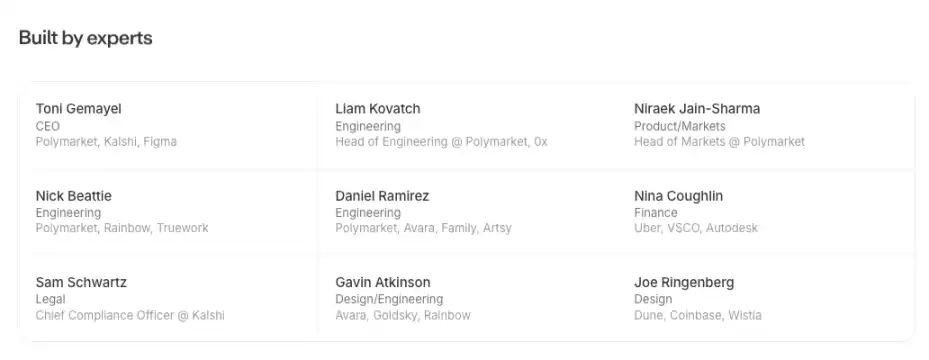
According to information on its official website, The Clearing Company's core team consists of several former executives and technical leads from Polymarket and Kalshi. The company's founder and CEO, Toni Gemayel, is a seasoned operator in the prediction market space. His resume shows he previously worked at both Polymarket and Kalshi as Head of Growth. Additionally, he has a work background at the design unicorn Figma.

Beyond this, The Clearing Company's core engineering team is primarily composed of early employees from Polymarket, while also incorporating some operations personnel from Kalshi.

· Liam Kovatch (Engineering): Former Head of Engineering at Polymarket;

· Niraek Jain-Sharma (Product/Markets): Former Head of Markets at Polymarket;

· Sam Schwartz: Former Chief Compliance Officer at Kalshi;

· Nick Beattie and Daniel Ramirez: These two engineers also hail from the Polymarket team and have experience in development at Raibow and Avara, among others.

A Coinbase spokesperson told The Block that the startup has about 10 employees, and nearly the entire team will join Coinbase as part of the deal.

Relatively speaking, although The Clearing Company is a latecomer, its starting capital far exceeds that of Polymarket and Kalshi in their early days. Comparing the seed round funding data of the three companies clearly shows the leap in the prediction market sector's valuation system over the past five years.
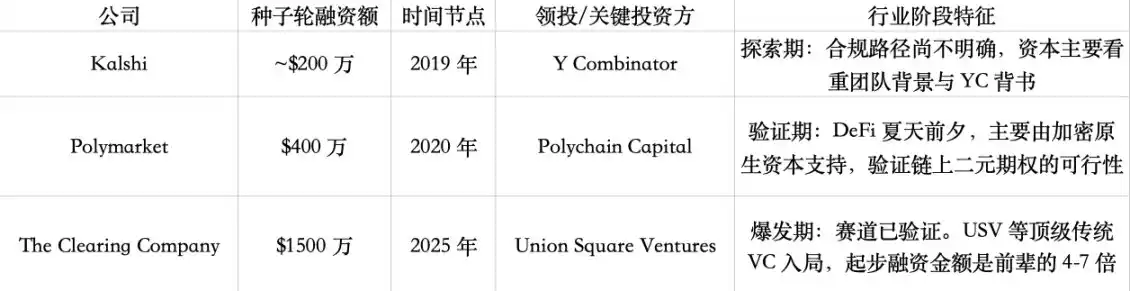
The Clearing Company completed a $15 million seed round led by Union Square Ventures even before its product launched. This amount is almost four times that of Polymarket's seed round at the time. This indicates that even before the Coinbase acquisition, the primary market had already tagged this hybrid-genes team with extremely high expectations.

Coinbase Launches Stock Trading and Prediction Market Services

At its System Update launch event on December 18, Coinbase announced a significant expansion of the range of assets tradable on its platform, including stock trading, prediction markets, new cryptocurrencies, and perpetual futures, among other new services, aiming to solidify its market positioning as an "all-in-one trading platform."

Coinbase will first launch trading services for hundreds of stocks based on market capitalization and trading volume, with plans to add thousands more stocks and ETFs in the coming months. Users can enjoy zero-commission trading, unrestricted by traditional market hours, available 24 hours a day, five days a week. Additionally, Coinbase has partnered with the $11 billion prediction market provider Kalshi, allowing users to trade on the outcomes of real-world events like elections, sports, collectibles, and economic indicators.

Simultaneously, Coinbase also launched the AI-driven wealth management tool Coinbase Advisor and the Coinbase Business service for startups, further expanding its business scope. Company executives stated that these new features will be supported by the Coinbase Tokenize platform, an end-to-end institutional-grade platform designed for tokenizing real-world assets.

Recently, Coinbase, Kalshi, Crypto.com, Robinhood, and Underdog jointly formed the Prediction Market Alliance (the Coalition for Prediction Markets). This national organization is dedicated to maintaining a safe, transparent, and federally regulated access environment for prediction markets.

Coinbase is gradually downplaying its label as a mere cryptocurrency trading platform. As Robinhood and Interactive Brokers venture into prediction markets, Coinbase must defend its territory. Having a native prediction product will complete its product matrix of spot, futures, and prediction markets, enabling users to perform a full suite of operations from buying Bitcoin to hedging macroeconomic risks within a single account.

The Next Stage of Competition in Prediction Markets

The acquisition of The Clearing Company is Coinbase's tenth announced acquisition in 2025. Deals completed earlier this year include Roam, Spindl, Iron Fish, Deribit, Opyn Markets, Liquifi, Sensible, Echo, and Vector.fun.

From the distribution partnership with Kalshi to acquiring the team and technology of The Clearing Company, Coinbase's path in the prediction market has become clear. First, validate demand and product form through partnerships, then internalize key capabilities through mergers and acquisitions, ultimately forming scalable long-term business lines.

Competition in prediction markets is shifting from who launches first to who can run compliantly and sustainably in the long term. By bringing people and technology into its system, Coinbase is clearly positioning itself early for the next stage of licensed, institutionalized competition.


Связанные с этим вопросы

QWhat did Coinbase announce on December 22nd, and what is the expected timeline for the deal?

ACoinbase announced it has reached an agreement to acquire The Clearing Company, with the transaction expected to be completed in January.

QWhich two major prediction market platforms do the core team members of The Clearing Company come from?

AThe core team members of The Clearing Company come from Polymarket and Kalshi.

QWhat was the amount of The Clearing Company's seed funding round, and which firm led it?

AThe Clearing Company completed a $15 million seed funding round led by Union Square Ventures.

QWhat new types of trading did Coinbase announce in its System Update on December 18th?

ACoinbase announced it would expand its platform to include stock trading, prediction markets, new cryptocurrencies, and perpetual futures.

QWhat is the name of the coalition formed by Coinbase, Kalshi, and others to advocate for prediction markets?

AThe coalition is named the Coalition for Prediction Markets.

Похожее

Will the Next Crypto Bull Run Start with On-Chain Trading of SpaceX?

This article presents a scenario-based forecast for the crypto industry from 2026 to 2029, arguing that the next major cycle will be driven not by technological narratives but by legal access to real-world assets. The author predicts that by mid-2026, pre-IPO perpetual contracts for top private companies like SpaceX, OpenAI, and Anthropic on platforms like Hyperliquid will become the primary gateway for accessing quality assets, as most crypto-native tokens fail to capture real value. The much-hyped AI x Crypto intersection largely fails except for prediction markets, which thrive on betting on AI model supremacy. By 2027, public blockchain foundations are forced to choose between catering to retail speculation or building compliant infrastructure for institutions, with many opting for the latter. Growth in stablecoins and tokenized private credit/equity hits a "triple ceiling" due to regulatory and political uncertainty rather than market demand. The pivotal shift is forecast for 2028. A major liquidation event in pre-IPO perpetuals exposes the structural flaw of synthetic markets lacking a real underlying asset anchor. In response, regulatory changes finally allow the public solicitation of private securities resales to verified accredited investors. This creates a legitimate secondary market for real company equity, which then becomes the core asset class of the new bull market, relegating synthetic perps to a niche role. By 2029, the industry becomes "boring" but foundational. Tokens without claims on real cash flows or assets cease trading. Stablecoin growth is steady but politically capped. Crypto infrastructure fades from view as it gets absorbed into traditional finance backends. The article's central thesis is that the key bottleneck for crypto's next phase is legal and regulatory channels for real asset ownership, not technology.

marsbit1 ч. назад

Will the Next Crypto Bull Run Start with On-Chain Trading of SpaceX?

marsbit1 ч. назад

The Value Distribution of Stablecoins

**Summary: The Value Distribution of Stablecoins** The article argues that stablecoins are evolving from mere trading tools into broader channels for dollar access. It divides the stablecoin ecosystem into four layers to analyze how value is distributed: 1. **Issuance Layer:** Mints stablecoins, holds reserve assets, and captures the spread between reserve yield and user costs (e.g., Tether, Circle). This layer currently earns the largest profit margin. 2. **Infrastructure Layer:** Connects stablecoins to the traditional financial system, handling fiat on/off-ramps, banking integration, compliance (KYC/AML), and asset management (e.g., Bridge, BVNK). This is the "unglamorous" but critical work, building the essential bridges between crypto and real-world finance. 3. **Acquiring/Distribution Layer:** Integrates stablecoins into merchant systems, manages payment flows, and provides enterprise financial software (e.g., Stripe, Coinbase). They act as the access point for businesses. 4. **Application Layer:** The end-users and businesses that ultimately use stablecoins for payments, settlements, or as a store of value. They benefit from convenience but have little pricing power. The core thesis is that while the issuance layer currently dominates profits, the often-overlooked **infrastructure layer holds significant long-term potential**. The real challenge and barrier to mass adoption is not the on-chain transfer of stablecoins (which is simple), but the complex "last mile" integration into existing business workflows, banking systems, and regulatory frameworks across different countries. Companies in this layer are currently in a "land grab" phase, investing heavily to build networks, secure bank partnerships, and establish compliance pathways. While their position is currently pressured by the profitable issuers above and distribution platforms below, the article suggests that if stablecoins become a default financial rail for businesses, the infrastructure providers who have done the hard work of integration will ultimately gain strong pricing power and become entrenched, essential players.

marsbit7 ч. назад

The Value Distribution of Stablecoins

marsbit7 ч. назад

The Value Distribution of Stablecoins

The Value Distribution of Stablecoins The article argues that stablecoins are evolving from a mere trading tool into a broad "dollar channel." It analyzes the industry's value chain through four layers: 1. **Issuance Layer (e.g., Tether, Circle):** The top layer that mints stablecoins, holds reserve assets, and captures the thickest interest rate spread. 2. **Infrastructure Layer (e.g., Bridge, BVNK):** Connects stablecoins to the traditional financial system, handling critical but complex "dirty work" like fiat on/off-ramps, banking integration, compliance (KYC/AML), and cross-border settlement. 3. **Acquiring/Distribution Layer (e.g., Stripe, Coinbase):** Embeds stablecoins into merchant systems, manages payment flows, and integrates with enterprise software. 4. **Application Layer:** End-users and businesses that ultimately use stablecoins for payments, settlement, or storing value. The author posits that while the issuance layer currently captures the most profit, the most overlooked and potentially critical layer is infrastructure. The core challenge for stablecoin adoption isn't the on-chain transfer (which is simple), but bridging the gap between blockchain and the real-world financial system. This involves solving practical problems for businesses: fiat conversion, reconciliation, tax handling, and user onboarding. Infrastructure companies are currently in a difficult "land-grab" phase—building networks, securing banking relationships, and achieving compliance country-by-country. They face pressure from both the profitable issuance layer above and distribution platforms below. However, the author suggests this layer is building a crucial moat. Once stablecoins become a default business rail, the infrastructure players who have done the hard work of integration may gain significant, durable value and pricing power.

链捕手7 ч. назад

The Value Distribution of Stablecoins

链捕手7 ч. назад

Торговля

Спот
Фьючерсы
活动图片