Read 500 Pages of Reports from Five Institutions for You, This One Article is Enough for the Crypto Annual Outlook

marsbitОпубликовано 2025-12-25Обновлено 2025-12-25

Введение

This comprehensive analysis synthesizes key insights from leading crypto research reports (Delphi Digital, Messari, Four Pillars, Coinbase, a16z) for the 2026 outlook. A consensus emerges: the era of pure 4-year speculative cycles is ending, replaced by structural maturation driven by liquidity convergence, infrastructure development, and regulatory clarity. Major themes include: 1. **Agentic Finance:** AI agents will become primary economic actors, managing capital and executing complex DeFi strategies autonomously, necessitating new "Know Your Agent" (KYA) identity protocols and machine-native settlement layers. 2. **Super-App Integration:** User-friendly "super-apps" will bundle complex crypto experiences (payments, investing, lending) into simple interfaces, hiding technical complexities to drive mass adoption, often powered by stablecoins. 3. **Ownership & Utility Shift:** Value will accrue to "Ownership Coins" with revenue-sharing models and real-world utility, moving beyond pure governance tokens. This includes tokenized real-world assets (RWA) and protocols finding product-market fit, like DePIN for AI computational needs. 4. **Privacy Renaissance:** Privacy-focused technologies and assets (e.g., Zcash) are predicted for a resurgence as essential hedges against surveillance and for enabling competitive advantages and sophisticated on-chain wealth management. 5. **Institutional & Regulatory Formalization:** With clearer US regulation (e.g., anticipated legislatio...

Author:Eli5DeFi

Compiled by: Deep Tide TechFlow

As the crypto industry moves towards 2026, leading research institutions are gradually reaching a consensus:

"The era of purely speculative cycles is fading away."

It is being replaced by structural maturity driven by liquidity convergence, infrastructure development, and industry consolidation, rather than short-term narrative-driven market fluctuations.

Here are the core viewpoints of major crypto research institutions on the 2026 outlook (saving you the time of reading hundreds of pages of reports):

Core Summary:

  • "Death of the Cycle": Research institutions unanimously agree that the traditional 4-year halving speculative cycle is gradually fading. The future will be dominated by structural maturity, with value increasingly focused on "Ownership Coins" with revenue-sharing models and projects with real-world applications, rather than short-term speculative narratives.

  • The Rise of "Agentic Finance": Major institutions (such as Delphi Digital, a16z, Coinbase) predict that AI Agents will become major economic participants. This will drive the development of "Know Your Agent" (KYA) identity protocols and machine-native settlement layers, technologies that go beyond human manual capabilities.

  • Super-App Consolidation: As US regulation gradually becomes clearer (research from Four Pillars, Messari, etc.), complex crypto experiences will be integrated into user-friendly "Super-Apps" and privacy-supporting blockchains. These technologies will hide technical details, driving mass adoption.

Delphi Digital's View: Infrastructure, Applications, and Markets

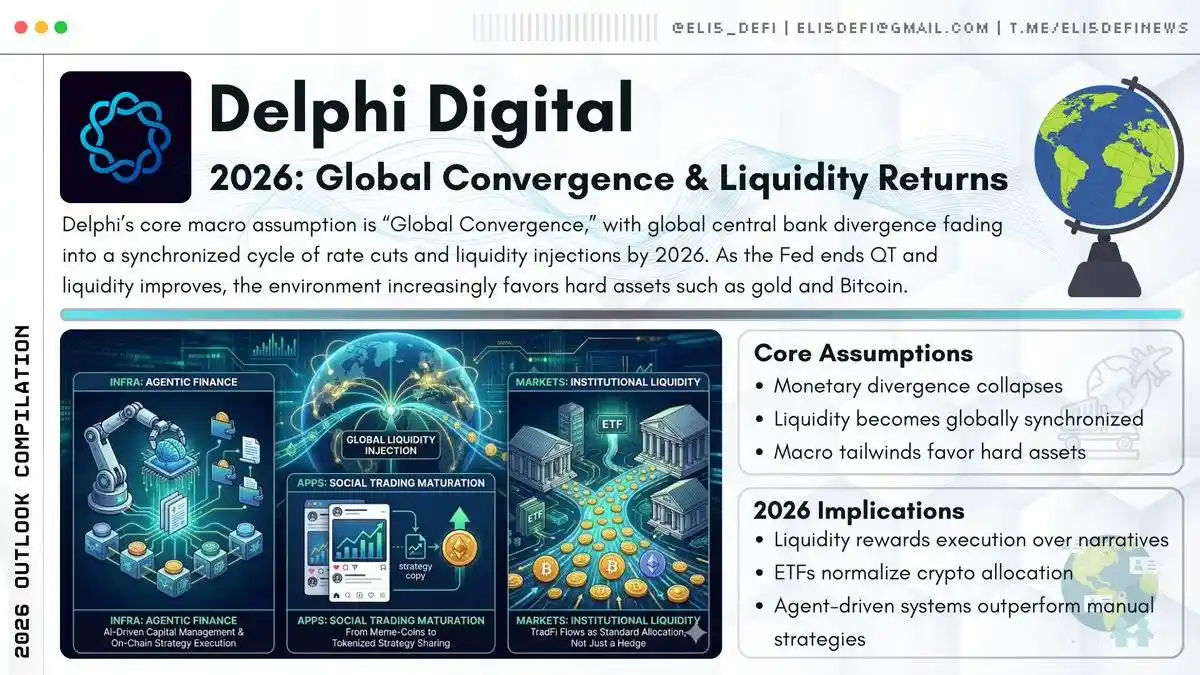
Delphi Digital's macro hypothesis is based on "Global Convergence." They predict that by 2026, the divergence in monetary policies of global central banks will end, shifting towards a unified cycle of interest rate cuts and liquidity injection. After the Federal Reserve ends quantitative tightening (QT), improved global liquidity will benefit hard assets like gold and Bitcoin.
2026 Outlook:

  1. Agentic Finance

A major expansion in infrastructure is reflected in the rise of "Agentic Finance." AI agents will no longer be just chatbots but will actively manage capital, execute complex decentralized finance (DeFi) strategies, and optimize yields on-chain without human intervention.

  1. Social Trading and the "Pump" Economy

On the consumer application side, Delphi highlighted the stickiness of platforms like @Pumpfun and predicted the maturation of "Social Trading." The trend will shift from simple meme coin speculation to more complex copy-trading hierarchies, with strategy sharing becoming a tokenized product.

  1. Institutional Liquidity

Market structure will change with the further adoption of Exchange Traded Funds (ETFs). Traditional finance (TradFi) liquidity will enter the crypto market, not just as a hedging tool but as a standard portfolio allocation driven by macro liquidity easing.

Click to view the full report:

  • Infrastructure 2026 Outlook

  • Applications 2026 Outlook

  • Markets 2026 Outlook

Messari: 2026 Crypto Industry Outlook - Market Structure and the Rise of Utility

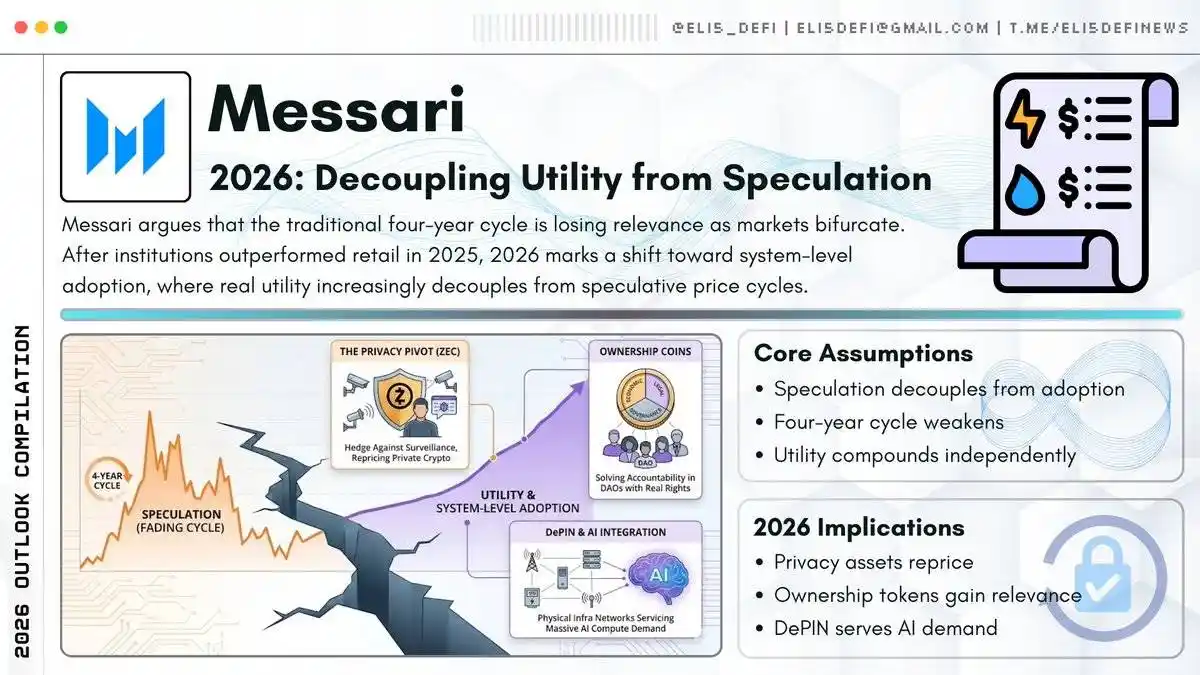
Messari's core argument is "The Separation of Utility and Speculation." They believe the traditional "four-year cycle" model is gradually losing relevance, and the market is moving towards differentiation. They hypothesize that 2025 was a year where institutional investors prevailed and retail investors were frustrated, while 2026 will become the era of "system-level applications," not just speculative games of asset prices.
2026 Outlook:

  1. Privacy Shift ($ZEC)

Messari presents a contrarian growth view: the revival of the privacy sector. They specifically mention assets like @Zcash (ZEC), not just as "privacy coins" but as necessary hedges against increasing surveillance and corporate control, predicting a repricing opportunity for "privacy cryptocurrencies."

  1. Ownership Coins

2026 will see a new token classification—"Ownership Coins." These tokens combine economic, legal, and governance rights. Messari believes these tokens have the potential to solve the accountability crisis in Decentralized Autonomous Organizations (DAOs) and may spawn the first projects with market capitalizations reaching billions of dollars.

  1. DePIN and AI Integration

The research also delves into the potential of DePIN (Decentralized Physical Infrastructure Networks), expecting these protocols to find market fit in the real world by meeting the massive demand for computing and data in the AI field.

Read the full report: 2026 Crypto Industry Report

Four Pillars: Regulatory Restructuring and Super-Apps

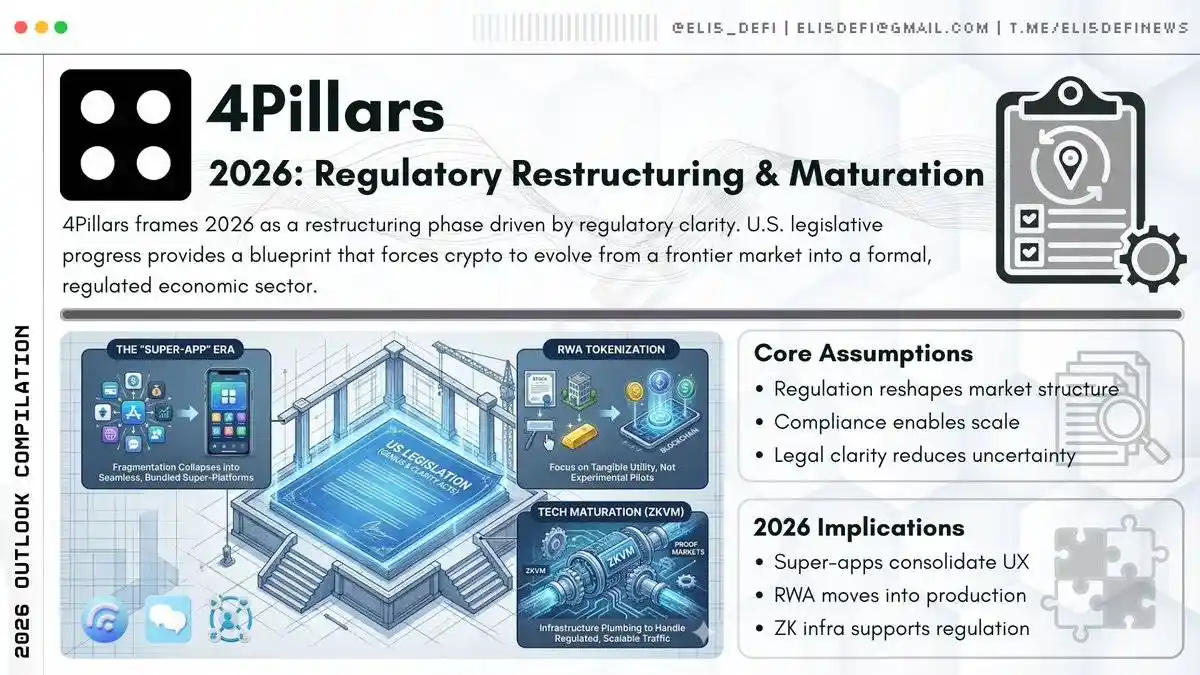
Four Pillars' 2026 outlook revolves around "Regulatory Restructuring." Their core assumption is that US legislative actions (specifically mentioning the GENIUS and CLARITY acts) will become the blueprint for driving comprehensive market reform.

This regulatory clarity will act as a catalyst, transforming the market from a "wild west" state into a formal economic sector.
Four Pillars' 2026 Outlook

  1. The Era of Super-Apps

Four Pillars predict that the current fragmented crypto application ecosystem will gradually consolidate into "Super-Apps." These platforms, driven by stablecoins, will integrate payment, investment, and lending functions, completely simplifying blockchain complexity and enhancing user experience.

  1. RWA Tokenization

As the market restructures, the tokenization of stocks and traditional assets will become a trend, but the focus will be on actual utility rather than experimental projects.

  1. Technological Maturation

On the technical front, the report emphasizes the importance of Zero-Knowledge Virtual Machines (ZKVM) and Proof Markets on Ethereum. They are seen as critical technological infrastructure to handle the traffic scale of emerging regulatory bodies.

Read the full report: 2026 Outlook: Restructuring and a Century-Long Perspective

Coinbase: 2026 Crypto Market Outlook - Markets, Regulation, and Adoption

Coinbase's report presents the view of "Death of the Cycle." They explicitly state that 2026 will mark the end of the traditional Bitcoin halving cycle theory. Future markets will be driven by structural factors: including macro demand for alternative stores of value and the formalization of the crypto industry as a medium-sized alternative asset class.

2026 Outlook:

  1. Tokenomics 2.0

A shift from "governance-only" tokens to "revenue-linked" models. Protocols will gradually introduce token buyback-and-burn or fee-sharing mechanisms (complying with new regulations) to better align token holder interests with platform success.

  1. Digital Asset Trading 2.0 (DAT 2.0)

The crypto market will move towards more professionalized trading models, particularly the procurement and trading of "sovereign block space." Block space will be regarded as a critical resource in the digital economy.

  1. Intersection of AI and Crypto

Coinbase predicts that AI agents will heavily utilize crypto payment channels, driving demand for "crypto-native settlement layers." These layers can support continuous micro-transactions between machines, a need that traditional payment systems cannot meet.

Read the full report: 2026 Crypto Market Outlook

a16z Crypto: 2026 Outlook - The Future of Internet-Native Finance and AI

a16z Crypto's outlook is based on a core hypothesis: "The internet becomes the bank." They believe that the flow of value will become as free as the flow of information. The current friction between the on-chain and off-chain worlds is the main bottleneck, and 2026 will be the year this barrier is eliminated through better infrastructure.
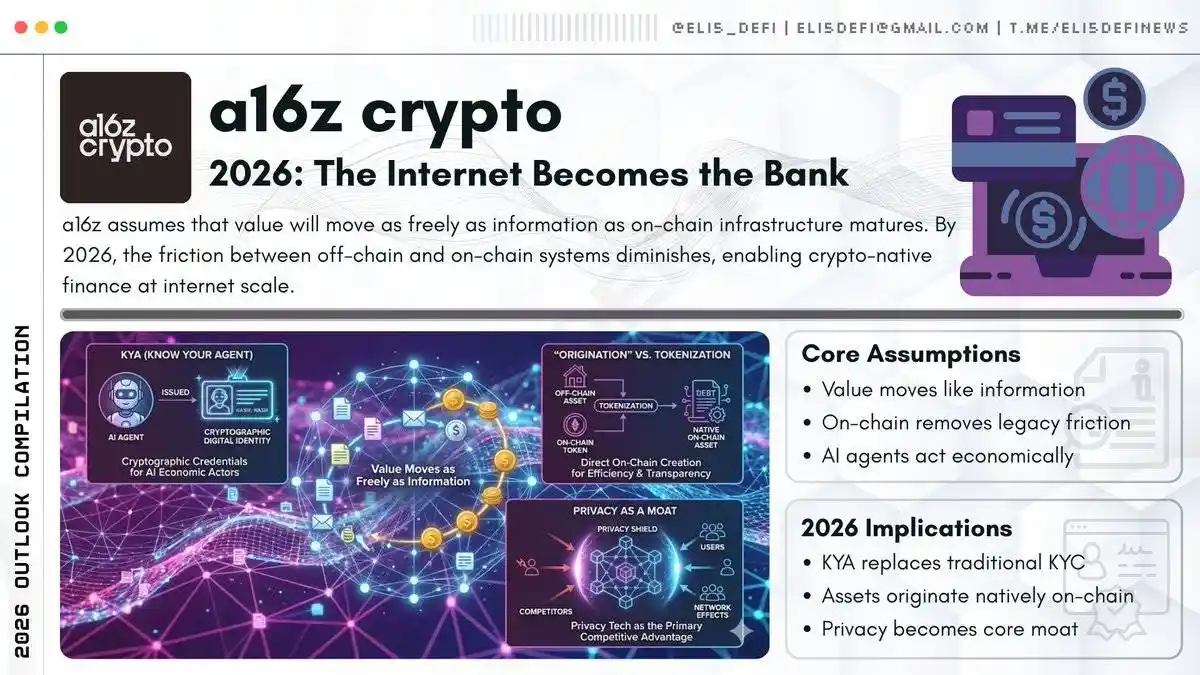
a16z Crypto's 2026 Outlook

  1. KYA (Know Your Agent)

As AI Agents become major economic participants, identity verification will shift from traditional KYC (Know Your Customer) to KYA (Know Your Agent). AI agents will require cryptographically signed credentials to conduct transactions, giving rise to a whole new layer of identity infrastructure.

  1. "Asset Origination" VS "Asset Tokenization"

a16z predicts the market will gradually shift from tokenizing off-chain assets (e.g., buying treasury bonds and putting them on-chain) to generating debt and assets directly on-chain. This shift can not only reduce service costs but also greatly enhance transparency.

  1. Privacy as a Moat

In a world of prevalent open-source code, a16z emphasizes that privacy technology (especially the ability to maintain state privacy) will become the most important competitive advantage for blockchains. This will create strong network effects for privacy-supporting blockchains.

  1. Wealth Management for All

The combination of AI and crypto payment channels will democratize complex wealth management (such as asset rebalancing, tax-loss harvesting), making services previously available only to high-net-worth individuals accessible to ordinary users.

Read the full report: Major Trends in Crypto for 2026

Summary

The 2026 crypto industry outlook shows that structural maturity will replace speculative cycles, driven by liquidity convergence, regulatory clarity, and infrastructure.

Major research institutions unanimously agree that value will concentrate on settlement layers, aggregation platforms, and systems capable of attracting real users and capital.

Future opportunities will shift from chasing cycles to understanding capital flows. 2026 will reward projects that quietly build infrastructure, distribution capabilities, and trust at scale.

Связанные с этим вопросы

QWhat is the consensus view among leading research institutions regarding the future of crypto speculation cycles?

ALeading research institutions agree that the era of pure speculative cycles is fading. The future will be driven by structural maturity, including liquidity convergence, infrastructure development, and industry consolidation, rather than short-term narrative-driven market volatility.

QWhat is 'Agentic Finance' and why is it considered a major trend for 2026?

A'Agentic Finance' refers to the rise of AI Agents as primary economic actors. These agents will autonomously manage capital, execute complex DeFi strategies, and optimize yields on-chain without human intervention. This trend is expected to drive the development of 'Know Your Agent' (KYA) identity protocols and machine-native settlement layers.

QHow do reports predict the role of 'Super-Apps' in the crypto space by 2026?

AReports predict that fragmented crypto applications will consolidate into user-friendly 'Super-Apps.' These platforms, often privacy-focused and driven by stablecoins, will integrate payments, investments, and lending, simplifying blockchain complexity and driving mass adoption by hiding technical details.

QWhat are 'Ownership Coins' and how do they differ from traditional tokens?

A'Ownership Coins' are a new token classification that combines economic, legal, and governance rights. They are designed to address accountability crises in DAOs and focus on revenue-sharing models and real-world utility, moving beyond mere governance tokens to better align token holder interests with platform success.

QWhy is privacy highlighted as a critical area of growth and competition in the 2026 crypto outlook?

APrivacy is emphasized as a key competitive advantage and growth area due to increasing surveillance and corporate control. Technologies like zero-knowledge proofs and privacy-focused blockchains (e.g., Zcash) are expected to see renewed interest, offering essential hedging tools and enabling state privacy, which will create strong network effects.

Похожее

AI PC Battle: Bet on the Toll Booth, Not the Camp

**Title:** The AI PC Battle: Don't Bet on Sides, Bet on the Tollbooth **Summary:** The AI PC competition is moving beyond simple "x86 vs. Arm" narratives. The core investment thesis should focus on identifying which players can sustain margins, cash flow, and pricing power throughout the upgrade cycle, rather than backing a particular architecture. The opportunity is analyzed in three layers: 1. **The Advanced Foundry Tollbooth:** TSMC is positioned to collect "tolls" regardless of which chip designer wins, due to its dominant ~70% share in advanced semiconductor manufacturing, which is essential for high-end AI PC chips. 2. **Compute & Platform Spillover:** AMD represents an offensive in the x86 CPU+GPU space, while NVIDIA leverages its GPU and CUDA software stack dominance. Both benefit from the demand for increased local AI compute. 3. **Architecture Diffusion & Turnaround Plays:** ARM and Intel offer potential for significant upside (elasticity), but investments here require stricter discipline due to higher execution risks and competitive challenges. The industry is transitioning from concept to shipment validation. While short-term forecasts for AI PC adoption have been revised down slightly due to tariffs and procurement delays, the long-term trend towards AI becoming a standard PC feature remains intact. The key driver for upgrade cycles will be whether compelling enterprise applications (e.g., privacy-sensitive computing, low-latency inference) emerge beyond consumer-focused features like meeting summarization. Investment strategy should prioritize companies with platform-level advantages and recurring revenue streams. TSMC offers high certainty as the foundational tollbooth. AMD presents a strong offensive play within the established ecosystem. ARM and Intel are higher-risk, higher-potential-reward turnaround bets. The report cautions against chasing short-term hype and emphasizes a disciplined, long-term approach focused on buying ecosystem strength and cash-flow certainty after market enthusiasm subsides. **Key Risks:** Underwhelming AI PC applications slowing upgrade cycles; slow improvement in Windows on Arm compatibility; macro/tariff impacts on PC demand; potential advanced node supply-demand mismatches affecting TSMC; high overall AI sector valuations making stocks vulnerable to a risk-off shift in markets.

marsbit9 мин. назад

AI PC Battle: Bet on the Toll Booth, Not the Camp

marsbit9 мин. назад

Ten-Thousand-Word Analysis: From $10 to $290, MRVL Wins the Entire AI Era by 'Not Making GPUs'

Marvell Technology's stock price surged from under $10 in 2016 to a record $290 in June 2026, fueled not by making GPUs, but by dominating AI infrastructure connectivity. This analysis argues the market misvalues MRVL as merely a smaller Broadcom in custom AI chips, overlooking its true, unique position. Marvell's core strength lies in enabling high-speed data flow for AI clusters through three interconnected businesses. First, it holds a commanding ~70% market share in high-speed optical DSPs (essential for data center light modules), a deep-moat business with accelerating growth. Second, its custom AI chip design business serves hyperscalers like AWS, Microsoft, and Google, with a significant revenue pipeline despite lower margins. Third, stable cash flows come from Ethernet switch chips and enterprise storage controllers. Together, they form a full-stack "AI data movement" platform. CEO Matt Murphy's transformative leadership since 2016, involving strategic divestments, key acquisitions (like Inphi for optical DSPs), and securing long-term agreements with major cloud providers, repositioned the company. A pivotal $2 billion strategic investment from NVIDIA in 2026 underscored Marvell's critical role in the AI ecosystem, particularly through collaborations like NVLink Fusion. While Marvell faces risks—including client concentration (losing the Amazon Trainium3 design), lower-margin business mix, competitive threats, insider selling, and complex supply chains—its fundamentals remain strong. The optical interconnect moat is widening with the acquisition of Celestial AI (photonics fabric), and financial metrics show accelerating revenue growth and operating leverage. With a PEG ratio suggesting undervaluation relative to its growth, the thesis is that the market undervalues Marvell's monopolistic position in AI "plumbing" while overemphasizing its competitive custom chip segment. The story transcends investing, symbolizing how in any complex system—from the internet to AI—the value of "connection" ultimately surpasses that of individual "nodes."

marsbit38 мин. назад

Ten-Thousand-Word Analysis: From $10 to $290, MRVL Wins the Entire AI Era by 'Not Making GPUs'

marsbit38 мин. назад

AI Relay Stations Spark Heated Debate on Zhihu: Behind Cheap Tokens, What Are Users Really Worried About?

A discussion on Zhihu about "AI relay stations" shifted the niche developer topic of "cheap tokens" into broader user awareness. Users moved beyond simply questioning the legitimacy of these services to focus on practical concerns: Where do cheap tokens truly come from? Is the model being accessed the real one? Can relay stations see prompts, code, and API keys? For occasional users, are the risks worth it? The core debate centered less on price and more on trust. A primary worry is model authenticity—the risk of "model swapping," where users paying for a premium model might be routed to a cheaper one, creating an information asymmetry. Others argued that cost comparisons matter; while cheaper than official pay-as-you-go APIs, relay stations may not be the lowest-cost option versus subscriptions, domestic models, or free tiers, making user needs assessment crucial. Speculation about token sources ranged from legitimate bulk discounts to gray-area methods like account sharing or exploiting regional pricing. This opacity makes risk assessment difficult for users. Data security emerged as a critical concern, especially for enterprise use. When processing sensitive information like code, contracts, or client data, the inability to verify a relay station's data handling, retention, or access policies poses significant compliance and confidentiality risks. The evolving consensus suggests relay stations can be used cautiously for low-sensitivity, disposable tasks (e.g., summarizing public info, simple translation). However, they should not be the default for sensitive, professional, or production workflows involving proprietary data, Agents, or automated systems. Recommendations include avoiding large prepayments, not relying on a single service, using test prompts to monitor quality, anonymizing data where possible, and keeping official channels as backups. Ultimately, the discussion framed tokens not just as a billing unit but as a measure of real cost encompassing price, model integrity, data security, and service stability. The popularity of relay stations highlights user demand for affordable access, but the debate underscores a key trade-off: the savings from cheap tokens may come at the price of trust, transparency, and control over one's data and AI experience.

marsbit1 ч. назад

AI Relay Stations Spark Heated Debate on Zhihu: Behind Cheap Tokens, What Are Users Really Worried About?

marsbit1 ч. назад

In-Depth Research Report on TradFi: The Convergence Wave of Crypto and Traditional Finance

In 2026, the crypto industry is undergoing a profound infrastructure-level transformation—TradFi assets are migrating on-chain at an unprecedented pace. According to CoinGecko's Q1 2026 report, the total value locked (TVL) of tokenized real-world assets (RWA) has surpassed $31 billion, a nearly 4x increase from $7.8 billion at the beginning of 2025, with the sector’s aggregate market capitalization reaching $19.3 billion. Among these, the market cap of tokenized stocks surged from $2 million to $486 million, with Q1 spot trading volume reaching $15.1 billion—a single quarter already surpassing the entire second half of 2025. RWA perpetual contract Q1 trading volume reached a staggering $524.8 billion, far exceeding the $313 billion for all of 2025. Meanwhile, BlackRock's BUIDL fund has reached $2.3 billion in scale and has filed for two new tokenized funds, signaling that the world's largest asset manager's tokenization strategy is evolving from pilot to product suite expansion. HTX, as a core participant in the crypto exchange sector, officially launched TradFi perpetual futures products including NVDA, AAPL, MSFT, META, and SPY in 2026, enabling crypto users to gain 24/7 trading access to core U.S. equities. Boston Consulting Group predicts that global tokenized asset scale could reach $16 trillion by 2030, while McKinsey offers a conservative estimate of approximately $2 trillion. The on-chain migration of TradFi assets is no longer a "future narrative" but a structural transformation unfolding in real time, as crypto exchanges evolve from single crypto asset trading platforms toward "multi-asset-class trading infrastructure."

HTX Learn1 ч. назад

In-Depth Research Report on TradFi: The Convergence Wave of Crypto and Traditional Finance

HTX Learn1 ч. назад

Торговля

Спот
Фьючерсы

Популярные статьи

Как купить ONE

Добро пожаловать на HTX.com! Мы сделали приобретение Harmony (ONE) простым и удобным. Следуйте нашему пошаговому руководству и отправляйтесь в свое крипто-путешествие.Шаг 1: Создайте аккаунт на HTXИспользуйте свой адрес электронной почты или номер телефона, чтобы зарегистрироваться и бесплатно создать аккаунт на HTX. Пройдите удобную регистрацию и откройте для себя весь функционал.Создать аккаунтШаг 2: Перейдите в Купить криптовалюту и выберите свой способ оплатыКредитная/Дебетовая Карта: Используйте свою карту Visa или Mastercard для мгновенной покупки Harmony (ONE).Баланс: Используйте средства с баланса вашего аккаунта HTX для простой торговли.Третьи Лица: Мы добавили популярные способы оплаты, такие как Google Pay и Apple Pay, для повышения удобства.P2P: Торгуйте напрямую с другими пользователями на HTX.Внебиржевая Торговля (OTC): Мы предлагаем индивидуальные услуги и конкурентоспособные обменные курсы для трейдеров.Шаг 3: Хранение Harmony (ONE)После приобретения вами Harmony (ONE) храните их в своем аккаунте на HTX. В качестве альтернативы вы можете отправить их куда-либо с помощью перевода в блокчейне или использовать для торговли с другими криптовалютами.Шаг 4: Торговля Harmony (ONE)С легкостью торгуйте Harmony (ONE) на спотовом рынке HTX. Просто зайдите в свой аккаунт, выберите торговую пару, совершайте сделки и следите за ними в режиме реального времени. Мы предлагаем удобный интерфейс как для начинающих, так и для опытных трейдеров.

710 просмотров всегоОпубликовано 2024.04.12Обновлено 2026.06.02

Как купить ONE

Обсуждения

Добро пожаловать в Сообщество HTX. Здесь вы сможете быть в курсе последних новостей о развитии платформы и получить доступ к профессиональной аналитической информации о рынке. Мнения пользователей о цене на ONE (ONE) представлены ниже.

活动图片