Range-Bound Under Pressure

insights.glassnodeОпубликовано 2026-02-18Обновлено 2026-02-18

Введение

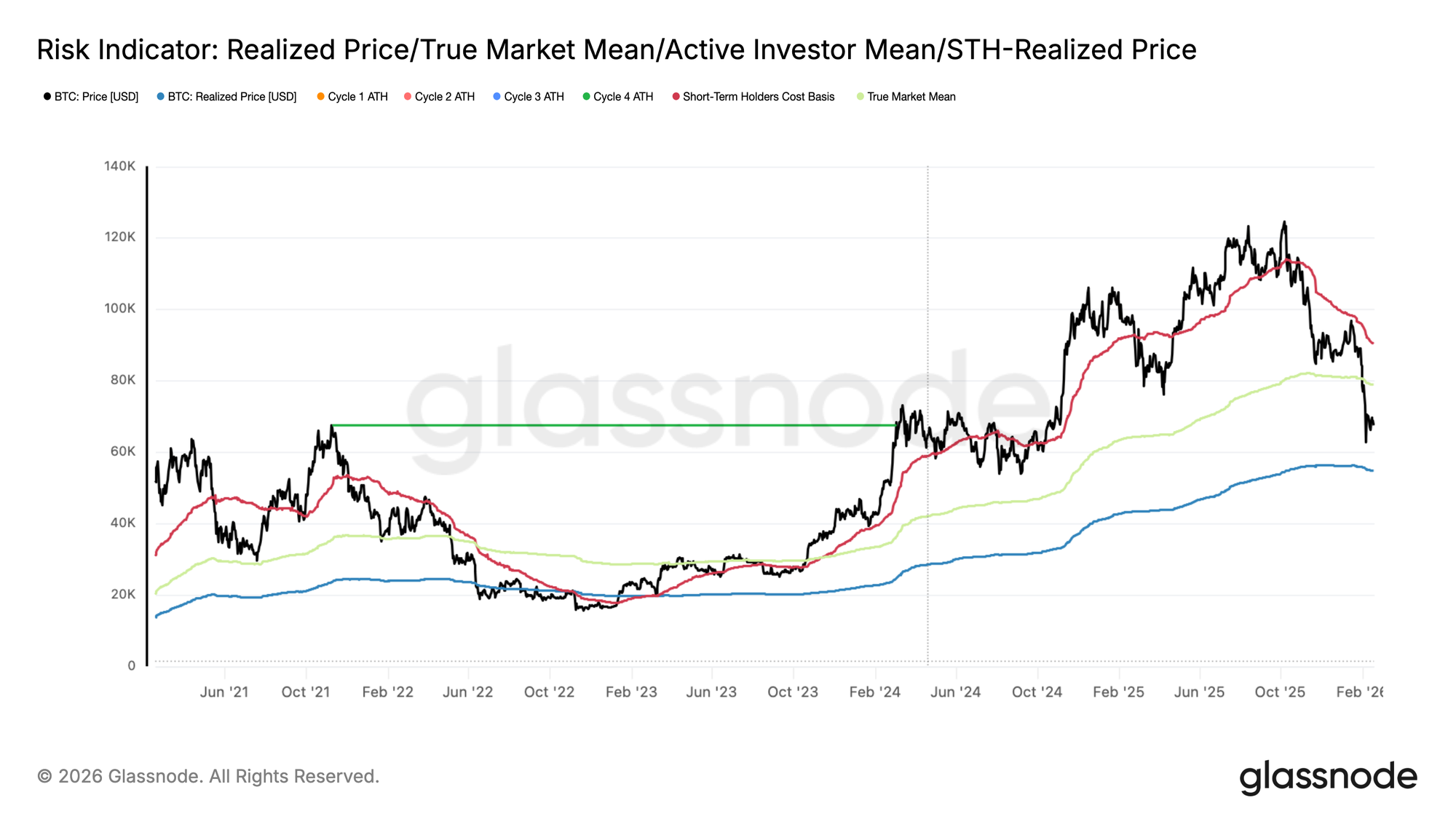
Bitcoin's market structure has shifted into a defensive, range-bound phase, confined between key on-chain valuation anchors: the True Market Mean (resistance near $79k) and the Realized Price (support near $54.9k). Since breaking below the Mean in late January, downside pressure has been absorbed by a $60k–$69k demand cluster established in H1 2024, preventing further collapse. On-chain metrics show distribution has eased but strong accumulation is absent, with liquidity weak (Realized P/L Ratio compressed at 1–2). ETF outflows and negative spot flows indicate diminished institutional demand. Derivatives markets show panic unwinding—volatility and skew have compressed, and crash hedges are being closed. This reflects stabilization, not bullish conviction. A sustained recovery requires renewed spot demand, accumulation, and improved liquidity. Until then, range-bound consolidation dominates.

The market’s renewed contraction phase began in late January, marked by a decisive break below the True Market Mean, a core on-chain price model tracking the aggregate cost basis of active supply, currently positioned near $79k. Historically, deeper bear market phases have found their lower structural boundary around the Realized Price, which estimates the average acquisition cost of all circulating coins and now stands near $54.9k.

In prior cycles, these two valuation anchors have framed extended periods of compression and absorption. In the absence of an unexpected macro catalyst, the $79k True Market Mean and the $54.9k Realized Price are likely to define the primary resistance and support corridor for the mid-term market structure.

Live Chart

Demand Cluster Absorbing Pressure

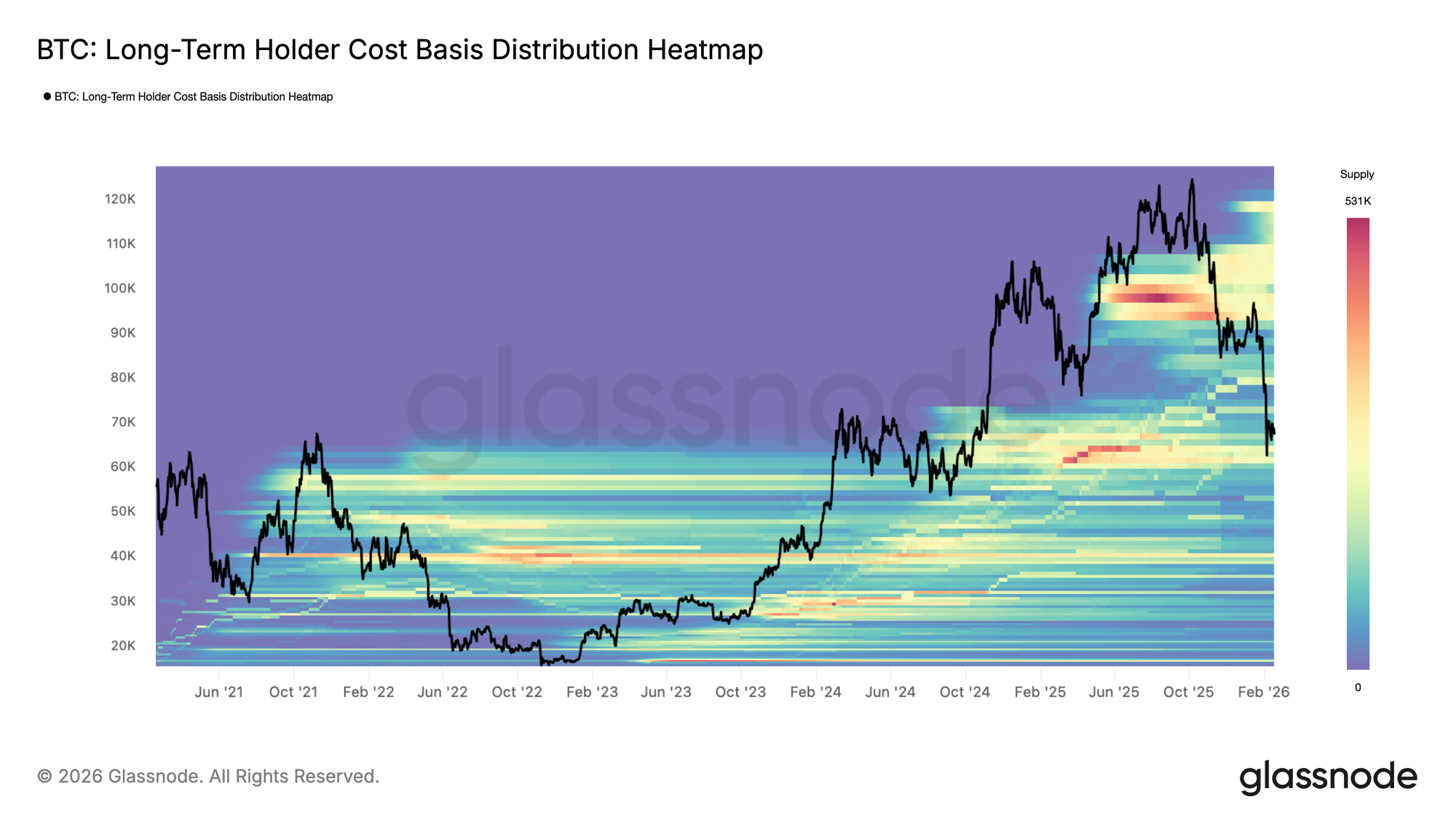
A closer inspection of price behavior since the breakdown below the True Market Mean indicates that downside pressure has largely been absorbed within a dense demand zone between $60k and $69k. This cluster was primarily established during the H1 2024 consolidation phase, where investors accumulated within a prolonged range and have since held their positions for over a year.

The positioning of this cohort near breakeven levels appears to have moderated incremental sell pressure, contributing to the development of another sideways structure since late January 2026. The defense of the $60k–$69k range suggests that medium-term holders remain resilient, allowing the market to transition from impulsive decline into range-bound absorption.

Live Chart

Buyer Aggression in Focus

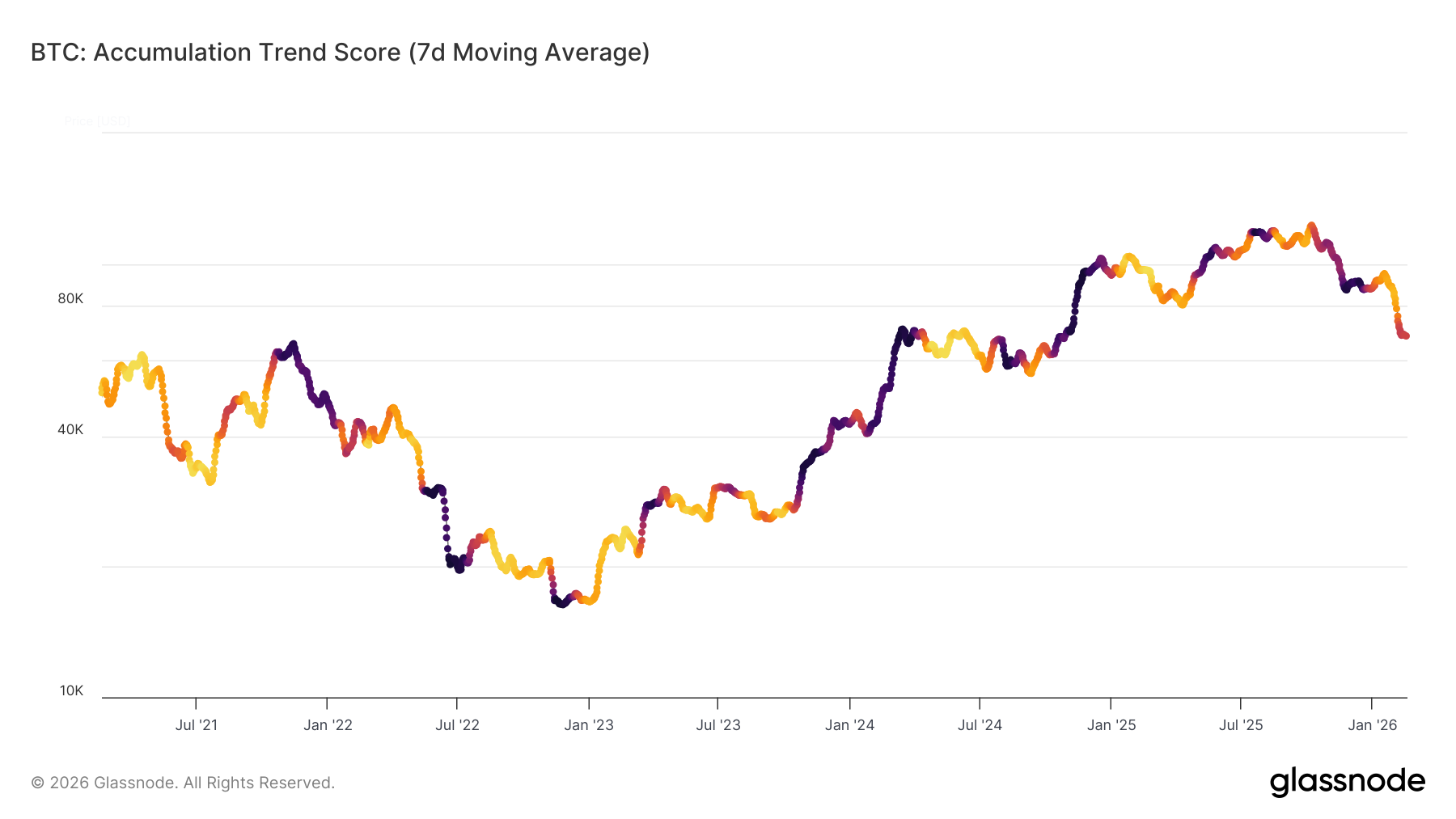
The duration of the current range-bound structure will largely depend on the strength and persistence of buy-side activity. To quantify this behavior, we examine the Accumulation Trend Score (ATS), which measures balance changes across wallet cohorts, assigning greater weight to larger entities.

The 7-day moving average of ATS reflects a notable behavioral shift, moving from strong distribution following the loss of the True Market Mean (ATS < 0.1) toward a more neutral and fragile equilibrium near 0.43. This moderation suggests that aggressive selling has eased, but conviction-driven accumulation has yet to fully re-emerge.

A sustained rise in ATS toward 1 would signal renewed large-entity accumulation, potentially extending the current range, whereas a failure to strengthen would reinforce underlying structural fragility.

Live Chart

Liquidity Remains Constrained

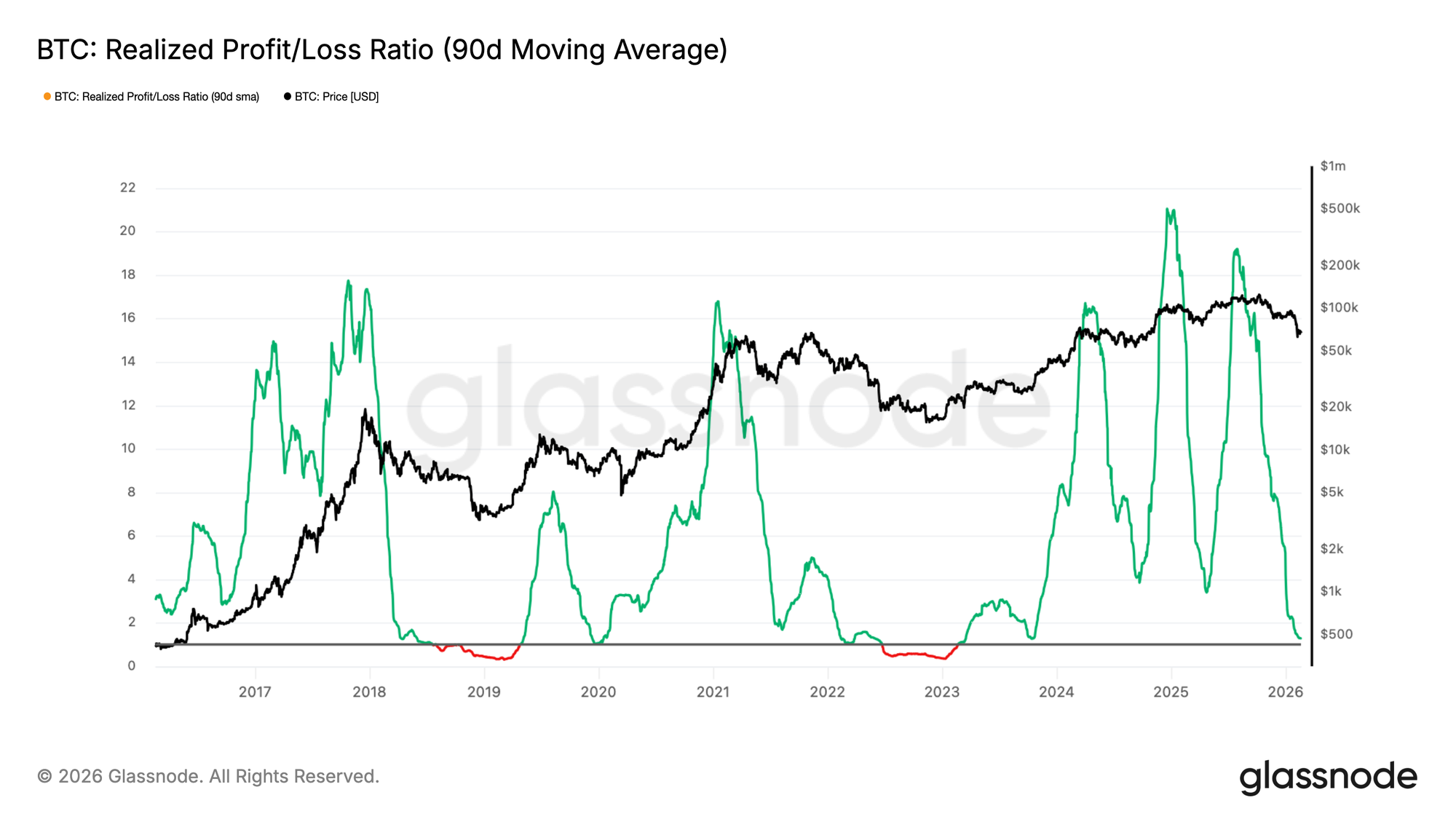
Beyond the absence of strong accumulation, broader liquidity conditions continue to reflect structural weakness. As a proxy for market liquidity, the Realized Profit/Loss Ratio provides insight into capital flow dynamics by measuring the average USD value of realized profit for every dollar realized in loss.

The 90-day moving average of this metric has been declining back into the 1–2 range, a zone that historically characterizes transitions from early bear phases toward more stressed conditions, where realized losses begin to dominate (Realized P/L Ratio < 1). This compression indicates that profit-taking remains subdued and capital rotation is limited.

Until the Realized Profit/Loss Ratio decisively reclaims levels above 2, signalling renewed profitability and stronger liquidity inflows, the broader market bias is likely to remain structurally negative.

Live Chart

Off-Chain Insights

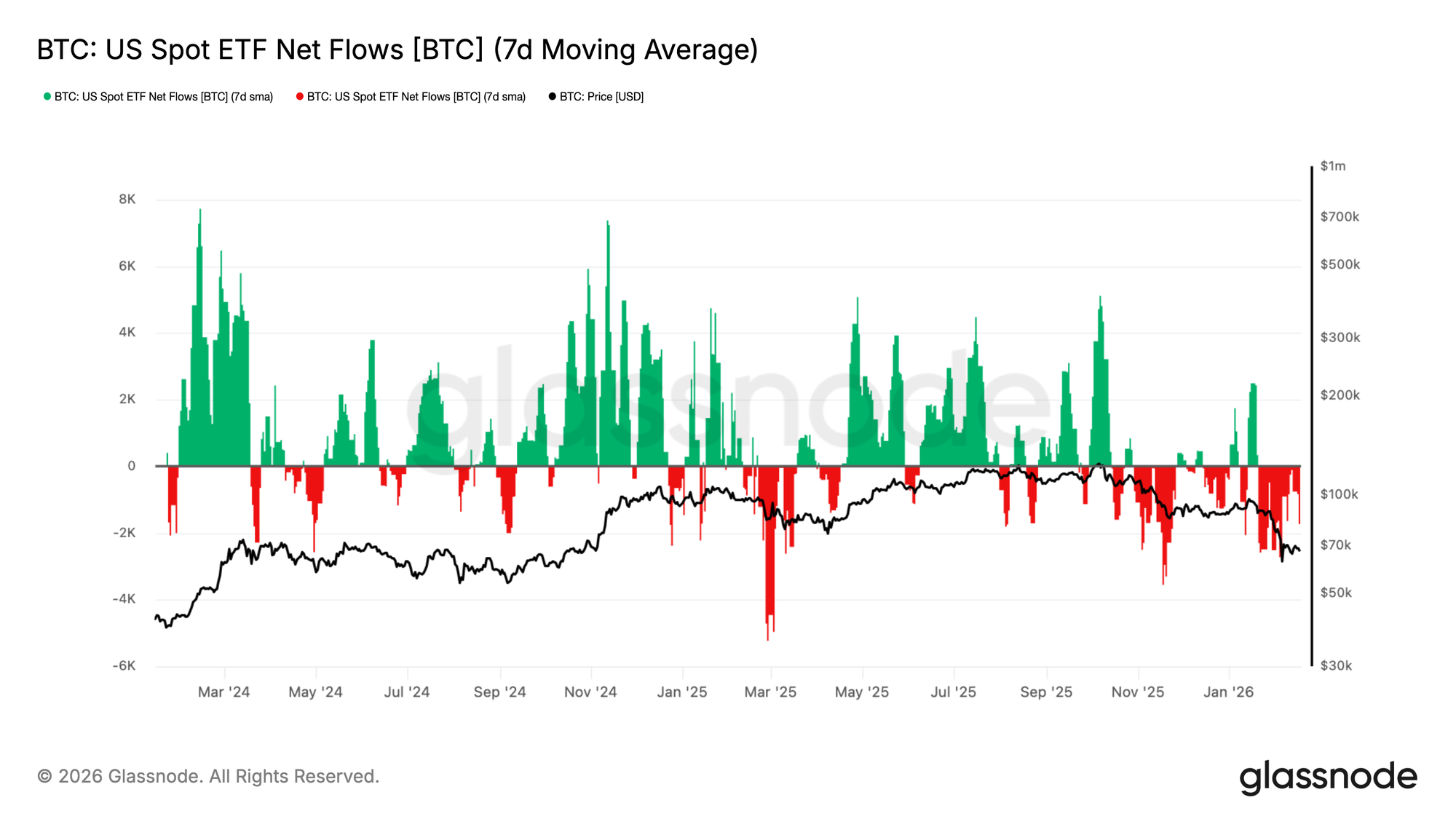
ETFs are Still Seeing Outflows

Demand across US Spot ETFs has deteriorated materially, with the 7-day moving average of net flows rotating back into persistent outflows as BTC retraces toward the $70K region. What previously acted as a steady structural bid has now softened, signalling a contraction in marginal institutional demand.

This marks a notable shift from the prior expansionary regime, where consistent inflows helped absorb supply and support higher price discovery. Instead, flows are now broadly negative, reinforcing the view that capital allocators are stepping back rather than deploying into weakness.

With ETF demand no longer providing a reliable cushion beneath the market, downside risk remains elevated, and any recovery attempts are likely to struggle unless netflows stabilize and re-accelerate into sustained inflows.

Live Chart

Spot Bias Turns Firmly Negative

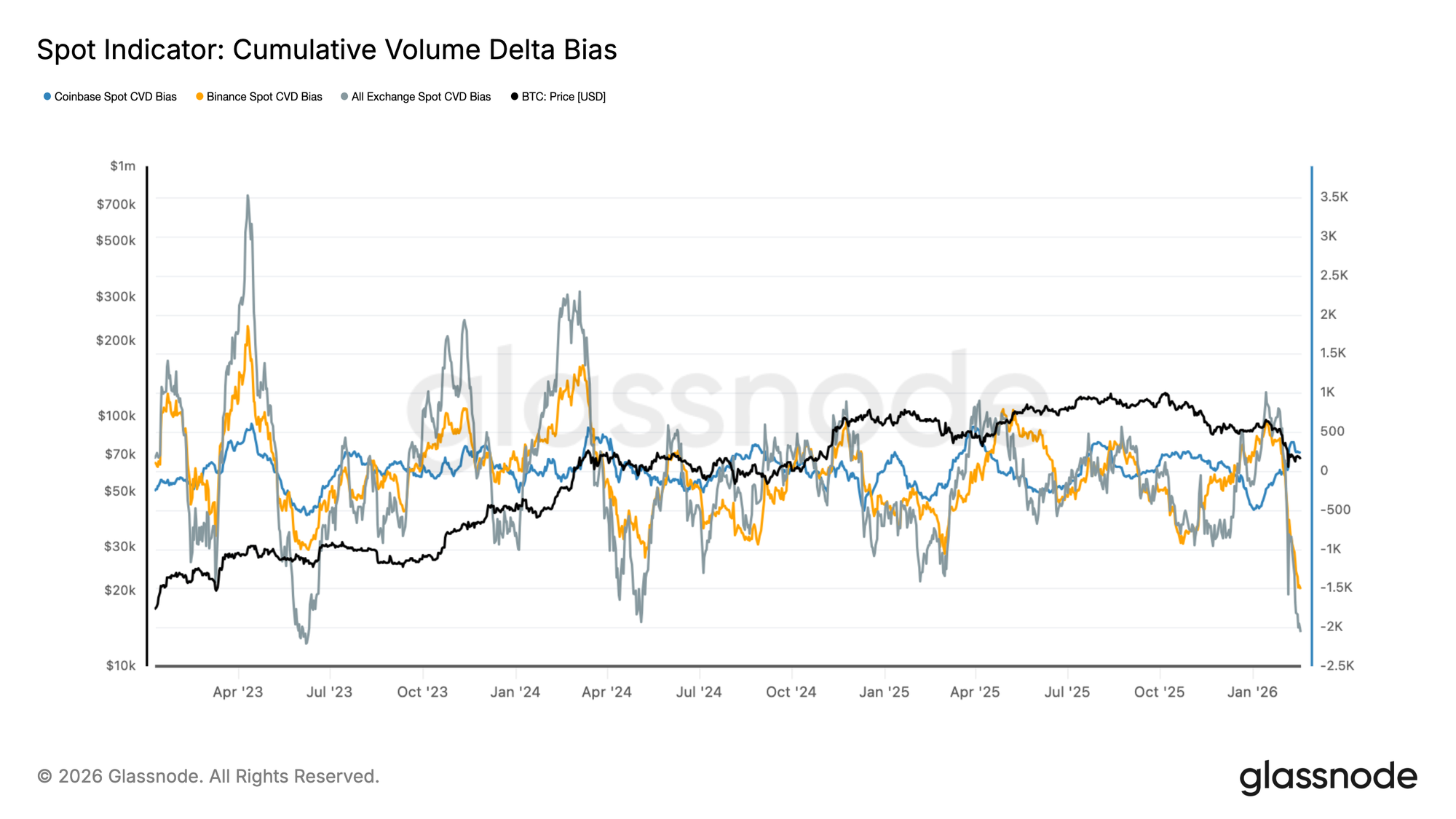
Spot Cumulative Volume Delta across major exchanges has rolled over sharply, with both Binance and the broader all-exchange CVD bias flipping decisively negative. This shift reflects an acceleration in aggressive sell-side activity, as market orders increasingly lift bids rather than offers.

Notably, Coinbase spot CVD has also softened, signalling that US-based demand is no longer providing a consistent counterbalance to global sell pressure. The alignment of negative CVD across venues suggests that recent weakness is driven by active distribution rather than passive liquidity gaps.

With spot flows skewed toward sell aggression, price action remains vulnerable. A stabilization in CVD, particularly a constructive divergence between price and spot delta, would be required to signal that organic demand is beginning to absorb supply more effectively.

Live Chart

Perpetual Funding Still Defensive

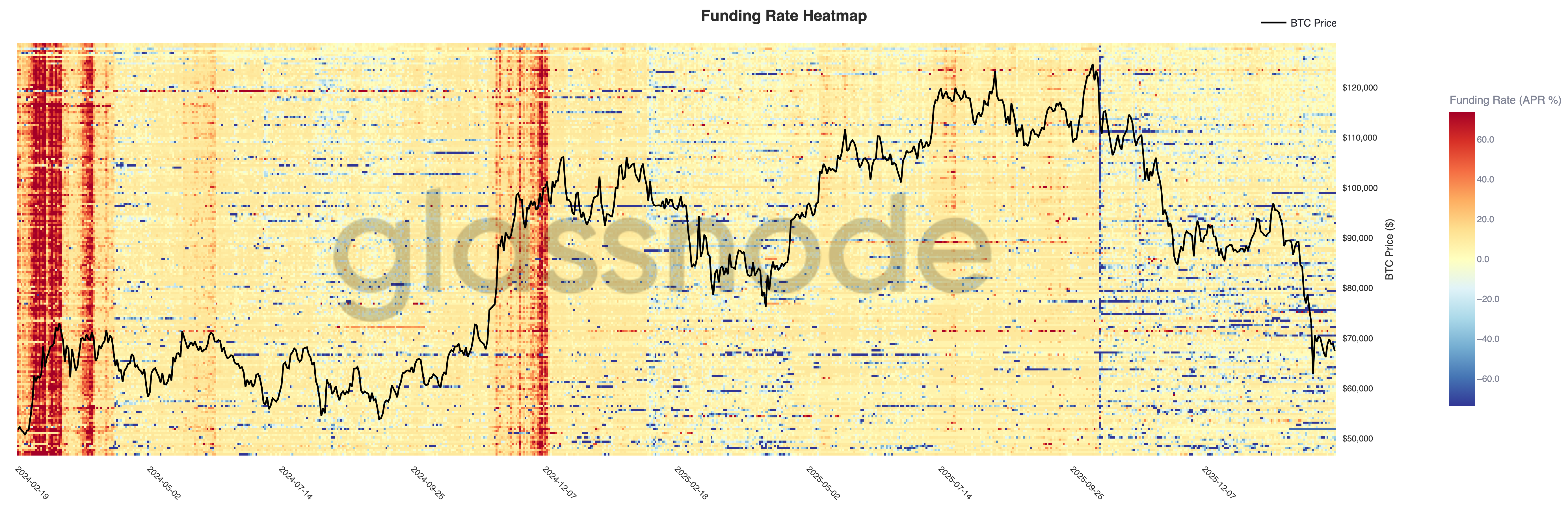
Perpetual funding rates have compressed sharply across venues, with the heatmap showing a broad shift from sustained positive funding during the advance toward $120K to increasingly neutral and negative prints as price retraces toward $70K. This transition reflects a meaningful unwind in long-side positioning.

Earlier expansion phases were characterised by persistent positive funding, signalling aggressive long leverage and trend reinforcement. In contrast, the current regime is marked by episodic negative funding spikes, suggesting traders are either hedging downside exposure or positioning tactically short into weakness.

With leverage no longer structurally skewed long, the derivatives complex has shifted into a more defensive posture. A sustained recovery would likely require funding to stabilize alongside renewed spot demand, rather than relying solely on short-covering flows.

Live Dashboard

Panic Premium Is Resetting

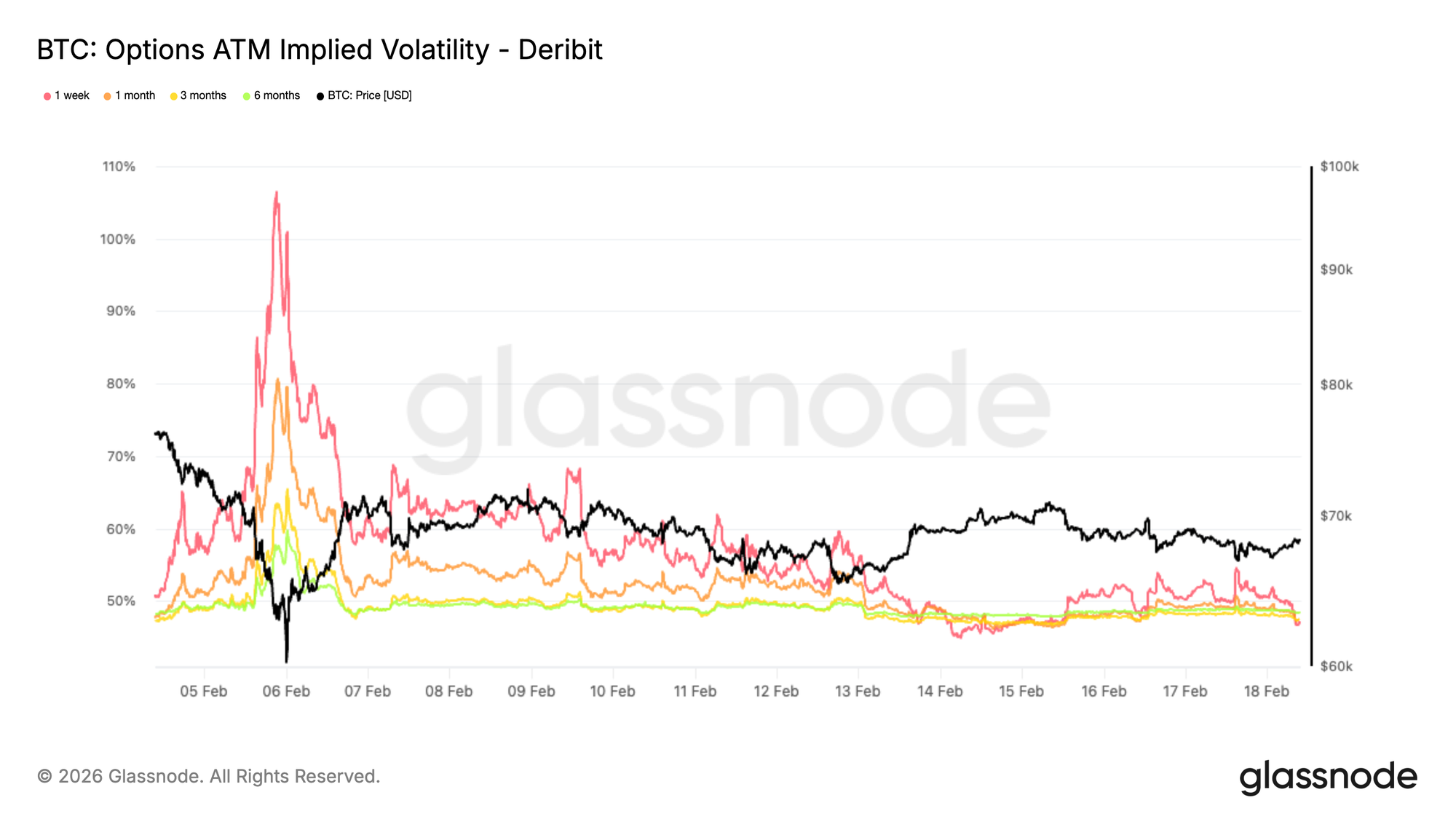
One-month ATM implied volatility has compressed sharply from recent panic highs, which reached 80% for the one-month tenor and 65% for the three-month, to roughly 47% across both maturities.

That decline reflects a meaningful reduction in immediate downside hedging demand. During the liquidation phase, traders aggressively paid up for short-term protection. That urgency has now faded.

The volatility risk premium is being unwound as defensive positioning is reduced. The market is no longer pricing an imminent crash scenario and instead reflects expectations of consolidation, with volatility contained within a narrower range.

This does not imply renewed bullish conviction. Rather, it signals that stress pricing has normalized and that positioning is being reset. The takeaway is structural. The forced hedging phase appears to be behind us, and volatility expectations are recalibrating lower as market positioning stabilizes.

Live Chart

Extreme Downside Skew Eases

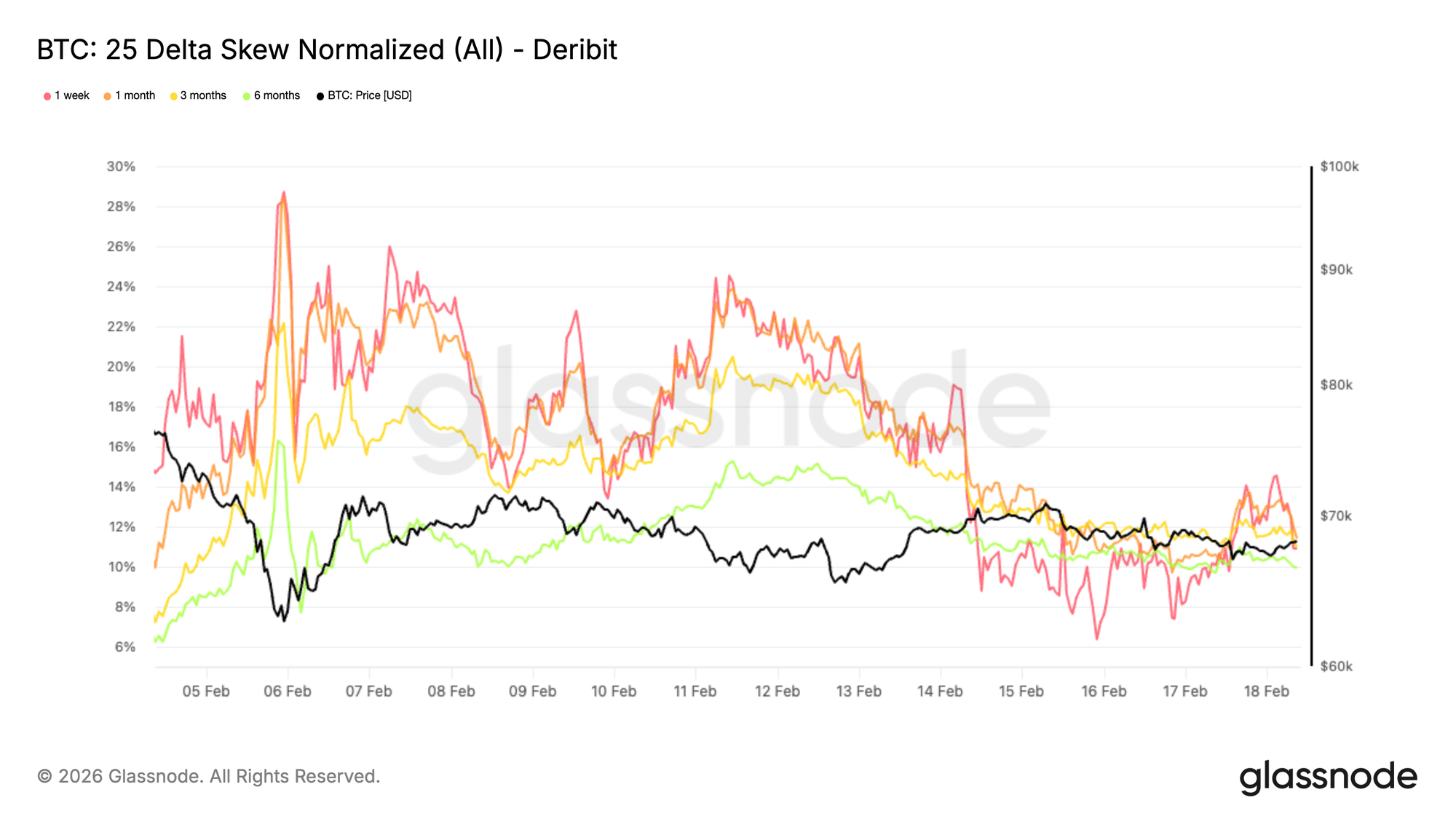
The 25-delta skew, which measures the volatility differential between downside puts and upside calls, has compressed meaningfully. A positive reading indicates that puts are priced richer than calls, signaling stronger demand for downside protection.

Following the retest of the $60K region, skew held near 20%. It has since eased to roughly 11% across tenors, marking a sharp 9-point moderation over recent sessions.

At the lows, puts traded at a significant premium as traders rushed to secure crash protection. That urgency has subsided. However, skew remains elevated relative to pre-selloff levels, indicating that downside hedging is still favored over upside exposure.

Traders are scaling back extreme tail hedges, but they are not rebuilding upside convexity. The takeaway is balanced. Stress has moderated, yet positioning remains cautious rather than constructive.

Live Chart

Volatility Risk Premium Diverges

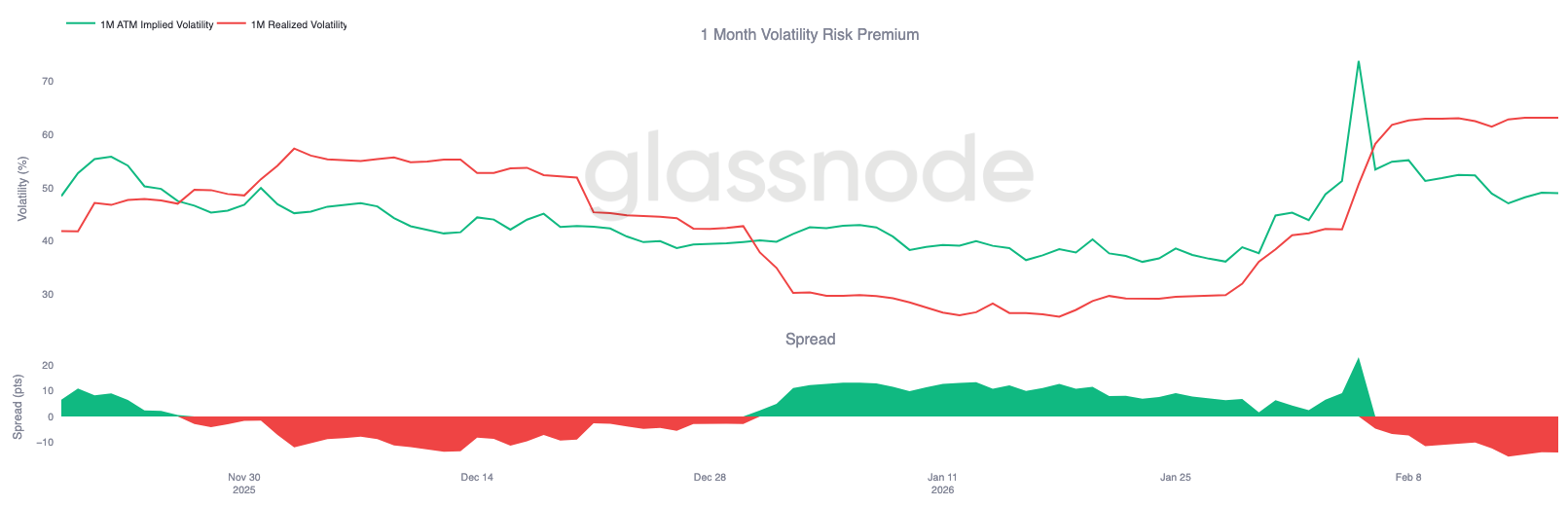
As implied volatility compresses and skew normalizes, the one-month volatility risk premium provides additional context. This metric compares implied volatility to realized volatility, assessing whether options markets are pricing more or less movement than has actually materialized.

During the liquidation-driven move, realized volatility expanded sharply, with large daily ranges pushing short-term realized metrics materially higher.

At the same time, implied volatility has begun to retrace as panic-driven hedging demand fades. This divergence often appears in the later stages of a stress episode.

When realized volatility spikes while implied volatility declines, it typically suggests that the forced component of the move has largely passed.

With crash hedges being unwound and positioning stabilizing, realized volatility is likely to moderate from elevated levels as the market transitions from reactive flows toward more deliberate positioning dynamics.

Live Dashboard

60K Put Premium: Hedge Unwinds Emerging

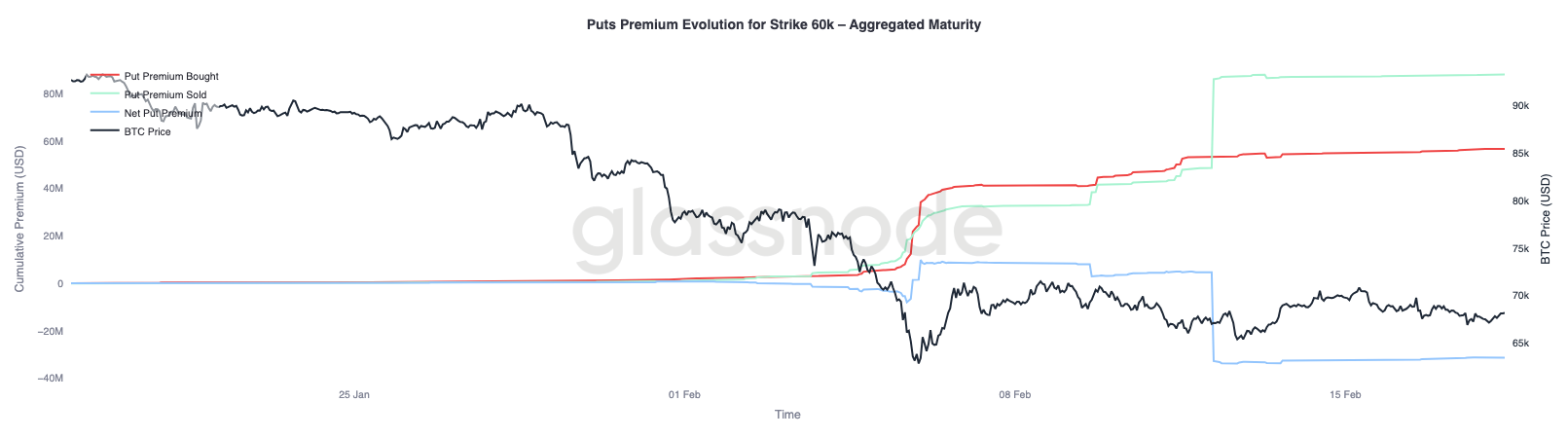
Zooming in on the $60K put premium evolution, the behavioral shift becomes clearer. During and immediately after the crash, put premium bought dominated flows, as traders aggressively accumulated downside protection at that strike, reinforcing demand for crash insurance.

As price stabilized, this dynamic began to reverse. Downside hedges were gradually unwound, and put premium sold increased meaningfully. The gap between premium bought and premium sold has widened in favor of sellers, pushing net premium lower. Some participants are now monetizing previously acquired protection while volatility at that strike remains relatively elevated.

The broader picture is consistent. The market remains cautious, but the urgency to own crash protection is fading. Rather than rebuilding upside exposure, traders appear to be repositioning for a more contained environment, where range-bound dynamics replace panic-driven flows.

Live Dashboard

Conclusion

Bitcoin remains confined within a structurally defined corridor between the True Market Mean near $79k and the Realized Price around $54.9k. The breakdown below active cost basis has shifted the regime firmly defensive, with price now relying on the $60k–$69k demand cluster to absorb persistent sell pressure. While this zone has so far moderated downside momentum, conviction remains fragile.

On-chain accumulation has improved from outright distribution but has yet to transition into strong, large-entity buying. Liquidity conditions remain constrained, as reflected by the Realized Profit/Loss Ratio hovering in a compressed 1–2 range, indicating limited capital rotation. Spot flows continue to skew negative, and ETF outflows confirm that institutional demand is not currently providing a structural bid.

In derivatives, the panic phase appears to be fading. Implied volatility and skew have compressed, and crash hedges are being unwound. However, this normalization reflects stabilization rather than renewed bullish positioning.

Taken together, the market is transitioning from reactive liquidation to controlled consolidation. For a durable recovery to emerge, renewed spot demand, sustained accumulation, and improving liquidity conditions will be required. Until then, range-bound absorption between key valuation anchors remains the dominant structural theme.


Disclaimer: This report does not provide any investment advice. All data is provided for informational and educational purposes only. No investment decision shall be based on the information provided here, and you are solely responsible for your own investment decisions.

Exchange balances presented are derived from Glassnode’s comprehensive database of address labels, which are amassed through both officially published exchange information and proprietary clustering algorithms. While we strive to ensure the utmost accuracy in representing exchange balances, it is important to note that these figures might not always encapsulate the entirety of an exchange’s reserves, particularly when exchanges refrain from disclosing their official addresses. We urge users to exercise caution and discretion when utilizing these metrics. Glassnode shall not be held responsible for any discrepancies or potential inaccuracies.

Please read our Transparency Notice when using exchange data.

Связанные с этим вопросы

QWhat are the two key on-chain price models mentioned that define the primary resistance and support corridor for Bitcoin's mid-term market structure, and what are their current approximate values?

AThe two key on-chain price models are the True Market Mean (currently near $79k), which tracks the aggregate cost basis of active supply and acts as primary resistance, and the Realized Price (currently near $54.9k), which estimates the average acquisition cost of all circulating coins and acts as primary support.

QAccording to the article, what specific price range has been acting as a demand cluster absorbing sell pressure, and when was this zone primarily formed?

AThe demand cluster absorbing sell pressure is between $60k and $69k. This zone was primarily established during the H1 2024 consolidation phase, where investors accumulated positions that have now been held for over a year.

QWhat does the Accumulation Trend Score (ATS) measure, and what value would signal renewed large-entity accumulation according to the analysis?

AThe Accumulation Trend Score (ATS) measures balance changes across wallet cohorts, assigning greater weight to larger entities. A sustained rise in ATS toward a value of 1 would signal renewed large-entity accumulation.

QHow has the behavior of US Spot ETF flows changed, and what does this shift indicate about institutional demand?

AUS Spot ETF flows have rotated from consistent inflows to persistent outflows, indicating a material deterioration in demand. This shift signals a contraction in marginal institutional demand and means ETFs are no longer providing a reliable structural bid beneath the market.

QWhat is the current state of implied volatility and options skew according to the off-chain insights, and what does this normalization suggest about market sentiment?

AOne-month ATM implied volatility has compressed sharply from panic highs (around 80%) to roughly 47%, and the 25-delta skew has moderated from 20% to about 11%. This normalization suggests the forced hedging phase is over and panic has subsided, but it reflects stabilization and cautious positioning rather than renewed bullish conviction.

Похожее

Blockchain Has Finally Started to Sail into the Mainstream After 18 Years

Blockchain Finds Its True Path After 18 Years: Becoming the Financial Backbone for AI Agents and Autonomy This analysis explores a pivotal shift in the blockchain and crypto investment landscape, driven by the dominance of AI. Major venture capital firms, including Variant, Paradigm, Haun Ventures, and YZi Labs, are moving beyond pure "crypto" investment theses. They are expanding their focus to AI, robotics, and frontier tech, signaling that blockchain is no longer seen as a standalone sector but as an underlying infrastructure layer. The core argument is that blockchain's killer application may not be user-facing apps, but rather providing the economic rails for the coming wave of AI agents, autonomous robots, and automated systems. Key capabilities like self-custody wallets, programmable stablecoins for micropayments, on-chain identity, and verifiable smart contracts are positioned as essential for a future where machines conduct economic activity. The recent $1.4 billion investment by Tether (via its venture arm) in German robotics company NEURA Robotics exemplifies this, aiming to embed Tether's wallet tools directly into robots for autonomous transactions. While many "AI + Crypto" projects remain superficial, the article concludes that true value lies where crypto is a necessary component—enabling machine-to-machine payments, agent autonomy, verifiable data provenance, and open financial settlement for the AI era. For crypto venture capital, this convergence with AI represents both an adaptation to shifting capital flows and a potential path to unlocking the large-scale, non-speculative utility the industry has long sought.

marsbit2 мин. назад

Blockchain Has Finally Started to Sail into the Mainstream After 18 Years

marsbit2 мин. назад

Blockchain has finally begun sailing toward the main channel after 18 years

After 18 years of development, blockchain technology is beginning to move from a specialized niche into mainstream adoption, according to a recent industry analysis. The shift is reflected in the changing strategies of major crypto venture capital firms, which are expanding their focus beyond pure "digital ownership" towards broader themes like "autonomy." The report highlights that leading VC firms like Variant, Paradigm, Haun Ventures, and YZi Labs are broadening their investment mandates to include not only crypto but also artificial intelligence (AI), robotics, biotech, and other frontier technologies. This reflects a recognition that the isolated "crypto investment" narrative is losing appeal to limited partners (LPs) as capital and attention increasingly flow toward AI and other high-growth tech sectors. A key emerging thesis is that blockchain's most significant future application may not be as a consumer-facing product, but as the underlying economic and settlement infrastructure for the AI era. As AI agents and autonomous systems become more prevalent, they will require programmable, global, and low-cost payment networks (like stablecoins), verifiable digital identities, and secure wallets to manage transactions and assets on behalf of users. The investment by stablecoin issuer Tether into robotics company NEURA, with plans to integrate its wallet technology, is cited as a prime example of this convergence. However, the article cautions that simply labeling projects as "AI + Crypto" is insufficient. True value lies in integrations where blockchain technology is essential—such as enabling machine-to-machine micropayments, verifiable data provenance for AI, or transparent governance for autonomous organizations—rather than being a superficial marketing add-on. In conclusion, while AI currently dominates the tech narrative and capital flows, it may ultimately create the real-world, high-frequency demand that the crypto industry has long sought. For crypto VCs and projects, the path forward is to position blockchain not as a competing sector, but as a critical foundational layer powering autonomy and economic activity in an AI-driven future.

链捕手8 мин. назад

Blockchain has finally begun sailing toward the main channel after 18 years

链捕手8 мин. назад

Y Combinator Co-founder: How to Make a Billion Dollars?

The Y Combinator co-founder argues that becoming a billionaire by founding a successful startup is not only possible but demonstrably achievable without unfair or unethical practices. He disputes a politician's claim to the contrary, using the example of a founder whose company grew at 93% monthly solely through creating a product users loved and recommended. The core mechanism is exponential growth. A conservative 15% monthly growth rate compounds to a 4384x increase over five years, which can easily lead to billion-dollar valuations and founder wealth. The process depends on two key variables: the growth rate and the duration it can be sustained. A high growth rate stems from a great product that users naturally promote, while a long duration requires a large enough market. For aspiring founders, especially young ones, the simplest path is to build something they and their friends genuinely need. Young people's current needs often predict future mass-market trends. He advises against actively "searching" for ideas, as this tends to filter out unconventional but promising ones. Instead, inspiration should come from working on interesting projects with friends, as many iconic companies (e.g., Apple, Facebook) started this way. Ultimately, building a massively valuable startup is not about exploitation but empathy: deeply understanding a user group and building a product that significantly improves their lives. This, powered by exponential growth in a large market, is the legitimate path to immense wealth creation.

Foresight News11 мин. назад

Y Combinator Co-founder: How to Make a Billion Dollars?

Foresight News11 мин. назад

The 800V Voltage Standard Championed by Nvidia: Which Infrastructure Providers Stand to Benefit?

NVIDIA is actively promoting the 800VDC architecture as a key direction for its next-generation AI factories and high-power racks, particularly for the upcoming Rubin and Kyber platforms. The primary driver is the rapidly increasing power density of AI racks, with designs like GB200/GB300 NVL72 reaching 120-140kW and future systems potentially hitting 180-220kW. At such high power levels, traditional low-voltage power delivery becomes inefficient due to massive current, leading to significant copper use, cable bulk, heat, and power loss. The 800VDC standard aims to increase efficiency by transmitting power at higher voltage and lower current to the rack before stepping it down locally for GPUs. NVIDIA claims this can improve efficiency by up to 5%, reduce total cost of ownership (TCO) by up to 30%, and cut copper usage by approximately 45%. This shift redefines infrastructure roles, pushing power engineering to the forefront alongside GPU performance. Key beneficiaries and ecosystem partners highlighted include: 1. **Power Infrastructure Providers:** Companies like Vertiv, Schneider Electric, Delta Electronics (台达电), and Korean firms LS Electric and HD Hyundai Electric are involved in designing next-gen AI factory power distribution, rack power supplies, and backup systems. 2. **Power Semiconductors:** Suppliers of SiC/GaN devices, such as Infineon and STMicroelectronics, are better suited for high-voltage, high-efficiency conversion in this new architecture. 3. **Connectivity & Structure:** The focus shifts to high-reliability components like busbars, high-voltage connectors, and advanced PCBs that meet stricter insulation and safety requirements. 4. **Liquid Cooling & Rack ODM:** As power and heat density rise, liquid cooling becomes critical. Full-rack system integrators (e.g., Dell, Wiwynn, Wistron) must now demonstrate robust pre-delivery testing capabilities, including burn-in testing under full load, requiring significant power and cooling infrastructure in their factories. The transition is not immediate for all data centers but is targeted at high-density AI factories. NVIDIA’s 800VDC ecosystem is in a preparatory phase, with full-scale production expected to align with the 2027 launch of Kyber rack-scale systems. The investment thesis revolves around which companies can demonstrate proven product integration, customer validation, and reliable delivery of complete, high-power AI rack systems, making power, cooling, and testing capabilities new critical variables in the AI infrastructure value chain alongside GPUs.

marsbit31 мин. назад

The 800V Voltage Standard Championed by Nvidia: Which Infrastructure Providers Stand to Benefit?

marsbit31 мин. назад

Did 'Unlimited Minting' Actually Happen? Zcash Founder Responds to Four Major Market Concerns

The Orchard shielding pool in the privacy cryptocurrency Zcash was recently found to have contained a critical counterfeiting vulnerability that existed for four years. This discovery caused significant market panic and a sharp drop in the price of ZEC, though it has since recovered partially. Zcash founder Zooko Wilcox addressed four key questions raised by the vulnerability. First, while it's unknown if the bug was exploited, he believes it likely was not, citing advanced, targeted discovery methods, a rapid response to freeze the pool, and the typical "smash-and-grab" nature of past crypto exploits. Second, he states that if no exploitation occurred, all legitimate user funds in Orchard are recoverable. However, cautious users moving funds should be aware of privacy trade-offs and other risks involved in transferring to transparent or Sapling pools. Third, users currently cannot independently verify that the total ZEC supply hasn't been inflated due to this bug. However, the proposed "Ironwood" network upgrade will restore this ability by permanently sealing the Orchard pool. This will prevent any counterfeit funds from circulating and allow anyone running a node to cryptographically verify that the supply cap has not been breached. Finally, regarding other undiscovered vulnerabilities, Wilcox notes that intensive ongoing audits by multiple teams, including using advanced AI-assisted tools, have so far found no other counterfeiting bugs. This provides increased, though not absolute, confidence. In conclusion, while assessments suggest the bug was likely unused and funds are safe, the core issue was the loss of user-verifiable supply integrity. The Ironwood upgrade is presented as the solution, aiming to restore trust by allowing users to independently verify Zcash's supply security without relying on third-party assurances.

marsbit32 мин. назад

Did 'Unlimited Minting' Actually Happen? Zcash Founder Responds to Four Major Market Concerns

marsbit32 мин. назад

Торговля

Спот
Фьючерсы

Популярные статьи

Как купить S

Добро пожаловать на HTX.com! Мы сделали приобретение Sonic (S) простым и удобным. Следуйте нашему пошаговому руководству и отправляйтесь в свое крипто-путешествие.Шаг 1: Создайте аккаунт на HTXИспользуйте свой адрес электронной почты или номер телефона, чтобы зарегистрироваться и бесплатно создать аккаунт на HTX. Пройдите удобную регистрацию и откройте для себя весь функционал.Создать аккаунтШаг 2: Перейдите в Купить криптовалюту и выберите свой способ оплатыКредитная/Дебетовая Карта: Используйте свою карту Visa или Mastercard для мгновенной покупки Sonic (S).Баланс: Используйте средства с баланса вашего аккаунта HTX для простой торговли.Третьи Лица: Мы добавили популярные способы оплаты, такие как Google Pay и Apple Pay, для повышения удобства.P2P: Торгуйте напрямую с другими пользователями на HTX.Внебиржевая Торговля (OTC): Мы предлагаем индивидуальные услуги и конкурентоспособные обменные курсы для трейдеров.Шаг 3: Хранение Sonic (S)После приобретения вами Sonic (S) храните их в своем аккаунте на HTX. В качестве альтернативы вы можете отправить их куда-либо с помощью перевода в блокчейне или использовать для торговли с другими криптовалютами.Шаг 4: Торговля Sonic (S)С легкостью торгуйте Sonic (S) на спотовом рынке HTX. Просто зайдите в свой аккаунт, выберите торговую пару, совершайте сделки и следите за ними в режиме реального времени. Мы предлагаем удобный интерфейс как для начинающих, так и для опытных трейдеров.

1.5k просмотров всегоОпубликовано 2025.01.15Обновлено 2026.06.02

Как купить S

Sonic: Обновления под руководством Андре Кронье – новая звезда Layer-1 на фоне спада рынка

Он решает проблемы масштабируемости, совместимости между блокчейнами и стимулов для разработчиков с помощью технологических инноваций.

2.3k просмотров всегоОпубликовано 2025.04.09Обновлено 2025.04.09

Sonic: Обновления под руководством Андре Кронье – новая звезда Layer-1 на фоне спада рынка

HTX Learn: Пройдите обучение по "Sonic" и разделите 1000 USDT

HTX Learn — ваш проводник в мир перспективных проектов, и мы запускаем специальное мероприятие "Учитесь и Зарабатывайте", посвящённое этим проектам. Наше новое направление .

1.8k просмотров всегоОпубликовано 2025.04.10Обновлено 2025.04.10

HTX Learn: Пройдите обучение по "Sonic" и разделите 1000 USDT

Обсуждения

Добро пожаловать в Сообщество HTX. Здесь вы сможете быть в курсе последних новостей о развитии платформы и получить доступ к профессиональной аналитической информации о рынке. Мнения пользователей о цене на S (S) представлены ниже.

活动图片