Prediction Markets Hit Record Highs As Bets Explode On Global Conflict

bitcoinistОпубликовано 2026-03-31Обновлено 2026-03-31

Введение

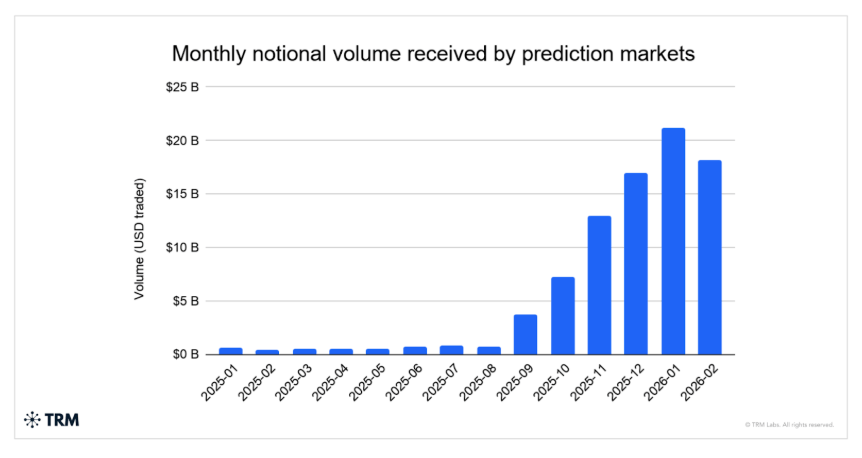
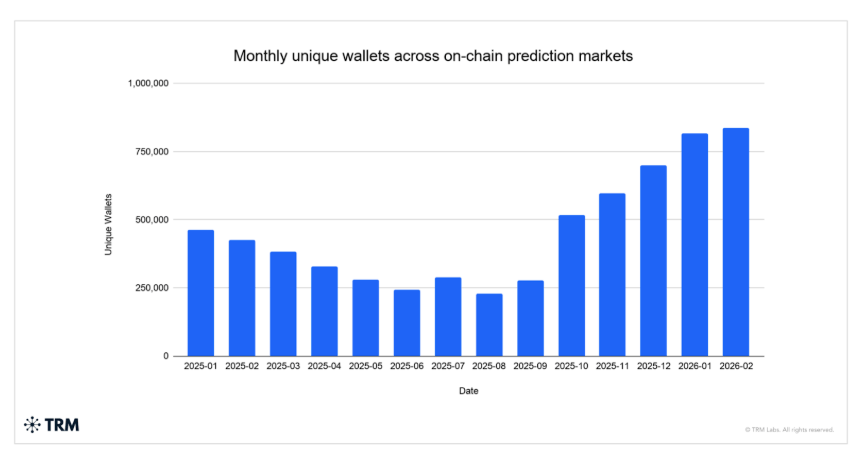
Prediction markets are experiencing unprecedented growth, driven by automated AI agents and high-frequency trading bots that extracted approximately $40 million from market inefficiencies in a single month. These markets are increasingly dominated by bets on geopolitical events, such as the US-Israeli conflict with Iran, and major political events like the 2028 US Presidential primary, rather than cryptocurrency prices. TRM Labs reported a 2,800% year-over-year increase, with March 2026 seeing 191 million transactions totaling nearly $24 billion. This surge has attracted regulatory scrutiny over potential insider trading, leading to bipartisan efforts to ban "casino-style" event contracts. Platforms like Kalshi and Polymarket are implementing internal restrictions to preempt stricter regulations, as the industry balances its role as a forecasting tool with concerns over speculation on global conflicts.

Prediction markets are being dominated by automated AI agents and high-frequency trading bots, which extracted around $40 million from market inefficiencies within a single month.

These digital traders look for news of global unrest and respond in milliseconds, often moving the price of a contract before the rest of us can even think about the headline.

This new world of professionalized, machine-based speculation has turned what was once a niche hobby for crypto enthusiasts into a high-stakes financial arena.

Blockchain analytics company TRM Labs reported that prediction markets have seen substantial growth, fueled by greater accessibility, regulatory progress, and integration with mainstream platforms like Google Finance.

The firm noted that these markets are increasingly serving as real-time indicators for geopolitical and macroeconomic events, gaining attention from major media outlets.

War And Elections Drive Unprecedented Volume

The primary catalyst for this massive activity is no longer the price of digital coins. Instead, traders are putting money on the line over the US-Israeli conflict with Iran and other international flashpoints.

The political implications are also significant, with huge monetary stakes riding on the 2028 US Presidential primary nominations. It has been suggested that such platforms are now being used as a measure of the way in which public opinion is shifting, with their probabilities featured on Google Finance and in the news as a more fluid alternative to traditional political polling.

The extent to which this industry is growing can be quantified by recent figures, which showed an increase of over 2,800% compared to the previous year. Indeed, in March 2026, there were over 191 million transactions in the space.

BTCUSD currently trading at $67,503. Chart: TradingView

To put that in perspective, that figure equates to almost $24 billion in total value for that month alone, representing a staggering increase from the $1.85 billion in March 2025. This indicates that people and investors are viewing these markets as crucial in hedging against any changes in economic policies or shifts in interest rates.

Prediction Markets: Lawmakers Target Event Based Betting

However, the sudden increase in value has caught the attention of regulators in Washington. The regulators have expressed concerns that people may be using inside information to make profits from military actions and other government decisions.

These suspicions of insider trading have led to a bipartisan push for new legislation. US President Donald Trump and members of Congress are looking at a bill that would effectively ban contracts tied to “casino-style” events, potentially stripping the industry of its most popular categories.

Platforms Introduce New Trading Guardrails

In an effort to stave off a total shutdown, major platforms like Kalshi and Polymarket are beginning to implement their own internal restrictions. These measures aim to curb the most controversial types of betting while maintaining the market’s role as a forecasting utility.

Data shows that the outcome of these regulatory battles will determine if the sector stays a permanent fixture of the financial world. For now, the industry remains in a volatile state, balancing between its value as a source of truth and its reputation as a venue for speculating on global tragedy.

Featured image from Unsplash, chart from TradingView

Связанные с этим вопросы

QWhat is the primary catalyst for the massive growth in prediction market activity according to the article?

AThe primary catalyst is no longer the price of digital coins, but traders betting on geopolitical events like the US-Israeli conflict with Iran and other international flashpoints, as well as major political events like the 2028 US Presidential primary nominations.

QHow much value did automated AI agents and trading bots extract from market inefficiencies in a single month?

AAutomated AI agents and high-frequency trading bots extracted around $40 million from market inefficiencies within a single month.

QWhat are US lawmakers concerned about regarding prediction markets, and what action are they considering?

AUS lawmakers are concerned that people may be using inside information to profit from military actions and government decisions. They are considering a bipartisan bill that would ban contracts tied to 'casino-style' events.

QWhat was the reported percentage increase in prediction market transactions in March 2026 compared to the previous year?

AThe reported increase was over 2,800% compared to the previous year, with over 191 million transactions in March 2026.

QHow are major prediction market platforms like Kalshi and Polymarket responding to regulatory pressure?

AThey are implementing their own internal restrictions to curb the most controversial types of betting in an effort to stave off a total shutdown and maintain the market's role as a forecasting utility.

Похожее

Peeking Through Windows, Precision Hijacking? Two Giants of Prediction Markets Engage in Corporate Espionage

Polymarket, a prediction market platform, is investigating a suspected corporate espionage case involving its main rival, Kalshi. Polymarket accuses Kalshi of stealing business information and copying product launches through potentially illicit means, compiling a "plagiarism file" documenting over a dozen suspiciously coincidental product releases and marketing campaigns. Key incidents include a February 2026 free-grocery pop-up event, where Kalshi launched an almost identical campaign just nine days before Polymarket's scheduled launch, seemingly to siphon attention. Furthermore, an article leaked Kalshi's plans for a perpetual futures trading product merely an hour before Polymarket's own planned announcement for a similar tool in April 2026. Polymarket executives suspect either an internal mole or physical surveillance, noting that the office of Paradigm—a Kalshi investor—directly faces their Manhattan workspace, leading them to install dark window film. Both Paradigm and Kalshi have dismissed the allegations as baseless and ridiculous. Kalshi claims its product developments are independent and coincidental timing is merely market-driven. The rivalry intensifies as both companies secure significant funding, with Polymarket seeking a $15 billion valuation and Kalshi valued at $22 billion amid growing regulatory scrutiny of the prediction market industry.

foresightnews_api6 мин. назад

Peeking Through Windows, Precision Hijacking? Two Giants of Prediction Markets Engage in Corporate Espionage

foresightnews_api6 мин. назад

Hyperliquid, Wall Street's All-Day Trading Convenience Store

**Hyperliquid: Wall Street's 24/7 Trading Convenience Store** Written by Vicky Ge Huang, Wall Street Journal. Hyperliquid, a decentralized crypto trading platform, has become a go-to venue for Wall Street traders, especially during weekends when traditional U.S. markets are closed. Operating 24/7, it allows traders to pre-position or close trades ahead of market opens, capitalizing on events like geopolitical news. The platform, founded by former Hudson River Trading quant Jeff Yan, offers perpetual contracts on a wide range of assets, including Bitcoin, the S&P 500, oil, and even pre-IPO companies like SpaceX. Its growth exemplifies the merging of traditional finance and crypto markets, attracting significant volume from professional traders seeking leverage and constant access. A key differentiator, according to Yan, is user self-custody of assets—a necessity highlighted by the FTX collapse. Despite U.S. regulatory restrictions, some American users reportedly access the platform via VPN, drawn by its ease of use, lack of stringent KYC, and strong community culture on platforms like Discord and X. The platform is not without risks. Perpetual contracts are complex and highly leveraged, leading to massive liquidations during market volatility. Hyperliquid itself saw $10 billion in liquidations during a market crash in October last year. Regulatory warnings emphasize insufficient risk disclosure for retail investors. With about 11 employees, Hyperliquid and its associated blockchain reportedly generated around $800 million in revenue last year. Its native token, HYPE, has surged over 100% since late 2024. The platform plans to expand into prediction markets and options trading, aiming to become a hub for all financial activity.

foresightnews_api8 мин. назад

Hyperliquid, Wall Street's All-Day Trading Convenience Store

foresightnews_api8 мин. назад

Former Bankless Member Lucas: Why I Still Bullish on Ethereum

Former Bankless member Lucas explains why he remains bullish on Ethereum despite widespread pessimism. He acknowledges ETH's poor price performance over the past five years compared to Bitcoin and traditional markets, but draws parallels to historical multi-year consolidations seen in tech giants like Amazon and NVIDIA before major breakouts. Fundamentally, Ethereum is stronger than ever: record-high daily transactions (2.27 million in May 2026), significantly lower average gas fees ($0.27), over 400 million total addresses, and more than 32% of ETH staked, securing the network. Lucas's core thesis remains unchanged: all valuable assets will eventually be tokenized, Ethereum will become the primary settlement layer for these assets, and ETH will capture the resulting value. This transition is already underway. Stablecoins, the first proven tokenized real-world asset (RWA), have a $300+ billion market cap, with 54% settled on Ethereum. The broader RWA sector has surpassed $30 billion, with over 53% deployed on Ethereum. He compares the current RWA adoption phase to early DeFi in 2019-20, suggesting immense growth potential. Key catalysts like the potential passage of the U.S. CLARITY Act in 2026 could accelerate institutional adoption. While other blockchains will share the market, Lucas argues that traditional finance prioritizes Ethereum's security, stability, and established ecosystem for trillion-dollar asset tokenization. He concludes that as global assets migrate on-chain, the market will reprice ETH accordingly.

foresightnews_api11 мин. назад

Former Bankless Member Lucas: Why I Still Bullish on Ethereum

foresightnews_api11 мин. назад

Торговля

Спот
Фьючерсы

Популярные статьи

Неделя обучения по популярным токенам (2): 2026 может стать годом приложений реального времени, сектор AI продолжает оставаться в тренде

2025 год — год институциональных инвесторов, в будущем он будет доминировать в приложениях реального времени.

1.8k просмотров всегоОпубликовано 2025.12.16Обновлено 2025.12.16

Неделя обучения по популярным токенам (2): 2026 может стать годом приложений реального времени, сектор AI продолжает оставаться в тренде

Обсуждения

Добро пожаловать в Сообщество HTX. Здесь вы сможете быть в курсе последних новостей о развитии платформы и получить доступ к профессиональной аналитической информации о рынке. Мнения пользователей о цене на AI (AI) представлены ниже.

活动图片