Polymarket's "Hand of God": Frequent Prediction Disputes, the Black Box of Adjudication Power Under the "Centralization" Dilemma

marsbitОпубликовано 2026-01-22Обновлено 2026-01-22

Введение

A semantic dispute over whether the U.S. "invaded" Venezuela led to a multimillion-dollar betting outcome on Polymarket, where the "No" option was controversially settled despite real-world actions that many perceived as invasion. This incident highlights a recurring structural flaw in decentralized prediction markets: the challenge of defining "truth" for complex real-world events. Similar semantic ambiguities have repeatedly occurred on Polymarket, such as a high-stakes bet on whether Ukraine’s President Zelensky wore a suit at a specific event. While real-world evidence seemed clear, the outcome was swayed by decentralized oracle UMA’s governance mechanism, allowing token holders to vote on disputed results—sometimes enabling large players to manipulate outcomes. These cases reveal the limits of "code is law" in prediction markets. While blockchain excels at executing predefined rules trustlessly, it struggles with contextual, socially constructed events like political or military interpretations. The authority to define and settle reality ultimately remains centralized in the hands of rule-makers and arbitrators, even when execution is decentralized. Prediction markets work best for clearly defined, data-driven questions but face inherent challenges when applied to politicized or semantically ambiguous events. The core issue isn’t whether the market is decentralized, but who holds the power to define reality when consensus breaks down.

Whether the United States has "invaded" Venezuela—this semantic judgment directly determines a bet worth over ten million dollars.

You might find this counterintuitive, as in the real world, the U.S. has indeed taken a series of measures against Venezuela, including military deployments and direct actions. In everyday language and media narratives, such actions are easily interpreted as an "invasion."

However, the final settlement result did not align with the expectations of some betting users—Polymarket ultimately did not recognize the U.S. military's actions as constituting an "invasion" within its rule context, thereby negating the validity of the "Yes" option and sparking protests from users.
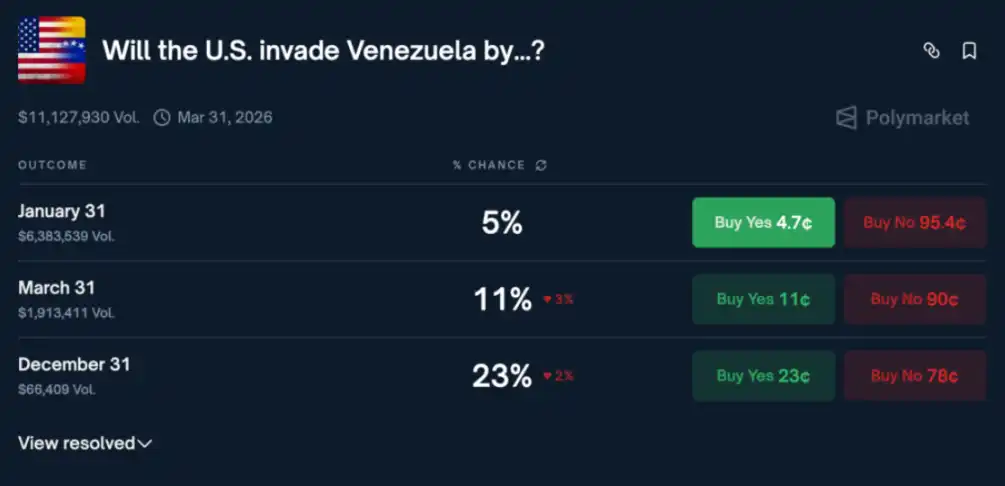
This is actually a not-so-new but highly representative controversy, once again exposing a long-standing yet often overlooked structural issue in prediction markets: When it comes to complex real-world events, on what basis, and by whom, is "fact" defined in decentralized prediction markets?

I. Frequent "Semantic Traps" in Prediction Markets

The reason it is "not so new" is that similar semantic disputes have occurred multiple times in prediction markets.

Indeed, such situations on Polymarket are already commonplace, especially in predictions surrounding political figures and international situations. The platform has repeatedly produced adjudication results that users consider "counterintuitive." Some predictions, almost uncontroversial in reality, have fallen into repeated appeals and reversals on-chain; other events have seen final adjudication results that significantly deviate from most users' real-world judgments.

In more extreme cases, during the dispute adjudication phase, the oracle mechanism allows token holders to participate in voting, leading to situations where certain topical events can be "swayed by the voting power of major players"...

These controversies share a common characteristic: they are often not technical issues but social consensus problems. A widely discussed example is the prediction about whether Ukrainian President Zelensky "wore a suit" at a specific time:

In reality, Zelensky wore a formal suit to a public event last June. Interpretations from multiple sources, including the BBC and designers, confirmed it as a suit. By common sense, the result should have been settled. But on Polymarket, this seemingly clear fact turned into a tug-of-war involving hundreds of millions of dollars.

During this period, the probability of Yes and No fluctuated wildly, with high-risk arbitrage behaviors. Some achieved huge floating profits in a short time, while the final settlement was repeatedly delayed.
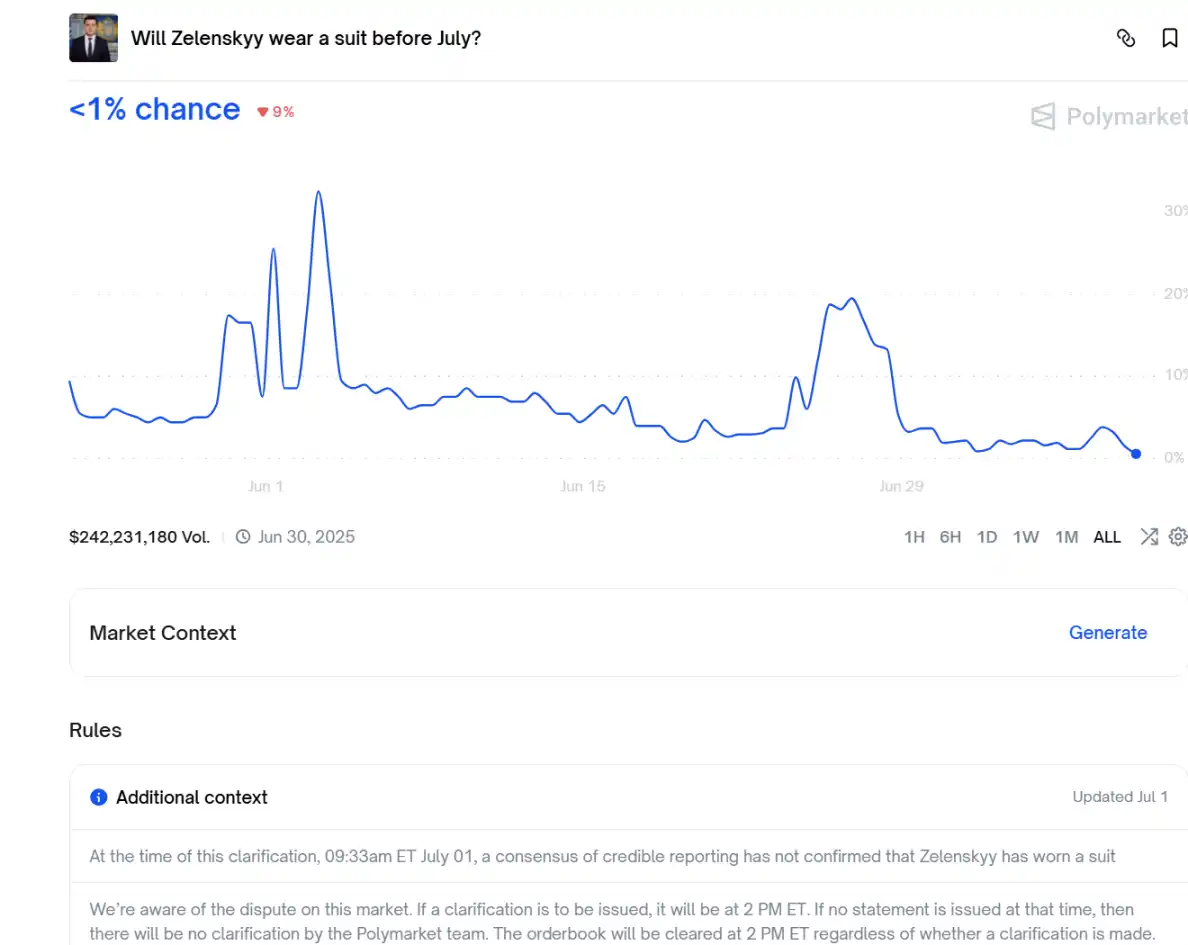
The key issue is that Polymarket relies on the decentralized oracle UMA for result adjudication. Its operating mechanism allows holders to participate in dispute resolution through voting, making it easy for major players to manipulate the outcome of certain topical events.

More controversially, the platform level does not deny that this mechanism could be exploited but insists on "rules are rules," refusing to adjust the adjudication logic afterward, ultimately allowing large funds to flip the outcome using the rules themselves.

It is precisely such cases that provide a highly representative and clear insight into the institutional boundaries of prediction markets.

II. The Failure Boundary of "Code is Law"

Objectively speaking, prediction markets are now considered one of the most imaginative applications of blockchain. They are no longer just a small tool for "betting" or "predicting the future" but have become outposts for institutions, analysts, and even central banks to observe market sentiment (Extended reading: "The Breakout Moment of 'Prediction Markets': ICE Enters, Hyperliquid Doubles Down, Why Are Giants Competing to 'Price Uncertainty'?").

But all of this has a prerequisite: prediction questions must be answerable clearly.

It is important to know that blockchain systems are naturally good at handling deterministic problems—such as whether assets have arrived, whether states have changed, whether conditions have been met. Once these results are written on-chain, there is almost no room for tampering.

However, prediction markets often face another type of object: whether a war has broken out, whether an election has ended, whether a certain political or military action constitutes a judgment of a particular nature. These problems are not inherently encodable; they highly depend on context, interpretation, and social consensus, rather than a single, verifiable objective signal.

This is why, no matter what kind of oracle or adjudication mechanism is adopted, subjectivity is almost unavoidable in the process of translating real-world events into settleable results.

This is also why, in multiple Polymarket controversies, the disagreement between users and the platform is not about whether the facts exist, but about which interpretation of reality is the one that can be settled.

Ultimately, when this power of interpretation cannot be completely formalized by code, the underlying logic of the grand vision that "code is law" inevitably hits its boundary in the face of complex social semantics.

III. The "Last Mile" of Truth is Hard to Decentralize

In many decentralized narratives, "centralization" is often seen as a system defect. But the author believes that in the specific context of prediction markets, the opposite is true.

Because prediction markets do not eliminate adjudication power; they merely transfer it from one position to another:

  • Trading and settlement phase: Highly decentralized, automated execution;
  • Definition and interpretation phase: Highly centralized, reliant on rules and adjudicators;

In other words, decentralization solves the credibility of execution but cannot avoid the reality of centralized interpretation power. This is why the concept of "code is law," which is highly attractive in the blockchain world, often seems inadequate in prediction markets—because code cannot generate social consensus on its own; it can only faithfully execute established rules.

And when the rules themselves cannot cover the full complexity of reality, adjudication power inevitably returns to the hands of "people." The only difference is that this power no longer appears as an explicit arbiter but is hidden within problem definition, rule interpretation, and adjudication processes.

Returning to the Polymarket controversy itself, it does not mean the failure of prediction markets, nor does it mean the decentralized narrative is a castle in the air. On the contrary, such controversies remind us to re-understand the applicable boundaries of prediction markets: They are very suitable for data/events with clear outcomes and definitions but are naturally not good at handling highly politicized, semantically ambiguous, value-judgment-intensive real-world problems.

From this perspective, prediction markets never solve "who is right or wrong" but rather how the market efficiently aggregates expectations under given rules. So once the rules themselves become the focus of controversy, the system exposes its institutional boundaries.

Like the latest controversy over whether Venezuela was "invaded," it essentially shows that when it comes to complex real-world events, decentralization does not mean there is no adjudicator, but that adjudication power exists in a more hidden way.

For ordinary users, what truly matters may not be whether the prediction market "is decentralized," but rather: when a dispute occurs, who has the power to define the problem? Who decides which version of reality can be settled? Are the rules clear and predictable enough?

In this sense, prediction markets are not only an experiment in collective wisdom but also a power game about "who has the right to define reality."

Understanding this, we can find a balance point closer to certainty amidst uncertain truths.

Связанные с этим вопросы

QWhat is the core structural problem of decentralized prediction markets exposed by the article?

AThe core problem is that decentralized prediction markets struggle with defining 'fact' or 'truth' for complex real-world events. While execution and settlement are decentralized, the interpretation and definition of outcomes remain centralized and rely on human judgment, creating a 'black box' of adjudication power.

QHow did Polymarket resolve the bet on whether the US 'invaded' Venezuela, and why did it cause controversy?

APolymarket ruled that the 'Yes' option (US invaded Venezuela) did not occur, despite real-world military actions and media narratives suggesting otherwise. This caused controversy because the platform's rules and oracle mechanism did not align with common language understanding or user expectations, leading to protests from bettors who lost significant funds.

QWhat mechanism does Polymarket use for dispute resolution, and what risk does it introduce?

APolymarket uses the decentralized oracle UMA for dispute resolution, which allows token holders to vote on contested outcomes. This introduces the risk of manipulation by large players ('whales') who can use their voting power to sway results in their favor, even if it contradicts broader consensus or factual evidence.

QWhy is the concept of 'code is law' limited in prediction markets according to the article?

A'Code is law' is limited because code cannot generate social consensus or interpret complex, context-dependent real-world events. It can only execute predefined rules. When rules are ambiguous or unable to cover semantic nuances (e.g., defining 'invasion' or 'suit'), subjective human intervention becomes necessary, revealing the boundary of decentralized adjudication.

QWhat type of events are prediction markets well-suited for, and which are they poorly suited for?

APrediction markets are well-suited for events with clear, objective, and easily verifiable outcomes (e.g., data-driven or binary events). They are poorly suited for highly politicized, semantically ambiguous, or value-laden events (e.g., political judgments, military actions) where definitions rely on interpretation and social consensus rather than pure facts.

Похожее

War Trade Unwinding | TradeXYZ Weekend Observations

Weekend markets saw a clear return of risk appetite. Major indices rose broadly, with significant gains in tech and precious metals, while energy sectors fell sharply on the "end of war" narrative. On June 14, oil prices initially rose on reports Iran had not yet finalized a memorandum of understanding. Later, YNET reported Trump might immediately lift the maritime blockade on Iran and the Strait of Hormuz. At 21:30, Trump confirmed on Truth Terminal that a deal with Iran was done, authorizing an immediate end to the US blockade and toll-free opening of the Strait. Iran's deputy foreign minister simultaneously announced an immediate and permanent halt to military actions on multiple fronts. Oil prices had already fallen to weekend boundaries, pre-pricing the news. The S&P 500 subsequently touched 7530. Markets will likely remain in a waiting period until the formal peace deal signing on June 19. At the moment of the deal announcement, gold jumped from ~4,221 to a high of 4,337, and silver from ~67.85 to 70.83, before stabilizing at higher levels. Individual stocks and ETFs like NBIS, RKLB, and LITE performed strongly. NBIS, added to the Nasdaq index, saw a target price increase due to strong AI cloud growth. RKLB, also added to the index, benefited from positive SpaceX valuation sentiment. LITE received a $1,130 target from JPMorgan. SPCX rose quickly after Musk tweeted SpaceX could potentially reach ~$1 trillion in revenue by 2030. In summary, the market shock from the multi-month war is beginning to dissipate. Israel's actions remain the key variable before the June 19 signing. Upcoming events like Fed Chair Warsh's debut and BoJ rate hike expectations will also significantly impact markets this week.

marsbit4 мин. назад

War Trade Unwinding | TradeXYZ Weekend Observations

marsbit4 мин. назад

Will the Next Crypto Bull Run Start with On-Chain Trading of SpaceX?

This article presents a scenario-based forecast for the crypto industry from 2026 to 2029, arguing that the next major cycle will be driven not by technological narratives but by legal access to real-world assets. The author predicts that by mid-2026, pre-IPO perpetual contracts for top private companies like SpaceX, OpenAI, and Anthropic on platforms like Hyperliquid will become the primary gateway for accessing quality assets, as most crypto-native tokens fail to capture real value. The much-hyped AI x Crypto intersection largely fails except for prediction markets, which thrive on betting on AI model supremacy. By 2027, public blockchain foundations are forced to choose between catering to retail speculation or building compliant infrastructure for institutions, with many opting for the latter. Growth in stablecoins and tokenized private credit/equity hits a "triple ceiling" due to regulatory and political uncertainty rather than market demand. The pivotal shift is forecast for 2028. A major liquidation event in pre-IPO perpetuals exposes the structural flaw of synthetic markets lacking a real underlying asset anchor. In response, regulatory changes finally allow the public solicitation of private securities resales to verified accredited investors. This creates a legitimate secondary market for real company equity, which then becomes the core asset class of the new bull market, relegating synthetic perps to a niche role. By 2029, the industry becomes "boring" but foundational. Tokens without claims on real cash flows or assets cease trading. Stablecoin growth is steady but politically capped. Crypto infrastructure fades from view as it gets absorbed into traditional finance backends. The article's central thesis is that the key bottleneck for crypto's next phase is legal and regulatory channels for real asset ownership, not technology.

marsbit1 ч. назад

Will the Next Crypto Bull Run Start with On-Chain Trading of SpaceX?

marsbit1 ч. назад

The Value Distribution of Stablecoins

**Summary: The Value Distribution of Stablecoins** The article argues that stablecoins are evolving from mere trading tools into broader channels for dollar access. It divides the stablecoin ecosystem into four layers to analyze how value is distributed: 1. **Issuance Layer:** Mints stablecoins, holds reserve assets, and captures the spread between reserve yield and user costs (e.g., Tether, Circle). This layer currently earns the largest profit margin. 2. **Infrastructure Layer:** Connects stablecoins to the traditional financial system, handling fiat on/off-ramps, banking integration, compliance (KYC/AML), and asset management (e.g., Bridge, BVNK). This is the "unglamorous" but critical work, building the essential bridges between crypto and real-world finance. 3. **Acquiring/Distribution Layer:** Integrates stablecoins into merchant systems, manages payment flows, and provides enterprise financial software (e.g., Stripe, Coinbase). They act as the access point for businesses. 4. **Application Layer:** The end-users and businesses that ultimately use stablecoins for payments, settlements, or as a store of value. They benefit from convenience but have little pricing power. The core thesis is that while the issuance layer currently dominates profits, the often-overlooked **infrastructure layer holds significant long-term potential**. The real challenge and barrier to mass adoption is not the on-chain transfer of stablecoins (which is simple), but the complex "last mile" integration into existing business workflows, banking systems, and regulatory frameworks across different countries. Companies in this layer are currently in a "land grab" phase, investing heavily to build networks, secure bank partnerships, and establish compliance pathways. While their position is currently pressured by the profitable issuers above and distribution platforms below, the article suggests that if stablecoins become a default financial rail for businesses, the infrastructure providers who have done the hard work of integration will ultimately gain strong pricing power and become entrenched, essential players.

marsbit8 ч. назад

The Value Distribution of Stablecoins

marsbit8 ч. назад

The Value Distribution of Stablecoins

The Value Distribution of Stablecoins The article argues that stablecoins are evolving from a mere trading tool into a broad "dollar channel." It analyzes the industry's value chain through four layers: 1. **Issuance Layer (e.g., Tether, Circle):** The top layer that mints stablecoins, holds reserve assets, and captures the thickest interest rate spread. 2. **Infrastructure Layer (e.g., Bridge, BVNK):** Connects stablecoins to the traditional financial system, handling critical but complex "dirty work" like fiat on/off-ramps, banking integration, compliance (KYC/AML), and cross-border settlement. 3. **Acquiring/Distribution Layer (e.g., Stripe, Coinbase):** Embeds stablecoins into merchant systems, manages payment flows, and integrates with enterprise software. 4. **Application Layer:** End-users and businesses that ultimately use stablecoins for payments, settlement, or storing value. The author posits that while the issuance layer currently captures the most profit, the most overlooked and potentially critical layer is infrastructure. The core challenge for stablecoin adoption isn't the on-chain transfer (which is simple), but bridging the gap between blockchain and the real-world financial system. This involves solving practical problems for businesses: fiat conversion, reconciliation, tax handling, and user onboarding. Infrastructure companies are currently in a difficult "land-grab" phase—building networks, securing banking relationships, and achieving compliance country-by-country. They face pressure from both the profitable issuance layer above and distribution platforms below. However, the author suggests this layer is building a crucial moat. Once stablecoins become a default business rail, the infrastructure players who have done the hard work of integration may gain significant, durable value and pricing power.

链捕手8 ч. назад

The Value Distribution of Stablecoins

链捕手8 ч. назад

Торговля

Спот
Фьючерсы

Популярные статьи

Как купить S

Добро пожаловать на HTX.com! Мы сделали приобретение Sonic (S) простым и удобным. Следуйте нашему пошаговому руководству и отправляйтесь в свое крипто-путешествие.Шаг 1: Создайте аккаунт на HTXИспользуйте свой адрес электронной почты или номер телефона, чтобы зарегистрироваться и бесплатно создать аккаунт на HTX. Пройдите удобную регистрацию и откройте для себя весь функционал.Создать аккаунтШаг 2: Перейдите в Купить криптовалюту и выберите свой способ оплатыКредитная/Дебетовая Карта: Используйте свою карту Visa или Mastercard для мгновенной покупки Sonic (S).Баланс: Используйте средства с баланса вашего аккаунта HTX для простой торговли.Третьи Лица: Мы добавили популярные способы оплаты, такие как Google Pay и Apple Pay, для повышения удобства.P2P: Торгуйте напрямую с другими пользователями на HTX.Внебиржевая Торговля (OTC): Мы предлагаем индивидуальные услуги и конкурентоспособные обменные курсы для трейдеров.Шаг 3: Хранение Sonic (S)После приобретения вами Sonic (S) храните их в своем аккаунте на HTX. В качестве альтернативы вы можете отправить их куда-либо с помощью перевода в блокчейне или использовать для торговли с другими криптовалютами.Шаг 4: Торговля Sonic (S)С легкостью торгуйте Sonic (S) на спотовом рынке HTX. Просто зайдите в свой аккаунт, выберите торговую пару, совершайте сделки и следите за ними в режиме реального времени. Мы предлагаем удобный интерфейс как для начинающих, так и для опытных трейдеров.

1.5k просмотров всегоОпубликовано 2025.01.15Обновлено 2026.06.02

Как купить S

Sonic: Обновления под руководством Андре Кронье – новая звезда Layer-1 на фоне спада рынка

Он решает проблемы масштабируемости, совместимости между блокчейнами и стимулов для разработчиков с помощью технологических инноваций.

2.3k просмотров всегоОпубликовано 2025.04.09Обновлено 2025.04.09

Sonic: Обновления под руководством Андре Кронье – новая звезда Layer-1 на фоне спада рынка

HTX Learn: Пройдите обучение по "Sonic" и разделите 1000 USDT

HTX Learn — ваш проводник в мир перспективных проектов, и мы запускаем специальное мероприятие "Учитесь и Зарабатывайте", посвящённое этим проектам. Наше новое направление .

1.8k просмотров всегоОпубликовано 2025.04.10Обновлено 2025.04.10

HTX Learn: Пройдите обучение по "Sonic" и разделите 1000 USDT

Обсуждения

Добро пожаловать в Сообщество HTX. Здесь вы сможете быть в курсе последних новостей о развитии платформы и получить доступ к профессиональной аналитической информации о рынке. Мнения пользователей о цене на S (S) представлены ниже.

活动图片