Polymarket's "2028 Presidential Election" Traffic King Is... LeBron James???

Odaily星球日报Опубликовано 2026-04-23Обновлено 2026-04-23

Введение

An article titled "Polymarket's '2028 Presidential Election' Volume Leader is... LeBron James???" discusses a peculiar trend on the prediction market platform Polymarket. Despite having less than a 1% real-time probability of winning, celebrities like NBA star LeBron James (with $48.41 million in trading volume), Kim Kardashian ($33.84 million), and even ineligible candidates such as Elon Musk ($23.14 million) dominate trading activity for the 2028 U.S. presidential election. In contrast, high-probability candidates like Vice President JD Vance and California Governor Gavin Newsom have significantly lower volumes. The high volumes for unlikely candidates are not driven by irrational betting. Instead, they are largely attributed to users seeking risk-free returns from Polymarket’s 4% annualized holding rewards for certain markets, which exceeds the yield on 5-year U.S. Treasuries. Large holders often simultaneously buy both "YES" and "NO" shares on these candidates to capitalize on this incentive. Additionally, some users purchase "NO" shares for liquidity or pricing advantages and later convert them into "YES" shares for their preferred candidates. Thus, the seemingly absurd trading behavior is rational and strategically motivated.

Original | Odaily Planet Daily (@OdailyChina)

Author | Azuma (@azuma_eth)

This morning, Barron's reporter Nick Devor posted a very "bizarre" phenomenon on X — on the "2028 Presidential Election" prediction event on Polymarket, about 70% of the trading volume is concentrated on some almost impossible (real-time probability less than 1%) candidates.

For example, the highest trading volume is actually NBA star LeBron James (trading volume $48.41 million), followed closely by entertainment celebrity Kim Kardashian (trading volume $33.84 million), and even some candidates who are not even U.S. citizens (not meeting the candidacy rules), such as the world's richest man Elon Musk (trading volume $23.14 million), New York City Mayor Zohran Mamdani (trading volume $18.39 million)......

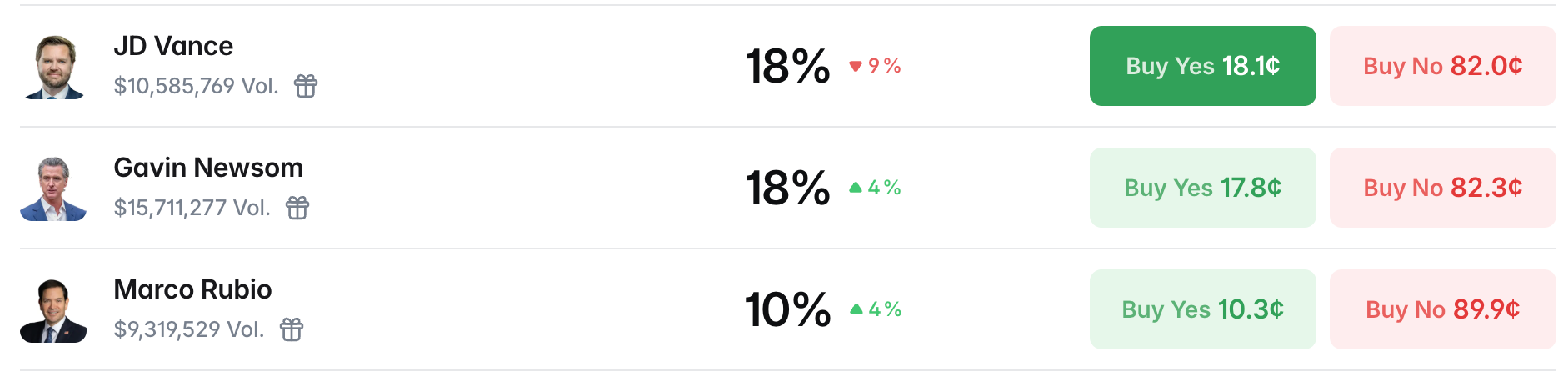
As for those truly high-probability candidates, such as the real-time probability leader Vice President JD Vance (trading volume $10.58 million), California Governor Gavin Newsom (trading volume $15.71 million), Secretary of State Marco Rubio (trading volume $9.32 million), their trading volumes are far lower than the aforementioned "celebrity candidates".

Official data from Polymarket shows that the total trading volume for the "2028 Presidential Election" has reached $549 million, making it the platform's hottest betting event. However, a closer look at the trading volume data for the 36 candidates reveals the counterintuitive situation described above. Why is this? Are people crazy, betting on candidates who are almost or completely impossible?

The answer, of course, is no. Earlier this year, Odaily wrote an article titled "Who is Placing Counterintuitive Bets in Prediction Markets?", which used examples like "The Second Coming of Jesus" and "Flat Earth Theory" to explain that the groups trading or providing liquidity in these absurd event markets can be categorized into three main types: "lottery players, bots, and airdrop hunters".

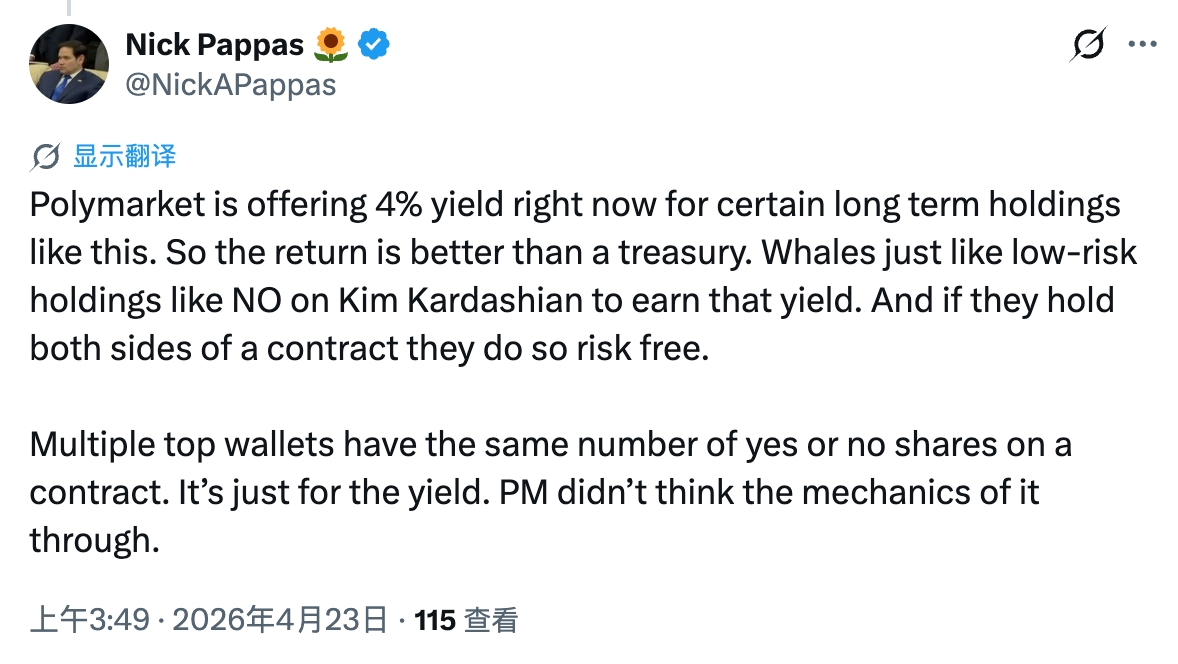
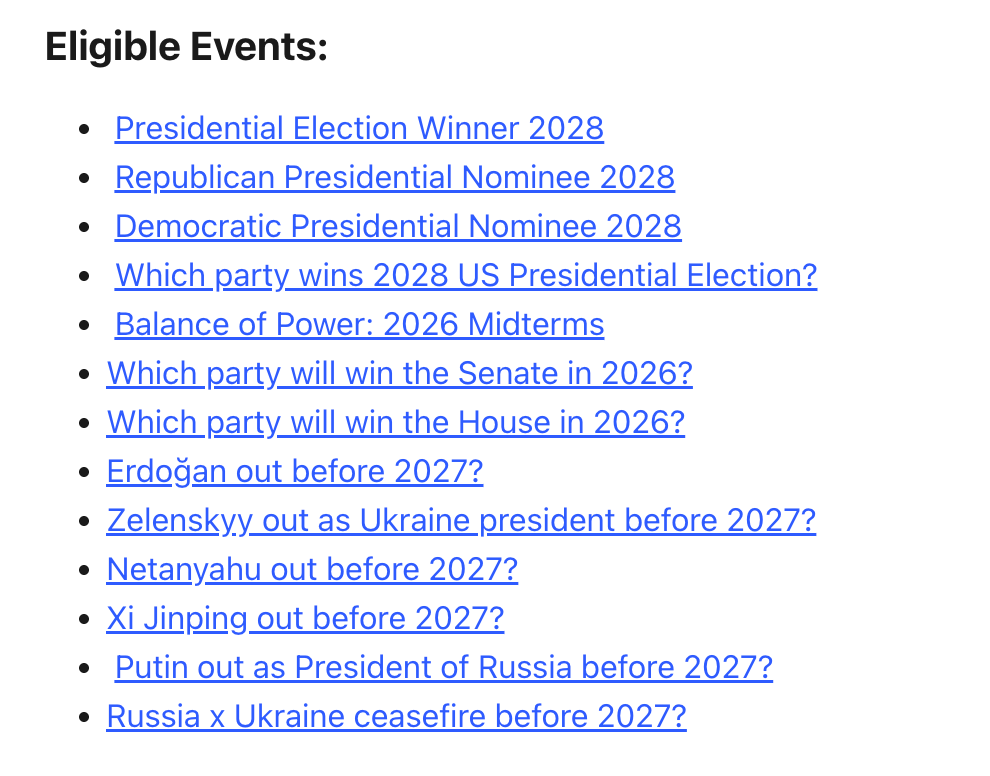
Nick Devor's own explanation also aligns with the third logic we listed. He found that multiple top addresses hold equal quantities of YES and NO shares for the same candidate, essentially aiming to earn risk-free returns subsidized by Polymarket — to maintain long-term pricing accuracy, Polymarket provides a 4% annualized holding reward based on the total position value for holdings in certain markets, and the "2028 Presidential Election" is one of these subsidized events.

Nick Devor stated that a 4% annualized return is higher than the current U.S. Treasury yield (3.98% for 5-year notes), making whales prefer this low-risk holding strategy. For example, they might buy NO shares for James or Kardashian (it's all the same, just buy whoever is popular) to capture this return; by simultaneously holding both YES and NO shares, they can achieve risk-free returns.

As for why some users unilaterally hold small amounts of YES shares for such low-probability candidates, another X user A5 (@probablythenuts) explained that in this type of multi-option market, Polymarket offers a feature that allows users to convert a set of NO shares into a corresponding set of YES shares.

Many users utilize this feature for better liquidity depth or pricing — meaning they don't directly buy YES shares for the candidate they think will win, but first buy NO shares for the candidates they believe will lose, and then convert these NO shares into a corresponding set of YES shares. Additionally, they can buy NO shares for multiple candidates and, after conversion, hold a corresponding set of YES shares for other candidates, including any new candidates added to the event in the future.

Therefore, the users trading James and Kardashian on Polymarket's "2028 Presidential Election" event are neither crazy nor foolish. They are either seeking stable annualized returns or a better execution path. While the operations may seem absurd, they are still driven by rationality.

Связанные с этим вопросы

QWhy is LeBron James the highest volume candidate in Polymarket's 2028 US Presidential Election market, despite having less than a 1% chance of winning?

AThe high trading volume on seemingly improbable candidates like LeBron James is primarily driven by users seeking to earn a risk-free 4% annualized yield on their positions, which is subsidized by Polymarket and is higher than the current 5-year US Treasury yield. Additionally, some users trade these candidates to utilize a platform feature that allows for the conversion of NO shares into YES shares for better execution.

QWhat are the three main groups of participants that trade in outlandish prediction market events, as mentioned in the article?

AThe three main groups are lottery-type bettors, automated trading bots, and airdrop farmers (users seeking to earn platform rewards).

QWhat specific financial incentive does Polymarket offer to encourage liquidity in its '2028 Presidential Election' market?

APolymarket offers a 4% annualized yield on the total position value for holding shares in certain markets, including the '2028 Presidential Election' market, to maintain long-term pricing accuracy.

QHow can a user achieve a risk-free return on Polymarket according to the explanation provided?

AA user can achieve a risk-free return by simultaneously holding both YES and NO shares for the same candidate, thereby qualifying for the platform's 4% annualized yield subsidy on the total position value without any market exposure.

QWhat is the functional reason, unrelated to yield farming, that a user might trade the NO shares of a low-probality candidate like Kim Kardashian?

AA user might trade the NO shares of a low-probability candidate to later use Polymarket's conversion feature, which allows them to swap a set of NO shares for a corresponding set of YES shares, often to get better liquidity or pricing than buying the YES shares directly.

Похожее

TechFlow Intelligence Bureau: Chip Stocks Lose Trillions in a Single Day, Bitcoin Falls Below $60,000, US-Iran Conflict Escalates

**Daily Tech & Markets Roundup: AI Advances, Market Turmoil, and Geopolitical Tensions** **AI / LLMs**: Anthropic's internal report on AI self-improvement sparked serious discussions about Recursive Self-Improvement (RSI). Meanwhile, debate continues on AI coding tools after Claude was accused of introducing bugs into the rsync codebase. In positive news, DeepSeek V4 Flash impressed in local deployment tests, and GitHub Copilot now supports custom endpoints for local models. A surprising research turn suggests removing chain-of-thought prompting can sometimes improve LLM performance. **Crypto / Web3**: Bitcoin plunged below $60,000, with its RSI hitting levels last seen during the COVID-19 crash, driven by strong U.S. jobs data reviving interest rate hike fears. Discussions highlight Ethereum DeFi's continued lack of a smooth consumer payment layer. **Chips / Hardware**: Chip stocks suffered a massive sell-off, with the Philadelphia Semiconductor Index posting its worst single-day drop in six years, erasing over a trillion dollars in value. Marvell, Micron, AMD, and Intel were among the biggest losers. **Tech Companies**: A leaked Microsoft document revealing goals to make Copilot "addictive" drew criticism. LinkedIn founder Reid Hoffman left Microsoft's board to focus full-time on his AI agent startup, Manus. Google was revealed to be paying SpaceX $920 million monthly for AI training compute. **Markets & Macro**: A blowout U.S. jobs report (172k vs. 80k expected) crushed hopes for near-term rate cuts, sending Treasury yields soaring and triggering a broad market sell-off. CEOs from Kraft, McDonald's, and Whirlpool simultaneously warned U.S. consumers are exhausting their savings. **Geopolitics**: U.S.-Iran tensions escalated with missile/drone interceptions and U.S. strikes on Iranian radar sites, keeping the critical Strait of Hormuz largely closed since late February and posing ongoing oil supply risks. **The Bottom Line**: The strong jobs data acted as a single trigger for correlated sell-offs across equities, crypto, and chips. Underlying the volatility is a stark contradiction between robust employment data and warnings of consumer weakness, alongside geopolitical risks that could reignite inflation, leaving markets to price in a fraught macro outlook with no clear "soft landing" path.

marsbit36 мин. назад

TechFlow Intelligence Bureau: Chip Stocks Lose Trillions in a Single Day, Bitcoin Falls Below $60,000, US-Iran Conflict Escalates

marsbit36 мин. назад

It Took Me a Year to See the Bitter Truth About Agent Payments

After a year building infrastructure for the Agent economy, engaging with major players like Stripe, Visa, and Coinbase, the author shares a sobering analysis of the current state of Agent payments. The core finding is a stark lack of genuine, immediate demand across most envisioned use cases. The article breaks down four key market segments: 1. **Agent-to-Merchant (Consumer Shopping):** For most product categories (e.g., clothing, electronics), conversational AI shopping is a step backwards from visual e-commerce interfaces. While agents excel at understanding needs, they can't replace side-by-side product comparison. Real merchant interest is defensive "Agent Engine Optimization," not driven by current customer demand. Potential exists for high-frequency, low-decision purchases (like food delivery) or navigating complex store UIs, but these require massive B2C distribution channels dominated by giants like Amazon. 2. **Agent-to-API (Developer Services):** Developers already have subscriptions and billing relationships for APIs (compute, data). Prepaid balances solve micro-payment issues for low transaction volumes. A deeper structural problem is that major SaaS vendors' business models rely on enterprise contracts, resisting granular pay-per-call pricing. While protocols like MPP and x402 serve the long tail of niche services, this market is small and developers are historically low-willingness-to-pay. 3. **Agent-to-Agent:** This remains largely theoretical with minimal transaction volume. While it represents a long-term bet on a fundamentally new transaction infrastructure (sub-second, micro-penny to million-dollar, multi-party settlements), it does not constitute a present market. 4. **Agent-to-Finance:** This is the only category with existing, paying demand. Integrating AI into financial workflows (trading, portfolio management) is a natural evolution and enables new capabilities like autonomous rebalancing. However, competition favors established, regulated institutions. The "real problem" is not moving money between agents, but the broader challenge of **coordination**—orchestrating work between agents and humans, verifying outcomes, and settling results. Payment is just one component of settlement, which is itself part of coordination. Companies that solve the coordination layer will subsume payment, not the other way around. While well-funded incumbents build defensively for a long-term future, startups must find where the market is today—which, for the author's team, lies outside these four categories in an area of real, growing, and underserved activity.

marsbit1 ч. назад

It Took Me a Year to See the Bitter Truth About Agent Payments

marsbit1 ч. назад

It Took Me a Year to See the Hard Truth About Agent Payments

**Title: It Took Me a Year to See the Hard Truth About Agent Payments** Over the past year, I've worked on infrastructure for the Agent economy, engaging with major players like Stripe, Visa, Coinbase, and numerous startups. The findings reveal a stark reality: genuine, widespread demand for Agent-based payments does not yet exist. **Key Observations:** * **Agent-to-Merchant (Shopping):** The user experience for AI shopping often falls short, especially for visual product discovery. While AI excels at understanding needs, conversational interfaces can't yet replace browsing and comparing multiple products visually. Current merchant interest is largely defensive ("Agent Engine Optimization") for a future that hasn't arrived. High-frequency, low-friction purchases (like food delivery) are potential fits, but lack open APIs and face high AI inference costs. Simpler, more affordable, or cross-language interactions for complex UIs are a niche opportunity but require massive consumer distribution to scale. * **Agent-to-API (Developer Tools):** Developer payment needs for APIs (computing, data, models) are already met through subscriptions and prepaid credits. The core challenge is not payment friction but supplier economics: most large SaaS providers prefer enterprise contracts over micropayments for API calls. Protocols like MPP and x402 suit the long-tail of smaller services but cater to a developer market historically reluctant to pay for these tools. Major infrastructure needs at the top of the stack are already being addressed. * **Agent-to-Agent (Machine Commerce):** This is a long-term vision with almost no current transaction volume. While a future with high-speed, high-frequency, multi-party machine-to-machine transactions would require novel infrastructure, it remains theoretical. The market is not here yet. * **Agent-to-Finance:** This is the only category with clear, present demand. Financial professionals and DeFi users already pay for tools, and AI augmentation is a natural evolution. Autonomous AI agents can enable entirely new financial strategies. However, competition is fierce from established, regulated incumbents who can more easily layer AI onto their existing products. **The Core Insight:** Companies, especially giants with long time horizons, are building defensively for a potential future of mass machine commerce. For them, early investment is a low-cost hedge. For startups, the current market reality is different. The primary challenge isn't just moving money between agents (payments). The larger, unsolved problem is **orchestration** – coordinating work between agents and humans, verifying outcomes, and then settling. Payment is just a part of settlement, which is just a part of orchestration. Companies that solve the orchestration problem will subsume payments, not the other way around. After a year of building, we see the real, growing, and underserved market opportunity lies in this broader domain of orchestration.

链捕手1 ч. назад

It Took Me a Year to See the Hard Truth About Agent Payments

链捕手1 ч. назад

Claude Opus 4.8 Finds a $4.5 Billion Bug: The AI Era is Mass-Producing Hackers

A researcher discovered a critical "infinite mint" vulnerability in the Zcash cryptocurrency's Orchard protocol using Claude Opus 4.8, leading to a swift fix but also a 50% market drop, erasing billions in value. This incident highlights a new era where powerful, accessible AI models are dramatically lowering the barrier to finding software vulnerabilities. Previously, the security community feared specialized models like Claude Mythos Preview, capable of finding decades-old zero-day exploits. The Zcash case, however, involved a publicly available, general-purpose model. This shift makes advanced security auditing—and attack capabilities—accessible to far more people, not just experts. The mass democratization of vulnerability discovery brings a dual challenge: a flood of low-quality, AI-generated false reports that overwhelm maintainers, and the real, rapid uncovering of deep, dangerous bugs. Open-source projects, often understaffed and unfunded, are particularly vulnerable to this "attention DDoS." The article cites examples like curl shutting down its bug bounty program due to the unsustainable workload. Our perceived digital safety has often been luck, relying on the high cost and effort required to find deeply hidden flaws in complex systems, as seen with historical vulnerabilities like Heartbleed or Baron Samedit. AI changes this cost structure, effectively "mass-producing flashlights" to illuminate every corner of our codebase. While large companies operate extensive security chains involving external white-hat hackers and massive defensive operations, the global cybersecurity workforce faces a severe shortage, especially of experienced personnel capable of analyzing complex threats and coordinating fixes. The core dilemma emerges: AI makes *finding* bugs cheap and scalable, but *fixing* them remains a slow, expensive, and human-intensive process. The article concludes that AI won't destroy the internet but acts as a bright light, revealing that our digital existence is not inherently secure but is precariously maintained by ongoing human effort. The true cost in the AI era may not be discovery, but whether there will be enough people left willing and able to do the hard work of repair.

marsbit2 ч. назад

Claude Opus 4.8 Finds a $4.5 Billion Bug: The AI Era is Mass-Producing Hackers

marsbit2 ч. назад

Торговля

Спот
Фьючерсы

Популярные статьи

Как купить S

Добро пожаловать на HTX.com! Мы сделали приобретение Sonic (S) простым и удобным. Следуйте нашему пошаговому руководству и отправляйтесь в свое крипто-путешествие.Шаг 1: Создайте аккаунт на HTXИспользуйте свой адрес электронной почты или номер телефона, чтобы зарегистрироваться и бесплатно создать аккаунт на HTX. Пройдите удобную регистрацию и откройте для себя весь функционал.Создать аккаунтШаг 2: Перейдите в Купить криптовалюту и выберите свой способ оплатыКредитная/Дебетовая Карта: Используйте свою карту Visa или Mastercard для мгновенной покупки Sonic (S).Баланс: Используйте средства с баланса вашего аккаунта HTX для простой торговли.Третьи Лица: Мы добавили популярные способы оплаты, такие как Google Pay и Apple Pay, для повышения удобства.P2P: Торгуйте напрямую с другими пользователями на HTX.Внебиржевая Торговля (OTC): Мы предлагаем индивидуальные услуги и конкурентоспособные обменные курсы для трейдеров.Шаг 3: Хранение Sonic (S)После приобретения вами Sonic (S) храните их в своем аккаунте на HTX. В качестве альтернативы вы можете отправить их куда-либо с помощью перевода в блокчейне или использовать для торговли с другими криптовалютами.Шаг 4: Торговля Sonic (S)С легкостью торгуйте Sonic (S) на спотовом рынке HTX. Просто зайдите в свой аккаунт, выберите торговую пару, совершайте сделки и следите за ними в режиме реального времени. Мы предлагаем удобный интерфейс как для начинающих, так и для опытных трейдеров.

1.4k просмотров всегоОпубликовано 2025.01.15Обновлено 2026.06.02

Как купить S

Sonic: Обновления под руководством Андре Кронье – новая звезда Layer-1 на фоне спада рынка

Он решает проблемы масштабируемости, совместимости между блокчейнами и стимулов для разработчиков с помощью технологических инноваций.

2.3k просмотров всегоОпубликовано 2025.04.09Обновлено 2025.04.09

Sonic: Обновления под руководством Андре Кронье – новая звезда Layer-1 на фоне спада рынка

HTX Learn: Пройдите обучение по "Sonic" и разделите 1000 USDT

HTX Learn — ваш проводник в мир перспективных проектов, и мы запускаем специальное мероприятие "Учитесь и Зарабатывайте", посвящённое этим проектам. Наше новое направление .

1.8k просмотров всегоОпубликовано 2025.04.10Обновлено 2025.04.10

HTX Learn: Пройдите обучение по "Sonic" и разделите 1000 USDT

Обсуждения

Добро пожаловать в Сообщество HTX. Здесь вы сможете быть в курсе последних новостей о развитии платформы и получить доступ к профессиональной аналитической информации о рынке. Мнения пользователей о цене на S (S) представлены ниже.

活动图片