Polymarket Rushes to Launch Token with Revenue Data? Sports Market Opens for Fees, Aiming to Become Web3's New "Money Printing Machine"

marsbitОпубликовано 2026-02-18Обновлено 2026-02-18

Введение

Polymarket, a leading prediction market platform, has begun charging taker fees on sports markets starting February 18, 2026, beginning with NCAA basketball and Serie A. This follows its recent introduction of fees on its 15-minute crypto markets, which already generate over $1.08 million in weekly revenue. With sports accounting for 39% of platform activity and having significantly larger average trade sizes than crypto markets, this move is expected to substantially boost revenue. Conservative estimates project annualized revenue could exceed $200 million after full rollout. The fee model is dynamically designed, charging up to 0.44% for market orders (takers) when event outcomes are most uncertain (50% probability), while limit order makers receive a 25% rebate. This strategy aims to maintain liquidity and competitive low costs compared to traditional sportsbooks. The platform, valued at up to $116 billion in secondary markets, is also preparing for a potential mid-2026 token launch ($POLY trademark filed), with a highly anticipated airdrop. While it faces competition and regulatory scrutiny, its deep liquidity, low fees, and data partnership with NYSE parent ICE (a major investor) form a strong moat for its new revenue "money machine."

Author: Frank, PANews

On February 18, 2026, Polymarket announced that starting from this day, the platform would begin piloting the collection of market order fees in the sports market. The first wave of events covered includes U.S. college basketball (NCAA) and Serie A (Italian football league), with plans to gradually extend to all sports events in the future.

Previously, relying solely on fees from its 15-minute cryptocurrency up/down markets, Polymarket's recent weekly revenue had already surpassed $1.08 million. According to on-chain data, the sports market accounts for nearly 40% of the platform's total trading activity. If converted to annual revenue, fees from the crypto market alone could contribute approximately $56 million in annualized income. Therefore, when the larger share of the sports market also begins charging fees, Polymarket might become the biggest money printer in the crypto space.

PANews conducted an in-depth analysis of Polymarket's fee mechanism, revenue model, competitor benchmarking, and token airdrop expectations.

From "Zero Revenue" to Millions Weekly: The $9 Billion Giant Starts Eagerly Making Money

For a long time, Polymarket operated with almost "zero revenue," as the vast majority of markets did not impose any trading fees. This free strategy brought it astonishing growth: total trading volume for the full year 2025 reached $21.5 billion, accounting for nearly half of the global prediction market volume ($44 billion); the single-month trading volume in January 2026 even hit a record high of over $12 billion.

However, with the upcoming token listing this year, the zero-revenue model clearly could not match its valuation. Its valuation had already reached $9 billion in the latest funding round. In October 2025, Intercontinental Exchange (ICE), the parent company of the New York Stock Exchange, injected a massive $2 billion into Polymarket. According to data from PM Insights, as of January 19, 2026, the implied valuation of Polymarket equity in the secondary market had climbed to $11.6 billion, a nearly 29% increase from the previous funding round. There are reports that the valuation in subsequent funding rounds could reach $12 billion to $15 billion. Such a high valuation requires matching revenue to support it.

The turning point came in January 2026; it was evident that Polymarket had become eager since the start of the year.

In January, Polymarket formally introduced a "Taker Fee" for its high-frequency trading product, the 15-minute cryptocurrency up/down markets, with a maximum rate of 3%. The data showed immediate results: in early February 2026, weekly fee revenue broke through $1.08 million, with the 15-minute up/down markets alone contributing $787,000 in a certain week in January, accounting for 28.4% of the total platform's prediction market fee revenue ($2.7 million) during the same period. To date, Polymarket has generated over $4.7 million in fees, ranking among the top in revenue charts.

The Ingenious Design Behind 0.45%: A Fee Model Not Just for Profit

The fee introduced by Polymarket for the sports market is a carefully designed dynamic fee model.

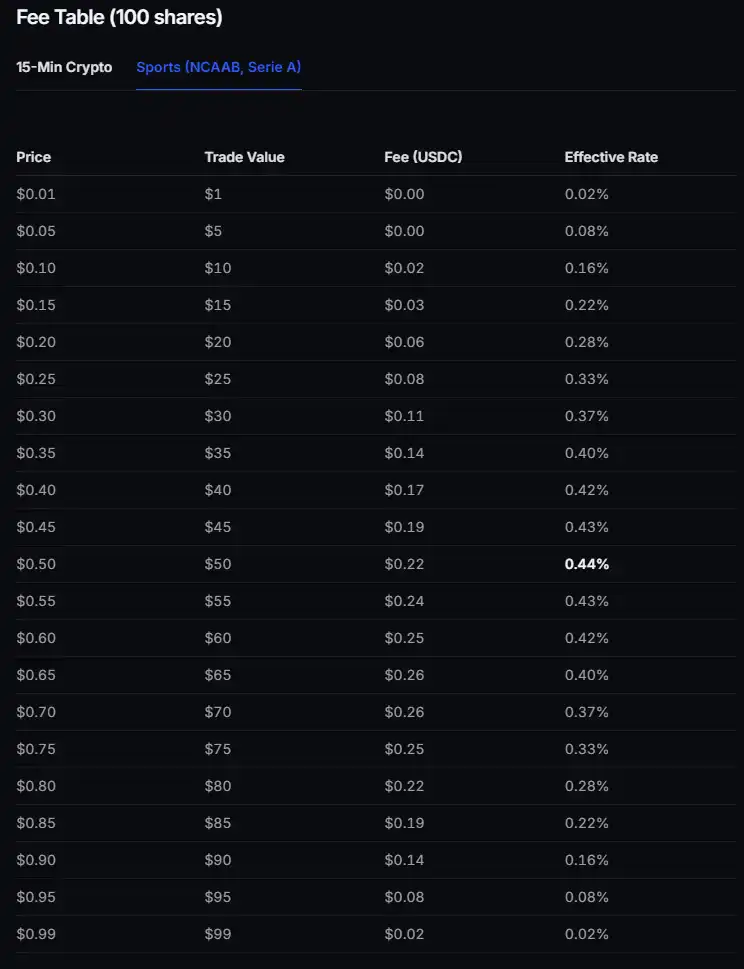
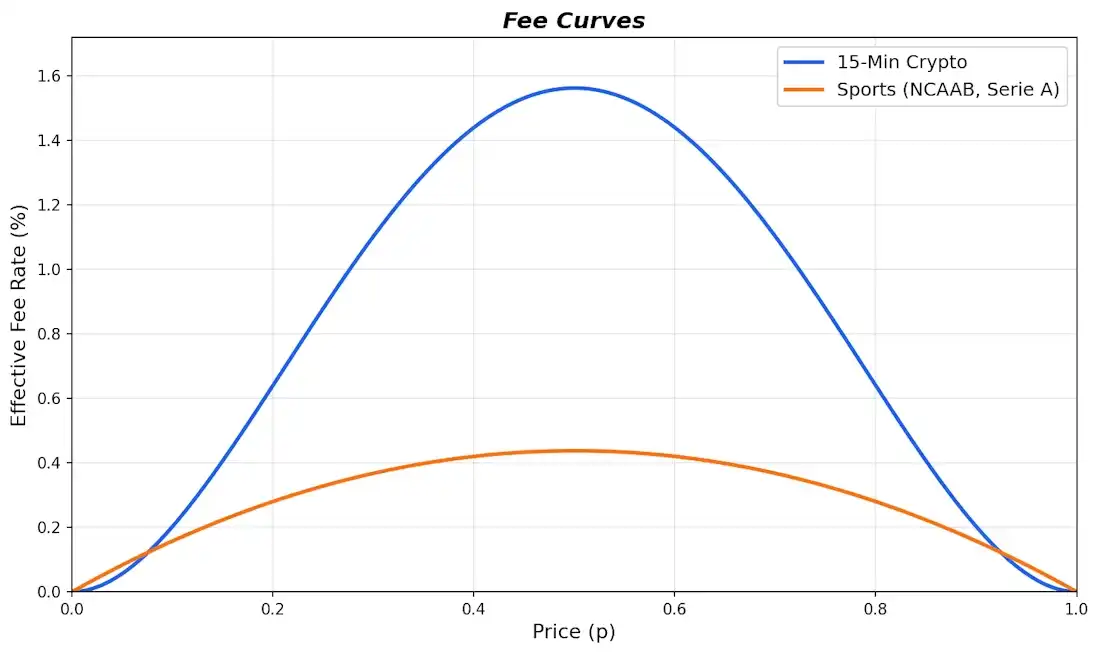
According to Polymarket's official documentation and community analysis, the sports market fee is only charged on market orders (Taker). Limit orders (Maker) are not only free but also receive a 25% rebate from the Taker fees. Similar to the crypto market fee model, the rate is not a fixed value but fluctuates with changes in event probability:

Simply put, the more uncertain the market, the higher the fee, peaking at 0.44% at a 50% probability, and dropping to only 0.13%-0.16% at probabilities of 10% or 90%.

However, by standard, the sports market fee rate is significantly lower than that of the crypto market. Nevertheless, this does not diminish the revenue potential of the sports market.

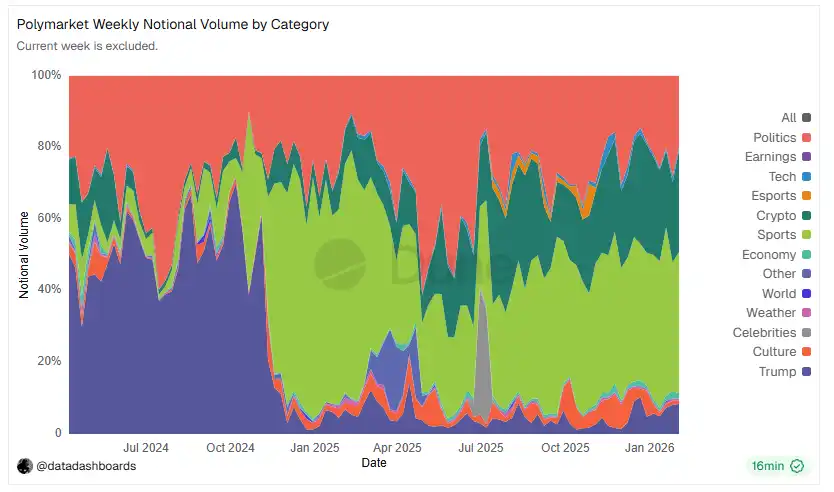
Data shows that sports markets currently account for 39% of Polymarket's total trading activity, surpassing political (20%) and crypto (28%) categories. More crucially, according to previous PANews analysis data, the average trading volume of short-term sports markets on Polymarket ($1.32 million) is 30 times that of short-term crypto markets ($44,000). This means that if fees are fully rolled out in the sports market, revenue will experience massive growth.

Taking the 2026 Super Bowl as an example, Polymarket's total trading volume in related markets reached approximately $795 million, covering various sub-markets such as game outcome, player performance, and halftime show predictions. The total weekly prediction market volume was once driven by sports events to break $6.3 billion.

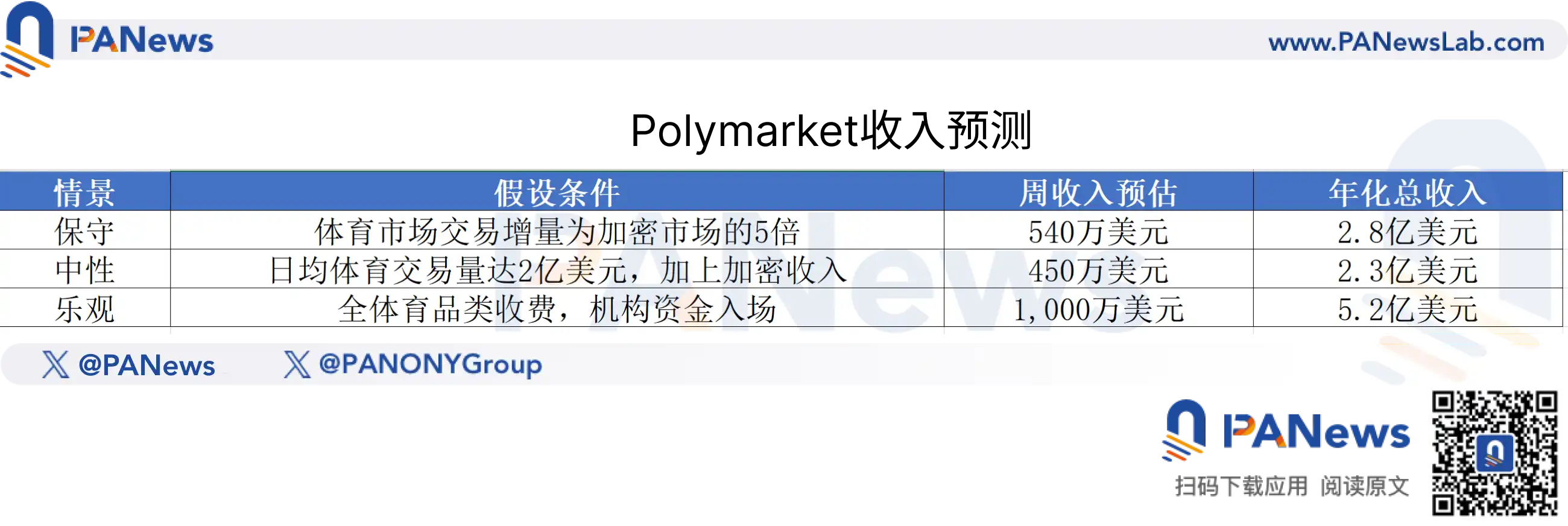
Based on existing data, PANews constructed three profit forecast scenarios (assuming an average effective fee rate of 0.25% for sports markets, considering probability distribution and free limit orders):

Even under the most conservative estimate, Polymarket's annualized revenue after full fee implementation would exceed $200 million, enough to place it among the highest-revenue protocols in the Web3 space.

While surpassing Tether's treasury interest income or Ethereum mainnet gas fees might be unrealistic, at the application layer, Polymarket has the full potential to compete for the title of "most profitable dApp." Especially considering its user retention rate is as high as 85%, far exceeding that of general DeFi protocols, this high stickiness implies higher quality revenue.

POLY Token and Airdrop: A "Wealth Feast" Worth Billions?

Polymarket's high valuation and massive user base make its token airdrop one of the most anticipated events of 2026.

Polymarket's Chief Marketing Officer, Matthew Modabber, has clearly stated: "There will be a token, there will be an airdrop." Market predictions indicate a 62%-70% probability that Polymarket will issue its token before December 31, 2026. Considering the progress of restarting U.S. operations, the Token Generation Event (TGE) is likely to be completed around mid-2026.

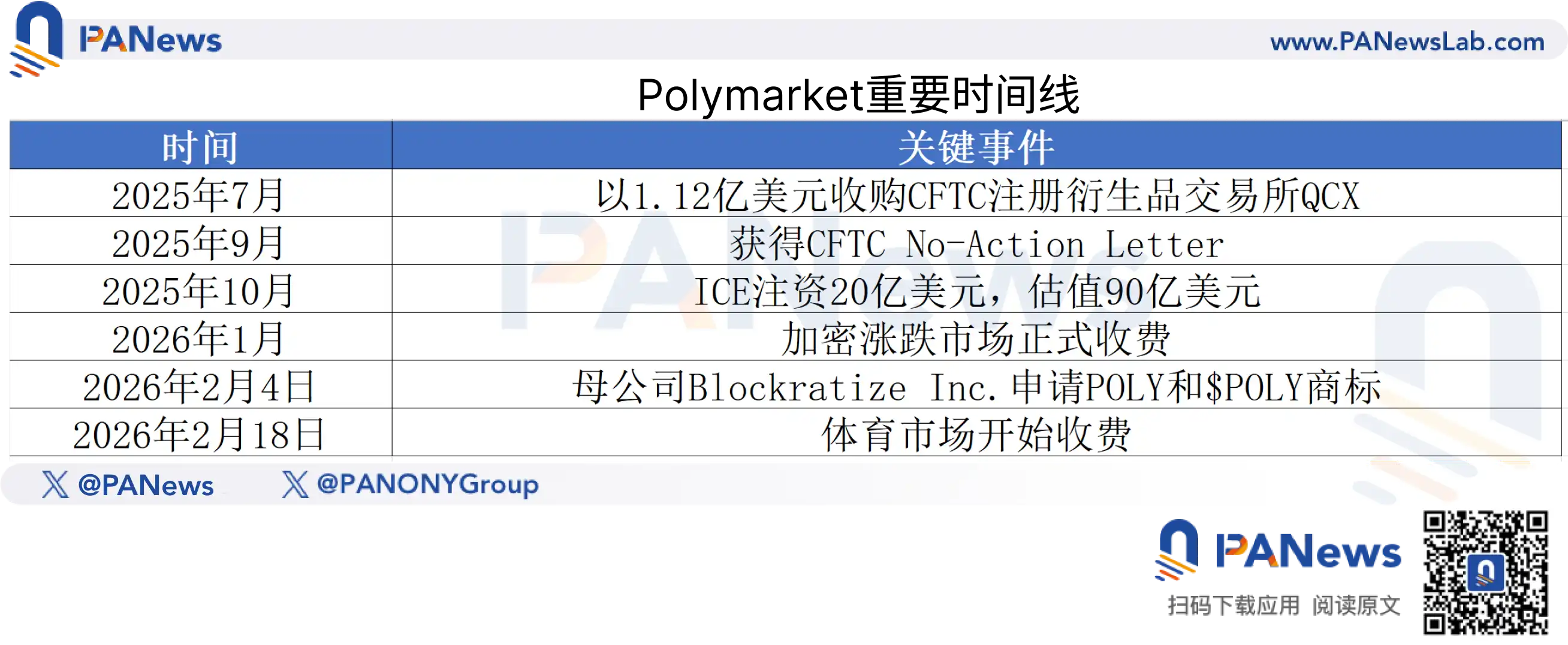
On February 4, 2026, its parent company, Blockratize Inc., applied for the trademarks "POLY" and "$POLY," which is also considered by the industry as a significant milestone for TGE. According to general practices in the crypto industry, it typically takes 3-6 months from trademark registration to TGE.

Airdrop Scale May Surpass Hyperliquid; The Era of Volume Farming is Over

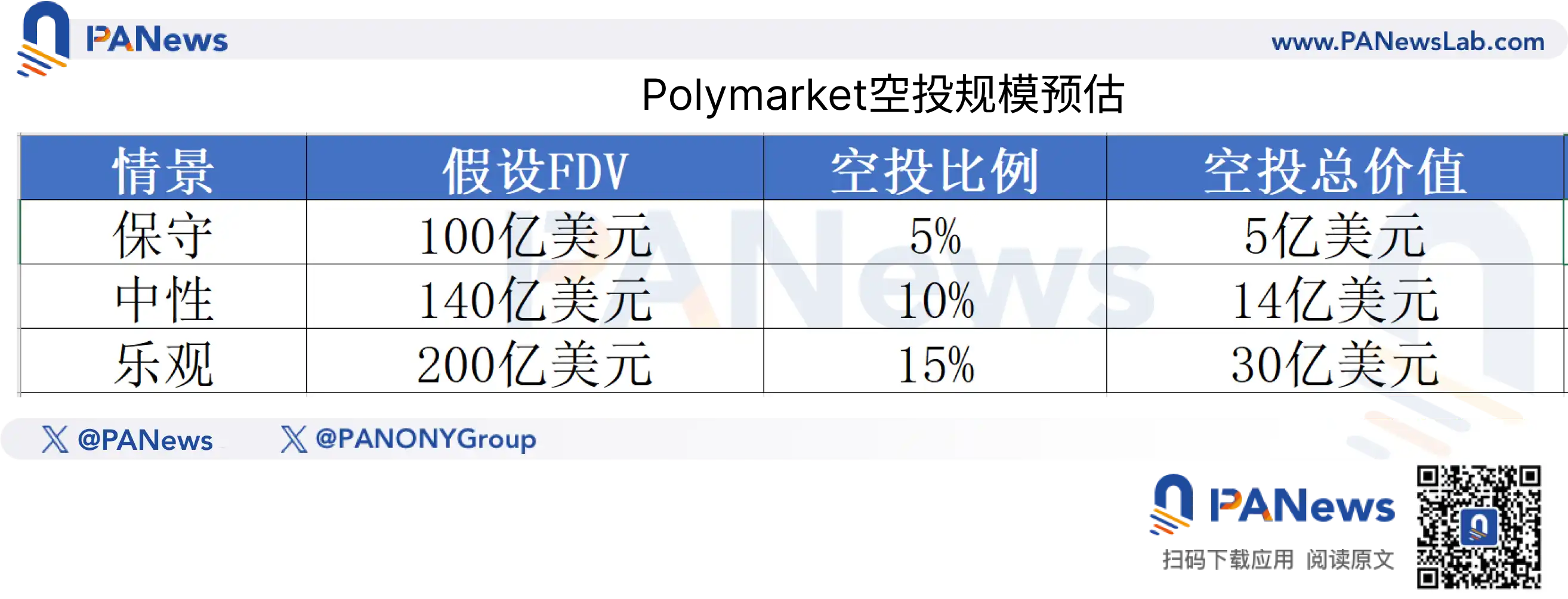
Referring to recent airdrop ratios of top projects (Arbitrum, Jupiter, Hyperliquid), the community allocation usually ranges between 5%-15% of the total supply. PANews calculated based on different valuation assumptions:

If the total airdrop is $1.4 billion, and assuming there are 500,000 eligible active addresses, the average airdrop value per account could be around $2,800. However, according to the "Pareto principle," top users might reap rewards ranging from hundreds of thousands to even millions of dollars, so ordinary retail users need to manage their expectations reasonably.

It is worth noting that, simultaneously with the fee launch, Polymarket introduced a 4% annualized holding reward, with hourly snapshots and daily distributions. This mechanism reveals the project's clear preference: the duration funds are held is far more important than trading frequency.

Moat and Concerns: Where are the Risks for This "Money Printer"?

Charging fees means users incur additional costs. So, what gives Polymarket the confidence to sustain this?

A triple moat is clearly visible: First, the platform possesses unmatched liquidity depth in the prediction market space, which is crucial for large-volume traders. Second, compared to the 5%-10% rake in traditional betting and Kalshi's 1%-3.5%, the peak fee rate of 0.45% still holds an overwhelming cost advantage. Third, ICE's involvement not only brought capital but also data distribution capabilities. ICE plans to integrate Polymarket's real-time prediction data for its global institutional clients, constituting a "second growth curve" beyond trading fees.

However, risks should not be overlooked:

Short-term trading volume fluctuations: Polymarket's monthly trading volume once dropped from a peak of $1.026 billion in November 2025 to $543 million in December 2025. Will fee introduction exacerbate this trend? However, considering the positive effects of increased order book depth and reduced spreads after introducing the Maker Rebate, long-term trading volume might actually increase.

Competitive landscape: Kalshi holds a first-mover advantage in the U.S. compliant market (2025 revenue approximately $260 million). Hyperliquid is attempting to enter the prediction market赛道 through "Outcome Trading" (FDV approx. $16 billion). Predict.fun attracts users with DeFi yield叠加.

Regulatory uncertainty: Although it has obtained a No-Action Letter from the CFTC and acquired the compliant exchange QCX, changes in the U.S. regulatory environment remain the sword of Damocles hanging over the prediction market.

Postscript

From free to fee-based, from crypto up/down markets to global sports events, Polymarket is undergoing a meticulously planned business model upgrade. It already earns millions weekly just from the crypto market, and the sports market—this behemoth accounting for nearly 40% of the platform's volume with liquidity 30 times that of crypto—has only just begun charging. Polymarket's story provides a model worth pondering: a platform's true value might not lie in how much money it is making at the moment, but in its proven ability to charge fees whenever it decides to. When the cake is big enough and the moat deep enough, opening the fee floodgates is only a matter of time.

And for this money printer that's warming up, February 18th was just the start button being pressed.

Связанные с этим вопросы

QWhat is the main reason Polymarket is introducing fees for sports markets, and when did this initiative begin?

APolymarket is introducing fees for sports markets to generate revenue that matches its high valuation, which reached $90 billion in recent funding. This initiative began on February 18, 2026, starting with NCAA basketball and Serie A leagues, with plans to expand to all sports events.

QHow does Polymarket's dynamic fee model for sports markets work, and what is the peak fee rate?

APolymarket's dynamic fee model charges only market orders (Taker), while limit orders (Maker) are free and receive a 25% rebate from Taker fees. The fee rate fluctuates based on event probability, peaking at 0.44% when the probability is 50%, and decreasing to 0.13%-0.16% at probabilities of 10% or 90%.

QWhat is the estimated annual revenue for Polymarket if sports markets are fully monetized, according to PANews' analysis?

AAccording to PANews' analysis, if sports markets are fully monetized, Polymarket's annualized revenue is estimated to exceed $200 million, based on a conservative scenario with an average effective fee rate of 0.25% for sports markets.

QWhat are the key factors contributing to Polymarket's competitive advantages or 'moat' in the prediction market space?

APolymarket's competitive advantages include unmatched liquidity depth in prediction markets, a cost advantage with peak fees of 0.45% compared to traditional betting (5%-10%) or competitors like Kalshi (1%-3.5%), and data distribution capabilities through its partnership with ICE, which plans to integrate Polymarket's real-time prediction data for institutional clients.

QWhat is the expected timeline for Polymarket's token generation event (TGE), and what evidence supports this prediction?

AThe token generation event (TGE) for Polymarket is expected around mid-2026, supported by the high probability (62%-70%) of a token launch by December 31, 2026, and the trademark application for 'POLY' and '$POLY' by its parent company Blockratize Inc. on February 4, 2026, which typically precedes a TGE by 3-6 months in the crypto industry.

Похожее

Has Hook Summer Really Arrived? sato, Lo0p, FLOOD Ignite the New Narrative of Uniswap v4

"Hook Summer" Arrives? Sato, Lo0p, FLOOD Ignite Uniswap v4 Narrative Amidst a slight market recovery, attention within the Ethereum ecosystem has shifted to Meme coins built on Uniswap v4's Hook protocol. Following ASTEROID, tokens like sato, sat1, Lo0p, and FLOOD have become market focal points, with market caps ranging from millions to tens of millions, bringing concentrated liquidity to a narrative-dry market. Uniswap v4 Hooks are "plugin smart contracts" that allow developers to inject custom logic at key points in a liquidity pool's lifecycle (initialization, adding/removing liquidity, swaps, etc.), making the AMM programmable. Recent representative projects include: * **sato**: Market cap peaked over $38M; uses a v4 curve mechanism for minting/burning, locking ETH as reserve. * **sat1**: Market cap briefly exceeded $10M, positioning as an "optimized sato," but later declined significantly. * **Lo0p**: Market cap neared $6.6M; a "lending AMM protocol" allowing users to borrow ETH against deposited LO0P tokens without immediate selling pressure. * **FLOOD**: Market cap approached $6M; channels trading reserves into Aave v3 to generate yield, which is retained in the pool. The emergence of these Hook-based tokens could drive long-term growth for the Uniswap ecosystem by attracting users and liquidity to v4 pools. Combined with Uniswap's activated fee switch (partially used to burn UNI), the long-term outlook for UNI appears positive. However, short-term UNI price appreciation is not directly guaranteed. Factors include the sustainability and lifecycle of these new tokens, their price volatility, overall market conditions, and regulatory pressures. Currently, Uniswap v4's TVL ($595M) lags behind v3 and v2, indicating Hook adoption still requires time to mature. In summary, the Hook ecosystem serves as "long-term nourishment" for UNI, but acts more as a "catalyst" than a direct "booster" in the short term. Note: These are early-stage experimental tokens and may carry unknown risks.

marsbit3 мин. назад

Has Hook Summer Really Arrived? sato, Lo0p, FLOOD Ignite the New Narrative of Uniswap v4

marsbit3 мин. назад

Has Hook Summer Truly Arrived? sato, Lo0p, FLOOD Ignite the New Uniswap v4 Narrative

With the broader market showing signs of recovery, a new wave of interest has emerged around Ethereum-based meme coins. Following ASTEROID, tokens like sato, sat1, Lo0p, and FLOOD, built upon the Uniswap v4 Hook protocol, are capturing market attention. Their market capitalizations range from millions to tens of millions of dollars, injecting much-needed focused liquidity into a market lacking narratives. This article explores whether this trend signifies an incoming "Hook Summer" and its potential impact on UNI's price. Hooks are essentially plug-in smart contracts for Uniswap v4 liquidity pools, allowing developers to inject custom logic at key points in a pool's lifecycle (like initialization, adding/removing liquidity, swaps). This transforms the AMM into programmable building blocks. Key highlighted projects include: * **sato**: Peaked over $38M market cap. It utilizes a v4 curve for minting/burning; buying locks ETH as reserve to mint new tokens, while selling redeems ETH from the reserve and burns tokens. * **sat1**: Market cap briefly exceeded $10M, promoted as an "optimized sato," but later declined significantly. * **Lo0p**: Reached nearly $6.6M. It's a lending AMM protocol where buying LO0P tokens locks them as collateral, allowing users to borrow ETH from the pool reserve at 40% LTV, aiming to improve capital efficiency for idle ETH in LPs. * **FLOOD**: Peaked near $6M. Its mechanism directs asset reserves from buys into Aave v3 to generate yield, with fees and interest retained in the pool to potentially influence the token's price long-term. In the long term, the development of the Hook ecosystem can attract users and liquidity to Uniswap v4, benefiting UNI's fundamentals—especially combined with the recent activation of the protocol fee switch, where a portion of fees is used to burn UNI. However, in the short term, these Hook-based tokens are unlikely to directly drive significant UNI price appreciation. Their impact is moderated by factors like token sustainability, price volatility, and broader market and regulatory conditions. Currently, Uniswap v4's TVL ($595M) still trails behind v2 and v3, indicating adoption and growth will take time. The article concludes that while the Hook ecosystem provides long-term "nourishment" for UNI, its short-term role is more of a "catalyst" than a "booster." Readers are cautioned that these are early-stage experimental tokens and may carry unknown risks.

Odaily星球日报15 мин. назад

Has Hook Summer Truly Arrived? sato, Lo0p, FLOOD Ignite the New Uniswap v4 Narrative

Odaily星球日报15 мин. назад

Interview with Michael Saylor: I Did Say I Would Sell Bitcoin, But Never a Net Sale

Interview with Michael Saylor: I Said We'd Sell Bitcoin, But Never Be a Net Seller In a recent podcast, MicroStrategy Executive Chairman Michael Saylor clarified the company's stance on potentially selling Bitcoin. Following MicroStrategy's earnings call statement about being prepared to sell BTC to fund dividends for its STRC (Strategic) credit product, Saylor emphasized the distinction between selling and being a "net seller." Saylor explained the core business model: MicroStrategy sells credit instruments like STRC and uses the proceeds to buy Bitcoin, which is viewed as "digital capital" expected to appreciate around 30-40% annually. A portion of these capital gains can then be used to pay the dividends on the credit products. He stressed that even if the company sells some Bitcoin for dividends, it simultaneously buys much more with new credit issuance. For example, after raising $3.2 billion from STRC sales in April, the dividend obligation was only $80-90 million, making the company a net buyer. The clarification aims to counter market narratives questioning the value of Bitcoin on MicroStrategy's balance sheet if it were never sold, and to dismiss claims of a "Ponzi scheme." Saylor reiterated his personal philosophy for investors: "Don't be a net seller of bitcoin" and ensure your Bitcoin holdings increase each year. Saylor also discussed Bitcoin's role as the foundation for "digital credit," noting that STRC has become the largest and most liquid preferred stock issue in the U.S., offering high risk-adjusted returns (Sharpe ratio). He highlighted Bitcoin's deep liquidity, stating that even large purchases by MicroStrategy do not move the market significantly, which is driven by macro factors, geopolitical tensions, and capital flows from ETFs and credit products. Finally, Saylor reflected on his early inspiration from sci-fi books, which motivated his path to MIT, and maintained his fundamental thesis on Bitcoin remains unchanged: it is superior digital capital enabling superior digital credit.

链捕手19 мин. назад

Interview with Michael Saylor: I Did Say I Would Sell Bitcoin, But Never a Net Sale

链捕手19 мин. назад

Beaten SK Hynix Employees in China: Year-end Bonus Less Than 5% of Korean Staff's

"SK Hynix Chinese Staff Hit Hard: Bonuses Less Than 5% of Korean Counterparts" Driven by the AI boom, South Korea's SK Hynix is experiencing record performance, with media reports predicting massive year-end bonuses for its employees, making them highly desirable in the matchmaking market. However, this prosperity starkly contrasts with the situation for the company's Chinese employees. According to reports, SK Hynix operates under a rule allocating 10% of operating profit for employee bonuses. While projections suggest Korean employees could receive bonuses reaching millions of RMB, a Chinese employee with over a decade of technical experience revealed the disparity: "If they get 3 million, Chinese staff get less than 5% of that." After adjustments based on KPI ratings, this employee's highest bonus was slightly over 100,000 RMB. Bonuses are paid annually in Korea but semi-annually in China. During the industry downturn in 2023-2024, Chinese employees received no bonus at all. The gap extends beyond bonuses. Recruitment posts for SK Hynix's Chinese factories (in Wuxi, Dalian, Chongqing) show engineer monthly salaries ranging from 10,000 to 35,000 RMB, with a 13th-month salary promised. Chinese employees also receive standard benefits like annual leave but lack stock incentives, which are reportedly unavailable to them. Furthermore, management positions in China are predominantly held by Korean personnel, though industry observers note a gradual increase in local middle managers over time. SK Hynix has confirmed the 10% bonus rule but cautioned that specific future bonus amounts remain unpredictable. The company forecasts strong demand for HBM and other high-value enterprise products for the next 2-3 years, driven by AI infrastructure investment. This focus on business-to-business markets may continue to constrain supply for consumer products, potentially prolonging price increases for components like memory.

链捕手33 мин. назад

Beaten SK Hynix Employees in China: Year-end Bonus Less Than 5% of Korean Staff's

链捕手33 мин. назад

Торговля

Спот
Фьючерсы

Популярные статьи

Как купить F

Добро пожаловать на HTX.com! Мы сделали приобретение Synfutures (F) простым и удобным. Следуйте нашему пошаговому руководству и отправляйтесь в свое крипто-путешествие.Шаг 1: Создайте аккаунт на HTXИспользуйте свой адрес электронной почты или номер телефона, чтобы зарегистрироваться и бесплатно создать аккаунт на HTX. Пройдите удобную регистрацию и откройте для себя весь функционал.Создать аккаунтШаг 2: Перейдите в Купить криптовалюту и выберите свой способ оплатыКредитная/Дебетовая Карта: Используйте свою карту Visa или Mastercard для мгновенной покупки Synfutures (F).Баланс: Используйте средства с баланса вашего аккаунта HTX для простой торговли.Третьи Лица: Мы добавили популярные способы оплаты, такие как Google Pay и Apple Pay, для повышения удобства.P2P: Торгуйте напрямую с другими пользователями на HTX.Внебиржевая Торговля (OTC): Мы предлагаем индивидуальные услуги и конкурентоспособные обменные курсы для трейдеров.Шаг 3: Хранение Synfutures (F)После приобретения вами Synfutures (F) храните их в своем аккаунте на HTX. В качестве альтернативы вы можете отправить их куда-либо с помощью перевода в блокчейне или использовать для торговли с другими криптовалютами.Шаг 4: Торговля Synfutures (F)С легкостью торгуйте Synfutures (F) на спотовом рынке HTX. Просто зайдите в свой аккаунт, выберите торговую пару, совершайте сделки и следите за ними в режиме реального времени. Мы предлагаем удобный интерфейс как для начинающих, так и для опытных трейдеров.

478 просмотров всегоОпубликовано 2024.12.21Обновлено 2025.03.21

Как купить F

Обсуждения

Добро пожаловать в Сообщество HTX. Здесь вы сможете быть в курсе последних новостей о развитии платформы и получить доступ к профессиональной аналитической информации о рынке. Мнения пользователей о цене на F (F) представлены ниже.

活动图片