Polymarket acquires Brahma to fix ‘liquidity imbalance’: Report

ambcryptoОпубликовано 2026-03-19Обновлено 2026-03-19

Введение

Polymarket has acquired crypto infrastructure firm Brahma to address liquidity imbalances and improve its on-chain trading systems. While popular markets like elections attract significant activity, niche markets suffer from low participation and unreliable pricing. The acquisition aims to distribute liquidity more evenly and enhance platform efficiency. Despite rapid growth and a valuation of $18–20 billion, driven by the 2024 election cycle, Polymarket faces inconsistent trading activity and a recent drop in market share. Competitor Kalshi, a regulated non-crypto platform, briefly captured 66% market share during the election. Polymarket continues to focus on crypto, with plans for a native token, contrasting with Kalshi’s traditional approach.

In a surprising shift, Polymarket has moved beyond simply hosting bets on future events and is now working to build the full infrastructure behind those wagers.

According to reports, Polymarket has acquired Brahma, a company specializing in crypto and DeFi infrastructure. This means Polymarket wants better technology to make its platform faster, smoother, and more on-chain.

Polymarket has grown rapidly, now valued at an estimated $18–20 billion, boosted by heavy activity during the 2024 elections. Yet with that growth come new challenges.

What is Polymarket trying to revamp with Brahma?

One of the core problems is liquidity imbalance. This means popular wagers, like elections or major sports events, attract a lot of money and activity.

Whereas, smaller or niche wagers struggle because not enough people are betting on them. That makes prices less reliable and the markets less useful.

Citing examples, Fortune added,

Larger event contracts, like those in sports or politics, easily bring lots of money into the pool. But smaller wagers focused on niche areas such as, for instance, the outcome of a bowling match in Spain, struggle to amass a sizable amount of liquidity.

Therefore, by acquiring Brahma, Polymarket is trying to fix this by improving how liquidity is distributed across markets. The plan also focuses on making trading more efficient and strengthening its blockchain-based system.

Remarking on this initiative, Shayne Coplan, founder and CEO of Polymarket, told Fortune,

Building reliable infrastructure across blockchain networks and traditional financial rails is hard—there are no shortcuts.

That said, Brahma, founded in 2021, has already processed over $1 billion in transactions, and by bringing its team in-house, Polymarket is effectively shutting down Brahma’s external operations to focus entirely on its growth.

Polymarket’s metrics paint a confusing picture

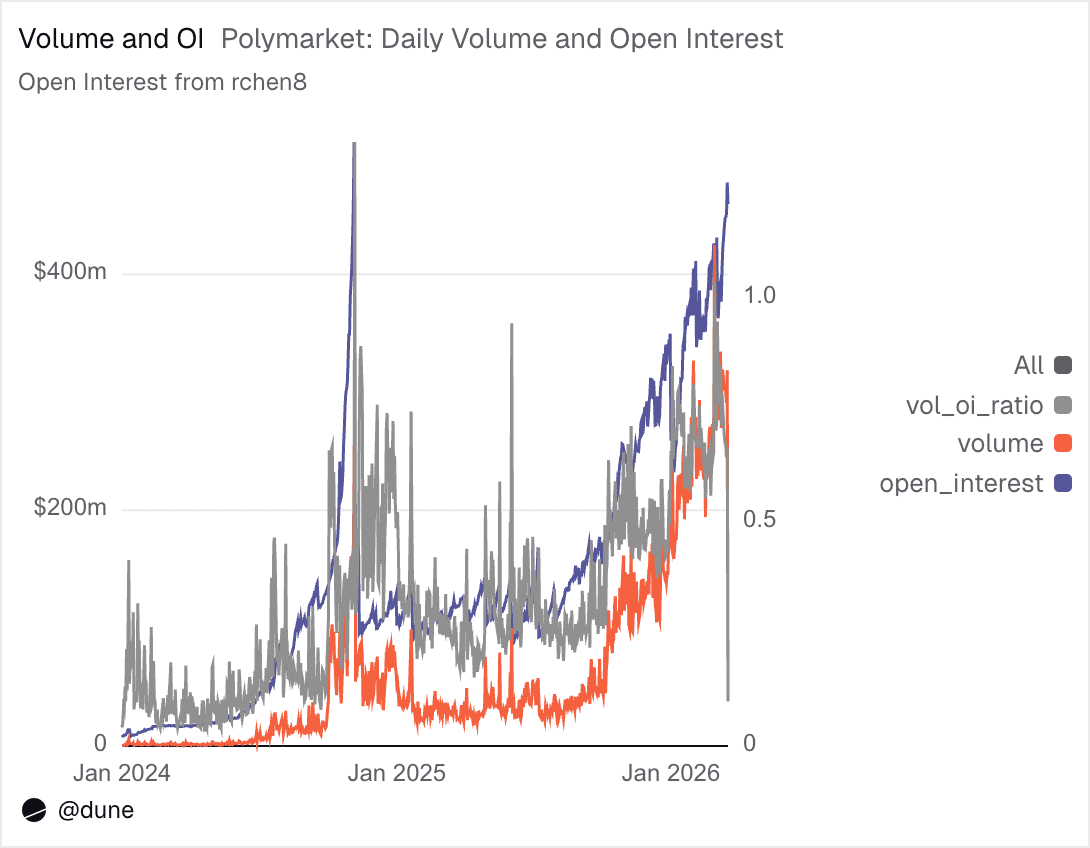
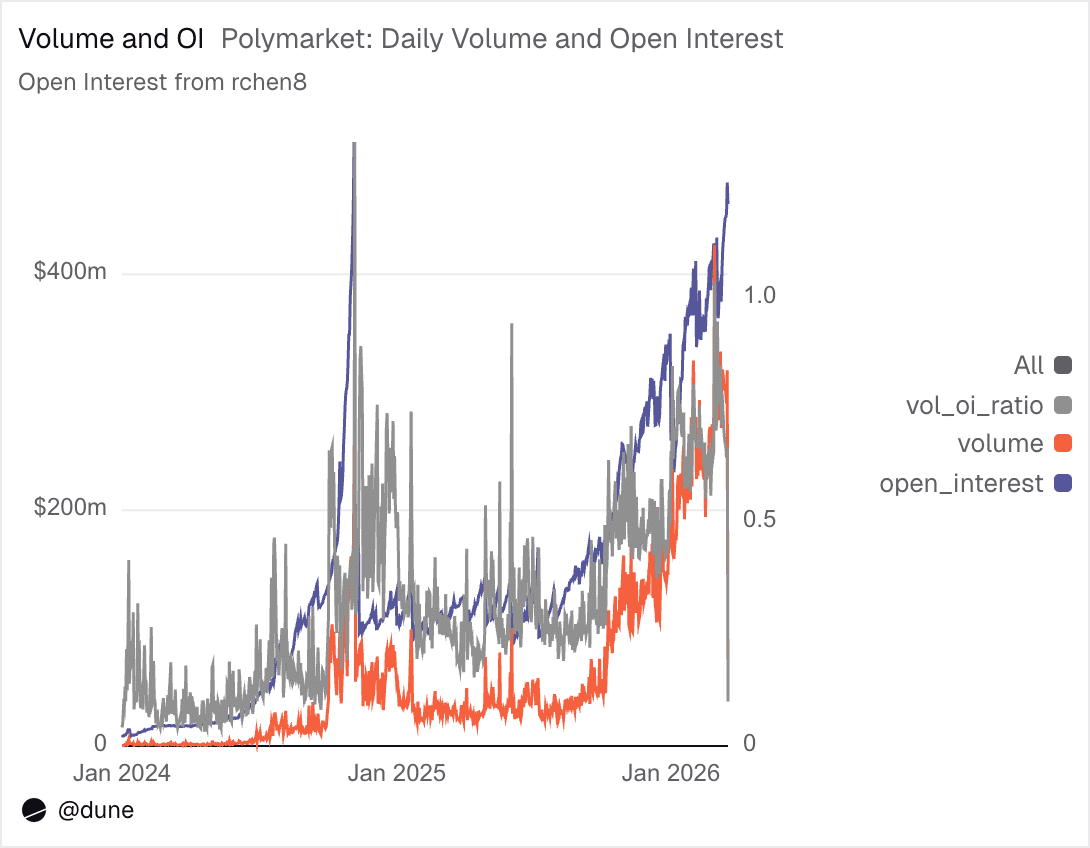
However, the platform’s internal data suggests that growth is not entirely balanced. While more capital is flowing into the system, as seen in the steady rise in Open Interest, actual trading activity remains inconsistent.

Source: Dune

This gap shows that users place long-term bets but trade inconsistently, resulting in low liquidity and one-sided markets.

Even though the platform became very popular during the 2024 election cycle, its dominance didn’t last. Its market share dropped sharply from over 61% to around 32% as the hype faded. However, at press time, Polymarket’s stock price stood at $141.60, marking a more than 20% increase year-to-date.

Is Polymarket losing ground against Kalshi?

In fact, during the 2024 election, its U.S.-based competitor Kalshi took advantage of the slowdown, briefly capturing about 66% market share and handling nearly $1 billion in weekly trading volume.

This competition reflects two very different paths. Kalshi follows a fully regulated approach with no blockchain, DeFi, or token layer.

Polymarket, in contrast, is doubling down on crypto. Besides Brahma, the platform’s CEO is also hinting at a potential POLY token. With a possible 2026 launch, it acts as a strong incentive for users, something regulated platforms like Kalshi are struggling to offer.


Final Summary

  • The Brahma acquisition shows that fixing liquidity and market efficiency is now more important than just attracting users.
  • Competition from regulated players like Kalshi adds pressure, especially as they gain ground during periods of low hype.

Связанные с этим вопросы

QWhat is the primary reason Polymarket acquired Brahma, according to the report?

APolymarket acquired Brahma to fix the 'liquidity imbalance' on its platform by improving how liquidity is distributed across markets, making trading more efficient, and strengthening its blockchain-based system.

QWhat specific problem does the 'liquidity imbalance' cause for smaller wagers on Polymarket?

ASmaller or niche wagers struggle to attract enough betting activity, which makes their prices less reliable and the markets less useful due to low liquidity.

QHow did Polymarket's market share change after the hype of the 2024 election cycle faded?

APolymarket's market share dropped sharply from over 61% to around 32% after the hype of the 2024 election cycle faded.

QWhich competitor briefly captured about 66% market share during Polymarket's slowdown, and what is its key operational difference?

AKalshi, Polymarket's U.S.-based competitor, briefly captured about 66% market share. Its key difference is that it follows a fully regulated approach with no blockchain, DeFi, or token layer.

QWhat potential incentive is Polymarket's CEO hinting at to attract users, and how does it contrast with regulated platforms?

APolymarket's CEO is hinting at a potential POLY token, which acts as a strong incentive for users. This is something regulated platforms like Kalshi struggle to offer.

Похожее

The AI Agent Era Accelerates Its Arrival: Questflow Defines a New Paradigm of Financial Intelligence with On-Chain AI Brokerage

The AI Agent era is accelerating, with the CB Insights AI 100 list highlighting global investment confidence. The focus has shifted from whether AI works to its speed of deployment and ability to manage complex workflows, with autonomous AI Agents driving this transformation. At the forefront is Questflow, a Singapore-based startup redefining financial intelligence through its on-chain AI brokerage. Unlike tools that merely provide data dashboards, Questflow deploys AI Agents that proactively scan markets, form judgments, and execute trades via a conversational interface—operating 24/7 without requiring manual confirmation for each decision. This embodies the new AI paradigm of agents capable of executing multi-step workflows autonomously. Questflow's mission is to democratize institutional-grade trading intelligence. Historically reserved for the ultra-wealthy, this capability is now accessible starting from just $1 through Questflow's "AI Clone + Copy Trade" model. The platform charges only a 1% execution fee, aligning its incentives directly with users and eliminating traditional management or performance fees. The timing is opportune, aligning with key trends identified by CB Insights: the scalable deployment of AI Agents, accelerated AI adoption in financial services, and the maturation of on-chain infrastructure. With robust liquidity on platforms like Hyperliquid and Polymarket, alongside advancements in AI reasoning and non-custodial wallet security, Questflow is positioned to merge the roles of broker, fund, and exchange into a single, accessible platform for millions.

链捕手1 мин. назад

The AI Agent Era Accelerates Its Arrival: Questflow Defines a New Paradigm of Financial Intelligence with On-Chain AI Brokerage

链捕手1 мин. назад

Why Pricing Social Interactions is Doomed to Fail?

Titled "Why Putting a Price on Social Interaction Is Doomed to Fail," this article critiques attempts to monetize social networks directly through SocialFi models, arguing their inevitable failure stems from a fundamental misunderstanding of media dynamics. Using Marshall McLuhan's theory of "hot" and "cold" media, the author posits that social networks are inherently "cold" media. Their value isn't contained in individual posts but is co-created through user participation, interpretation, and fragmented, ongoing interaction (e.g., replies, shares). This ambiguity and need for user involvement are core to their function. The article asserts that SocialFi projects like Friend.tech failed because introducing real-time, tradable financial pricing (a definitive "hot" signal) into this "cold" environment doesn't add a layer—it replaces the medium's essence. The unambiguous price signal overshadows and nullifies the nuanced, participatory social signal. Users become traders, not participants, and when speculative profits vanish, the underlying social ecosystem—never genuinely cultivated—collapses entirely. This principle extends beyond crypto. The author argues platforms like Twitter have gradually "heated up" through metrics (likes, retweets counts, algorithmically defined value), shifting users from participants to performers and eroding organic engagement. The solution isn't to abandon capital but to manage its entry point. Successful models like Substack, Patreon, or Bandcamp allow capital to "condense" at specific, isolated nodes (e.g., subscriptions, one-time payments) without permeating and "heating" every social interaction. They preserve the core "cold," participatory medium while enabling monetization at designated boundaries. The NFT boom and bust serves as a stark parallel: the ancient "cold" medium of collecting (valued for story, community, gradual accumulation) was rapidly destroyed by platforms that introduced real-time floor prices, rarity scores, and trading dashboards, transforming collectors into speculators and vaporizing cultural value when prices fell. The core lesson: "Liquidity equals heat." Injecting high liquidity and definitive pricing into a "cold" participatory medium doesn't optimize it; it fundamentally alters and destroys its value-creating mechanism. The future lies not in pricing every social gesture but in finding precise, non-invasive points for capital to condense without overheating the entire ecosystem.

marsbit9 мин. назад

Why Pricing Social Interactions is Doomed to Fail?

marsbit9 мин. назад

Jensen Huang's CMU Speech: In the AI Era, Don't Just Watch, Build

Jensen Huang, CEO of NVIDIA and a first-generation immigrant, delivered the commencement address to Carnegie Mellon University's class of 2026. He shared his personal journey from a humble background to founding NVIDIA, emphasizing resilience, learning from failure, and the responsibility that comes with leadership. Huang framed the present moment as the dawn of the AI revolution, a shift he believes is more profound than previous computing waves. He described AI as fundamentally resetting computing—moving from human-written software to machines that understand, reason, and use tools. This will create a new industry for generating intelligence and transform every sector. While acknowledging AI's potential to automate tasks and displace some jobs, Huang distinguished between the *tasks* of a job and its core *purpose*. He argued AI will augment human capability, not replace humans. The real risk, he stated, is not AI itself, but people being left behind by those who effectively use AI. He presented AI as a generational opportunity for massive infrastructure investment—in chip factories, data centers, energy grids, and advanced manufacturing—that could re-industrialize nations like the U.S. and bridge the digital divide by making computing and intelligent tools accessible to all. Huang called for a balanced approach: advancing AI safely and responsibly, establishing prudent policies, ensuring broad access, and encouraging universal participation. He urged the graduates not to fear the future but to engage with optimism and ambition, reminding them of CMU's motto, "My heart is in the work." His core message was clear: this is their moment to actively build and shape the AI-powered future, not merely observe it.

marsbit1 ч. назад

Jensen Huang's CMU Speech: In the AI Era, Don't Just Watch, Build

marsbit1 ч. назад

Торговля

Спот
Фьючерсы
活动图片