Polymarket: 84% of Traders Are Losing Money, 0.033% of People Take the Majority of Profits

marsbitОпубликовано 2026-04-08Обновлено 2026-04-08

Введение

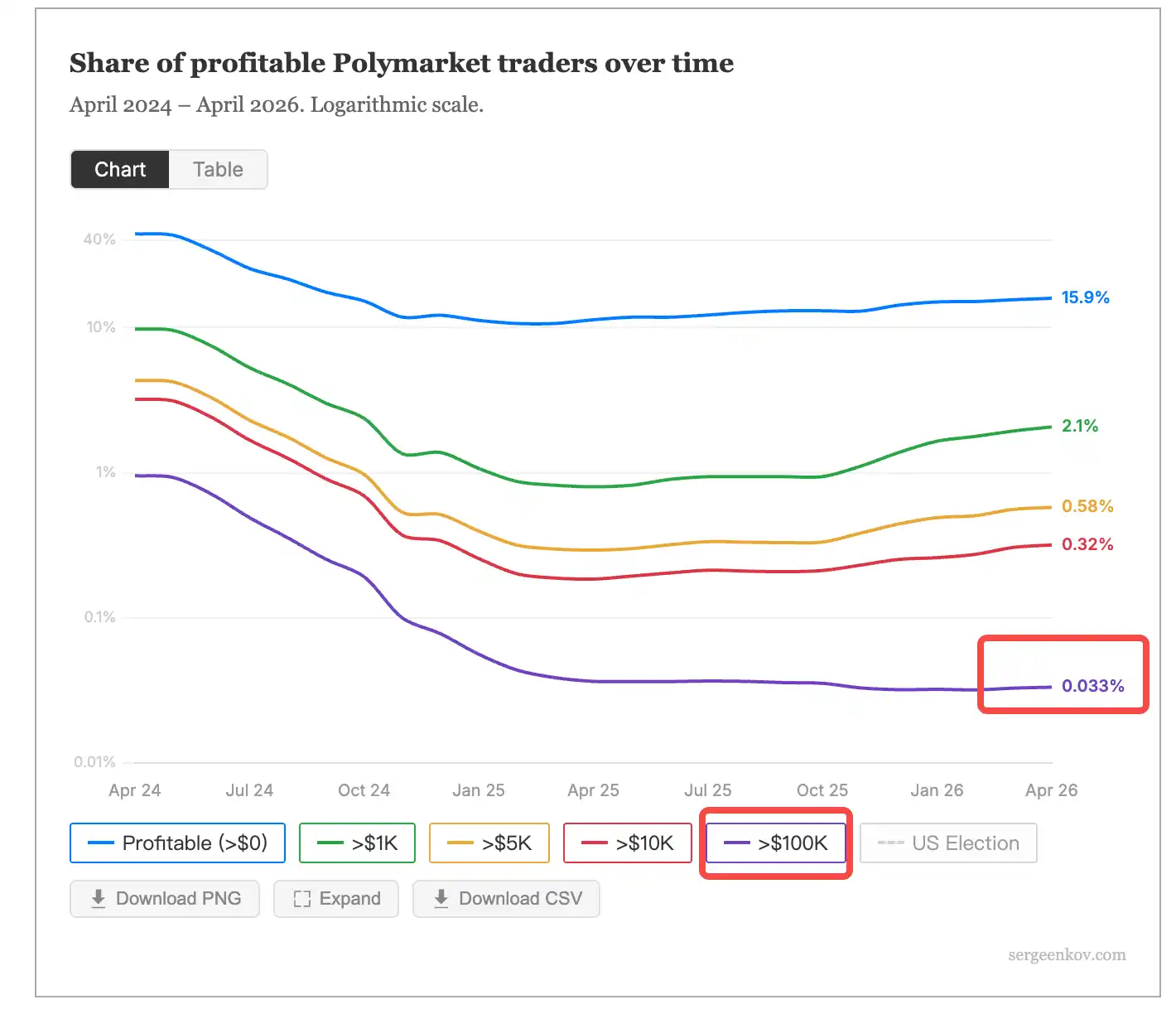
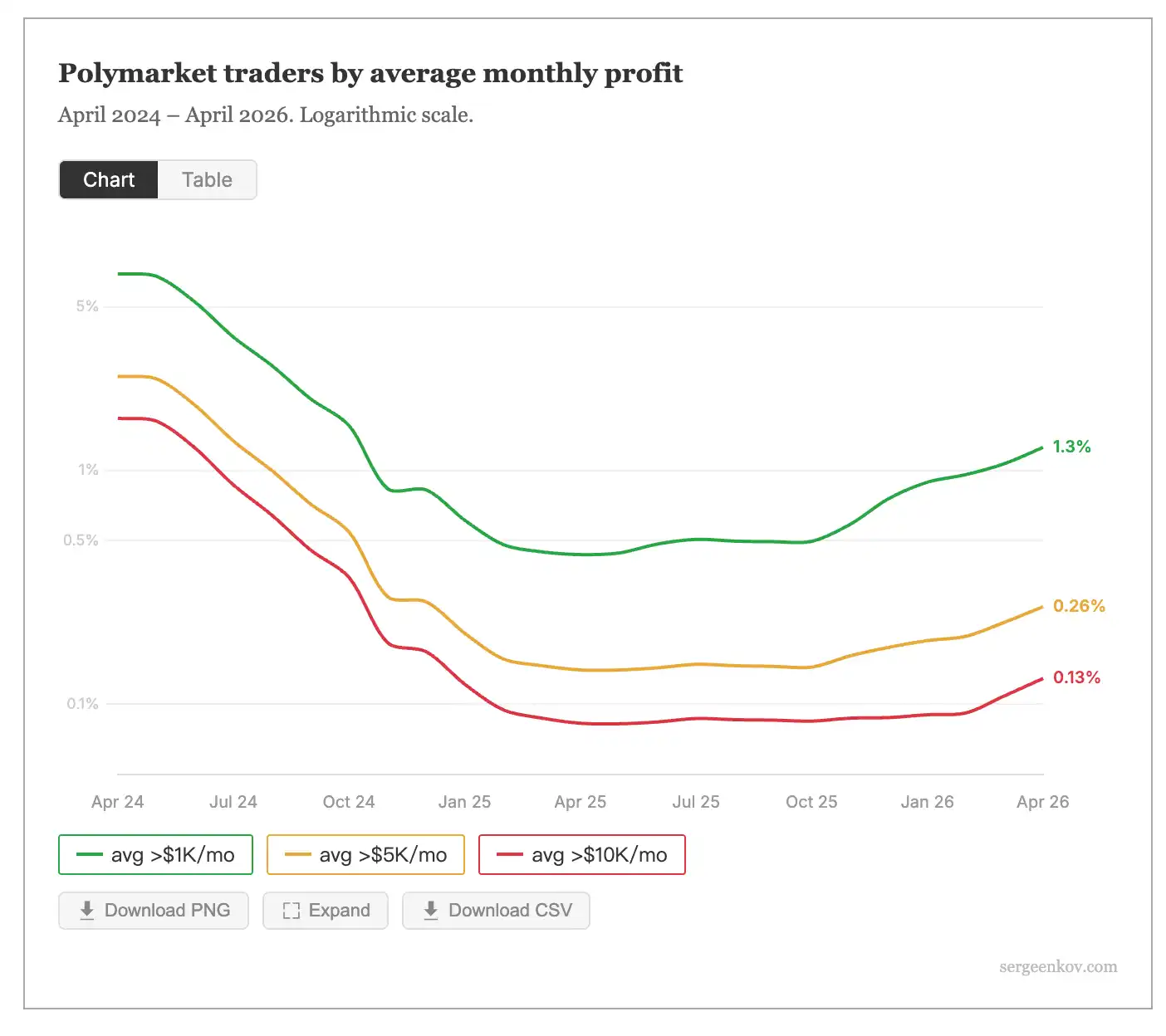
A recent analysis of 2.5 million Polymarket wallet addresses by on-chain researcher Andrey Sergeenkov reveals that 84.1% of traders are losing money, with only 16% achieving any profit. A mere 2% of addresses have accumulated over $1,000 in profits, while just 0.033% (840 addresses) have earned more than $100,000. The study, which improved on prior methodologies by accounting for token splits and mergers, shows a significant increase in unprofitable traders compared to a previous 70% estimate. Profit concentration is extreme: only 1.25% of addresses make over $1,000 monthly, 0.26% earn above $5,000, and just 0.13% surpass $10,000. Most high-earning addresses are short-lived, with 53% of top traders active for only one month. Research indicates that automated strategies—such as arbitrage bots and high-frequency trading systems—dominate profits, exploiting public on-chain data and speed advantages that manual retail traders lack. Despite Polymarket’s accuracy in prediction (94% a month before outcomes), the platform exhibits a stark wealth disparity, raising questions about its function as an information aggregator versus a zero-sum game favoring sophisticated players.

Author: Deep Tide TechFlow

Deep Tide Guide: The latest analysis of 2.5 million wallet addresses on Polymarket by on-chain researcher Andrey Sergeenkov shows that 84.1% of traders are at a loss, with only 2% of addresses accumulating profits exceeding $1,000, and 840 addresses (0.033%) profiting over $100,000. The timing of this report is quite delicate—Polymarket has just secured an exclusive predictive market partnership with MLB for up to $300 million and is pushing hard for retail user growth.

Wealth distribution in on-chain prediction markets is even more brutal than most people imagine.

According to a report by The Defiant on April 6, independent on-chain researcher Andrey Sergeenkov released a profit and loss analysis covering 2.5 million Polymarket wallet addresses, with data as of April 1, 2026. The core conclusion: 84.1% of traders are losing money, and less than 16% of addresses have achieved any level of positive returns.

This is not the first such study. In December 2025, blockchain analyst DeFi Oasis analyzed 1.7 million addresses and 124 million transactions, concluding that 70% of traders were not profitable. Sergeenkov's data sample is larger, and the methodology has been improved (capturing token splits and merges missed in previous research), with the loss ratio jumping from 70% to 84%.

The Top of the Pyramid: Less Than 0.26% Earn Over $5,000 Monthly

Sergeenkov conducted a full analysis of transaction data from two smart contracts, CTF Exchange and NegRisk CTF Exchange, by tracking all USDC fund flows (including buys, sells, redemptions, splits, and merges) on the Polygon chain.

The numbers in the high-profit range are quite stark: addresses with average monthly profits exceeding $1,000 account for 1.25%; those exceeding $5,000 are only 0.26%, about 6,600 addresses; and those exceeding $10,000 drop to 3,250, representing 0.13% of all traders.

More critical is the issue of sustainability. Among those 6,600 addresses with average monthly profits exceeding $5,000, 53% were active for one month and then disappeared, with only 2.6% trading continuously for over a year. Sergeenkov summarized in the report: "Most traders come, trade for a while, and then leave."

In contrast, bottom-feeders consistently harvest profits. An academic paper from Spain's IMDEA Networks Institute analyzed 86 million on-chain transactions between April 2024 and April 2025, finding that arbitrage traders extracted approximately $40 million in profits just from price differences. A single wallet achieved the highest profit of $2 million from 4,049 transactions, averaging $496 per trade.

Retail Manual Trading Can't Beat Bots, Information Advantage Highly Concentrated

The root cause of losses is not complicated. IMDEA's research shows that the largest profits are concentrated in wallets using automated strategies: arbitrage bots, market-making algorithms, and high-frequency trading systems. Manual retail traders typically enter the market only after prices have already adjusted.

This is the fundamental difference between prediction markets and traditional gambling. Polymarket's order book is completely public, and on-chain data is transparent, but this transparency instead makes it easier for professional traders to build systematic advantages. A quantitative wallet equipped with low-latency APIs and probability models is not in the same arena as an ordinary user who opens the app to place a bet after seeing the news.

According to Token Terminal data, Polymarket's nominal trading volume over the past 30 days is approximately $9.8 billion, with about 462,600 monthly active traders. The platform's growth itself is not an issue, but the relationship between user growth and user profitability is inverse—Sergeenkov's data shows that the decline in the proportion of profitable traders is directly related to peaks in user growth, especially the influx after the November 2024 U.S. election.

Information Aggregation Tool or Zero-Sum Game?

This report has reignited an old debate: who exactly do prediction markets serve?

The core argument of supporters is information aggregation. Polymarket's official data claims that its price prediction accuracy exceeds 94% one month before the outcome is determined. In other words, even if 84% of traders are losing money, the market as a whole is still producing valuable probability signals. The losing retail traders are essentially paying for information pricing.

Critics argue that when 84% of a platform's participants are losing money and profits are highly concentrated in the hands of automated traders, the difference between it and a casino is merely a matter of regulatory classification. Especially in the realm of sports contracts, the line between prediction markets and sports betting is being deliberately blurred.

Polymarket's valuation has exceeded $20 billion, and the Intercontinental Exchange (parent company of the NYSE) invested $2 billion in October 2025. Capital markets are clearly betting on the growth story of prediction markets.

But Sergeenkov's report raises a simple question: when the next wave of 2.5 million users floods in, how will their fate differ from the previous wave?

Связанные с этим вопросы

QAccording to the analysis of 2.5 million Polymarket wallet addresses, what percentage of traders are losing money?

A84.1% of traders are losing money.

QWhat is the estimated number of addresses that have profited more than $100,000 on Polymarket, according to the researcher Andrey Sergeenkov?

A840 addresses (0.033% of the total) have profited more than $100,000.

QWhat does the research from the IMDEA Networks Institute identify as the primary reason for散户 (retail traders) losses on prediction markets like Polymarket?

AThe research found that the largest profits are concentrated in wallets using automated strategies (arbitrage bots, market-making algorithms, and high-frequency trading systems), while manual retail traders typically enter the market after prices have already adjusted.

QWhat key statistic does the article mention about the sustainability of high-earning traders (those making over $5,000 monthly)?

AAmong the 6,600 addresses with monthly profits exceeding $5,000, 53% were only active for one month before disappearing, and only 2.6% traded consistently for over a year.

QDespite most traders losing money, what is the core argument of supporters who defend the value of prediction markets like Polymarket?

ASupporters argue that prediction markets serve as valuable information aggregation tools, with Polymarket's prices achieving over 94% accuracy in predicting outcomes one month in advance, meaning the market as a whole produces valuable probabilistic signals even if most individual traders lose money.

Похожее

The Largest IPO in History Is Approaching, Surpassing SpaceX, 28 Years of AI Self-Iteration, Countdown to Intelligence Explosion

"Anthropic Nears Trillion-Dollar IPO, Fueled by Explosive Growth and 2028 'Intelligence Explosion' Warning Anthropic is considering a deal valuing the AI company near $1 trillion, potentially leading to one of the largest IPOs ever and surpassing SpaceX. Its revenue has skyrocketed, with Annual Recurring Revenue (ARR) reaching $45 billion in May 2026—a 500% increase in just five months. This vertical growth curve is attributed to its key products, Claude Code and Cowork, dominating AI coding and enterprise collaboration. Beyond commercial success, co-founder Jack Clark issued a pivotal warning in an interview: there is a greater than 50% chance that by the end of 2028, AI systems will achieve recursive self-improvement—the ability to autonomously build a 'better version' of themselves, initiating an 'intelligence explosion.' This prophecy underpins the company's astronomical valuation, as the market prices in the potential for transformative and disruptive AI. Further signaling its ambition, Anthropic formed a $1.5 billion joint venture with Goldman Sachs and Blackstone, aiming to disrupt traditional consulting firms like McKinsey by deploying Claude AI for complex strategic work. This move tests AI's capacity to replace high-level cognitive labor, a precursor to its predicted autonomous evolution. The narrative presents a dual future: unprecedented economic opportunity alongside significant risks like economic restructuring and security threats. Anthropic's meteoric rise and Clark's 2028 prediction frame the coming years as a countdown to a potential technological singularity."

marsbit7 мин. назад

The Largest IPO in History Is Approaching, Surpassing SpaceX, 28 Years of AI Self-Iteration, Countdown to Intelligence Explosion

marsbit7 мин. назад

Has Hook Summer Really Arrived? sato, Lo0p, FLOOD Ignite the New Narrative of Uniswap v4

"Hook Summer" Arrives? Sato, Lo0p, FLOOD Ignite Uniswap v4 Narrative Amidst a slight market recovery, attention within the Ethereum ecosystem has shifted to Meme coins built on Uniswap v4's Hook protocol. Following ASTEROID, tokens like sato, sat1, Lo0p, and FLOOD have become market focal points, with market caps ranging from millions to tens of millions, bringing concentrated liquidity to a narrative-dry market. Uniswap v4 Hooks are "plugin smart contracts" that allow developers to inject custom logic at key points in a liquidity pool's lifecycle (initialization, adding/removing liquidity, swaps, etc.), making the AMM programmable. Recent representative projects include: * **sato**: Market cap peaked over $38M; uses a v4 curve mechanism for minting/burning, locking ETH as reserve. * **sat1**: Market cap briefly exceeded $10M, positioning as an "optimized sato," but later declined significantly. * **Lo0p**: Market cap neared $6.6M; a "lending AMM protocol" allowing users to borrow ETH against deposited LO0P tokens without immediate selling pressure. * **FLOOD**: Market cap approached $6M; channels trading reserves into Aave v3 to generate yield, which is retained in the pool. The emergence of these Hook-based tokens could drive long-term growth for the Uniswap ecosystem by attracting users and liquidity to v4 pools. Combined with Uniswap's activated fee switch (partially used to burn UNI), the long-term outlook for UNI appears positive. However, short-term UNI price appreciation is not directly guaranteed. Factors include the sustainability and lifecycle of these new tokens, their price volatility, overall market conditions, and regulatory pressures. Currently, Uniswap v4's TVL ($595M) lags behind v3 and v2, indicating Hook adoption still requires time to mature. In summary, the Hook ecosystem serves as "long-term nourishment" for UNI, but acts more as a "catalyst" than a direct "booster" in the short term. Note: These are early-stage experimental tokens and may carry unknown risks.

marsbit32 мин. назад

Has Hook Summer Really Arrived? sato, Lo0p, FLOOD Ignite the New Narrative of Uniswap v4

marsbit32 мин. назад

Has Hook Summer Truly Arrived? sato, Lo0p, FLOOD Ignite the New Uniswap v4 Narrative

With the broader market showing signs of recovery, a new wave of interest has emerged around Ethereum-based meme coins. Following ASTEROID, tokens like sato, sat1, Lo0p, and FLOOD, built upon the Uniswap v4 Hook protocol, are capturing market attention. Their market capitalizations range from millions to tens of millions of dollars, injecting much-needed focused liquidity into a market lacking narratives. This article explores whether this trend signifies an incoming "Hook Summer" and its potential impact on UNI's price. Hooks are essentially plug-in smart contracts for Uniswap v4 liquidity pools, allowing developers to inject custom logic at key points in a pool's lifecycle (like initialization, adding/removing liquidity, swaps). This transforms the AMM into programmable building blocks. Key highlighted projects include: * **sato**: Peaked over $38M market cap. It utilizes a v4 curve for minting/burning; buying locks ETH as reserve to mint new tokens, while selling redeems ETH from the reserve and burns tokens. * **sat1**: Market cap briefly exceeded $10M, promoted as an "optimized sato," but later declined significantly. * **Lo0p**: Reached nearly $6.6M. It's a lending AMM protocol where buying LO0P tokens locks them as collateral, allowing users to borrow ETH from the pool reserve at 40% LTV, aiming to improve capital efficiency for idle ETH in LPs. * **FLOOD**: Peaked near $6M. Its mechanism directs asset reserves from buys into Aave v3 to generate yield, with fees and interest retained in the pool to potentially influence the token's price long-term. In the long term, the development of the Hook ecosystem can attract users and liquidity to Uniswap v4, benefiting UNI's fundamentals—especially combined with the recent activation of the protocol fee switch, where a portion of fees is used to burn UNI. However, in the short term, these Hook-based tokens are unlikely to directly drive significant UNI price appreciation. Their impact is moderated by factors like token sustainability, price volatility, and broader market and regulatory conditions. Currently, Uniswap v4's TVL ($595M) still trails behind v2 and v3, indicating adoption and growth will take time. The article concludes that while the Hook ecosystem provides long-term "nourishment" for UNI, its short-term role is more of a "catalyst" than a "booster." Readers are cautioned that these are early-stage experimental tokens and may carry unknown risks.

Odaily星球日报44 мин. назад

Has Hook Summer Truly Arrived? sato, Lo0p, FLOOD Ignite the New Uniswap v4 Narrative

Odaily星球日报44 мин. назад

Торговля

Спот
Фьючерсы

Популярные статьи

Как купить PEOPLE

Добро пожаловать на HTX.com! Мы сделали приобретение ConstitutionDAO (PEOPLE) простым и удобным. Следуйте нашему пошаговому руководству и отправляйтесь в свое крипто-путешествие.Шаг 1: Создайте аккаунт на HTXИспользуйте свой адрес электронной почты или номер телефона, чтобы зарегистрироваться и бесплатно создать аккаунт на HTX. Пройдите удобную регистрацию и откройте для себя весь функционал.Создать аккаунтШаг 2: Перейдите в Купить криптовалюту и выберите свой способ оплатыКредитная/Дебетовая Карта: Используйте свою карту Visa или Mastercard для мгновенной покупки ConstitutionDAO (PEOPLE).Баланс: Используйте средства с баланса вашего аккаунта HTX для простой торговли.Третьи Лица: Мы добавили популярные способы оплаты, такие как Google Pay и Apple Pay, для повышения удобства.P2P: Торгуйте напрямую с другими пользователями на HTX.Внебиржевая Торговля (OTC): Мы предлагаем индивидуальные услуги и конкурентоспособные обменные курсы для трейдеров.Шаг 3: Хранение ConstitutionDAO (PEOPLE)После приобретения вами ConstitutionDAO (PEOPLE) храните их в своем аккаунте на HTX. В качестве альтернативы вы можете отправить их куда-либо с помощью перевода в блокчейне или использовать для торговли с другими криптовалютами.Шаг 4: Торговля ConstitutionDAO (PEOPLE)С легкостью торгуйте ConstitutionDAO (PEOPLE) на спотовом рынке HTX. Просто зайдите в свой аккаунт, выберите торговую пару, совершайте сделки и следите за ними в режиме реального времени. Мы предлагаем удобный интерфейс как для начинающих, так и для опытных трейдеров.

730 просмотров всегоОпубликовано 2024.04.12Обновлено 2025.03.21

Как купить PEOPLE

Обсуждения

Добро пожаловать в Сообщество HTX. Здесь вы сможете быть в курсе последних новостей о развитии платформы и получить доступ к профессиональной аналитической информации о рынке. Мнения пользователей о цене на PEOPLE (PEOPLE) представлены ниже.

活动图片