Polygon deploys Madhugiri hard fork, aims for 33% throughput boost

cointelegraphОпубликовано 2025-12-09Обновлено 2025-12-09

Введение

Polygon has deployed the Madhugiri hard fork, targeting a 33% increase in network throughput and reducing block consensus time to one second. The upgrade includes support for three Fusaka Ethereum Improvement Proposals (EIP-7823, EIP-7825, EIP-7883), which improve efficiency and security by limiting gas consumption for heavy mathematical operations. It also introduces a new transaction type for Ethereum-Polygon bridge traffic and adds flexibility for future upgrades. This enhancement aims to better support high-frequency use cases like stablecoins and real-world asset (RWA) tokenization. The hard fork follows the recent Heimdall 2.0 upgrade, which significantly reduced finality times, despite a brief disruption in September due to a bug that was later resolved.

Blockchain network Polygon has rolled out its latest protocol upgrade, known as the Madhugiri hard fork, which aims to achieve a 33% increase in network throughput and reduce block consensus time to one second.

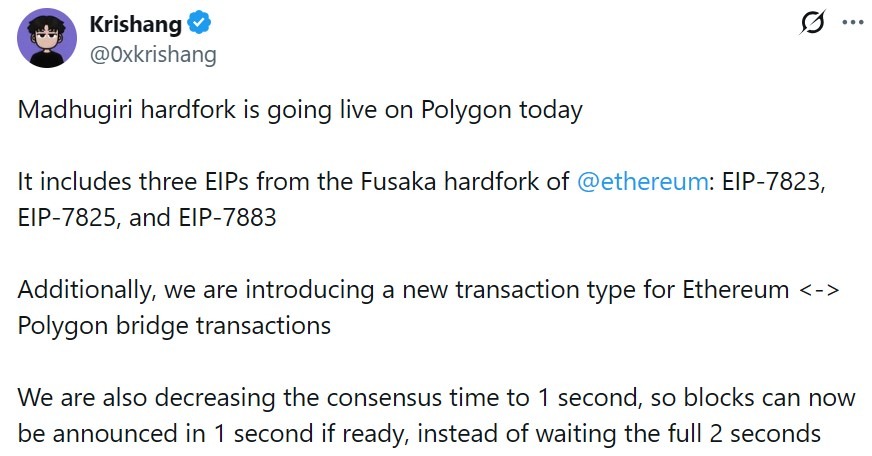
Polygon core developer Krishang Shah said on X that the update includes support for three Fusaka Ethereum Improvement Proposals, specifically EIP-7823, EIP-7825 and EIP-7883. These EIPs make heavy mathematical operations more efficient and secure by limiting the amount of gas they consume.

They also prevent single transactions from consuming excessive computing power, helping the network run more smoothly and predictably.

The upgrade introduces a new transaction type for Ethereum to Polygon bridge traffic and adds a built-in flexibility feature for future upgrades. Polygon previously said that the update makes throughput increases as easy as “flipping a few switches.”

“We are also decreasing the consensus time to 1 second, so blocks can now be announced in 1 second if ready, instead of waiting the full 2 seconds,” Shah wrote.

Source: Krishang Shah

New update reinforces Polygon for stablecoins and RWAs

With Madhugiri now live, Polygon aims to reinforce its infrastructure while materially improving its performance. These are prerequisites for high-frequency and high-trust use cases, such as real-world asset (RWA) tokenization and stablecoins.

Aishwary Gupta, the global head of payments and RWAs at Polygon Labs, previously forecasted a “stablecoin supercycle.”

Gupta said there will be a surge of “at least 100,000 stablecoins” in the next five years. However, he said this would not only be about minting tokens and must have a corresponding utility like yield.

Gupta also advocated for more transparency and accountability in the RWA sector. He previously argued that RWA numbers are meaningless if the assets cannot be audited, settled or traded.

“When transparency and accountability are established, RWAs will reach even greater heights, unlocking trillions in institutional capital,” he wrote.

Related: Polygon co-founder mulls resurrecting MATIC a year after POL rebrand

Hard fork follows major Heimdall upgrade

The upgrade comes on the heels of rapid prior improvements. On July 10, Polygon deployed Heimdall 2.0, dubbed by Polygon Foundation CEO Sandeep Nailwal as the network’s “most technically complex” hard fork since its launch.

The update reduced transaction finality times from one to two minutes to roughly five seconds.

However, on Sept. 10, the network experienced a significant disruption when a bug caused finality delays of 10 to 15 minutes, affecting validator sync, remote procedure call services and third-party tooling. Despite this, the team assured the community that blocks were still running.

On Sept. 11, the Polygon Foundation announced that the consensus and finality functions had been restored through a hard fork. With the update, nodes were no longer stuck, while checkpoints and milestones were finalized as expected.

Magazine: Ethereum’s Fusaka fork explained for dummies: What the hell is PeerDAS?

Похожее

Exploring Bitcoin Valuation in 2026 from Macro and On-Chain Structural Perspectives

Tiger Research analyzes Bitcoin's valuation outlook for 2026 from macro and on-chain perspectives. Despite a 27% price drop in Q1, the macro environment remains supportive. Global M2 hit a record $13.44 trillion, but Chinese liquidity, which contributed over 60% of M2 growth, has limited access to Bitcoin markets. The Iran conflict pushed oil prices higher, raising March CPI to 3.3% and narrowing the Fed's rate cut path. However, the easing direction remains intact. Bitcoin ETF flows turned positive in March after five months of outflows, and corporate accumulation continues. On-chain metrics show a shift from undervaluation to early equilibrium. Key indicators like MVRV-Z and NUPL have exited panic zones. The critical resistance is at $78k, the long-term holder cost basis, while the key support is at $54k. Although transaction counts increased, active addresses and average transfer size declined, indicating superficial growth rather than real network expansion. BTCFi ecosystem growth has weakened, leading to a -10% adjustment in fundamental metrics. The 12-month price target is set at $143k, based on a $132.5k neutral benchmark adjusted by -10% (fundamentals) and +20% (macro). This represents a 103% upside from current levels. Short-term catalysts include a break above $78k, sustained ETF inflows, and a Fed policy shift post-geopolitical de-escalation.

marsbit17 мин. назад

Exploring Bitcoin Valuation in 2026 from Macro and On-Chain Structural Perspectives

marsbit17 мин. назад

Anthropic Starts Poaching Scientists? $27K Weekly Onsite Stipend to Fix Claude's Expert-Level Errors

Anthropic has launched a new STEM Fellow program, offering $3,800 per week for a three-month, in-person residency in San Francisco. The role targets experts from science, technology, engineering, and mathematics (STEM) fields—machine learning experience is helpful but not required. Instead, Anthropic values scientific judgment and a willingness to learn quickly. Fellows will work with Claude models and internal tools under the guidance of an Anthropic researcher. Example projects include a materials scientist identifying errors in Claude’s reasoning or a climate scientist integrating atmospheric modeling software with Claude. The goal is to have experts "tell Claude where it's wrong" and improve its scientific capabilities. This initiative is part of Anthropic’s broader strategy to strengthen its scientific ecosystem, following earlier programs like the AI Safety Fellows and AI for Science programs. The company acknowledges that current AI models, while powerful, still produce high-confidence errors and lack end-to-end research autonomy. The program aims to embed domain expertise directly into model development, turning scientists into "high-level reviewers" for AI. Anthropic CEO Dario Amodei has previously emphasized AI’s potential to accelerate scientific breakthroughs, particularly in biology and healthcare. The company believes that the next phase of AI competition will depend not on scaling parameters, but on integrating human expertise to refine model accuracy and reliability.

marsbit47 мин. назад

Anthropic Starts Poaching Scientists? $27K Weekly Onsite Stipend to Fix Claude's Expert-Level Errors

marsbit47 мин. назад

On the Eve of X Money's Launch, Musk Dismantles the Referee First

"X Money Launches After Dismantling Regulator: Musk's 9-Day Power Play" In February 2025, a team from the "Department of Government Efficiency" (DOGE), led by Elon Musk, entered the Consumer Financial Protection Bureau (CFPB) headquarters. Shortly after, the CFPB was effectively dismantled—its funding frozen, activities suspended, and nearly 90% of staff laid off. This move came just nine days after X announced a partnership with Visa and as X Money prepared to launch. The article contrasts this with the decade-long regulatory battles faced by companies like Coinbase and PayPal. Coinbase spent over $75 million in political contributions and endured a major SEC lawsuit to operate legally. PayPal complied with strict state and federal rules for its stablecoin PYUSD, including 100% reserve requirements and monthly audits. However, Musk’s approach was different. After the CFPB introduced a rule placing large digital payment apps under federal oversight, Musk tweeted "Delete CFPB." Within months, the rule was revoked by Congress. Meanwhile, DOGE operatives gained "god-tier" access to CFPB databases, potentially obtaining sensitive competitive information from rivals like Apple, Google, and PayPal. The article also highlights a "suspicious exemption clause" in the GENIUS Act, which allows private companies like X to issue stablecoins with fewer restrictions. Senator Elizabeth Warren questioned whether Musk, who was a senior presidential advisor during the Act’s drafting, influenced this clause. X Money offers a 6% APY on deposits, despite FDIC warnings that stablecoin users are not insured. As X Money launches to 600 million monthly users, the article questions the fairness of a system where Musk can bypass regulations that others spent years and millions to comply with. The dismantling of the CFPB and the alleged regulatory advantages raise concerns about the future of equitable rule-making in the U.S. financial system.

marsbit56 мин. назад

On the Eve of X Money's Launch, Musk Dismantles the Referee First

marsbit56 мин. назад

Торговля

Спот
Фьючерсы
活动图片