Policy Pilot First: Central Bank Explores Direct 'Money Distribution', Digital Yuan Users Already Benefiting

比推Опубликовано 2026-01-21Обновлено 2026-01-21

Введение

China's digital yuan (e-CNY) has entered a significant upgrade phase, transitioning from a non-interest-bearing digital cash (M0) to an interest-bearing asset classified as M1. As of January 1, 2026, users holding funds in verified tier 1-3 digital yuan wallets can earn interest at the current demand deposit rate of 0.05% per annum, paid quarterly. This move, a world-first for a central bank digital currency (CBDC), aims to boost user adoption by providing a tangible benefit for holding the digital currency, which had previously struggled to compete with established payment platforms like Alipay and WeChat Pay despite extensive pilot programs and government subsidies. A key structural change is the shift away from the 100% reserve requirement for commercial banks. Banks can now use a portion of the e-CNY deposits for lending and developing financial products, transforming the digital yuan from a cost center into a potential profit source and incentivizing them to promote it more actively. In contrast, non-bank payment institutions must still maintain 100% reserves. Beyond payments, the digital yuan is positioning itself as a programmable financial infrastructure. Its smart contract capability, though using a restricted Turing-complete design for security, enables complex applications like controlled fund disbursement for pre-paid services, family budgeting, and government subsidies. It also supports offline transactions via NFC. A major strategic focus is cross-border payme...

Author: Nancy, PANews

Original Title: While Wall Street Still Debates, Digital Yuan Already 'Distributes Money' to Users


Historically, in financial customer acquisition battles, 'distributing money to users' has always been the simplest and most effective weapon.

Over a decade ago, products like Yu'ebao used visible, calculable yields to pry open the cognitive boundaries of ordinary people towards financial products, also launching a frontal assault on traditional finance.

A similar game is playing out again across the ocean. These days, Wall Street elites and crypto-native giants are arguing fiercely over market structure bills related to stablecoin yields. One side attempts to defend the high walls of traditional finance through regulation, while the other tries to compete for the market with real money.

Shifting focus back to China, the digital yuan is undergoing a critical upgrade. As is well known, after several years of pilot programs, red envelope incentives, scenario promotions, and policy pushes have been deployed in turn, but the digital yuan has consistently struggled to become commonplace in every household.

As the digital yuan enters version 2.0 this year, it begins to possess interest-bearing capabilities, giving users, for the first time, an intuitive and practical reason to hold it: earning interest on holdings. Simultaneously, the digital yuan also transitions from being classified as M0 to M1, charting a longer-term path through smart contracts to become an underlying digital payment infrastructure.

Entering the Interest-Bearing Era, Upgrading to a 'Yield-Bearing Stablecoin'

If judged solely by scale, the progress of the digital yuan hasn't been slow.

After a decade of R&D exploration and pilot promotion, the digital yuan has reached a considerable size. As of the end of November 2025, it had cumulatively processed 3.48 billion transactions, with a transaction value of 167 trillion yuan; 230 million personal wallets and 18.84 million corporate wallets were opened, with pilot coverage extending to 26 regions across 17 provinces (autonomous regions, municipalities).

From infrastructure construction and technical verification to payment scenario implementation, the digital yuan has completed the phased goal of moving from usable to practical. This progress benefits both from the continuous improvement of underlying technology and strong policy-level promotion, creating usage opportunities for the digital yuan through methods like red envelope subsidies and consumption rebates.

But is the digital yuan truly common in daily life? The answer is unfortunately not optimistic.

Placed within the larger payment system, the contrast is particularly stark. In the third quarter of 2025 alone, Chinese non-bank payment institutions handled online payment business volume amounting to 85.28 trillion yuan, with 338.019 billion transactions. Not to mention, commercial payment networks formed by platforms like Alipay and WeChat Pay have long penetrated high-frequency scenarios such as daily necessities, clothing, housing, and transportation. Whether in terms of transaction scale, user stickiness, or fund settlement capacity, they far surpass what the digital yuan currently offers.

For most ordinary users and businesses, the digital yuan is just renminbi in a different guise; its essence remains funds sitting idle in an account, not earning interest. There is no difference from the user's perspective compared to balances in WeChat or Alipay wallets, so users naturally lack the motivation to change long-established usage habits.

This situation finally saw a turning point on January 1, 2026, when the digital yuan officially upgraded to a 'yield-bearing stablecoin'.

According to the latest policy, users can download the digital yuan App from official app stores and have funds in Tier 1, Tier 2, and Tier 3 real-name wallets accrue interest based on the listed demand deposit interest rate. The current annual interest rate is 0.05%, with interest settlement dates on March 20, June 20, September 20, and December 20 each year; it is important to note that anonymous wallets (Tier 4 wallets) opened solely with mobile number verification do not accrue interest for now.

This means users now have a channel for their short-term idle funds to appreciate, with automatic interest calculation and zero operational cost. Although this interest rate is not high, it provides a reason for users to retain funds and gives the digital yuan a competitive advantage compared to traditional financial products.

In the crypto world, stablecoin yield is not new, often achieved through DeFi, staking, or shadow interest rates. However, these mechanisms also come with challenges such as smart contract vulnerabilities, depegging risks, and regulatory uncertainty.

In contrast, the yield of the digital yuan is established within a safe and controllable framework under central bank supervision, ensuring fund stability and security. The digital yuan is included in the deposit insurance scope, enjoying the same safety guarantees as ordinary deposits, with coverage for compensation up to a limit of 500,000 yuan. This safety structure, backed by national credit, is fundamentally different from the crypto world's reliance on code and consensus mechanisms.

With this latest upgrade of the digital yuan, China has become the first economy globally to pay interest on a central bank digital currency.

Bidding Farewell to 100% Reserves, Banks Finally Have Motivation

Besides insufficient motivation on the user side, bank participation and incentive were also major challenges in promoting the digital yuan.

Initially, the digital yuan was positioned as M0 (digital cash). This design limited its application scenarios and could not generate yield for users. More importantly, it adopted a 100% reserve requirement system. This meant that commercial banks could not utilize the digital yuan deposited by users for fund utilization or lending; every unit of digital yuan received by banks had to be fully surrendered to the central bank and frozen in central bank accounts.

Consequently, banks not only failed to generate income from these funds but also bore significant operational costs for wallet opening, scenario expansion, anti-money laundering, customer service, etc. Therefore, banks lacked sufficient motivation to actively promote the digital yuan.

"The traditional account system has little room for innovation left. After the digital yuan is positioned as M1, it is becoming a piece of financial infrastructure, giving market institutions more space," according to a bank insider cited by Caixin Net.

The situation changed as the digital yuan gradually ascended to an M1 form.

In the new M1 model, the digital yuan balance in customers' real-name bank wallets becomes a liability of the commercial banks. Banks only need to deposit a portion of the funds with the central bank according to the statutory reserve requirement ratio; the remaining funds can be used for independently developing value-added services, such as launching exclusive wealth management products for digital yuan.

This institutional adjustment provides banks with more profit potential, incentivizing their active participation in building the digital yuan ecosystem. It also transforms banks from cost centers into profit centers, thereby enhancing their motivation to promote the digital yuan.

Currently, banks including Industrial and Commercial Bank of China (ICBC), Agricultural Bank of China (ABC), Bank of China (BOC), China Construction Bank (CCB), Bank of Communications, China Postal Savings Bank, and China Merchants Bank all provide digital wallet services.

It is important to note that non-bank payment institutions (such as Alipay and WeChat Pay) still need to maintain 100% reserves and cannot enjoy the relatively flexible fund operation space like banks.

Shedding the Payment Label, Smart Contracts Become New Financial Infrastructure

The digital yuan is gradually shedding its label as a 'payment substitute' and transforming towards a stickier digital financial infrastructure.

Unlike WeChat and Alipay, which are essentially payment tools storing traditional currency, the digital yuan is itself a form of money, used like electronic cash. Also, the digital yuan is not built on a blockchain but based on a newly designed account system. However, programmability based on smart contracts is its core competitive advantage, enabling it to be embedded into more complex performance and regulatory scenarios.
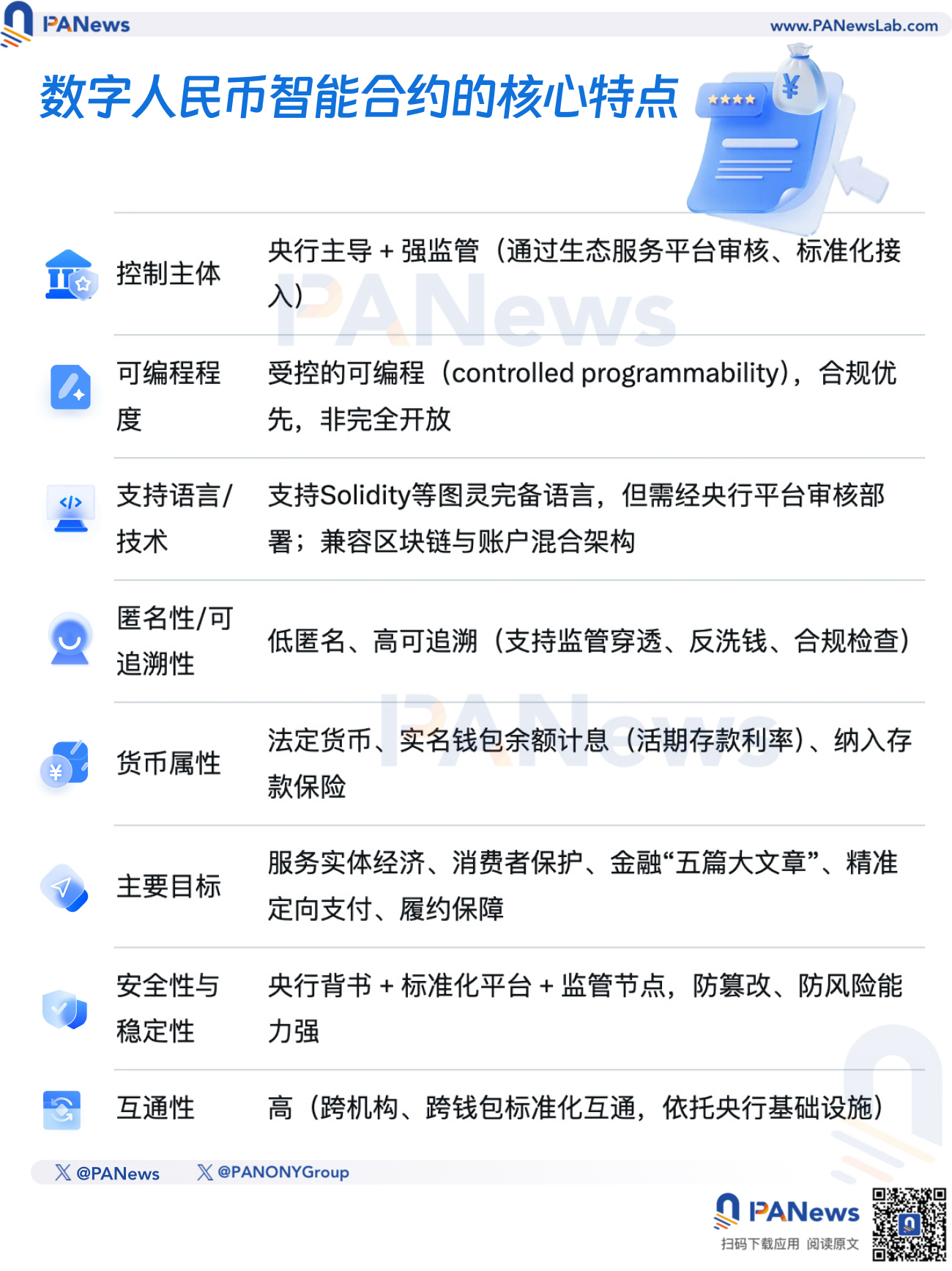
For example, in the pre-paid field, the digital yuan can achieve fund management modes like 'thawing in installments, paying per use'; in family and campus scenarios, parents can restrict children's accounts to specific consumption ranges; in government subsidy areas, the use of funds can also be precisely controlled.

In terms of technical implementation, according to disclosures by Caixin Net, the digital yuan adopts a restricted Turing-complete design, only supporting templated scripts permitted by the central bank. This design, while limiting certain functions, effectively ensures system security and controllability. Compared to the fully Turing-complete smart contracts of the crypto world, this design of the digital yuan avoids common risks like vulnerabilities, attacks, and governance failures in smart contracts. It is worth mentioning that the development of digital yuan smart contracts supports multiple programming languages, including fully Turing-complete languages compatible with Ethereum like Solidity. Therefore, development potential is not limited.

Furthermore, the digital yuan has demonstrated payment resilience. Its dual-offline payment function allows both payer and payee to complete transactions via手机NFC (Near Field Communication) in a no-network environment. This capability is irreplaceable in emergency scenarios and special environments. In contrast, in crypto systems, whether Bitcoin or stablecoin payments, they almost all rely on continuous internet connection to complete ledger synchronization and final settlement.
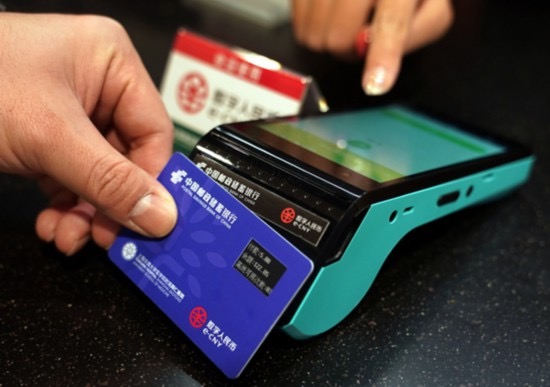
To bridge the 'digital divide' and adapt to the usage habits of different groups such as the elderly, students, and overseas visitors to China, the digital yuan also offers various forms of hard wallets, including IC cards, wearable devices (e.g., watches), SIM cards, and mobile terminals. This is fundamentally different from crypto hard wallets, which are primarily used for 'cold storage' of private keys as a defense against hacking attacks; digital yuan hard wallets focus more on the inclusivity of high-frequency payments. However, currently limited by the cost of deploying merchant acceptance terminals and the willingness to upgrade, the actual usage scope of digital yuan hard wallets remains limited, and their practical penetration effect still requires further observation.

Currently, the digital yuan is accelerating its evolution into a full-scenario currency. Its applications have broken through the retail sphere, forming replicable and promotable application models in areas like wholesale payments, public services, social governance, and even cross-border settlement, covering both online and offline scenarios. It is expected to further become an indispensable infrastructure in the digital economy.

Cross-border payment, in particular, is an important direction after its upgrade, supporting three-level transfers for countries, merchants, and individuals. As stablecoins rapidly penetrate the global cross-border payment field, the digital yuan is accelerating its 'going global' journey, becoming an important driving force for the internationalization of the renminbi. Through cross-border payments, the digital yuan can not only improve payment efficiency and reduce costs but also secure a place in the global payment system. For example, when overseas tourists consume in China, they don't need to exchange foreign currency; they can simply use the digital yuan App to scan a code and complete payment in their local currency at the real-time exchange rate. Currently, cross-border transfers conducted via mBridge have cumulatively exceeded $55 billion, with 95% settled using digital yuan.

In summary, for the digital yuan to truly complete the leap from a policy tool to a mass-market product, the real test may have just begun. But its path and potential are clearer than ever before.


Twitter:https://twitter.com/BitpushNewsCN

Bitpush TG Discussion Group:https://t.me/BitPushCommunity

Bitpush TG Subscription: https://t.me/bitpush

Original Link:https://www.bitpush.news/articles/7604656

Связанные с этим вопросы

QWhat is the major upgrade that digital yuan (e-CNY) underwent on January 1, 2026, and how does it benefit users?

AThe major upgrade is that digital yuan transitioned to an 'interest-bearing stablecoin.' Users with verified (Class I, II, and III) wallets can now earn interest on their holdings at the current demand deposit rate of 0.05% per annum, paid quarterly. This provides users with a reason to hold digital yuan as their short-term idle funds can now generate yield automatically and with zero operational cost.

QHow did the initial M0 (digital cash) positioning of the digital yuan limit its adoption by commercial banks, and how has the shift to M1 changed this?

AInitially, as M0, the digital yuan operated on a 100% reserve system. This meant commercial banks had to deposit 100% of the digital yuan they received with the central bank, freezing those funds. Banks could not use them for lending or other profitable activities, making the system a cost center with little incentive for promotion. The shift to M1 reclassifies the funds in user wallets as a liability of the commercial banks. Now, banks only need to deposit a portion (the required reserve ratio) with the central bank and can use the remaining funds to develop profitable services, such as exclusive wealth management products, turning digital yuan into a potential profit center and incentivizing banks to promote it.

QWhat is a key technological advantage of the digital yuan's smart contracts compared to those in the crypto world, according to the article?

AA key technological advantage is its security and controllability. The digital yuan uses a 'restricted Turing-complete' design, which only supports templated scripts permitted by the central bank. This design, while still supporting languages like Solidity, effectively avoids common risks found in fully Turing-complete smart contracts in the crypto world, such as vulnerabilities, attacks, and governance failures, ensuring system safety and control.

QBesides retail payments, in which other significant area is the digital yuan expanding its application, and what is a specific example provided?

AThe digital yuan is expanding significantly into cross-border payments. A specific example is the mBridge project, through which cross-border transfers have cumulatively exceeded $55 billion, with 95% of these settlements conducted using the digital yuan. This facilitates more efficient and lower-cost international transactions and serves as a key driver for the internationalization of the renminbi.

QHow does the security backing for the digital yuan's value differ from that of crypto-based stablecoins?

AThe value of the digital yuan is backed by the full faith and credit of the Chinese state. It is included within the deposit insurance system, guaranteeing compensation of up to 500,000 yuan per account in case of bank failure. This state-backed security framework is fundamentally different from crypto stablecoins, which rely on code, algorithmic mechanisms, or collateral reserves that are subject to smart contract risks, de-pegging events, and regulatory uncertainty.

Похожее

The Second Half of Macro Influencer Fu Peng's Career

Fu Peng, a prominent Chinese macroeconomist and former chief economist of Northeast Securities, has joined Hong Kong-based digital asset management firm Bitfire Group (formerly New Huo Group) as its chief economist. This move, announced in April 2026, triggered an 11% surge in Bitfire's stock price. Fu, known for his accessible macroeconomic commentary and large social media following, will focus on integrating digital assets into global asset allocation frameworks, particularly combining FICC (fixed income, currencies, and commodities) with cryptocurrencies for institutional clients. His career includes roles at Lehman Brothers and Solomon International, with significant influence gained through public communication. However, in late 2024, Fu faced temporary social media bans after a controversial private speech at HSBC on China's economic challenges, though he denied regulatory sanctions. He later left Northeast Securities citing health reasons. Bitfire, a licensed virtual asset manager serving high-net-worth clients, seeks to build trust and attract traditional capital through Fu’s expertise and credibility. The partnership represents a strategic shift for both: Fu enters the crypto sector after a traditional finance peak, while Bitfire aims to leverage his macro framework for institutional adoption. Outcomes remain uncertain regarding capital inflows and compatibility within corporate structure.

marsbit39 мин. назад

The Second Half of Macro Influencer Fu Peng's Career

marsbit39 мин. назад

Торговля

Спот
Фьючерсы

Популярные статьи

Что такое $BANK

Банк ИИ: Революционный шаг в будущее банковского дела Введение В эпоху, отмеченную быстрыми темпами технологического прогресса, Банк ИИ находится на пересечении искусственного интеллекта (ИИ) и банковских услуг. Этот инновационный проект стремится переопределить финансовый ландшафт, повышая операционную эффективность, меры безопасности и качество обслуживания клиентов с помощью ИИ. Приступая к этому изучению Банка ИИ, мы углубимся в то, что включает в себя проект, его операционную динамику, его исторический контекст и значительные вехи. Что такое Банк ИИ? В своей основе Банк ИИ представляет собой преобразовательную инициативу, направленную на интеграцию искусственного интеллекта в различные банковские операции. Этот проект использует возможности ИИ для автоматизации процессов, улучшения протоколов управления рисками иEnhancing взаимодействия с клиентами через персонализированные услуги. Основные цели Банка ИИ включают: Автоматизация банковских функций: Используя технологии ИИ, Банк ИИ стремится автоматизировать рутинные задачи, снижая нагрузку на человеческие ресурсы и повышая эффективность. Улучшение управления рисками: Проект использует алгоритмы ИИ для прогнозирования и выявления рисков, тем самым укрепляя меры безопасности против мошенничества и других угроз. Персонализация банковских услуг: Банк ИИ сосредоточен на предложении индивидуально подобранных финансовых продуктов и услуг, анализируя данные и поведение клиентов. Улучшение клиентского опыта: Внедрение решений на базе ИИ, таких как чат-боты и виртуальные помощники, направлено на предоставление пользователям более человеческого взаимодействия, революционизируя способ, которым клиенты взаимодействуют с банками. С этими целями Банк ИИ позиционирует себя как ключевого игрока в сделании банковских услуг более эффективными, безопасными и ориентированными на пользователей. Кто создатель Банка ИИ? Детали, касающиеся создателя Банка ИИ, остаются неизвестными. Таким образом, ни одно конкретное лицо или организация не были идентифицированы в доступной информации. Анонимность, окружающая начало проекта, поднимает вопросы, но не умаляет его амбициозного видения и целей. Кто инвесторы Банка ИИ? Подобно создателю проекта, конкретная информация о инвесторах или поддерживающих организациях Банка ИИ не была раскрыта. Без этой информации трудно описать финансовую поддержку и институциональную поддержку, которая может продвигать проект вперед. Тем не менее, важность наличия прочной инвестиционной базы является ключевой для поддержания развития в такой инновационной сфере. Как работает Банк ИИ? Банк ИИ работает на нескольких инновационных фронтах, сосредотачиваясь на уникальных факторах, которые отличают его от традиционных банковских рамок. Ниже приведены ключевые операционные особенности: Автоматизация: Применяя алгоритмы машинного обучения, Банк ИИ автоматизирует различные ручные процессы внутри банков. Это приводит к снижению операционных затрат и позволяет работникам перераспределять свои усилия на более стратегические деятельности. Совершенное управление рисками: Интеграция ИИ в практики управления рисками обеспечивает банки инструментами для точного прогнозирования потенциальных угроз, таких как мошенничество, обеспечивая безопасность информации и активов клиентов. Индивидуализированные финансовые рекомендации: Путем непрерывного обучения на основе взаимодействия с клиентами, системы ИИ развивают тонкое понимание потребностей пользователей, позволяя им предлагать персонализированные советы по финансовым решениям. Улучшенные взаимодействия с клиентами: Используя чат-боты и виртуальных помощников на базе ИИ, Банк ИИ обеспечивает более увлекательный клиентский опыт, позволяя пользователям быстро получать ответы на свои запросы, тем самым сокращая время ожидания и повышая уровень удовлетворенности. Все вместе эти операционные особенности позиционируют Банк ИИ как пионера в банковском секторе, устанавливающего новые эталоны для предоставления услуг и операционного совершенства. Хронология Банка ИИ Понимание траектории Банка ИИ требует взгляда на его исторический контекст. Ниже представлена хронология, подчеркивающая важные вехи и события: Начало 2010-х: Концепция интеграции ИИ в банковские услуги начала привлекать внимание, когда банковские учреждения осознали потенциальные преимущества. 2018: Произошел заметный рост внедрения технологий ИИ, когда банки начали использовать инструменты ИИ, такие как чат-боты, для базового обслуживания клиентов и системы управления рисками для улучшения безопасности. 2023: Сложность ИИ продолжала развиваться, при этом генеративный ИИ был представлен для выполнения более сложных задач, таких как обработка документов и анализ инвестиций в реальном времени. Этот год стал значительным шагом вперед в возможностях, которые ИИ-технологии предоставили банкам. 2024-Настоящее состояние: На данный момент Банк ИИ находится на восходящей траектории, с продолжающимися исследованиями и разработками, которые расширяют возможности в банковских операциях. Продолжение изучения приложений ИИ намекает на захватывающие события, которые еще предстоят. Ключевые моменты о Банке ИИ Интеграция ИИ в банковское дело: Банк ИИ сосредоточен на принятии искусственного интеллекта для оптимизации банковских процессов и улучшения пользовательского опыта. Автоматизация и фокус на управлении рисками: Проект сильно акцентирует внимание на этих областях, стремясь сместить бремя рутинных задач, одновременно усиливая системы безопасности с помощью предсказательной аналитики. Персонализированные банковские решения: Используя данные клиентов, Банк ИИ предоставляет индивидуально подобранные банковские услуги, которые учитывают потребности отдельных пользователей. Обязанность по развитию: Банк ИИ остается приверженным постоянным исследовательским и развивающим усилиям, обеспечивая свою адаптируемость и постоянную актуальность по мере того, как технологии продолжают развиваться. Заключение В заключение, Банк ИИ является важным шагом вперед в банковской индустрии, использующим искусственный интеллект для изменения операционных парадигм, повышения безопасности и повышения удовлетворенности клиентов. Несмотря на пробелы в информации о создателе и инвесторах, четкие цели и функциональные механизмы Банка ИИ обеспечивают прочную основу для его постоянной эволюции. Поскольку технологии ИИ продолжают развиваться и сливаться с банковским сектором, Банк ИИ хорошо позиционирован, чтобы существенно повлиять на будущее финансовых услуг, улучшая наш подход к пониманию и взаимодействию с банковским делом.

148 просмотров всегоОпубликовано 2024.04.06Обновлено 2024.12.03

Что такое $BANK

Как купить BANK

Добро пожаловать на HTX.com! Мы сделали приобретение Lorenzo Protocol (BANK) простым и удобным. Следуйте нашему пошаговому руководству и отправляйтесь в свое крипто-путешествие.Шаг 1: Создайте аккаунт на HTXИспользуйте свой адрес электронной почты или номер телефона, чтобы зарегистрироваться и бесплатно создать аккаунт на HTX. Пройдите удобную регистрацию и откройте для себя весь функционал.Создать аккаунтШаг 2: Перейдите в Купить криптовалюту и выберите свой способ оплатыКредитная/Дебетовая Карта: Используйте свою карту Visa или Mastercard для мгновенной покупки Lorenzo Protocol (BANK).Баланс: Используйте средства с баланса вашего аккаунта HTX для простой торговли.Третьи Лица: Мы добавили популярные способы оплаты, такие как Google Pay и Apple Pay, для повышения удобства.P2P: Торгуйте напрямую с другими пользователями на HTX.Внебиржевая Торговля (OTC): Мы предлагаем индивидуальные услуги и конкурентоспособные обменные курсы для трейдеров.Шаг 3: Хранение Lorenzo Protocol (BANK)После приобретения вами Lorenzo Protocol (BANK) храните их в своем аккаунте на HTX. В качестве альтернативы вы можете отправить их куда-либо с помощью перевода в блокчейне или использовать для торговли с другими криптовалютами.Шаг 4: Торговля Lorenzo Protocol (BANK)С легкостью торгуйте Lorenzo Protocol (BANK) на спотовом рынке HTX. Просто зайдите в свой аккаунт, выберите торговую пару, совершайте сделки и следите за ними в режиме реального времени. Мы предлагаем удобный интерфейс как для начинающих, так и для опытных трейдеров.

910 просмотров всегоОпубликовано 2025.05.09Обновлено 2025.05.09

Как купить BANK

Обсуждения

Добро пожаловать в Сообщество HTX. Здесь вы сможете быть в курсе последних новостей о развитии платформы и получить доступ к профессиональной аналитической информации о рынке. Мнения пользователей о цене на BANK (BANK) представлены ниже.

活动图片














