Polish lawmakers have doubled down on crypto regulation rejected by President Karol Nawrocki, deepening tensions between the president and Prime Minister Donald Tusk.
Polska2050, part of the ruling coalition in the Sejm — Poland’s lower house of parliament — reintroduced the extensive crypto bill on Tuesday, just days after Nawrocki vetoed an identical bill.
The bill’s backers, including Adam Gomoła — a member of Poland2050 — called Bill 2050 an “improved” successor to the vetoed Bill 1424, but government spokesman Adam Szłapka reportedly declared that “not even a comma” had been changed.
The division over Poland’s crypto bill comes amid the rollout of the European Union’s Markets in Crypto-Assets Regulation (MiCA) across member states ahead of a July 2026 compliance deadline for EU crypto businesses.
Critics say Bill 2050 is “exactly same bill”
The new version of Poland’s draft crypto bill provides an 84-page-long document that essentially replicates the original Bill 1424, aiming to designate the Polish Financial Supervision Authority as the country’s primary crypto asset market regulator.
Crypto advocates like Polish politician Tomasz Mentzen previously criticized Bill 1424 as “118 pages of overregulation,” particularly in comparison to shorter versions in other EU member states like Hungary or Romania.
“The government has once again adopted exactly the same bill on cryptoassets,” Mentzen wrote in an X post on Tuesday.
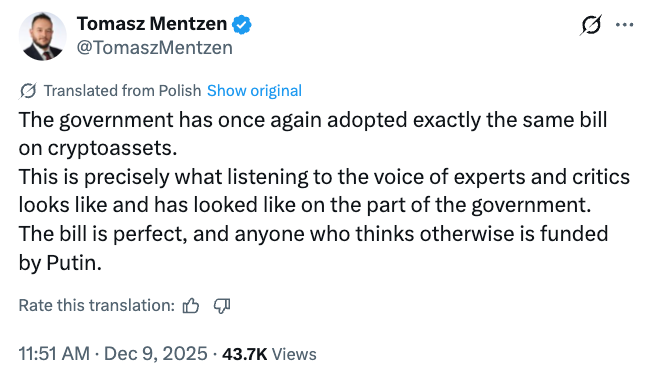
He also mocked Tusk’s claim that the president’s earlier veto was tied to the alleged involvement of the “Russian mafia,” saying: “The bill is perfect, and anyone who thinks otherwise is funded by Putin.”
Government spokesman Szłapka reportedly claimed that President Nawrocki will likely not veto the proposed bill this time, following a classified security briefing in parliament last week and “now has full knowledge” of the implications on national security.
The issue with MiCA: Local versus centralized EU oversight
Poland’s debate over its crypto bill sets an important precedent for implementing the EU-wide MiCA regulation, as the proposed legislation would place responsibility for market supervision on the local financial regulator.
The issue is particularly significant amid calls from some member states for more centralized MiCA supervision under the Paris-based European Securities and Markets Authority (ESMA).
In October, the Bank of France urged the EU to give the ESMA direct supervisory powers, warning that a fragmented approach to oversight could undermine the bloc’s financial sovereignty.
Some EU member states have pushed back against centralized oversight under MiCA, with regulators in Malta arguing that it could create additional layers of supervision that might stifle market innovation.
Related: EU plan would boost ESMA powers over crypto and capital markets
Notably, Polish economist Krzysztof Piech — a prominent critic of Poland’s proposed crypto bill — has questioned the need for the local legislation, noting that MiCA protections will take effect in 2026.
While local reports suggest that President Nawrocki may not veto the bill this time, there is also speculation that his office has been presented with an “alternative” draft aimed at creating more favorable market conditions. The proposed alternative is reportedly designed to align with the EU-wide MiCA framework and remove direct oversight from the local regulator.