Bitcoin miners could boost corporate adoption as crypto treasury buys slow

cointelegraphОпубликовано 2025-12-12Обновлено 2025-12-12

Введение

According to BitcoinTreasuries.NET, Bitcoin miners are poised to become key drivers of corporate Bitcoin adoption as purchases by crypto treasury companies slow significantly. Corporate treasuries are projected to buy only 40,000 BTC in Q4, the lowest since Q3 2024. Miners, who can generate BTC at a discount through block production, now account for 5% of new additions and 12 of public company balances. They are already among the largest corporate holders, with MARA Holdings and Riot Platforms ranking second and seventh, respectively. A November price drop below $90,000 created a stress test, leaving roughly 65% of corporate buyers with unrealized losses. This has not caused widespread distress but has led companies to a slower, more selective purchasing cadence as they reassess risk. The report concludes that miners' ability to acquire BTC cheaply makes their balance sheets increasingly vital for supporting corporate adoption.

Bitcoin miners, which can acquire the cryptocurrency at below-market costs, could be in the best position to shape corporate adoption as accumulation by crypto treasury companies slows, says BitcoinTreasuries.NET.

Bitcoin (BTC) treasury companies are projected to buy 40,000 BTC in the fourth quarter, the lowest since Q3 2024, BitcoinTreasuries.NET President Pete Rizzo said in a corporate adoption report released on Thursday.

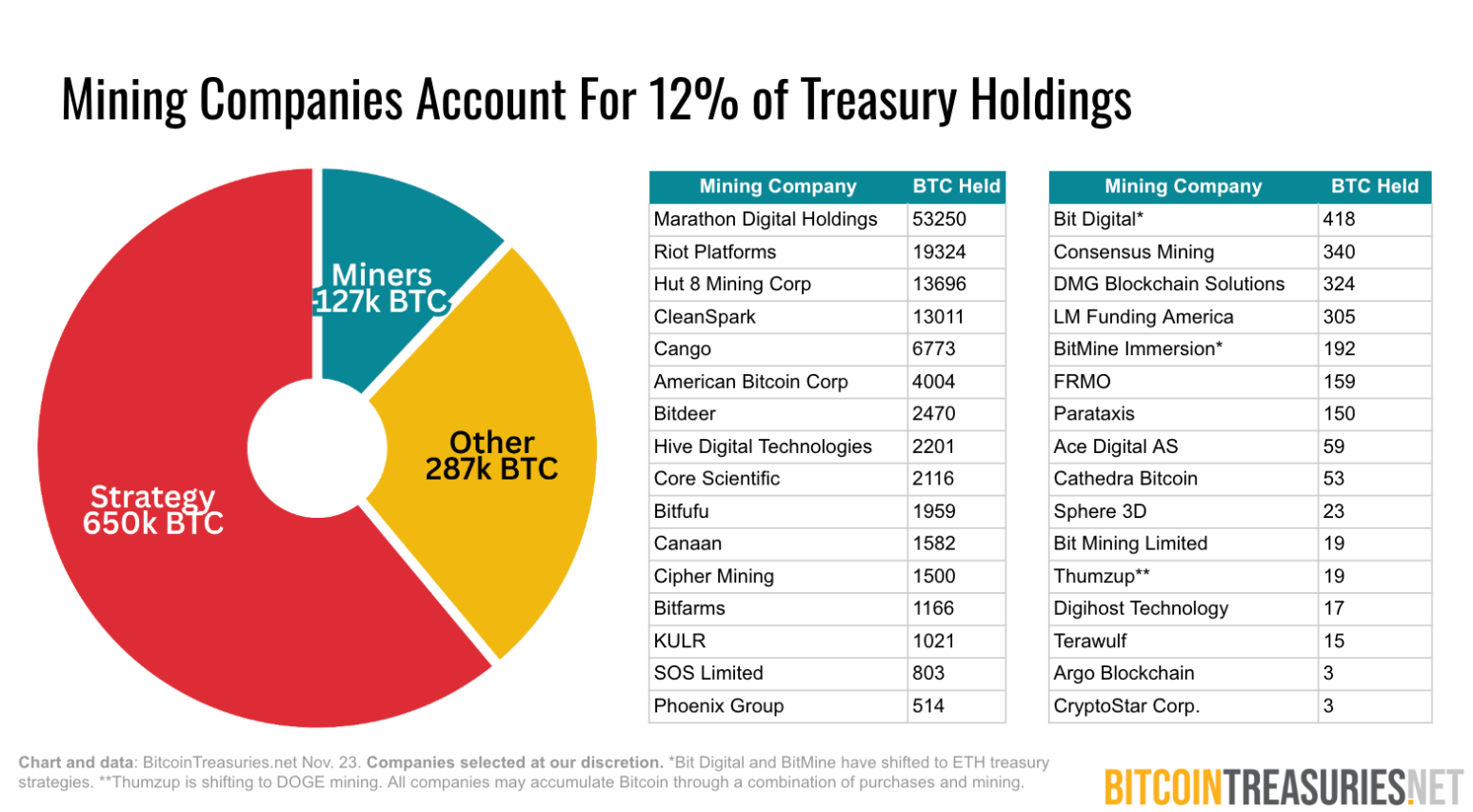
Despite the slowdown, Rizzo said Bitcoin mining companies continue to “anchor public‐market Bitcoin holdings” and accounted for 5% of new additions and 12% of aggregate public company balances in November.

“Because miners can acquire BTC at an effective discount to spot markets via block production, their balance sheets may become increasingly important in supporting corporate adoption, especially if other treasuries pause or slow purchases,” he said.

Miners already among top Bitcoin holders

On average, miners generate about 900 Bitcoin per day, according to Bitbo and MARA Holdings has the second largest Bitcoin stash among public companies, with a stash of 53,250 Bitcoin.
Source: BitcoinTreasuries.NET

Riot Platforms is the seventh largest public Bitcoin holder, with 19,324, while Hut 8 Mining is ninth with 13,696.

Rizzo said that the “summer buying frenzy” from crypto treasury companies has eased, but “demand has not vanished.”

“Public corporations appear to be normalizing to a slower, more selective cadence as they digest recent purchases and reassess risk,” he added.

November a stress test for treasury companies

In November, Bitcoin’s price sank below $90,000 for the first time since April, which created one of the first true stress tests for the Bitcoin capital markets era, Rizzo said.

Roughly 65% of buyers purchased Bitcoin above current market prices and now have unrealized losses.

Related: Businesses are absorbing Bitcoin 4x faster than it is mined: Report

“Bitcoin’s late‐November drawdown pushed spot prices toward $90,000, dragging many 2025 buyers into the red. For the 100 companies where cost basis could be measurable, about two‐thirds now sit on unrealized losses at current prices,” he said.

“This does not yet point to widespread distress, but it does force risk committees and boards to confront the downside of averaging into elevated prices and relying on long-term upside to validate treasury decisions.”

Magazine: Mysterious Mr Nakamoto author — Finding Satoshi would hurt Bitcoin

Похожее

After the Wealth Effect Disappears, The Myth or Elegy of Decentralization

The article "After the Wealth Effect Disappears: The Myth or Elegy of Decentralization" examines the evolution of Ethereum and Bitcoin, arguing that both have strayed from their original decentralized ideals. While Ethereum shifted from PoW to PoS to enhance scalability and value capture (ETH), it sacrificed node decentralization and embraced centralized governance, despite retaining smart contracts. Bitcoin maintained minimal governance but failed to support smart contracts, limiting its utility beyond being "digital gold." The author highlights how institutional adoption (e.g., BTC ETFs, DTCC’s blockchain migration) prioritizes long-term, low-risk gains, contrasting with retail’s speculative expectations. As centralized exchanges (CEXs) become less influential, activity migrates on-chain, but this shift may not yield the envisioned decentralized utopia. Stablecoins like USDT/USDC are increasingly replacing ETH as primary assets, further centralizing the ecosystem. Ultimately, the piece critiques the compromise between decentralization and wealth generation, noting that Ethereum’s "middleman" role—embodied by Vitalik Buterin and ETH’s capital-driven model—has eroded its foundational principles. The conclusion suggests that both decentralization and wealth effect narratives are being overshadowed by pragmatic, institution-friendly financial computing.

marsbit7 мин. назад

After the Wealth Effect Disappears, The Myth or Elegy of Decentralization

marsbit7 мин. назад

a16z Bets on Energy Tokenization Experiment: How Will DayFi Use DeFi to Restructure the Power Grid? Jae 2025/12/13 12:00

a16z Backs Energy Tokenization Experiment: How DayFi Aims to Restructure the Grid with DeFi As global tech giants compete for computing power, electricity has become a critical resource. DayFi, a decentralized energy capital markets protocol under the Daylight ecosystem, is launching a $50 million pre-deposit event on December 16. Backed by a16z Crypto and Framework Ventures, DayFi tokenizes future electricity revenue into tradable crypto assets. The protocol allows users to deposit stablecoins to mint GRID—a fully collateralized stablecoin—and then stake it to receive sGRID, a yield-bearing token representing a share in energy asset revenue. This creates a flywheel effect: liquidity funds distributed energy projects, which generate tokenized returns for holders. However, DayFi faces significant regulatory challenges. sGRID may be classified as a security by the SEC, requiring strict disclosures. Additionally, FERC’s restrictions on disclosing critical energy infrastructure data conflict with DeFi’s transparency requirements. Technical solutions like zero-knowledge proofs may be needed to verify收益 without exposing sensitive data. Valuation of the underlying energy assets—solar panels, batteries—also remains uncertain, with risks of depreciation and potential manipulation. Despite these hurdles, DayFi represents an ambitious attempt to bridge DeFi with physical energy grids, transforming electricity into a dynamic, tradable asset amid growing AI-driven power demand.

marsbit10 мин. назад

a16z Bets on Energy Tokenization Experiment: How Will DayFi Use DeFi to Restructure the Power Grid? Jae 2025/12/13 12:00

marsbit10 мин. назад

Oracle Plunges 40%, Will Overbuilding of AI Infrastructure Drag Down Giants?

Oracle's stock has plummeted 40% from its September peak, despite securing over $500 billion in AI infrastructure orders, signaling that massive future contracts no longer guarantee investor confidence. Similar concerns are emerging across the AI supply chain: Broadcom, with a $73 billion AI order backlog, saw its stock drop post-earnings, while GPU cloud provider CoreWeave fell 17% amid rising debt levels. The core issue is a market-wide skepticism about whether AI infrastructure builders—and their clients—can deliver. Orders are highly concentrated among a few tech giants (Meta, Alphabet, Microsoft, Amazon, Apple, Nvidia) and AI startups (OpenAI, Anthropic). Startups rely on external funding, creating obvious risk, but even cash-rich giants are showing strain. They are funding immense AI capex—often exceeding energy sector spending—with debt, while AI’s revenue contribution remains minor compared to core businesses. Oracle’s negative cash flow and record debt issuance highlight the financing challenge. Its novel “customer-owned chips” model shifts risk to clients like OpenAI and Meta, who must pay for and supply their own hardware. If AI demand doesn’t materialize as expected, underutilized data centers could become costly failures. While proponents argue AI growth is exponential and will eventually pay off, the timing is uncertain. The race between AI infrastructure expansion and actual market demand will determine whether giants are strengthened or broken by their bets.

深潮17 мин. назад

Oracle Plunges 40%, Will Overbuilding of AI Infrastructure Drag Down Giants?

深潮17 мин. назад

Торговля

Спот
Фьючерсы
活动图片