Plummeting Token Price, Whales Dumping and Exiting: The Aave Governance Battle Exposes DeFi's Governance Dilemma

marsbitОпубликовано 2025-12-23Обновлено 2025-12-23

Введение

The article details a major governance crisis within Aave, a leading DeFi lending protocol, sparked in December 2025. The conflict began when Aave Labs, the development team, switched the front-end service provider for its official website and redirected an estimated $10 million in annual fees from user transactions to its own controlled address instead of the community DAO treasury. This move was perceived by the Aave community as a "hidden privatization" of brand assets and a breach of trust. It raised a fundamental question: who ultimately controls a DeFi protocol—the founding team that builds the code and brand, or the token holders governing the DAO? Tensions escalated with the submission of an aggressive "poison pill" governance proposal demanding Aave Labs transfer all intellectual property, trademarks, and equity to the DAO. A more constructive counter-proposal, "Phase 1 - Ownership," sought to reclaim control of critical assets like domains and social media accounts for the DAO. Amid the internal strife, the AAVE token price fell over 25%, and a major whale investor sold their holdings at a significant loss, signaling eroding confidence. Aave Labs further angered the community by unilaterally advancing a snapshot vote during the Christmas holiday, a move criticized for violating procedural norms. Despite the turmoil, Aave's core protocol remained robust with $34 billion in assets. The SEC's decision to close its investigation without action was seen as a tacit en...

Author: Jae, PANews

When DeFi's governance benchmark collides with real-world commercial interests, a brutal game determining "who is the master" is unfolding within the leading lending protocol, Aave.

As a leader in the DeFi market, Aave not only manages approximately $34 billion in assets but is also regarded as a model of on-chain governance. In December 2025, however, Aave found itself in the most severe crisis of confidence in its eight-year history.

This controversy did not arise by chance. The initial trigger was a seemingly insignificant front-end fee allocation, but it unexpectedly set off a domino effect. Catalyzed layer by layer through a series of key events, it ultimately pushed the lending giant Aave into the spotlight.

This is more than just a dispute over profit distribution; it has torn open a gap, exposing the most fundamental and sensitive conflict in the DeFi space: under the narrative, who has the final say—the founding team, who controls the code and the brand, or the DAO community, which holds the governance tokens?

This is not just a crisis for Aave; this event poses an urgent question to the entire DeFi market: as protocols mature, how can the commercial incentives for development teams be balanced with the governance rights of token holders?

$10 Million "Vanish," Aave Labs Accused of Depriving Community Rights

The source of Aave's internal governance war began with an update at the technical optimization level.

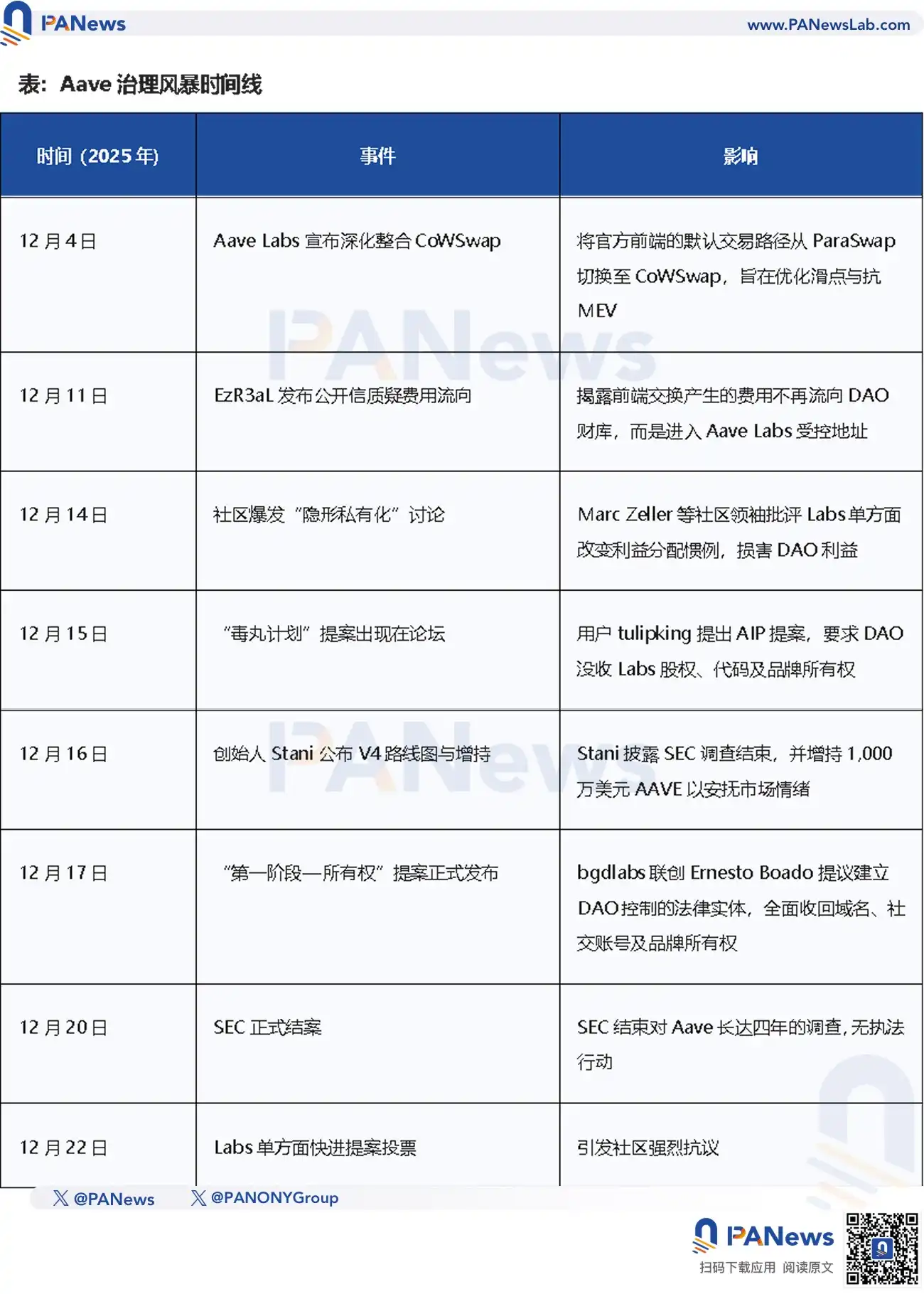
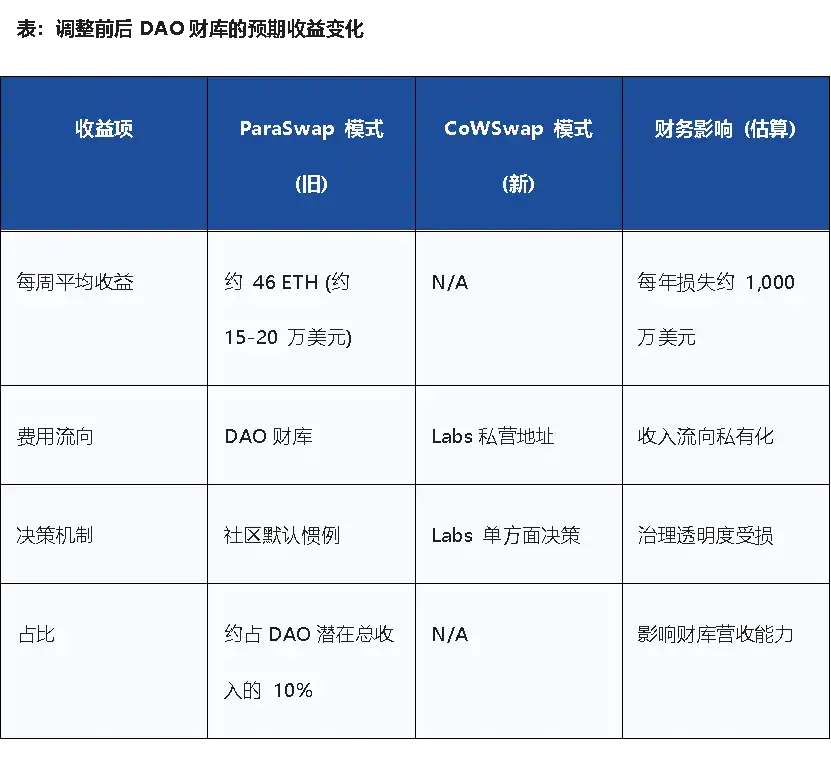
On December 4, 2025, Aave Labs announced that it was switching the asset swap service provider on its official frontend (app.aave.com) from ParaSwap to CoWSwap, citing better prices and MEV protection.

However, the ensuing financial changes were not fully disclosed in the announcement. Community representative EzR3aL discovered through on-chain data tracking that the fees generated by user transactions, after the change, no longer flowed to the DAO's public treasury but were instead transferred to an address controlled by Labs. Based on historical data estimates, this missing annualized revenue would amount to $10 million.

Aave community leader Marc Zeller pointed out: This is an invisible privatization of brand assets. Labs is using the technology and brand value developed with DAO funding to profit itself, breaking a long-standing trust agreement.

Aave founder Stani Kulechov, however, argued: This is a distinction between the protocol and the product. He explained that the Aave protocol, built by smart contracts, belongs to the DAO, while the commercial rights to the frontend product app.aave.com, which requires high operating and maintenance costs, should belong to the builders, Labs. The fees previously flowing to the DAO were merely "voluntary donations." This view challenges the traditional DeFi community belief that tokens should capture all economic value generated by the protocol's ecosystem.

To the community, Stani's logic is tantamount to a deprivation of sovereignty. The frontend, as the most important user entry point and traffic gate, if its revenue can be unilaterally intercepted by Labs, will similar revenue interception occur in future projects like Aave V4, the GHO stablecoin, and Horizon RWA? In this scenario, the value capture promise carried by the governance token AAVE risks becoming an empty promise.

Related reading: Annual Loss of Tens of Millions in Revenue Sparks Governance Controversy, Aave Labs Accused of "Stabbing the DAO in the Back"

Internal Conflict Heats Up, DAO Proposal Seeks to Reclaim Brand Ownership

When gentle negotiations failed to reach an agreement, radical factions within the community began adopting extreme博弈 strategies. On December 15, a governance proposal named the "Poison Pill Plan" was put forward by user tulipking, making three highly aggressive demands:

  1. Forced Asset Transfer: Require Labs to unconditionally transfer all code repositories, intellectual property (IP), and trademarks to the DAO, or face legal action.
  2. Equity Confiscation and Subsidiary Status: Advocate that the DAO should obtain 100% of Labs' equity, turning the originally independent company into a wholly-owned subsidiary of the DAO, with founders and employees becoming employees of the DAO.
  3. Recovery of Past Profits: Recover all historical frontend revenue generated from the use of the Aave brand from Labs and return it to the treasury.

This bombshell was temporarily shelved due to procedural issues, but its deterrent intent was achieved, demonstrating that the community has the ability and willingness to use governance votes to reversely吞并 a development team that refuses to cooperate.

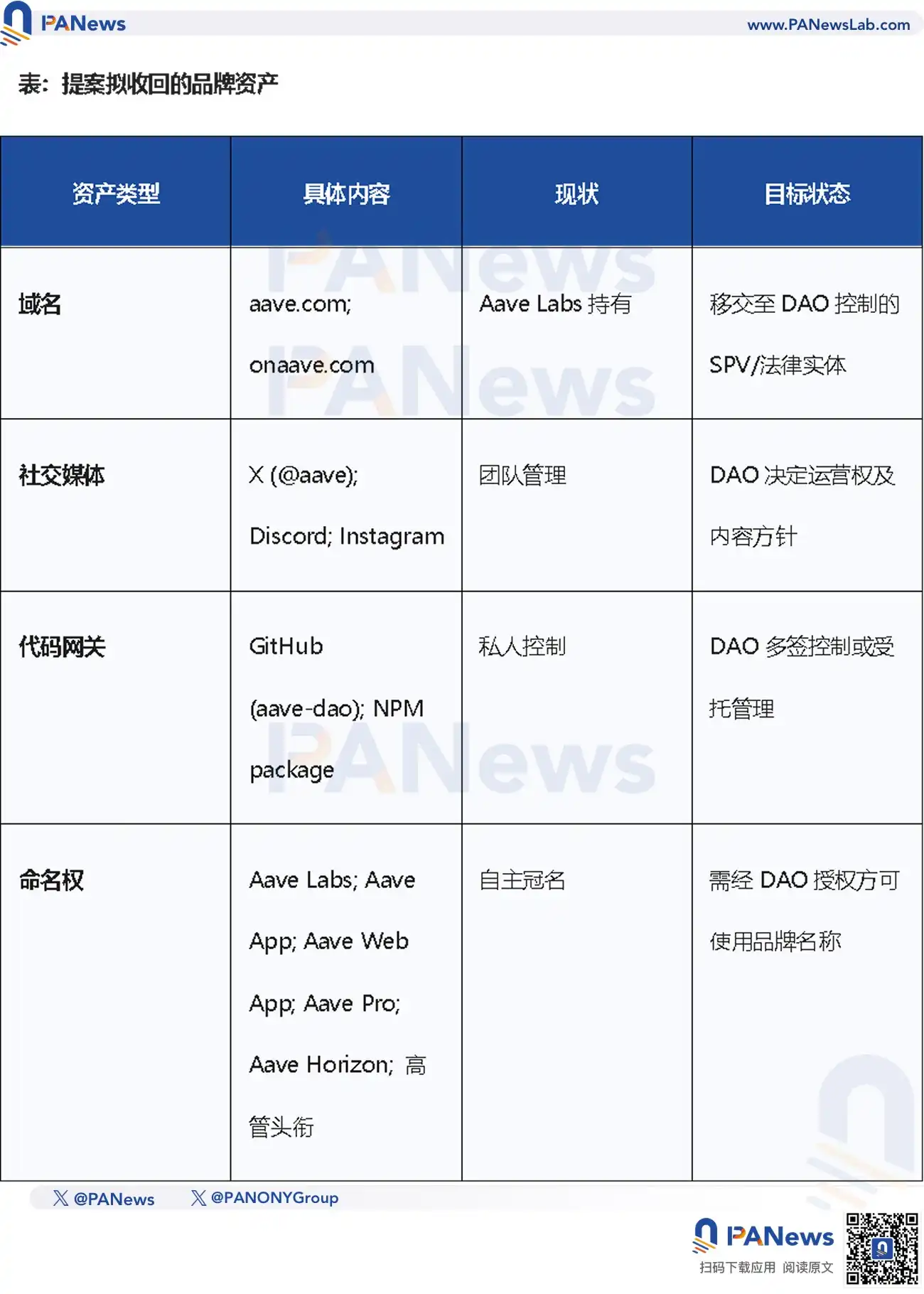
Under the shadow of the extreme proposal, Aave's former CTO Ernesto Boado proposed a more constructive proposal, "Phase 1 - Ownership," sounding the horn for the sovereignty recovery operation: reclaim domains like aave.com; reclaim control of official social media accounts like X and Discord; reclaim control of the GitHub code repository.

Boado stated bluntly, True decentralization must include the decentralization of "soft assets." He proposed establishing a legal entity controlled by the DAO to hold these brand assets, thereby gaining recourse rights within traditional legal jurisdictions. This marks the DAO's attempt to evolve from a loose on-chain voting organization into a "digital sovereign entity" with actual legal definition and assets.

Token Price Falls, Whales Cut Losses and Exit, Labs Unilaterally Advances Vote Sparking Discontent

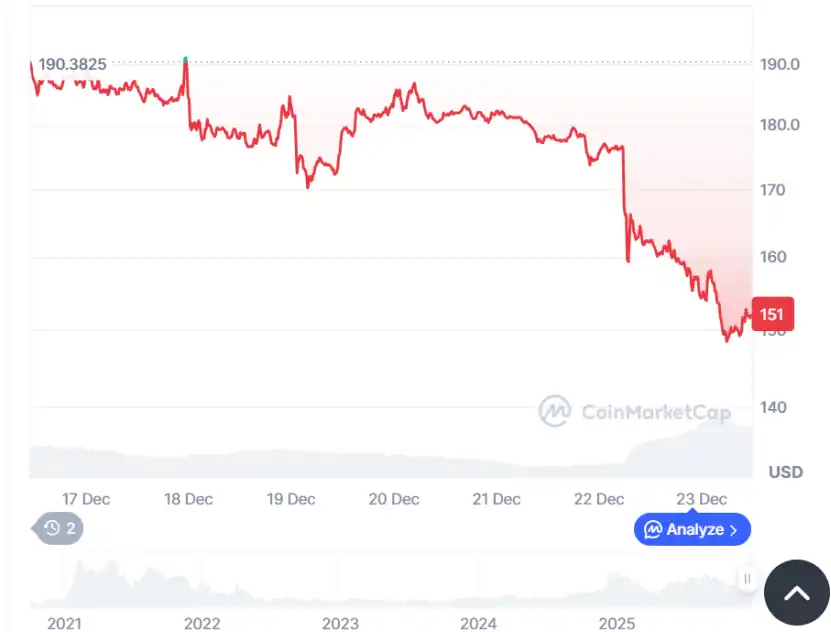
When governance is bogged down in internal strife, the secondary market votes with its feet. Although the protocol's locked $34 billion in assets showed no significant fluctuations, the price of the AAVE token, directly related to the interests of holders, fell continuously by over 25% in two weeks.

On December 22, the second-largest AAVE holder cut its losses and exited. It had accumulated 230,000 AAVE tokens at an average price of around $223 but liquidated its position at approximately $165 amid the governance chaos, resulting in an estimated paper loss of $13.45 million. The whale's departure is a negative statement on Aave's current governance chaos and a deep skepticism about its future value capture ability: if revenue can be easily stripped away, the token's past valuation model will also become invalid.

Adding insult to injury, Labs unilaterally advanced the proposal to the Snapshot voting stage without the original author Boado's consent, causing strong protests from the community. Multiple representatives criticized this move as violating normal governance procedures.

Crypto KOL 0xTodd pointed out two problems: 1) The voting date was set for December 23-26, during the Christmas holiday period when many users are on vacation, potentially leading to reduced voting participation; 2) Currently, Boado's proposal is still in the discussion phase. Typically, a discussion post requires 3-6 months of repeated communication and optimization before entering the voting stage.

But Stani replied that the new ARFC proposal vote fully complies with the governance framework, and voting is the best way to solve the problem and the ultimate form of governance. This shows a divergence between the DAO's focus on procedural correctness and Labs' focus on result-oriented efficiency.

On the other hand, absolute procedural correctness could also stifle efficiency. If the development team's commercial returns are completely剥夺, Labs' motivation to promote the protocol's V4 upgrade will significantly decrease. If the brand is managed by the DAO, and it encounters legal disputes, the lack of a directly responsible person could lead to difficulties in rapid response, potentially resulting in the brand being directly seized by regulators.

As of now,赞成票仅占3%,呈现一边倒的局势. The community may enter the "proposal—vote" process again,甚至恶化为一个死循环. In fact, Aave has already wasted a significant amount of time while stuck in this governance deadlock.

However, this crisis of confidence is likely only a阶段性 problem, and a necessary "rite of passage" for Aave as a DeFi leader.

Many seasoned DAO participants stated that even a governance benchmark like Aave is濒临分裂, perhaps the DAO governance model itself is not feasible. But the fact that such a transparent, intense, and evenly matched debate can occur within Aave itself proves its extremely high degree of decentralized governance. This collective correction ability is precisely the value of decentralized governance.

A more critical turning point came from external regulation. On December 20, the U.S. SEC ended a four-year investigation without taking any enforcement action against Aave. This was widely interpreted as regulatory默许 for highly decentralized governance models like Aave's.

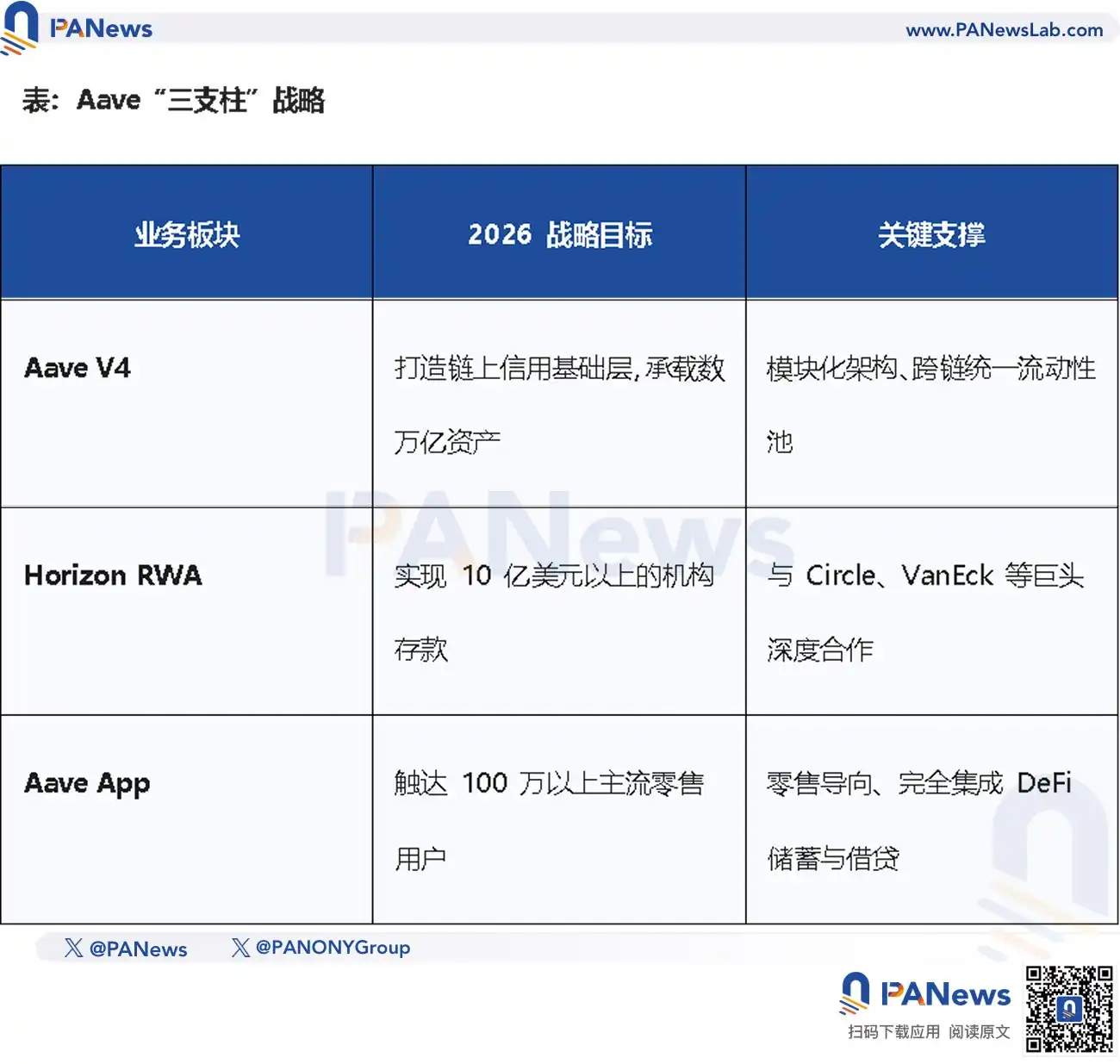
Amid the storm, Aave's fundamentals remain highly resilient. Founder Stani not only continued to respond to质疑, personally increasing his holdings by a total of $15 million in AAVE (suffering over $2 million in paper losses), but also announced a "Three Pillars" strategy to rebuild community consensus and trust. However, Stani's move was also questioned by the community, seen as an attempt to increase his own voting power. Even so, simply increasing Labs' influence in governance is still a temporary solution, not a fundamental cure.

Governance Evolution, Hybrid Organization May Become Path to Restructuring Interests

As the风波 evolves, a path of governance evolution may emerge: Aave might transform from a single on-chain protocol into a "hybrid organization."

Returning to the content of the latest proposal itself, the model proposed by Boado essentially redefines the relationship between the two parties in three aspects.

  1. DAO Owns Sovereignty: Not only owns the smart contracts, but also the brand, domains, trademarks, and user distribution channels;
  2. Labs as a Professional Service Provider: Labs no longer profits as an "owner," but as a top-tier service provider authorized by the DAO. The fees Labs charges on the frontend should be based on DAO authorization and may need to determine a sharing ratio with the DAO to cover development costs and feed back into the token's value;
  3. Contractual Governance: All profit distribution is no longer based on "voluntary donations" but on on-chain service agreements.

In fact, this controversy is highly similar to the 2023 incident where Uniswap Labs charging frontend fees caused community dissatisfaction. Ultimately, Uniswap reached an agreement with the community by defining Labs' commercialization rights and the decentralization of the protocol layer.

Aave may go a step further. It attempts to solve the problem of "who is the brand owner" at its legal root through the "Phase 1 - Ownership" proposal. If the proposal passes in the future, any commercialization move by Labs must receive DAO approval at the procedural level, which would fundamentally end the possibility of "invisible privatization."

Aave's dilemma is a universal contradiction faced by all decentralized protocols. Does the market want an efficient but potentially centralized "product," or a decentralized but potentially inefficient "protocol"? This not only concerns the permission boundaries of governance tokens but also determines the evolution direction of DeFi.

Currently, this $30+ billion DeFi experiment is at a crossroads, and its future direction will be slowly revealed through each on-chain vote.

Связанные с этим вопросы

QWhat was the initial event that triggered the governance crisis within Aave?

AThe crisis began when Aave Labs switched the asset swap provider on its official frontend from ParaSwap to CoWSwap on December 4, 2025, and it was subsequently discovered that the associated fees were being redirected to an address controlled by Labs instead of the community DAO, amounting to an estimated $10 million in lost annual revenue for the DAO.

QWhat is the core philosophical conflict exposed by this incident in the DeFi space?

AThe incident exposed the fundamental conflict over who has ultimate authority in a decentralized protocol: the founding team that controls the code and brand, or the DAO community that holds the governance tokens. It questions the balance between a development team's commercial incentives and the governance rights of token holders.

QWhat drastic action did a community member propose in the 'Poison Pill' governance proposal?

AThe 'Poison Pill' proposal demanded that Aave Labs unconditionally transfer all code repositories, intellectual property, and trademarks to the DAO; that the DAO acquire 100% of Labs' equity, effectively making it a subsidiary; and that Labs return all historical frontend revenue generated from using the Aave brand to the community treasury.

QHow did the market react to the internal conflict, as evidenced by the actions of a major token holder?

AThe market reacted negatively, with the AAVE token price falling over 25% in two weeks. A major whale, the second-largest holder, sold their entire position of 230,000 AAVE at a significant loss of approximately $13.45 million, signaling a loss of confidence in the protocol's governance and future value-capture ability.

QWhat potential new organizational structure is suggested as a solution to resolve the conflict between Aave Labs and the DAO?

AA potential solution is the evolution into a 'hybrid organization' model. This would involve the DAO holding sovereignty over all assets (including brand, domains, and trademarks), Aave Labs operating as a professional service provider authorized by the DAO with a clear revenue-sharing agreement, and all relationships being governed by on-chain service agreements rather than voluntary donations.

Похожее

South Korean Exchanges 'Battle' Regulators, Challenging the Boundaries of Enforcement and Legislation

South Korea's cryptocurrency industry is engaged in a rare, direct confrontation with regulators. The Financial Intelligence Unit (FIU), the primary anti-money laundering (AML) watchdog, has recently imposed heavy penalties on major exchanges like Upbit and Bithumb for alleged violations involving unregistered overseas VASPs and AML procedures. However, exchanges are now actively challenging these actions in court and through industry associations. In a significant shift, the Seoul Administrative Court ruled in favor of Upbit's operator, Dunamu, overturning part of an FIU-ordered business suspension. The court found the FIU's penalty criteria and justification insufficiently clear. Similarly, the court suspended the enforcement of a six-month business suspension against Bithumb pending a final ruling, citing potential irreversible harm to the exchange. Beyond legal battles, the industry is contesting proposed legislative amendments. The Digital Asset eXchange Alliance (DAXA) strongly opposes a draft rule that would mandate Suspicious Transaction Reports (STRs) for all crypto transfers over 10 million KRW (~$6,800). DAXA argues this "poison pill" clause violates legal principles and would overwhelm the STR system, increasing reports from 63,000 to an estimated 5.45 million annually for major exchanges, thereby crippling effective AML monitoring. This conflict highlights a structural tension in South Korea's crypto governance: comprehensive digital asset laws are still developing, while regulators rely heavily on AML enforcement. The industry's move from passive compliance to active legal and legislative challenges signifies a new phase, pressing for clearer rules and more proportionate enforcement. While short-term disputes may intensify, this clash could ultimately lead to a more mature and sustainable regulatory framework for South Korea's vibrant crypto market.

marsbit44 мин. назад

South Korean Exchanges 'Battle' Regulators, Challenging the Boundaries of Enforcement and Legislation

marsbit44 мин. назад

After 50x Storage Surge, Justin Sun Always Looks to the Next Decade

Sun Yuchen, known for his controversial stunts like a $30 million lunch with Warren Buffett (canceled due to a kidney stone) and eating a $6.2 million duct-taped banana, is often overshadowed by a significant fact: his decade-long track record of spotting major investment trends. In 2016, he famously advised young people to invest in Bitcoin, Nvidia, Tesla, and Tencent instead of buying property. A hypothetical $20,000 investment in Nvidia and Tesla from that list would now be worth over 50 million RMB. His latest major call was on November 6, 2025, predicting a "50x storage opportunity" tied to the AI boom, which materialized with Sandisk's stock surging nearly 50-fold by 2026. Looking ahead, Sun now focuses on the next frontier: Physical AI. He identifies four key areas: 1. **Embodied AI/Robotics**: He sees this reaching its "iPhone moment," with companies like UBTech and Galaxy General leading in commercialization. 2. **Drones**: Viewed as the first commercially viable form of Physical AI, revolutionizing sectors from warfare (e.g., AeroVironment's Switchblade) to logistics. 3. **Spatial Computing**: Beyond VR, it's about AI understanding physical space, a foundational technology for robotics and autonomous systems, exemplified by Apple's Vision Pro. 4. **Space Exploration**: After a 2025 suborbital flight with Blue Origin, Sun advocates for space as the ultimate frontier, discussing blockchain's potential role in space asset management and data transactions. His investment philosophy involves betting on entire, inevitable trends rather than single companies. For robotics, he sees Tesla (the body/manufacturer) and Nvidia (the brain/AI platform) as complementary plays. In defense drones, he highlights companies making tanks obsolete (AeroVironment) and those augmenting fighter jets (Kratos). For space, he participated in Blue Origin's flight and anticipates SpaceX's potential IPO to redefine the sector's valuation. Sun Yuchen's vision frames the next two decades not as a revolution in information flow (like the internet), but in the fundamental operation of the physical world through AI-powered robots, autonomous systems, and spatial intelligence, ultimately extending human and AI activity into space. While many still focus on conventional assets, he continues to look toward the next technological horizon.

marsbit1 ч. назад

After 50x Storage Surge, Justin Sun Always Looks to the Next Decade

marsbit1 ч. назад

The Billionaires Behind the Most Expensive Midterm Election in History

"The Most Expensive Midterm Elections and Their Billionaire Backers" This analysis details the unprecedented scale of spending in the 2026 midterm elections, highlighting the key billionaire donors shaping the political landscape. Jeff Yass, founder of Susquehanna International Group, has contributed over $81 million, ranking third among individual donors behind George Soros ($102.6M) and Elon Musk ($84.8M). Yass is a major donor to Trump's MAGA Inc. and supports school choice and various candidates. Overall, federal committees have raised over $4.7 billion this cycle, with political ad spending projected to reach $10.8 billion. Republican-aligned groups are significantly out-raising their Democratic counterparts. "Dark money" from undisclosed sources continues to grow. The core stakes involve control of Congress and policy direction for Trump's final term. Donors are also motivated by specific issues: Sergey Brin and Chris Larsen are funding opposition to a proposed California wealth tax and supporting crypto-friendly policies. Other top donors include OpenAI's Greg Brockman and his wife Anna ($50M total to MAGA Inc. and an AI-focused PAC), Richard Uihlein ($45.3M to conservative causes), venture capitalists Marc Andreessen and Ben Horowitz (each over $44M to crypto/AI PACs and MAGA Inc.), Miriam Adelson ($42.6M to GOP leadership PACs), Paul Singer ($33.9M), and Diane Hendricks ($25.8M to MAGA Inc.). The article notes that the peak fundraising period is still ahead, with major primaries approaching.

marsbit1 ч. назад

The Billionaires Behind the Most Expensive Midterm Election in History

marsbit1 ч. назад

The Largest IPO in History Is Approaching, Surpassing SpaceX, 28 Years of AI Self-Iteration, Countdown to Intelligence Explosion

"Anthropic Nears Trillion-Dollar IPO, Fueled by Explosive Growth and 2028 'Intelligence Explosion' Warning Anthropic is considering a deal valuing the AI company near $1 trillion, potentially leading to one of the largest IPOs ever and surpassing SpaceX. Its revenue has skyrocketed, with Annual Recurring Revenue (ARR) reaching $45 billion in May 2026—a 500% increase in just five months. This vertical growth curve is attributed to its key products, Claude Code and Cowork, dominating AI coding and enterprise collaboration. Beyond commercial success, co-founder Jack Clark issued a pivotal warning in an interview: there is a greater than 50% chance that by the end of 2028, AI systems will achieve recursive self-improvement—the ability to autonomously build a 'better version' of themselves, initiating an 'intelligence explosion.' This prophecy underpins the company's astronomical valuation, as the market prices in the potential for transformative and disruptive AI. Further signaling its ambition, Anthropic formed a $1.5 billion joint venture with Goldman Sachs and Blackstone, aiming to disrupt traditional consulting firms like McKinsey by deploying Claude AI for complex strategic work. This move tests AI's capacity to replace high-level cognitive labor, a precursor to its predicted autonomous evolution. The narrative presents a dual future: unprecedented economic opportunity alongside significant risks like economic restructuring and security threats. Anthropic's meteoric rise and Clark's 2028 prediction frame the coming years as a countdown to a potential technological singularity."

marsbit1 ч. назад

The Largest IPO in History Is Approaching, Surpassing SpaceX, 28 Years of AI Self-Iteration, Countdown to Intelligence Explosion

marsbit1 ч. назад

Торговля

Спот
Фьючерсы

Популярные статьи

Как купить S

Добро пожаловать на HTX.com! Мы сделали приобретение Sonic (S) простым и удобным. Следуйте нашему пошаговому руководству и отправляйтесь в свое крипто-путешествие.Шаг 1: Создайте аккаунт на HTXИспользуйте свой адрес электронной почты или номер телефона, чтобы зарегистрироваться и бесплатно создать аккаунт на HTX. Пройдите удобную регистрацию и откройте для себя весь функционал.Создать аккаунтШаг 2: Перейдите в Купить криптовалюту и выберите свой способ оплатыКредитная/Дебетовая Карта: Используйте свою карту Visa или Mastercard для мгновенной покупки Sonic (S).Баланс: Используйте средства с баланса вашего аккаунта HTX для простой торговли.Третьи Лица: Мы добавили популярные способы оплаты, такие как Google Pay и Apple Pay, для повышения удобства.P2P: Торгуйте напрямую с другими пользователями на HTX.Внебиржевая Торговля (OTC): Мы предлагаем индивидуальные услуги и конкурентоспособные обменные курсы для трейдеров.Шаг 3: Хранение Sonic (S)После приобретения вами Sonic (S) храните их в своем аккаунте на HTX. В качестве альтернативы вы можете отправить их куда-либо с помощью перевода в блокчейне или использовать для торговли с другими криптовалютами.Шаг 4: Торговля Sonic (S)С легкостью торгуйте Sonic (S) на спотовом рынке HTX. Просто зайдите в свой аккаунт, выберите торговую пару, совершайте сделки и следите за ними в режиме реального времени. Мы предлагаем удобный интерфейс как для начинающих, так и для опытных трейдеров.

1.3k просмотров всегоОпубликовано 2025.01.15Обновлено 2025.03.21

Как купить S

Sonic: Обновления под руководством Андре Кронье – новая звезда Layer-1 на фоне спада рынка

Он решает проблемы масштабируемости, совместимости между блокчейнами и стимулов для разработчиков с помощью технологических инноваций.

2.2k просмотров всегоОпубликовано 2025.04.09Обновлено 2025.04.09

Sonic: Обновления под руководством Андре Кронье – новая звезда Layer-1 на фоне спада рынка

HTX Learn: Пройдите обучение по "Sonic" и разделите 1000 USDT

HTX Learn — ваш проводник в мир перспективных проектов, и мы запускаем специальное мероприятие "Учитесь и Зарабатывайте", посвящённое этим проектам. Наше новое направление .

1.8k просмотров всегоОпубликовано 2025.04.10Обновлено 2025.04.10

HTX Learn: Пройдите обучение по "Sonic" и разделите 1000 USDT

Обсуждения

Добро пожаловать в Сообщество HTX. Здесь вы сможете быть в курсе последних новостей о развитии платформы и получить доступ к профессиональной аналитической информации о рынке. Мнения пользователей о цене на S (S) представлены ниже.

活动图片