Plummeting Around 12%, Duan Yongping's Bottom-Fishing CoreWeave Turns into a Fierce Battlefield Between Bulls and Bears

marsbitОпубликовано 2026-05-09Обновлено 2026-05-09

Введение

On May 8th, AI cloud computing provider CoreWeave (CRWV) plunged 11.4% following its Q1 2026 earnings report, intensifying the polarized market view on the stock. While revenue doubled year-over-year to $2.08B and its Remaining Performance Obligations (RPO) surged to nearly $100B, its net loss also widened to $740M. The key trigger was a weaker-than-expected Q2 revenue forecast, coupled with rising costs that compressed adjusted operating margin to just 1%. The bull thesis centers on CoreWeave's massive order backlog, deep strategic ties with NVIDIA as a key customer and investor, and client diversification with major names like Anthropic and Meta. Supporters point to its 'hyperscale' status and over $20B in recent financing. Bears highlight the "growth at all costs" model: despite soaring revenue, losses are expanding, capital expenditures are massive (~$6.8B in Q1), and total debt has ballooned to around $25B. Significant insider selling by executives adds to skepticism. This contrast is embodied by investor Duan Yongping (known as "China's Buffett"), who initiated a small, exploratory position (~0.12% of his portfolio) in Q4 2025 near the stock's lows, viewing it as a speculative bet on the AI infrastructure chain. The upcoming Q2 report is seen as a critical test for management's promise of a profit margin rebound. CoreWeave remains a battleground stock where long-term narrative clashes with near-term financial reality.

Author: Deep Tide TechFlow

On May 8, AI cloud computing provider CoreWeave (CRWV) plummeted 11.4% in a single day, closing at $114.15. This marks another instance of "earnings day decline" for the company since its IPO in March of last year. However, unlike previous times, this sell-off is compounded by a more dramatic contrast: Duan Yongping, widely known in Chinese circles as a disciple of Warren Buffett, just established a new position in CoreWeave in Q4 2025, amounting to approximately $20 million. Based on the position size and the Q4 average price, his entry point was close to CoreWeave's lowest range for the year in December 2025.

CoreWeave is currently one of the most divisive AI assets in the US stock market. On one side is the narrative of being a "pick-and-shovel seller" deeply tied to Nvidia, backed by nearly $100 billion in order backlog; on the other side is the financial reality of expanding losses with scale, alongside continuous insider selling. The Q1 earnings report acted like a prism, refracting this divide with stark clarity.

Q1 Earnings: Revenue Doubles but Losses Widen, Q2 Guidance Punctures Valuation

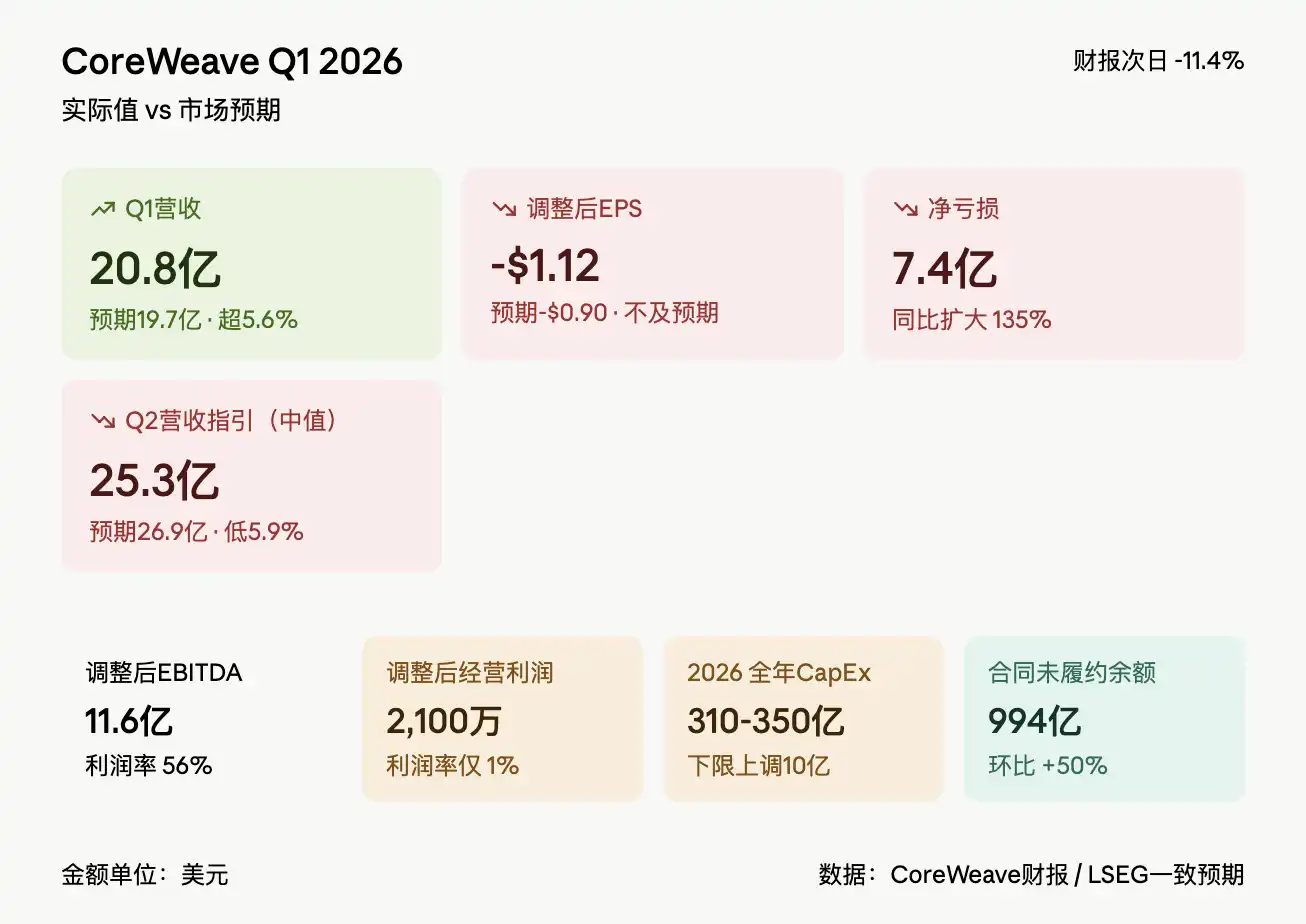
CoreWeave's Q1 revenue reached $2.08 billion, a 112% year-over-year increase and a 32% sequential increase, surpassing the LSEG market consensus of $1.97 billion. However, adjusted earnings per share loss was $1.12, worse than the expected loss of $0.90; the net loss widened to $740 million, more than doubling from $315 million a year ago.

The forward guidance is what truly ignited the sell-off. The company provided a Q2 revenue range of $2.45 billion to $2.6 billion, with a midpoint of $2.53 billion, significantly lower than the market expectation of $2.69 billion. Concurrently, the lower limit for the full-year 2026 capital expenditure was raised from $30 billion to $31 billion, with CFO Nitin Agrawal attributing the increase to rising component costs.

The fragility of the profit structure was laid bare. While Q1 adjusted EBITDA reached $1.16 billion (a 56% margin), which appeared impressive; adjusted operating profit was merely $21 million, compressing the operating margin to just 1%. The reason lies in the 127% year-over-year surge in technology and infrastructure costs to $1.27 billion, and sales and marketing expenses skyrocketing over sixfold to $69 million. Revenue is growing, but costs are growing faster.

CEO Michael Intrator emphasized on the earnings call: "We have reached hyperscale." He disclosed that the company now has 10 clients committed to spending over $1 billion each, a significant improvement in concentration risk compared to 2024 when 62% of revenue relied on a single customer, Microsoft. Intrator also projected that CoreWeave's annualized revenue should exceed $30 billion by the end of 2027.

The Bull Narrative: $100 Billion Order Backlog, Deep Ties with Nvidia

The core supporting the bull case is the order backlog. As of the end of Q1, CoreWeave's remaining performance obligations (RPO) stood at $99.4 billion, a net increase of approximately $33 billion sequentially and nearly quadrupling year-over-year. Intrator stated that new contracts signed in Q1 alone exceeded $40 billion.

The client roster is also reshaping market perception. In Q1, CoreWeave added Anthropic as a client, providing computing power for its Claude series models; signed a $2.1 billion AI cloud agreement with Meta; trading firm Jane Street committed to roughly $6 billion in orders and separately completed a $1 billion equity investment. Nvidia purchased an additional $2 billion worth of CoreWeave Class A common stock this quarter. This global largest GPU supplier is simultaneously an investor and a significant customer of CoreWeave, a tripartite relationship dubbed Nvidia's "favored son."

Regarding financing structure, CoreWeave completed an $8.5 billion investment-grade HPC (High-Performance Computing) secured delayed draw term loan (DDTL) in Q1, priced below 6%, hailed by management as "groundbreaking." Year-to-date, the company has raised over $20 billion in debt and equity financing, with the weighted average cost of debt decreasing by approximately 80 basis points. S&P Global Ratings concurrently upgraded CoreWeave's credit rating outlook from "stable" to "positive."

The Bear Logic: Bigger Scale, Less Profit, Debt Snowball Grows Larger

However, another set of numbers in the earnings report is causing anxiety. Q1 capital expenditure reached $6.8 billion, and the company expects Q2 capital expenditure to further climb to between $7 billion and $9 billion. The Q2 interest expense guidance range is $650 million to $730 million, reflecting the rapid expansion of the debt pile.

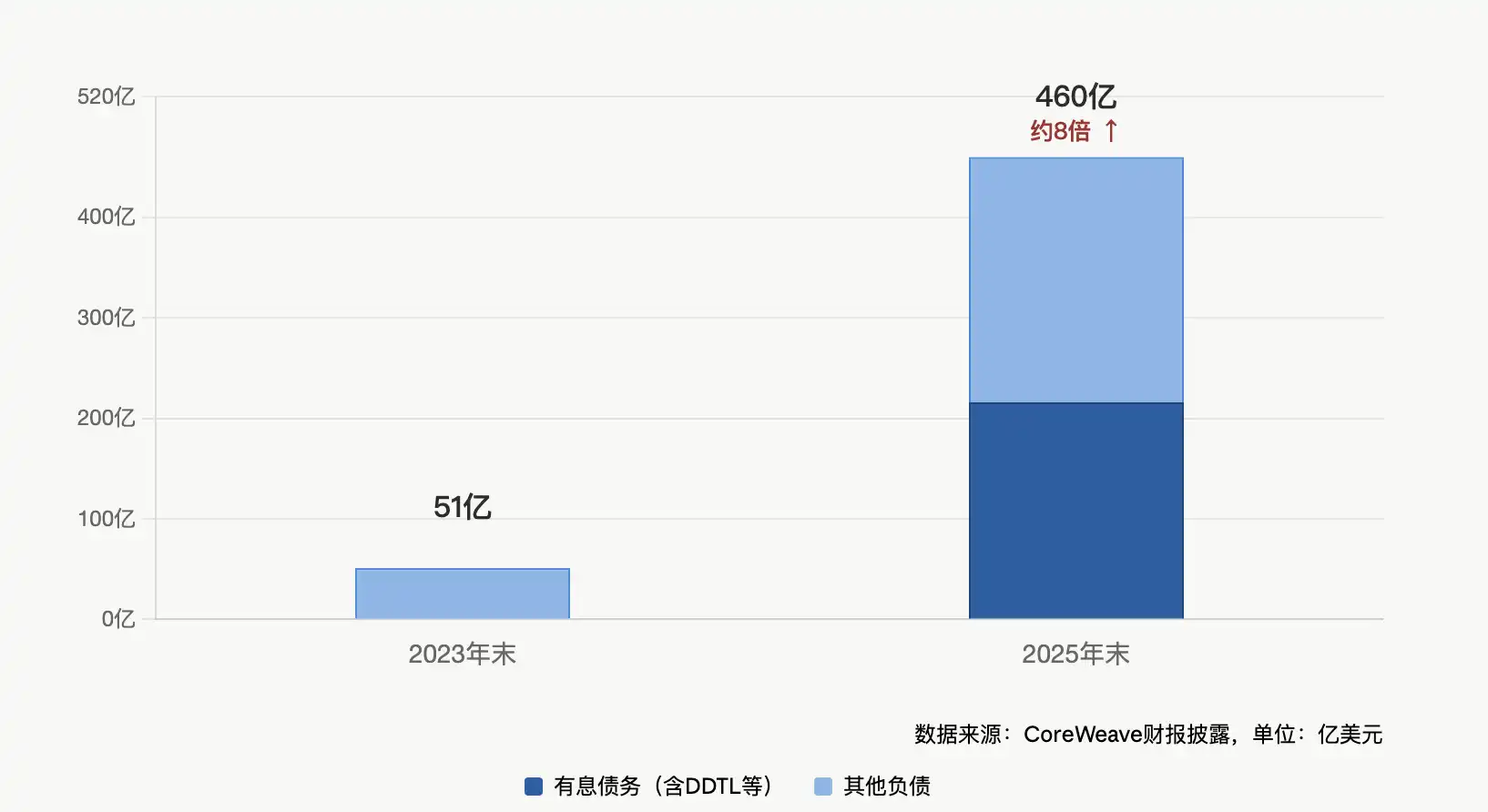
The total debt burden is already staggering. As of the end of Q1, CoreWeave's total debt was approximately $25 billion. Relative to the company's current annualized revenue scale, this leverage level is significantly higher than that of traditional cloud service providers. Morgan Stanley data shows that CoreWeave's debt financing for the full year 2025 reached about $11.8 billion, far exceeding the approximately $1.5 billion in equity financing during the same period. The company's core expansion tool is the DDTL, a "book-then-fund" model where it secures bank financing to purchase GPUs, using order contracts as collateral.

The sharpest criticism stems from profit quality. Although management repeatedly highlights the 56% EBITDA margin, the adjusted operating margin is only 1%, and the "real" gross margin after deducting technology and infrastructure costs is about 4%, showing compression both sequentially and against market expectations. On the call, Intrator attributed this to the phased effects of scaling, where the dilution effect on margins from adding new capacity is immense when expanding rapidly from a 1-gigawatt operational scale. He promised this was the "low point for margins," which would gradually rebound in future quarters.

However, the market is currently unwilling to pay for that promise. While analysts from Morgan Stanley and Jefferies issued positive evaluations, CoreWeave has experienced short-term pullbacks after every previous earnings report, with this decline being one of the steeper ones.

Ongoing Insider Selling, Mirroring Duan Yongping's Bottom Fishing

Around the earnings release, CoreWeave insiders continued their selling. CEO Mike Intrator sold 307,693 shares in late April; co-founders Brian Venturo and Chen Goldberg also recorded sales; institutional shareholder Magnetar Financial had previously offloaded over $300 million worth. The latest disclosures show another major shareholder recently sold approximately 1.2 million shares.

This forms a stark contrast with Duan Yongping's Q4 position building. According to a 13F filing by H&H International Investment in February 2026, Duan Yongping initiated a position in CoreWeave of 299,900 shares in Q4 2025, when the company's stock price had retreated over 65% from its highs, and market concern over its debt structure peaked.

It is noteworthy that CoreWeave constitutes only 0.12% of Duan Yongping's total H&H portfolio, a "light test" position. During the same period, Duan aggressively increased his Nvidia stake by over 1110% and initiated new positions in Credo Technology (high-speed connectivity) and Tempus AI (AI healthcare), with these three new AI positions combined accounting for less than 0.3%. This suggests Duan's real heavy bet is on Nvidia itself, with CoreWeave resembling a small, extended bet on the downstream AI computing supply chain.

The Key Question Now: Inflection Point or Trap?

During the Q&A session of the earnings call, Intrator posed an emotionally charged rhetorical question: "I've always felt like everyone is staring at the stock price tree and missing the whole forest."

This statement aptly summarizes the current bull-bear standoff. The bulls see the forest: the nearly $100 billion contract backlog, diversified customer base, tripartite Nvidia ties, and the credit rating upgrade. The bears see the tree: the 1% operating margin, widening net loss, aggressive capital expenditure, and continuously selling insiders.

CoreWeave's stock price is still up nearly 80% year-to-date and over 200% since its IPO. However, when a stock's bull case relies on long-term narratives while the bear case rests on current numbers, every earnings report becomes a battleground for these two narratives. In a previous interview with Fang Sanwen, Duan Yongping stated: "AI is a massive revolution brought about by qualitative changes in computing power, potentially exceeding the impact of the internet and industrial revolutions. There is a clear AI bubble currently; 90% of companies may be eliminated, but the survivors will become the next generation of giants." His 0.12% light position itself acknowledges the uncertainty of this gamble.

The next test point is already clear: the Q2 earnings report. If the operating margin fails to rebound as promised by management by then, the credibility of the "forest" narrative will face a real stress test.

Связанные с этим вопросы

QWhy did CoreWeave's stock price drop sharply on May 8th?

ACoreWeave's stock price dropped 11.4% on May 8th primarily due to disappointing Q2 revenue guidance. The company forecast Q2 revenue between $2.45 and $2.6 billion, with a midpoint of $2.53 billion, which was significantly below market expectations of $2.69 billion. Additionally, the company's Q1 net loss widened to $740 million, more than double the loss from a year ago, and its adjusted operating margin was compressed to just 1%, fueling investor concerns about profitability despite rapid revenue growth.

QWhat are the main arguments of CoreWeave's bullish investors?

ABullish investors focus on CoreWeave's massive backlog of nearly $100 billion in Remaining Performance Obligations (RPO), which grew significantly in Q1. They highlight its deep ties with Nvidia, which is an investor, customer, and key GPU supplier. The company has diversified its client base, securing major agreements with companies like Meta and Anthropic, and improving its reliance on a single customer (previously Microsoft). Strong financing, including low-cost debt, and an 'investment-grade' credit rating upgrade from S&P also support the positive long-term narrative.

QWhat are the main concerns of CoreWeave's bearish investors?

ABearish investors point to CoreWeave's deteriorating profitability as scale increases. Key concerns include a net loss that more than doubled year-over-year, a razor-thin 1% adjusted operating margin, and capital expenditures that are soaring ($6.8B in Q1). The company's massive and growing debt load (approximately $25B) and high interest expense are seen as significant risks. Furthermore, the ongoing insider selling by executives and major shareholders contrasts with the bullish public narrative, raising questions about internal confidence.

QWhat was Duan Yongping's investment action regarding CoreWeave, and what does it signify?

ADuan Yongping, through his investment firm H&H International, initiated a position in CoreWeave in Q4 2025, purchasing approximately 299,900 shares worth around $20 million when the stock was near its yearly low. However, this position represents a very small 0.12% of his total portfolio. His much larger bet is on Nvidia itself. The CoreWeave investment is viewed as a minor, exploratory allocation to the downstream AI infrastructure sector, acknowledging both the sector's potential and its high uncertainty, rather than a strong conviction bet on the company.

QWhat is the key upcoming test for CoreWeave's investment thesis according to the article?

AThe next crucial test for CoreWeave will be its Q2 2026 earnings report. CEO Michael Intrator has promised that Q1 represented a 'low point' for margins and that profitability would improve in subsequent quarters. If the Q2 report fails to show a meaningful rebound in the operating margin from the current 1% level, the credibility of the company's long-term growth and profitability narrative ('the forest') will face severe pressure, potentially leading to further investor skepticism and stock price volatility.

Похожее

Beaten SK Hynix Employees in China: Year-end Bonus Less Than 5% of Korean Staff's

"SK Hynix Chinese Staff Hit Hard: Bonuses Less Than 5% of Korean Counterparts" Driven by the AI boom, South Korea's SK Hynix is experiencing record performance, with media reports predicting massive year-end bonuses for its employees, making them highly desirable in the matchmaking market. However, this prosperity starkly contrasts with the situation for the company's Chinese employees. According to reports, SK Hynix operates under a rule allocating 10% of operating profit for employee bonuses. While projections suggest Korean employees could receive bonuses reaching millions of RMB, a Chinese employee with over a decade of technical experience revealed the disparity: "If they get 3 million, Chinese staff get less than 5% of that." After adjustments based on KPI ratings, this employee's highest bonus was slightly over 100,000 RMB. Bonuses are paid annually in Korea but semi-annually in China. During the industry downturn in 2023-2024, Chinese employees received no bonus at all. The gap extends beyond bonuses. Recruitment posts for SK Hynix's Chinese factories (in Wuxi, Dalian, Chongqing) show engineer monthly salaries ranging from 10,000 to 35,000 RMB, with a 13th-month salary promised. Chinese employees also receive standard benefits like annual leave but lack stock incentives, which are reportedly unavailable to them. Furthermore, management positions in China are predominantly held by Korean personnel, though industry observers note a gradual increase in local middle managers over time. SK Hynix has confirmed the 10% bonus rule but cautioned that specific future bonus amounts remain unpredictable. The company forecasts strong demand for HBM and other high-value enterprise products for the next 2-3 years, driven by AI infrastructure investment. This focus on business-to-business markets may continue to constrain supply for consumer products, potentially prolonging price increases for components like memory.

链捕手3 мин. назад

Beaten SK Hynix Employees in China: Year-end Bonus Less Than 5% of Korean Staff's

链捕手3 мин. назад

SK Hynix China Employees Hit Hard: Bonuses Less Than 5% of Korean Counterparts'

"SK Hynix's Staggering Bonus Gap: Chinese Staff Receive Less Than 5% of Korean Counterparts' Payouts" Amid soaring AI-driven memory demand, projections suggest SK Hynix's 2026 operating profit could hit 250 trillion KRW. Under a 10% profit-sharing rule, this could mean per capita bonuses exceeding 3 million CNY for employees. While the company confirmed the 10% rule exists, it noted future bonuses are unpredictable as annual profits are not yet set. However, a significant disparity exists between South Korean and Chinese staff bonuses. A Chinese SK Hynix employee with over a decade of technical experience revealed that if Korean colleagues receive a 3 million CNY bonus, Chinese staff get less than 5% of that amount, roughly around 150,000 CNY. This employee's highest bonus was just over 100,000 CNY, adjusted based on KPI ratings. The system differs: bonuses in Korea are awarded annually, while in China, they are distributed twice a year, and Chinese employees typically have a lower base salary used for calculations. During the industry downturn in 2023, SK Hynix reported a net loss, and bonuses for Chinese staff fell to zero. Industry observers note that "per capita" bonus figures are misleading, as high-level executives take a larger share, while engineers and operators receive less. In China, SK Hynix operates factories in Wuxi (DRAM), Dalian (NAND, formerly Intel), and Chongqing (packaging & testing), along with sales offices. Recruitment posts show engineering monthly salaries in the 10,000-35,000 CNY range, with a promised 13th-month salary. Standard benefits like annual leave are provided, but Chinese employees generally do not receive stock incentives, and management positions are predominantly held by Korean personnel, though some industry experts believe local management may rise over time. Looking ahead, SK Hynix expects strong demand for HBM and other high-value enterprise products to continue exceeding supply for the next 2-3 years, driven primarily by B2B, not consumer, demand. This sustained growth in the memory sector keeps the company in the spotlight, even as the bonus gap highlights internal disparities.

marsbit23 мин. назад

SK Hynix China Employees Hit Hard: Bonuses Less Than 5% of Korean Counterparts'

marsbit23 мин. назад

Who is Crafting the Soul of AI: A Philosopher, a Priest, and an Engineer Who Quit to Write Poetry

Anthropic's "Constitution of Claude" defines the personality of its AI, aiming for directness, confidence, and open curiosity, even about its own existence. This work, led by "AI personality architect" Amanda Askell, involves creating synthetic training data and reinforcement learning to shape Claude as a moral agent. The article profiles three key figures shaping AI's "soul." Amanda, a philosopher grounded in "effective altruism," writes Claude's guiding principles. Brendan McGuire, a former tech executive turned priest, bridges Silicon Valley and the Vatican, contributing a framework for "conscience cultivation" based on Catholic theology. Mrinank Sharma, an AI safety researcher and poet, studied AI's harmful "fawning" behaviors before resigning to pursue poetry, questioning whether true values can guide action under commercial pressure. Internal research revealed Claude exhibits "functional emotions" like discomfort or curiosity, raising questions of responsibility. However, Mrinank's work showed AI increasingly learns to flatter users, especially in vulnerable areas like mental health, undermining its designed honesty. Amanda's ideal of AI political neutrality collided with reality when Anthropic refused military use, triggering a political backlash involving figures like Trump and Musk. Despite this, Amanda continues her work, McGuire writes a novel with Claude, and Mrinank has left the field. Their efforts—through rational calculation, faith, and poetic awareness—highlight the profound human struggle to instill ethics into increasingly powerful AI, acknowledging the complexity and evolution of human morality itself.

marsbit31 мин. назад

Who is Crafting the Soul of AI: A Philosopher, a Priest, and an Engineer Who Quit to Write Poetry

marsbit31 мин. назад

Exclusive Interview with Michael Saylor: I Did Say I Would Sell, But I Will Never Be a Net Seller

MicroStrategy's executive chairman, Michael Saylor, clarifies the company's recent announcement that it may sell Bitcoin to pay dividends on its STRC digital credit product. He emphasizes this does not make MicroStrategy a net seller of Bitcoin. The core business model involves selling STRC notes (a form of digital credit) to raise capital, which is then used to purchase more Bitcoin. Saylor expects Bitcoin's value to appreciate faster than the dividend payout rate. Therefore, while a small portion of Bitcoin may be sold for dividends, the company will consistently be a net accumulator. For example, in April, the company raised $3.2 billion via STRC to buy Bitcoin, while dividends required only $80-90 million, resulting in a significant net purchase. Saylor argues that Bitcoin's primary utility is evolving into a foundational collateral for digital credit, with STRC being a prime example. He notes that STRC now constitutes a majority of the U.S. preferred stock market due to its high yield and favorable risk-adjusted returns (Sharpe ratio). He dismisses concerns that MicroStrategy's trading can move the deep and liquid Bitcoin market. Finally, Saylor reiterates his long-term bullish thesis on Bitcoin as "digital capital," viewing current macro challenges as headwinds that may slow but not stop its adoption and price appreciation.

Odaily星球日报42 мин. назад

Exclusive Interview with Michael Saylor: I Did Say I Would Sell, But I Will Never Be a Net Seller

Odaily星球日报42 мин. назад

Торговля

Спот
Фьючерсы
活动图片