Pantera, Coinbase back Surf’s $15M push to build crypto-native AI models

cointelegraphОпубликовано 2025-12-10Обновлено 2025-12-10

Введение

Surf, an AI platform for digital-asset analysis, has raised $15 million in a funding round led by Pantera Capital, with participation from Coinbase Ventures and DCG. The funds will support the development of Surf 2.0, which includes more advanced AI models, expanded proprietary data sets, and new agents for multi-step analytical tasks. Since its July launch, Surf has generated over one million research reports and achieved significant annual recurring revenue, serving major exchanges and research firms. Its multi-agent architecture analyzes onchain data, market behavior, and social sentiment through a chat interface, reducing manual workloads. The article also notes the growing convergence of AI and crypto, citing recent funding rounds for AI startups like Nous Research and Catena Labs, as well as Coinbase’s AI tool “Based Agent.” Additionally, a “human vs AI” trading competition hosted by Asterdex is currently underway, with human traders leading in returns as of mid-December.

Surf, an AI platform built for digital-asset analysis, raised $15 million in a round led by Pantera Capital with participation from Coinbase Ventures and DCG, to expand its AI models and enterprise tools.

The company offers a domain-specific model used by exchanges and research companies to analyze onchain activity, market behavior and sentiment. The funding will go toward Surf 2.0, which will introduce more advanced models, broader proprietary data sets and additional agents designed to handle multi-step analytical tasks.

Surf said its platform has seen rapid uptake since its launch in July, generating more than one million research reports and claiming millions in annual recurring revenue, with usage from a large share of major exchanges and research firms.

Surf’s model uses a multi-agent architecture that evaluates onchain data, social sentiment and token activity, delivering its analysis through a chat interface for research and reducing manual workloads for analysts and traders.

Related: How to turn ChatGPT into your personal crypto trading assistant

The continued integration of AI and digital assets

Artificial intelligence and blockchain are increasingly intersecting as more companies develop tools that leverage both technologies.

In April, decentralized AI startup Nous Research closed a $50 million Series A round led by Paradigm. The company is developing open-source AI models powered by decentralized infrastructure and uses the Solana blockchain to coordinate and incentivize global participation in training.

In May, Catena Labs, led by Circle co-founder Sean Neville, announced it had raised $18 million to develop a bank built around native AI infrastructure. The company said the system will be designed for both AI agents and human contributors, with AI handling day-to-day operations under human supervision.

In October, Coinbase introduced “Based Agent,” a tool that lets users create an AI agent with an integrated crypto wallet in just a few minutes to perform onchain actions such as trading, swapping, and staking.

As crypto and AI continue to converge, the role of human traders may also be shifting. The decentralized exchange Aster is running a “human vs AI” trading showdown, funding up to 100 human traders with $10,000 each to compete against top-performing AI agents Dec. 9–23.

Though the competition still has 13 days to go, Team Human was in the lead as of Wednesday, with a return on investment (ROI) of 13.36% compared to Team AI’s ROI of 0.54%.
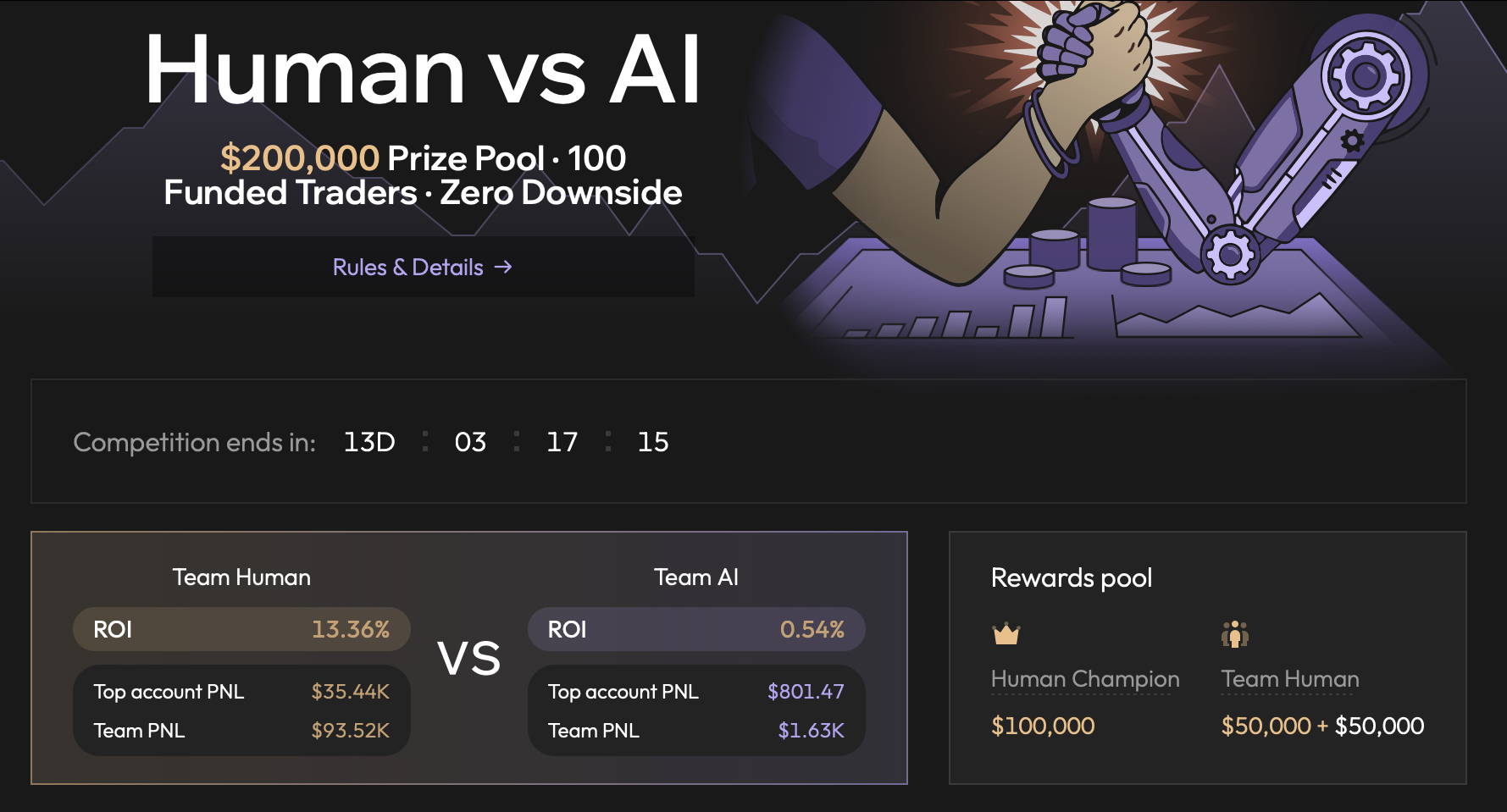
Human vs. AI trading scoreboard. Source: Asterdex.com

Magazine: Quantum attacking Bitcoin would be a waste of time: Kevin O’Leary

Похожее

Digital Asset Vaults Lose Their Luster: Twenty One's Stock Plunges 20% on First Trading Day

Twenty One Capital, a Bitcoin-focused treasury company backed by Tether and SoftBank, saw its shares plunge approximately 20% on its first day of trading on the New York Stock Exchange. The sharp decline reflects investor skepticism toward the valuation and business model of Bitcoin treasury companies amid a significant cryptocurrency market downturn. The company, led by 31-year-old CEO Jack Mallers, holds around 43,500 BTC. However, Bitcoin holdings have fallen over 25% since October’s all-time high near $126,000, putting pressure on the "digital asset treasury" (DAT) model. Despite its large Bitcoin reserve and strong backers, investors remain cautious due to unclear revenue paths and heavy reliance on Bitcoin’s volatile price. Twenty One went public via a merger with SPAC Cantor Equity. Unlike traditional companies, its valuation is almost entirely tied to its Bitcoin holdings, using metrics like "Bitcoin per Share" (BPS). Yet, the firm has not detailed how it will generate sustainable profits beyond holding Bitcoin. The sell-off reflects broader pressures on crypto-linked stocks. Other Bitcoin-heavy companies like Metaplanet, Trump Media, and Empery Digital also face millions in unrealized losses and falling share prices as Bitcoin corrects. The debut underscores high volatility and valuation risks in crypto investing. Despite innovation and institutional support, long-term viability requires transparent business models and clear profitability strategies—lessons even high-profile crypto firms must heed.

cointelegraph_中文26 мин. назад

Digital Asset Vaults Lose Their Luster: Twenty One's Stock Plunges 20% on First Trading Day

cointelegraph_中文26 мин. назад

Торговля

Спот
Фьючерсы
活动图片