Markets React Sharply as Fed’s Rate Cut Triggers Unexpected Sell-Off Across Major Crypto Assets

bitcoinistОпубликовано 2025-12-11Обновлено 2025-12-11

Введение

Markets reacted sharply to the Fed’s widely anticipated 25-basis-point rate cut, which triggered a significant crypto sell-off. Despite the cut, the Fed’s cautious tone and internal disagreements created uncertainty, with Chair Powell suggesting a potential pause in January. Projections indicated fewer future cuts than markets expected. Crypto reversed gains quickly, with total market cap falling 3% in 24 hours. Bitcoin dropped below $90,000, Ethereum fell over 3%, and altcoins saw deeper losses. Over $1 billion in leveraged positions were liquidated, and technical indicators turned bearish. Traders now await the PCE inflation report for further direction, as the market faces tighter liquidity and heightened macro sensitivity.

The Federal Reserve’s latest policy move was expected to calm financial markets. Instead, it set off one of the sharpest intraday reversals the crypto sector has seen this quarter.

After delivering a widely anticipated 25-basis-point rate cut, the Fed signaled a slower path ahead, and that shift in tone was enough to send major digital assets back. What looked like a supportive macro backdrop quickly turned into a trigger for risk-off positioning across Bitcoin, Ethereum, and the broader altcoin market.
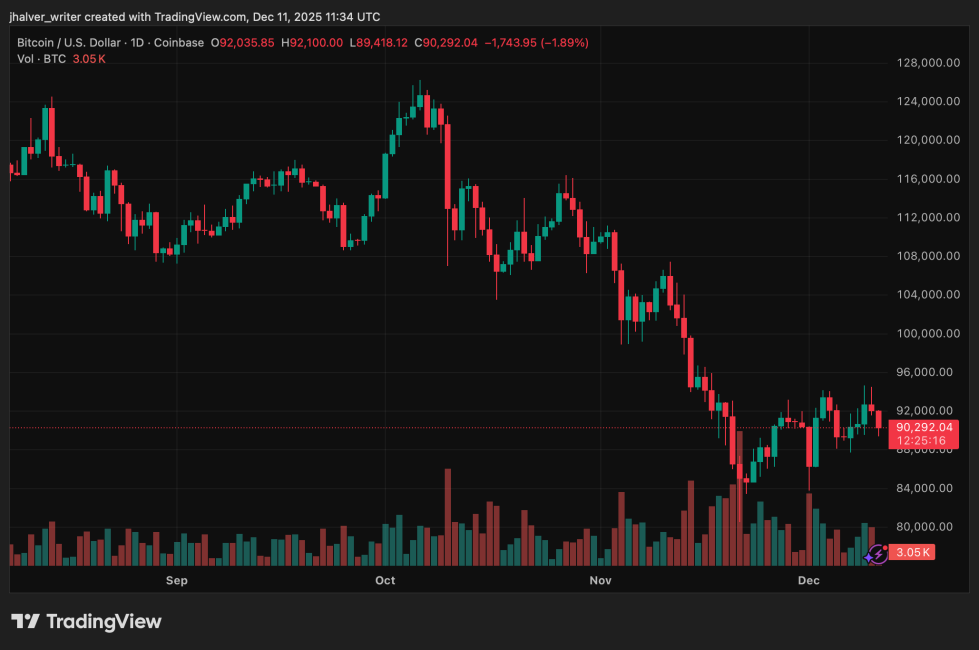
BTC's price trends to the downside on the daily chart. Source: BTCUSD on Tradingview

Mixed Fed Messaging Fuels Market Confusion

The Federal Open Market Committee lowered the federal funds rate to a 3.5%–3.75% range, marking its third cut of the year. But internal disagreement, including two members opposing any cut and one pushing for a larger one, highlighted uncertainty within the Fed itself.

Chair Jerome Powell supported that ambiguity by saying the central bank remains “well-positioned to wait,” a phrase traders interpreted as a possible pause in January.

Economic projections added more caution. Officials expect only one additional cut in 2026, far fewer than markets had priced in. While the Fed also announced $40 billion in monthly Treasury bill purchases, seen by some as “QE-lite”, investors viewed the move more as an attempt to steady liquidity in a slowing economy.

The dollar weakened sharply after Powell ruled out a 2026 rate hike, but expectations for near-term easing also faded. Futures markets quickly shifted, showing a higher probability of no change in January.

Crypto Markets Reverse as Liquidity Concerns Rise

The crypto market reacted within minutes of the Fed’s press conference. Total market capitalization fell roughly 3% over the next 24 hours, with Bitcoin sliding below $90,000 after briefly testing highs near $94,000 earlier in the week.

Ethereum lost more than 3%, and altcoins posted deeper declines as investors moved toward lower-risk exposure.

Rising liquidations added pressure. More than $1 billion in leveraged positions were wiped out in the broader market over a 24-hour period, while Bitcoin dominance climbed to around 58%, reflecting a shift away from speculative assets.

Technical signals also turned bearish, with total crypto market cap slipping below the 200-day EMA and several major tokens failing to reclaim key resistance levels.

What Comes Next as Traders Await Fresh Data

Attention now turns to the upcoming PCE inflation report, the Fed’s preferred gauge. A stronger-than-expected reading could delay further easing and intensify volatility across risk assets. For crypto traders, key levels include Bitcoin’s support zone near $89,000 and ETF flow trends, which continue to influence market stability.

The latest Fed decision currently has left markets searching for clearer direction. Until that emerges, crypto appears set to navigate a period of tighter liquidity, cautious sentiment, and elevated sensitivity to macroeconomic signals.

Cover image from ChatGPT, BTCUSD chart from Tradingview

Похожее

From Airdrop Myth to King of Derivatives: A Look Back at Hyperliquid's 2025 Conquest

Reviewing crypto's growth in 2025, Hyperliquid stands out. It began the year with an epic airdrop and strong price performance, capturing attention. By year's end, it transformed into a top-four revenue-generating platform in crypto, earning over $650M and at one point capturing 70% of all perp trading volume. Its success was no accident. In Q1, it solidified its reputation by being first to list new assets like the TRUMP perp and launched HyperEVM, a smart contract layer. Q2 saw explosive growth: HYPE token surged 4x from April lows, and HyperEVM's TVL grew from $350M to $1.8B. The platform gained mainstream media coverage. In Q3, major wallets like Phantom and MetaMask integrated via Hyperliquid's builder codes, routing $158B in volume and earning partners nearly $50M. A high-profile stablecoin bid war was won by Native Markets, aligning with Hyperliquid's bootstrapped ethos. However, new competitors like Aster and Lighter emerged with aggressive airdrops. Q4 brought permissionless listings via HIP-3, enabling new markets like stock perps and yield-bearing collateral. Yet, HYPE fell nearly 50% from its September peak due to market conditions, a rare ADL event during a crash, and the start of team token unlocks. As perps go mainstream in 2026, Hyperliquid's true test begins. Its success came from building a superior product and ecosystem without shortcuts. Maintaining leadership will require doing it all over again in a crowded field.

marsbit10 мин. назад

From Airdrop Myth to King of Derivatives: A Look Back at Hyperliquid's 2025 Conquest

marsbit10 мин. назад

ETC Olympia Development Part 1: Implementing ECIP-1111 and ECIP-1112

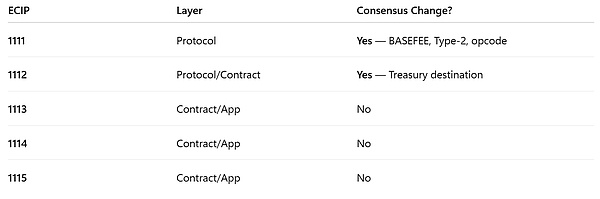
ETC Olympia Development Series Part 1: Implementing ECIP-1111 and ECIP-1112 This article introduces the first part of the Ethereum Classic Olympia development series, focusing on the implementation of ECIP-1111 and ECIP-1112. These two proposals are the only components within the broader Olympia framework that modify consensus behavior. ECIP-1111 modernizes the fee market by introducing an EIP-1559-style mechanism with a base fee and optional priority tip (miner tip). A key difference from Ethereum is that the base fee is not burned but is instead redirected to a treasury address defined by ECIP-1112. It also adds support for Type-2 transactions and the BASEFEE opcode (0x48), ensuring compatibility with modern EVM tooling and wallets. Crucially, it does not change miner rewards, monetary policy, or existing transaction types. ECIP-1112 defines an immutable, deterministic treasury smart contract that will receive the redirected base fees. This vault is designed to be receive-only upon activation, meaning it can accumulate value but cannot distribute funds until a separate, subsequent governance layer (defined in other ECIPs) is deployed and activated on the contract layer. The article emphasizes the modular architecture of Olympia. While the suite includes five ECIPs (1111-1115), only these two affect consensus. This separation ensures that the core protocol remains minimal and auditable, while future governance and funding mechanisms can evolve independently at the contract level without requiring further hard forks. The implementation is currently in the draft stage per the ECIP-1000 process. Any decision to move forward with mainnet activation will require extensive testing on the Mordor testnet and full community review.

金色财经14 мин. назад

ETC Olympia Development Part 1: Implementing ECIP-1111 and ECIP-1112

金色财经14 мин. назад

Market Divergence: SOL Becomes Institutional Darling, Terra Ecosystem Completely Collapses, ZEC Shorts Forced to 'Hold the Bag' by Whales?

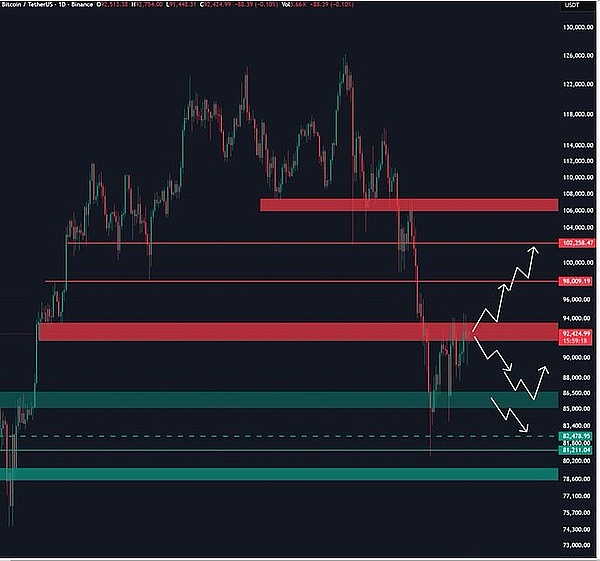
The cryptocurrency market is currently experiencing significant divergence, with some assets surging while others face severe downturns. Bitcoin (BTC) is testing a critical resistance zone between $92,000 and $94,000. A successful breakout could propel it toward $100,000, while failure may lead to a pullback below $90,000. Similarly, Ethereum (ETH) is approaching its key level at $3,400. Holding above this could push it to $3,700-$3,800, otherwise a retest of $3,000 support is likely. Solana (SOL) has emerged as a major institutional favorite. Despite market volatility, SOL ETFs continue seeing consistent inflows. Support from major platforms like Coinbase, which integrated Solana DEX functionality, and growing adoption by traditional finance giants like JPMorgan and Nasdaq, highlight strong fundamental strength. Accumulating SOL gradually is recommended. In contrast, the Terra ecosystem (LUNA, LUNC, USTC) has effectively collapsed. Founder Do Kwon received a 15-year prison sentence, and the project's $40 billion collapse triggered a broader market crisis. These assets are considered uninvestable. Zcash (ZEC) presents a cautionary tale for short sellers. Many are trapped in losing positions as large holders (whales) maintain price range, collecting funding rates systematically. This strategy allows whales to profit from perpetual funding while gradually squeezing shorts. The lesson: take profits quickly when shorting ZEC and avoid greed. Overall strategy: Wait for BTC/ETH to break key levels before acting, accumulate SOL steadily, avoid Terra assets entirely, and short ZEC with extreme caution.

金色财经15 мин. назад

Market Divergence: SOL Becomes Institutional Darling, Terra Ecosystem Completely Collapses, ZEC Shorts Forced to 'Hold the Bag' by Whales?

金色财经15 мин. назад

Торговля

Спот
Фьючерсы
活动图片