OpenAI Shuts Down Sora, Disney's $1 Billion Investment Goes Down the Drain, AI Video Market Reshuffles

marsbitОпубликовано 2026-03-27Обновлено 2026-03-27

Введение

OpenAI has officially shut down its AI video generation product Sora, including its consumer app, API, and the sora.com domain, as of March 24, 2026, just six months after its public launch. This decision also led to the cancellation of Disney’s three-year licensing agreement and a planned $1 billion investment in OpenAI. The tech community’s reaction highlighted Sora’s lack of real-world adoption, with many questioning whether the product was ever widely used. Competitors like Runway Gen-4, Kling 3.0, and Google Veo are now positioned as the main players in the AI video market. Sora’s shutdown is attributed to high operational costs—estimated at $15 million daily during peak usage—coupled with limited revenue alignment ahead of OpenAI’s expected IPO. Deepfake concerns related to Sora’s content generation features also contributed to its termination. OpenAI will retain Sora’s underlying technology for internal "world simulation" research aimed at robotics field, but no consumer-facing video products are planned. Current Sora users are advised to migrate to alternatives such as Runway, Kling, or Pika. The exit of OpenAI is expected to lead to market consolidation, potential price increases from remaining providers, and greater enterprise opportunities for competitors like Kling. Runway, in particular, may raise subscription prices due to increased demand.

Author: RoboRhythms

Compiled by: Deep Tide TechFlow

Deep Tide Guide: On March 24, 2026, OpenAI shut down Sora's App, API, and domain all at once. Disney's three-year licensing agreement and $1 billion investment subsequently collapsed.

The first reaction from the tech community was not regret, but "Did anyone actually use this thing?"—this statement speaks volumes more than any official announcement. Runway, Kling, and Google Veo are now the only real players left in the AI video space.

Full Text Below:

The product that was supposed to bring AI video generation to the masses has disappeared. OpenAI shut down Sora on March 24, 2026, taking down the standalone App, API, and sora.com, just about six months after the product's high-profile public release.

The timing is awkward. Disney signed a three-year licensing agreement in December 2025, authorizing OpenAI to use iconic characters like Mickey Mouse and Cinderella for Sora-generated content, and planned to invest $1 billion in OpenAI.

All of this is now canceled.

I think the most telling thing is the reaction from the tech community: the mainstream sentiment wasn't regret, but "Did anyone actually use this thing?" This statement reveals the product's actual trajectory more truthfully than any official announcement.

If you were using Sora or planning to build a product based on its API, here's what you need to know.

What Exactly Happened

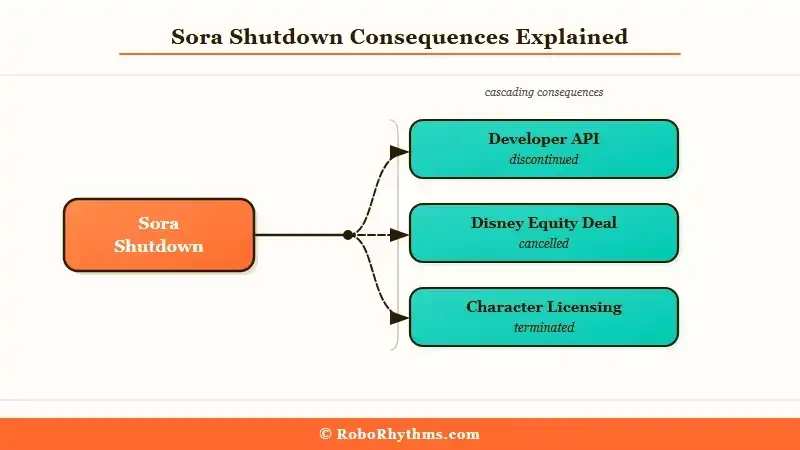
Sora's shutdown is a complete product termination, covering the App, developer API, and the sora.com domain.

OpenAI confirmed on March 24 that the entire Sora product line would be completely shut down. This is not a pivot, a rebrand, or a merger into another product.

The App is gone, the API is being shut down, sora.com is being taken offline.

Here is everything that was terminated:

  • Sora consumer App (text-to-video)
  • Sora API (developer and enterprise access)
  • sora.com website

Disney's planned $1 billion equity investment in OpenAI

The three-year character licensing agreement with Disney announced in December 2025

The Disney angle is not a footnote. A $1 billion deal collapsing within three months of its announcement suggests the relationship had already become complicated before the shutdown was officially announced.

Both Variety and Bloomberg confirmed that the deal was directly called off due to Sora's cessation of operations.

Only one part of Sora remains: the internal research team continues to advance what OpenAI calls "world simulation" research, aimed at robotics applications.

This project has nothing to do with the video product you might have used. OpenAI explicitly positions this as infrastructure research, not a future consumer product.

This also aligns with a pattern I've reported on before. OpenAI has a history of terminating products that no longer fit its revenue roadmap, and the timing—ahead of a planned IPO—follows the same logic.

Why This Is More Serious Than It Sounds

Sora's shutdown isn't just a product failure; it's OpenAI publicly conceding an entire AI category to the competitors it once looked down upon at its launch.

When Sora first debuted in 2024, the demos were stunning. Posts on r/singularity garnered hundreds of thousands of views, with a widespread belief that OpenAI had once again leapfrogged all competitors overnight.

Runway, Pika, and Kling were supposed to become irrelevant.

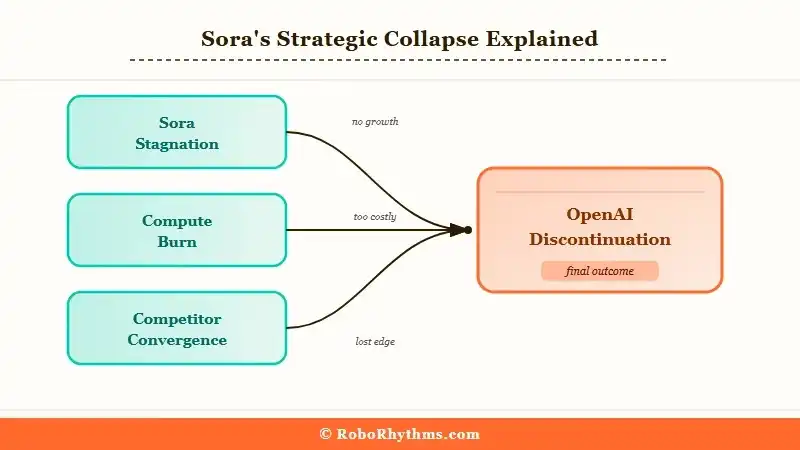
But the product stalled after its public launch. Runway Gen-4 kept iterating and shipping, Kuaishou's Kling 3.0 closed the quality gap faster than most analysts expected.

Google Veo's compute advantages were something OpenAI couldn't easily match in this non-core revenue赛道 (market).

Compute cost is the most staggering number. Analysts estimate Sora's compute cost peaked at around $15 million per day during peak usage.

For a company focused on pre-IPO financials, this was an extremely difficult expense to justify when the models that actually drive revenue (GPT-5 series, Operator API, enterprise contracts) all require more investment.

Then there was the deepfake issue. TechCrunch, in its shutdown report, called Sora "the most disturbing app on your phone," referring to the cameo feature that allowed users to insert real people into AI-generated scenes.

The backlash from this feature was significant, and in my view, the reputational drag made the shutdown decision easier than it otherwise might have been.

The industry impact is now clear: Runway, Kling, and Google Veo are the true players in AI video. The strategic uncertainty that OpenAI's presence created for every competitor has now been removed.

What This Means For You

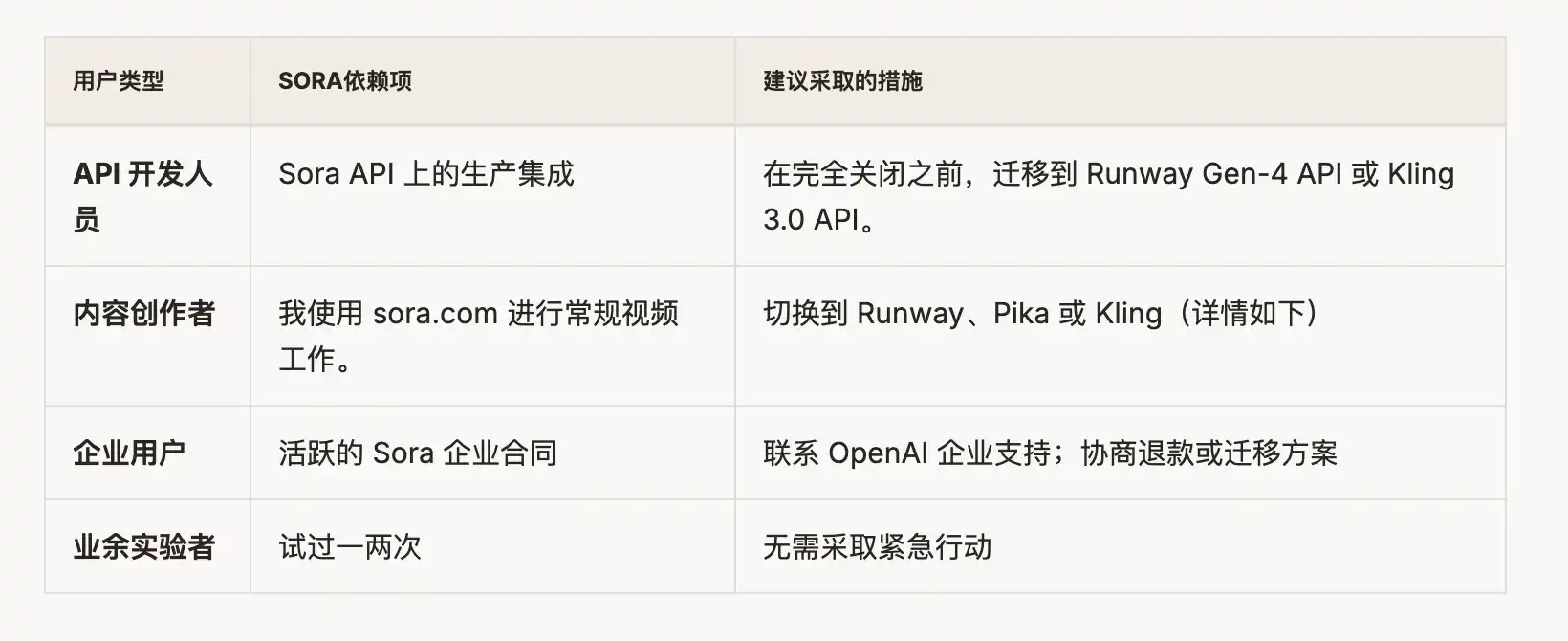
If you were using Sora or accessing its API, you need to act immediately. The shutdown timeline is effective now.

The three tools currently best positioned to absorb Sora's former user base:

Runway Gen-4—Technically closest to Sora's cinematic quality goals, with a mature API and an active developer community. Best for professional long-form video production.

Kling 3.0—Kuaishou's model has become the community's top choice for realistic motion effects and is the tool most recommended by former Sora users in migration discussions. Developer API available.

Pika 2.0—Faster, cheaper, and easier to use than the above two. Plans start around $8/month. Best for content creators prioritizing speed over cinematic quality.

If your primary use case is for virtual avatars or talking head videos, rather than purely generative scenes, the tool choice differs.

What Happens Next

The AI video market is about to consolidate, and prices will rise.

With OpenAI's exit, Runway, Kling, and Google Veo no longer operate in a market where a well-funded new entrant could颠覆 (disrupt) everyone's pricing expectations at any moment.

This changes the commercial dynamics for all remaining players.

My predictions for the next six months:

Runway will raise subscription prices. Demand will surge with the influx of Sora users, and Runway's pricing has been below what its competitive position could support. The diminished threat from OpenAI gives them clear room to reprice.

Google Veo will more aggressively push a consumer product. Google had been deliberately quiet about a public rollout for Veo; the addressable market is now clearer. Expect a more prominent consumer product before the end of 2026.

Kling will target the enterprise contracts Disney's departure leaves behind. Kuaishou has been building Kling as a professional-grade product. The OpenAI-Disney deal effectively blocked some enterprise relationships that are now reopening.

An outcome I don't see happening: OpenAI returning to AI video with a consumer product. Internal signals point to video being recast as robotics infrastructure research, and the window for re-entering the market is shorter than this company's typical development cycles.

From my experience observing every AI category, the company that wins is the one that accumulates iterations over time, not the one that released the best demo. Sora peaked at the demo; Runway has been accumulating for three years.

Frequently Asked Questions

Q: As of March 2026, is the Sora App still usable?

As of March 24, 2026, Sora has entered the shutdown process. OpenAI has not announced a specific final access date for all users, but the termination process has begun. Do not rely on its continued availability for any production environment work.

Q: What is the best alternative to Sora for API developers?

Runway Gen-4 currently has the most mature and stable developer API among AI video tools. Kling 3.0 also offers API access and is widely recommended in developer migration discussions. It's advisable to test both before fully migrating.

Q: Why did Disney cancel its $1 billion investment in OpenAI?

Disney's investment and the three-year licensing agreement were directly tied to the Sora product line, including rights to use Disney characters in AI-generated videos. With Sora's shutdown, the licensing arrangement lost its foundation. Both parties have called it off, according to Bloomberg and Variety.

Q: What will happen to the internal Sora research team at OpenAI?

The team continues to work on world simulation research for robotics. This work will not result in any consumer or developer-facing video products. OpenAI positions it as infrastructure research, not something on the product roadmap.

Q: Does this mean OpenAI is broadly scaling back consumer products?

OpenAI has made it clear that pre-IPO resources are focused on enterprise software, programming tools, and agent products. Sora's shutdown aligns directly with this direction.

Q: Is Google Veo now the best Sora alternative?

Veo is technically strong, but for developers and content creators, Runway Gen-4 and Kling 3.0 are currently more accessible and better supported. For most users needing to migrate today, Runway or Kling is the more practical choice.

Связанные с этим вопросы

QWhat was the main reason for OpenAI shutting down Sora according to the article?

AThe article states that Sora was shut down due to its high operational costs (estimated at $15 million daily in compute costs during peak usage) and because it did not align with OpenAI's pre-IPO focus on revenue-generating products like enterprise software, coding tools, and agent products. Additionally, reputational issues from deepfake concerns made the decision easier.

QWhich companies are now considered the main players in the AI video generation market after Sora's shutdown?

AAccording to the article, the main players in the AI video generation market after Sora's shutdown are Runway (Gen-4), Kling (3.0 by Kuaishou), and Google Veo.

QWhat was the financial and strategic impact of Sora's shutdown on Disney?

ADisney's planned $1 billion equity investment in OpenAI and a three-year character licensing deal, announced in December 2025, were both canceled as a direct result of Sora's shutdown. The deal had granted OpenAI rights to use Disney characters like Mickey Mouse and Cinderella in AI-generated content.

QWhat is the future of the internal Sora research team at OpenAI?

AThe internal Sora research team will continue its work, but it has been re-focused on 'world simulation' research for robotics applications. This is positioned as infrastructure research and will not lead to any future consumer or developer-facing video products.

QWhat does the article predict will happen to the AI video market in the next six months following Sora's exit?

AThe article predicts market consolidation and price increases. Specifically, it forecasts that Runway will raise its subscription prices, Google will more aggressively push Veo as a consumer product, and Kling will target the enterprise contracts that were previously blocked by the OpenAI-Disney deal.

Похожее

The More It Rises, the More Dangerous? The Systemic Risks Behind SpaceX's Soaring Valuation

Summary: The article raises concerns about the systemic risks posed by SpaceX's skyrocketing valuation, arguing that modern market mechanics, rather than fundamentals, are driving its price discovery. Following SpaceX's market capitalization surpassing $3 trillion in after-hours trading, the author contends that the market is no longer functioning properly. The core issue is not SpaceX's business prospects but the unhealthy market structure surrounding it. With limited float and the imminent launch of options trading, the stage is set for a potential "gamma squeeze"—a feedback loop where market makers hedging call options are forced to buy shares, pushing the price higher and attracting more speculative momentum traders. This mechanism, seen previously with Tesla and meme stocks, can decouple valuation from financial reality. The danger escalates as extreme valuations force passive funds, ETFs, pensions, and major indices to hold the stock. If SpaceX grows large enough—hypothetically reaching $5 or even $10 trillion—its performance would increasingly dictate broader market indices, embedding systemic risk. The author warns that when price appreciation itself becomes the primary bullish thesis, the market transforms from a capital allocation mechanism into a self-reinforcing speculative machine, endangering the retirement savings of ordinary investors tied to passive strategies. The piece questions whether such a system can still perform its fundamental role of price discovery.

marsbit5 мин. назад

The More It Rises, the More Dangerous? The Systemic Risks Behind SpaceX's Soaring Valuation

marsbit5 мин. назад

How Much of the Subscription Fee You Pay to Claude Can Optical Module Companies Get?

How much of your $20 Claude Pro subscription actually goes to AI model companies like Anthropic? A viral breakdown image highlights the fundamental valuation challenge for AI applications versus traditional SaaS. Unlike SaaS with high software margins, AI subscriptions face variable "inference costs": every user query consumes GPU time, power, and cloud resources. This creates a tension between fixed subscription fees and usage-driven expenses. While the specific dollar splits are illustrative, the core question is whether AI revenue can achieve SaaS-like margins as usage scales. Currently, infrastructure providers (cloud platforms, GPU makers like Nvidia, HBM suppliers, power/data centers) capture more certain revenue from growing AI usage. Their financials reflect pricing power and faster earnings validation. The bullish case hinges on efficiency improvements: model optimization, caching, smaller models, and custom chips could lower per-token costs over time. The key debate is whether cost declines can outpace increases in user workload complexity and volume. Ultimately, for AI companies to command high SaaS-like valuations, they must demonstrate not just user growth but also improving gross margins after accounting for inference costs. Investors will scrutinize not just subscriber numbers, but usage patterns, enterprise pricing tiers, and real efficiency gains.

marsbit15 мин. назад

How Much of the Subscription Fee You Pay to Claude Can Optical Module Companies Get?

marsbit15 мин. назад

OpenAI's Hyperliquid Pre-IPO Pricing Venture: Why Did It Last Only Half a Year?

The article discusses the rise and fall of Pre-IPO pricing markets on the Hyperliquid blockchain. Trade.xyz, an anonymous team, successfully built the largest pre-market for SpaceX (SPCX) by launching a contract with a clear anchor: the eventual Nasdaq listing price. This provided inherent price stability and validation. In contrast, Ventuals, a team backed by Paradigm, failed despite holding exclusive contracts for highly sought-after companies like OpenAI and Anthropic. Its key mistake was its pricing mechanism. For companies with no near-term IPO date, Ventuals' oracle relied partly on opaque private market transactions and, critically, partly on its own contract's moving average price. This created a self-referential feedback loop where prices were artificially propped up and detached from genuine supply and demand, leading to illiquid markets. Ventuals shut down after nine months, settling positions at final prices of $1,341.80 for OpenAI and $1,618.90 for Anthropic. Ironically, some employees and late-stage investors of these very companies reportedly used these flawed Ventuals prices for valuation reference, highlighting the acute demand for any price signal in illiquid private markets. The article concludes that while demand for pre-IPO trading is real and growing, with players like Coinbase now entering the space, the fundamental challenge remains: without a public listing to provide a definitive price anchor, these markets struggle to establish truly accurate and liquid pricing. The need for a transparent, self-correcting market is the critical lesson from Ventuals' failure.

marsbit31 мин. назад

OpenAI's Hyperliquid Pre-IPO Pricing Venture: Why Did It Last Only Half a Year?

marsbit31 мин. назад

With Daily Active Users Reaching 3-4 Times That of the Industry's Second Place, Which Crack in the Office Agent Market Has Tencent's WorkBuddy Torn Open?

Tencent's AI office assistant, WorkBuddy, has achieved daily active users (DAU) 3-4 times that of the industry's second-place product, primarily driven by non-technical users like HR, operations, and administrative staff. Its rapid growth, starting with a public beta in March 2026, highlights a key strategic divergence from competitors like OpenAI's Codex and Anthropic's Claude Code. Unlike those tools, which originated as developer-focused assistants (in command lines or IDEs) and are now expanding towards office scenarios, WorkBuddy was built from the ground up for non-technical office workers. Its development was user-driven, initiated after腾讯云's team observed non-technical employees using their CodeBuddy coding tool for general tasks. WorkBuddy's design is defined by three core decisions aimed at lowering barriers: 1) Using natural language instead of technical concepts, so users describe their goal without needing to understand prompts or agents. 2) Providing pre-packaged "Skill" templates for common office tasks like data processing, content creation, and research. 3) Natively integrating into existing腾讯 ecosystems like腾讯 Docs and WeChat, making the agent a seamless part of the user's workflow rather than a separate tool. This "scenario encapsulation" approach, prioritizing the shortest path for users to get work done, contrasts with the "underlying capability" focus of Codex and Claude, which offer more flexibility but require more technical setup. Analysts confirm WorkBuddy's leading market position in China by mid-2026, with massive user and request growth following its launch. Recognizing the same trend of surging non-technical adoption, OpenAI and Anthropic are now pivoting their products with features like role-based plugins (Codex) and a simplified desktop interface (Claude Cowork). However, adapting tools built for developers requires significant changes to interaction models and integrations. WorkBuddy currently holds an estimated six-month lead in delivering a complete solution for non-technical office users. Its recently launched enterprise version aims to solidify this advantage. The competition underscores two valid paths: embedding agent capabilities directly into familiar work environments versus building powerful, general-purpose agents that users must learn to access. WorkBuddy's early success demonstrates the effectiveness of the former strategy for mainstream office adoption.

marsbit40 мин. назад

With Daily Active Users Reaching 3-4 Times That of the Industry's Second Place, Which Crack in the Office Agent Market Has Tencent's WorkBuddy Torn Open?

marsbit40 мин. назад

Торговля

Спот
Фьючерсы
活动图片