OpenAI Launches Workflow Agent, GPTs Begin Countdown

marsbitОпубликовано 2026-04-24Обновлено 2026-04-24

Введение

OpenAI has launched Workspace Agents, an evolution of GPTs designed for teams. This new feature allows users to create reusable, shareable agents that automate repetitive workflows. Driven by Codex, these agents operate within their own workspace, can access files, call tools, and run continuously in the background. Users describe a workflow—such as collecting information, making judgments, generating results, and sending outputs—to ChatGPT, which then builds the agent. The entire team can use and refine the agent via ChatGPT or Slack. Once set up, the agent runs autonomously. Workspace Agents are team-shared, code-free, and manageable with predefined permissions and controls. They are suitable for structured, repeatable tasks involving multiple tools and continuous operation, such as software review, feedback整理, report generation, sales follow-up, and risk assessment. The system operates within clear rules, with sensitive actions requiring human confirmation. It aims to transform workflows from being person-dependent to being documented, executable, and reusable—akin to scientific management principles. Competing solutions from Microsoft and Google are also emerging in this space.

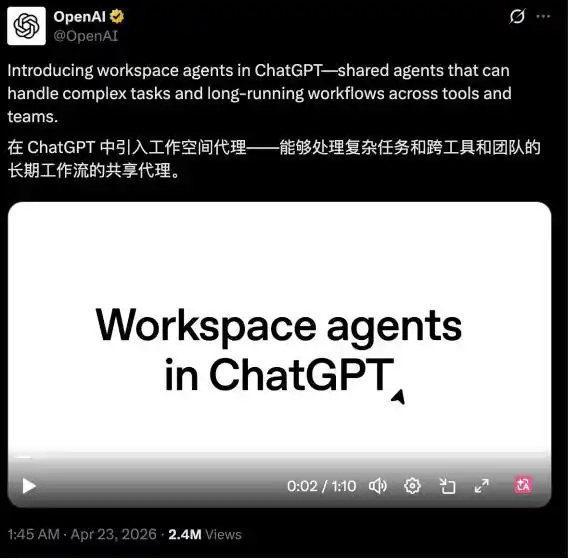
OpenAI released Workspace Agents in the early hours, marking the beginning of the countdown for GPTs.

This new product is introduced as an evolved form of GPTs, with a clear positioning: team-oriented, turning a repeatable workflow into a shareable, executable agent.

It is powered by Codex, has its own workspace, can access files, call tools, and execute tasks continuously in the background.

You describe a repetitive workflow to ChatGPT, such as collecting information, making judgments, generating results, and then sending the results out. ChatGPT will then build this process into an Agent, which your entire team can use in ChatGPT or Slack, making adjustments while using it.

Once set up, it will continue running in the background, even when people are away.

It sounds familiar, like OpenClaw · Team Edition.

01 Team-Shared Agent

As the name suggests, Workspace Agents are for work teams.

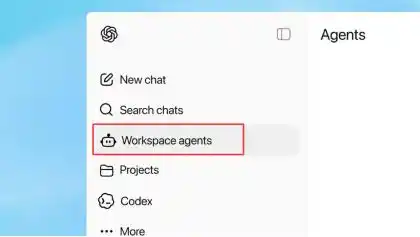
This new feature is placed in the sidebar of ChatGPT as a separate entry. Clicking on it reveals a space to build workflows.

You can create an agent from scratch or modify it based on official templates. The entire process requires no coding; simply describe the workflow in plain language, and the system will break it down step by step: what steps are needed, what tools are used, and what results are output.

The created agent will appear in the team directory, where other members can directly call the same agent or adjust and supplement the workflow during use.

In other words, the workflow becomes a reusable tool for the team. Moreover, it is not fixed; it can be continuously refined during use.

Additionally, Workspace Agents have their own workspace, allowing them to read and save files, call connected tools such as email, calendars, document systems, or other business systems, and execute code when needed.

They can also run continuously, either manually triggered or scheduled. Once the process starts, it will execute step by step without requiring human intervention at each step. As long as the entire process is feasible, you can let it run on its own.

The execution process is controllable. Workspace Agents follow pre-set permissions and control rules.

Each agent's accessible tools and data can be set in advance; operations involving content modification or sending information can require prior approval; administrators can monitor its usage and pause or adjust it when necessary.

Looking back at previous generations of products, this change becomes clearer.

The earliest GPTs were essentially prompt + knowledge base + Actions, configured once for single-user use, without true long-process execution capabilities.

Later, ChatGPT Agent could execute tasks but was more like a one-time call. It ended after completion, with no continuous operation or stable identity.

With Workspace Agents, this type of product has stabilized: it is team-shared, can run long-term, has its own context and memory, executes continuously according to preset processes, and includes permission and management mechanisms.

Based on the official description, this product is suitable for structured, repeatable tasks that rely on multiple tools and require continuous operation. For one-time conversations or temporary tasks, such complexity is likely unnecessary.

Workspace Agents are now available in research preview for ChatGPT Business, Enterprise, Education, and Teacher plans. For Enterprise and Education plans, administrators can manage these agents through role permissions.

02 Simplifying Processes Under Clear Rules

OpenAI provided five typical scenarios covering IT, product, operations, sales, and risk control functions.

None of these scenarios require coding. They share a commonality: the tasks themselves are not complex, but the information is scattered across different places, requiring people to search and organize repeatedly.

The first is software review: after an employee submits a software use or procurement request, the agent checks it against the company's existing tool list and security rules to determine whether the request can be approved, how to proceed, and, if necessary, directly submits the ticket.

The second is product feedback organization: the agent simultaneously checks Slack, customer service channels, and public forums to collect scattered user feedback, categorizes it briefly, identifies which are more important, organizes it into tickets, and outputs a阶段性 summary.

The third is weekly report generation: the agent pulls business data at fixed times, creates charts, writes a summary, and compiles a complete report for the team.

The fourth is sales lead follow-up: the agent checks new customer information, judges whether the customer is worth following up based on team rules, drafts a follow-up email, and syncs relevant content back to the CRM system.

The fifth is third-party risk assessment: the agent checks various information about suppliers, such as whether they are sanctioned, their financial status, and any negative news, then compiles a report according to the company's standards.

These five scenarios point to the same type of task, which is the primary use of Workspace Agents: if a process already exists but requires constant switching between different tools during execution, with results pieced together at the end, Workspace Agents can connect these steps and let them run sequentially.

The question then arises: while it's fine to let it collect information and organize processes, is it appropriate to leave judgment to it?

According to the official design, this issue has not been overlooked.

The "judgment" in Workspace Agents is not free rein; it operates within a set of rules.

For example, in the software review scenario, it checks against the company's existing list and security rules to decide whether to use a certain tool; in the sales lead scenario, it doesn't randomly pick customers but scores them based on pre-set team standards.

For more sensitive actions, such as modifying data, sending external messages, or creating schedules, the system can add a confirmation step by default. The process can run automatically, but critical nodes can still pause for human final decisions.

This actually defines a boundary.

Workspace Agents are more suitable for tasks where the rules are clear and the judgment criteria are already written.

If a task itself requires extensive ad-hoc judgment and constant adjustment based on context, it still needs human leadership.

03 Management Lessons from OpenClaw

From a management perspective, Workspace Agents solve not an efficiency problem but the organizational method of the process itself.

In many teams, workflows exist but are not fully documented.

They are scattered in different places: part in documents, part in systems, and part in the minds of those executing them.

The same task handled by different people may follow different sequences and judgment standards.

This is why many tasks seem simple but are difficult to stabilize.

In the late 19th century, Taylor proposed scientific management, whose core was transforming work from "relying on personal experience" to "steps that can be split, recorded, and repeatedly executed."

First, break down a task: how each step should be done, what standards to judge by, then fix these steps so different people can execute them in the same way.

What Workspace Agents do is very similar to this logic. A process must first be clearly written: when it starts, what data is used, what steps are involved, and what results are produced.

This content directly becomes an executable process. During execution, it no longer relies on someone remembering the next step but follows the defined sequence.

The change is that the process can be separated from people.

In the past, the "most familiar person" in a team often determined whether the process could run smoothly; now, this experience can be written into the process, and other team members can directly use the same approach.

Another important point is that the process must have boundaries: which parts can be automated, which must stop for confirmation, which data can be used, and which cannot—all must be set from the beginning.

From this perspective, Workspace Agents do not change the content of work; they change how the process exists.

The process is no longer just described; it can be run, reused, and continuously adjusted.

Tools like OpenClaw initially followed this direction: they attempted to let systems take over entire operational processes, turning actions that required step-by-step human completion at a computer into automatically executable workflows.

The difference is that Workspace Agents place this in a team environment and add layers of permissions, approvals, and management, making work more controllable.

Similar attempts are not unique to OpenAI.

Microsoft is advancing its Copilot Agents, embedding this capability into Microsoft 365, covering environments employees use daily, from email and documents to collaboration tools.

Google also launched an enterprise-side Agent platform today, focusing on how to manage and schedule large numbers of agents, allowing them to collaborate across different systems.

However, for enterprises, the difference is not just in functionality. The real cost lies in usage: whether employees need to learn new tools and whether processes need to be rebuilt determines whether these systems can truly operate.

The competition continues, but the direction is clear.

This article is from the WeChat public account "Letter AI", author: Yuan Xinyue

Связанные с этим вопросы

QWhat is the main purpose of OpenAI's newly released Workspace Agents?

AWorkspace Agents are designed for teams to create shareable, executable agents that automate repetitive workflows, allowing them to run continuously in the background with access to files, tools, and predefined rules.

QHow do Workspace Agents differ from previous GPTs and ChatGPT Agents?

AUnlike earlier GPTs (prompt + knowledge base + Actions for single users) and ChatGPT Agents (one-time execution without persistence), Workspace Agents are team-shared, have long-running capabilities, stable identities, context memory, and built-in permission management.

QWhat are some typical use cases for Workspace Agents mentioned in the article?

ATypical use cases include software compliance checks, product feedback aggregation, weekly report generation, sales lead follow-ups, and third-party risk assessments—all involving structured, repeatable tasks across multiple tools.

QHow does Workspace Agents handle decision-making and ensure control?

ADecision-making is rule-based, relying on predefined company standards (e.g., security rules or sales criteria). Sensitive actions like data modification or external communications can require human confirmation, and administrators can monitor, pause, or adjust agents.

QWhat management philosophy does Workspace Agents align with, according to the article?

AIt aligns with Taylor's scientific management principles, breaking down workflows into documented, repeatable steps that are detached from individual experience, making processes executable, shareable, and adjustable within teams.

Похожее

DAT Failing? Listed Companies Betting on HYPE Have Floating Profits of $12.5 Billion

Facing a potential need to sell Bitcoin to pay dividends amid a $12.5B quarterly net loss, the crypto treasury strategy pioneered by Strategy appears strained. In contrast, public companies that adopted a similar strategy by betting on the HYPE token are seeing massive gains, with collective unrealized profits exceeding $1.25 billion. Three key HYPE treasury companies are highlighted: 1. **Hyperliquid Strategies Inc. (PURR):** The largest holder, with approximately 22.3 million HYPE tokens valued at ~$1.636 billion, resulting in ~$1.22 billion in unrealized gains. It has fully transitioned from a biotech firm to a native crypto treasury, focusing on staking and ecosystem participation via validator operations. 2. **Hyperion DeFi (HYPD):** Holds about 2 million HYPE tokens (~$147M value) with ~$49.4M in gains. It is deeply integrated into the Hyperliquid ecosystem, running a top validator node and building DeFi products to generate additional yield. 3. **Lion Group Holding (LGHL):** A smaller player holding ~193,775 HYPE tokens (~$14.14M value), maintaining a long-term holding strategy alongside other crypto assets. The article argues that HYPE treasuries have an advantage over Bitcoin-based ones like Strategy's. Their success stems not just from price appreciation but from active on-chain participation—staking, earning validator rewards, and engaging with ecosystem protocols—creating a compounding "flywheel" effect. With Hyperliquid dominating the on-chain perpetuals market and HYPE's tokenomics encouraging buys and burns, these treasuries are positioned to benefit further if HYPE's price rises as some predict. While the original Bitcoin treasury strategy isn't declared a failure, the current narrative highlights the outsized success of early movers into the HYPE ecosystem.

Odaily星球日报3 мин. назад

DAT Failing? Listed Companies Betting on HYPE Have Floating Profits of $12.5 Billion

Odaily星球日报3 мин. назад

Comics Illustration: Helping You Understand China's New Regulations on Outbound Investment

Summary: Understanding China's New Regulations on Overseas Investment The State Council has announced new regulations on overseas investment, effective July 1, 2026. The core message is not a prohibition on international investment, but a call for both companies and individuals to operate with strong regulatory awareness. Here are the key points: 1. **Scope is Broad:** The rules apply not only to companies but also to other organizations and individual residents. 2. **Definition of Investment is Wide:** It encompasses not just capital transfers but also asset contributions, obtaining equity or rights, financing, providing guarantees, and direct or indirect acquisition of rights related to overseas entities or assets. 3. **Companies Must Plan Comprehensively:** Beyond simple ownership charts, firms need clear plans covering the investing entity, required approvals or filings, fund transfer paths, and compliance with technology, data, and security reviews. 4. **Individuals Should Prioritize Compliance:** Before focusing on returns, individuals must first assess their eligibility, understand legal channels for capital outflow, know what they are acquiring, and identify responsible parties in case of issues. 5. **Penalties are Significant:** Violations can result in fines and potentially restrictions on future overseas investment activities. In essence, overseas investment remains possible, but it must be approached with regulatory compliance as a fundamental priority, not solely based on commercial opportunity. *Note: This is a general informational summary and does not constitute legal advice or investment recommendations.*

marsbit17 мин. назад

Comics Illustration: Helping You Understand China's New Regulations on Outbound Investment

marsbit17 мин. назад

Nvidia Rack Disassembly Reveals New Growth Opportunity, MLCC Value Surges 182%

Supply bottlenecks in AI infrastructure have expanded to fundamental hardware components like multilayer ceramic capacitors (MLCCs), crucial for stabilizing power and filtering noise in AI servers. Both Goldman Sachs and Morgan Stanley highlight MLCCs as entering a historic "volume-price dual increase" supercycle driven by AI. Goldman forecasts the AI server MLCC market to surge over fourfold from ~$1.4B in FY2025 to ~$5.8B in FY2030, a 34% CAGR. The core driver is a structural supply-demand imbalance. While AI server demand is projected to grow ~4.3x by 2030, industry capacity expands at only ~10% annually, constrained by internal production of equipment and materials. This is compounded by strong demand from electric vehicles. The shortage is evident, with lead times for high-end MLCCs exceeding 20 weeks. The price cycle has officially begun. Japanese leaders Murata and Taiyo Yuden have raised prices by 15-35% for AI server and automotive MLCCs since April, citing material costs. Japan's April export data confirms the trend, with MLCC export value up 28% year-over-year. Profit leverage is significant: Goldman estimates a mere 5% price increase could boost Murata's FY2027 operating profit by ~13% and Taiyo Yuden's by up to 37%. Morgan Stanley's teardown of Nvidia's upcoming Vera Rubin AI rack reveals another catalyst: the MLCC value per rack has skyrocketed 182% from the previous generation to ~$4,320, highlighting the component's growing importance. With demand set to massively outstrip constrained supply, and price increases just starting, analysts position MLCCs at the beginning of a major, prolonged upcycle.

marsbit18 мин. назад

Nvidia Rack Disassembly Reveals New Growth Opportunity, MLCC Value Surges 182%

marsbit18 мин. назад

A 134% Surge, 75 P/E Ratio: Why Is the Market Paying Up for Murata's 'Zero Growth'?

Murata Manufacturing, the world's largest passive components maker, saw its stock price surge 134% over the past year and hit a record high on May 28th, despite reporting nearly zero growth in operating profit for its latest fiscal year. This has pushed its valuation to a P/E ratio of approximately 75x. The disconnect is driven by a fundamental market re-rating. The catalyst was a late-May meeting where management upgraded the AI investment cycle outlook to "lasting until around 2030" and noted that demand for its components is roughly double its supply capacity, with customers prioritizing securing volume over price. While Murata's revenue grew only 5.0% and operating profit stagnated at ¥281.8 billion for the fiscal year ending March 2026, its guidance for the current fiscal year projects a 34.8% jump in operating profit to ¥380 billion. This sharp growth is underpinned by expectations that its AI/data center-related revenue will nearly double from ¥170 billion to ¥325 billion, becoming a key pillar of its business. Analysts highlight that this growth stems not from broad price hikes but from a shift towards higher-value, cutting-edge MLCCs for AI servers, where Murata holds over 70% market share. The market is now pricing Murata not as a cyclical component maker but as a critical "AI pick-and-shovel" supplier with structural pricing power. However, the high valuation also carries risk if future AI demand or quarterly guidance falls short of the elevated expectations.

marsbit40 мин. назад

A 134% Surge, 75 P/E Ratio: Why Is the Market Paying Up for Murata's 'Zero Growth'?

marsbit40 мин. назад

a16z: Why Do Prediction Markets Matter?

Prediction markets, which allow users to trade on the outcome of future events, have gained significant traction, especially in the U.S. At their core, these markets function like any other market by aggregating information from all participants and translating it into a price signal—in this case, the perceived probability of a specific event occurring. Unlike polls or surveys that offer static snapshots, prediction markets provide dynamic, quantifiable probability estimates that update in real-time as new information and participants enter. A key advantage is the incentive structure: participants risk their own capital, which encourages serious research and trading based on genuine knowledge. This can surface information that traditional methods might miss. Furthermore, prediction markets can be created for a vast array of specialized questions—from geopolitical events to AI model performance—that aren't covered by traditional financial markets. However, several challenges remain. Infrastructure issues include reliably determining event outcomes and resolving disputes. Market design must ensure participation from well-informed individuals while preventing manipulation, such as insider trading or attempts to sway public perception by artificially moving prices. Addressing these concerns around rules, participation, and contract design is crucial. If these hurdles are overcome, prediction markets could evolve into a powerful, widely-used tool for forecasting and navigating uncertainty.

marsbit51 мин. назад

a16z: Why Do Prediction Markets Matter?

marsbit51 мин. назад

Торговля

Спот
Фьючерсы
活动图片