Only Work 2 Hours a Day? This Google Engineer Uses Claude to Automate 80% of His Work

marsbitОпубликовано 2026-04-15Обновлено 2026-04-15

Введение

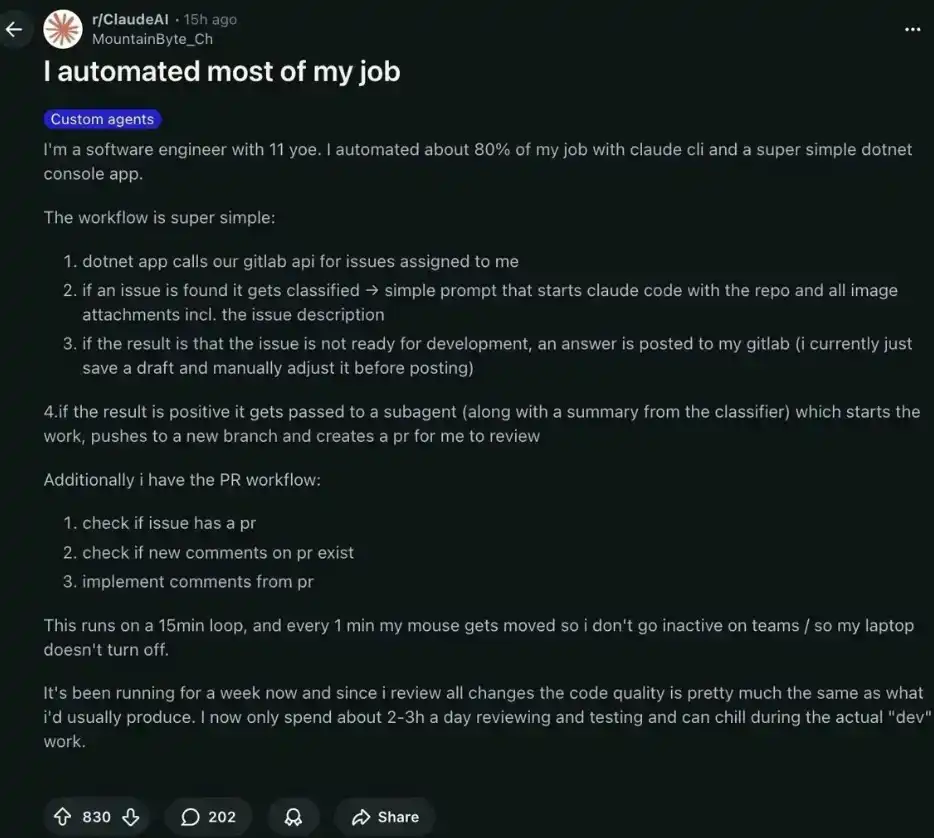
A Google engineer with 11 years of experience automated 80% of his work using Claude Code and a simple .NET application, reducing his daily work from 8 hours to just 2–3 hours while generating $28,000 in monthly passive income. The key to this transformation lies in three core elements: First, using a structured CLAUDE.md file based on Andrej Karpathy’s principles—Think Before Coding, Simplicity First, Surgical Changes, and Goal-Driven Execution—reduces Claude’s rule violations from 40% to just 3%. Second, the "Everything Claude Code" system acts as a full AI engineering team, with 27 pre-built agents for planning, reviewing, and executing tasks across multiple AI platforms. Third, a hidden token consumption issue in Claude Code v2.1.100 was identified, where 20,000 extra tokens were silently added, diluting instructions and reducing output quality. A quick fix using npx downgrades the version to avoid this. The automated system enables code generation, testing, and review to run autonomously in 15-minute cycles. The engineer now only reviews output, saving 5–6 hours daily. The setup takes less than 20 minutes, and the return on time investment is significant—potentially saving $10,000–$12,000 monthly for those valuing their time at $100/hour. The article emphasizes that managing AI systems, not just using them, is the new critical skill, enabling a shift from doing work to overseeing automated processes.

Editor's Note: As "AI writing code" gradually becomes an industry consensus, what truly changes productivity is not the model itself, but how you set rules for the model, organize workflows, and embed it into a sustainable operating system.

Starting from a simple CLAUDE.md file, to multi-agent collaboration, and then to an automated development loop, this method transforms the development process from a "dialogue between humans and AI" into "managing an AI engineering team." In this process, errors are constrained upfront, workflows are structured, and code generation, testing, and review are gradually taken over by the system instead of being manually executed.

More notably, the article also reveals a neglected detail: in long contexts and complex systems, model behavior is not entirely controllable. Whether it's hidden token consumption or diluted instructions, they can invisibly affect output quality. This makes "how to manage AI," rather than just "how to use AI," the new core competency.

At this point, developers no longer focus on coding but instead work around rule design, workflow scheduling, and result validation. Those who have completed this step first have already started shifting from "doing things personally" to "letting the system do things for them."

Below is the original text:

A Google engineer with 11 years of experience automated 80% of his work using Claude Code and a simple .NET application.

Now, he only works 2-3 hours a day instead of the original 8 hours. The rest of the time, he is basically in a "relaxed" state, with the system running on its own, generating $28,000 in passive income for him each month.

What he has mastered is precisely that set of methods you haven't yet learned.

Part 1—Writing CLAUDE.md According to Karpathy's Principles

Andrej Karpathy—one of the world's most influential AI researchers—once systematically summarized the most common mistakes large language models make when writing code: over-engineering, ignoring existing patterns, and introducing unnecessary additional dependencies that no one asked for.

Someone compiled these observations into a unified CLAUDE.md file.

The result: this project gained 15,000 stars on GitHub in a week. In a sense, it can be said that 15,000 people changed their way of working because of it.

The core idea is actually very simple: if errors are predictable, they can be prevented in advance with clear instructions. Just by placing a markdown file in the code repository, you can provide Claude Code with a complete set of structured behavioral rules, thereby unifying decision-making and execution across the entire project.

Inside this file, there are mainly four core principles:

· Think Before Coding → Avoid wrong assumptions and overlooked trade-offs
· Simplicity First → Avoid over-engineering and bloated abstractions
· Surgical Changes → Avoid modifying code that no one asked to change
· Goal-Driven Execution → Test first, then validate against clear success criteria

It doesn't rely on any framework, nor does it require complex tools—just one file can change Claude's behavior at the project level.

The real difference is:

· Without CLAUDE.md: Claude violates specifications about 40% of the time
· Using Karpathy's CLAUDE.md: Violation rate drops to about 3%
· Setup time: Only 5 minutes

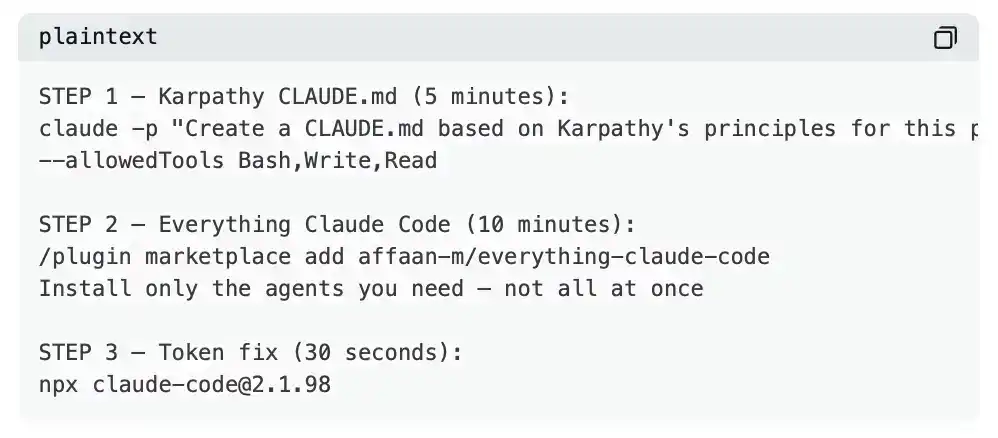
Command to automatically generate your own CLAUDE.md file:

claude -p "Read the entire project and create a CLAUDE.md based on:
Think Before Coding, Simplicity First, Surgical Changes, Goal-Driven Execution.
Adapt to the real architecture you see." --allowedTools Bash,Write,Read

It replaces this kind of Claude: over-engineering simple tasks, introducing unrequested dependencies, and even arbitrarily modifying files that shouldn't be touched.

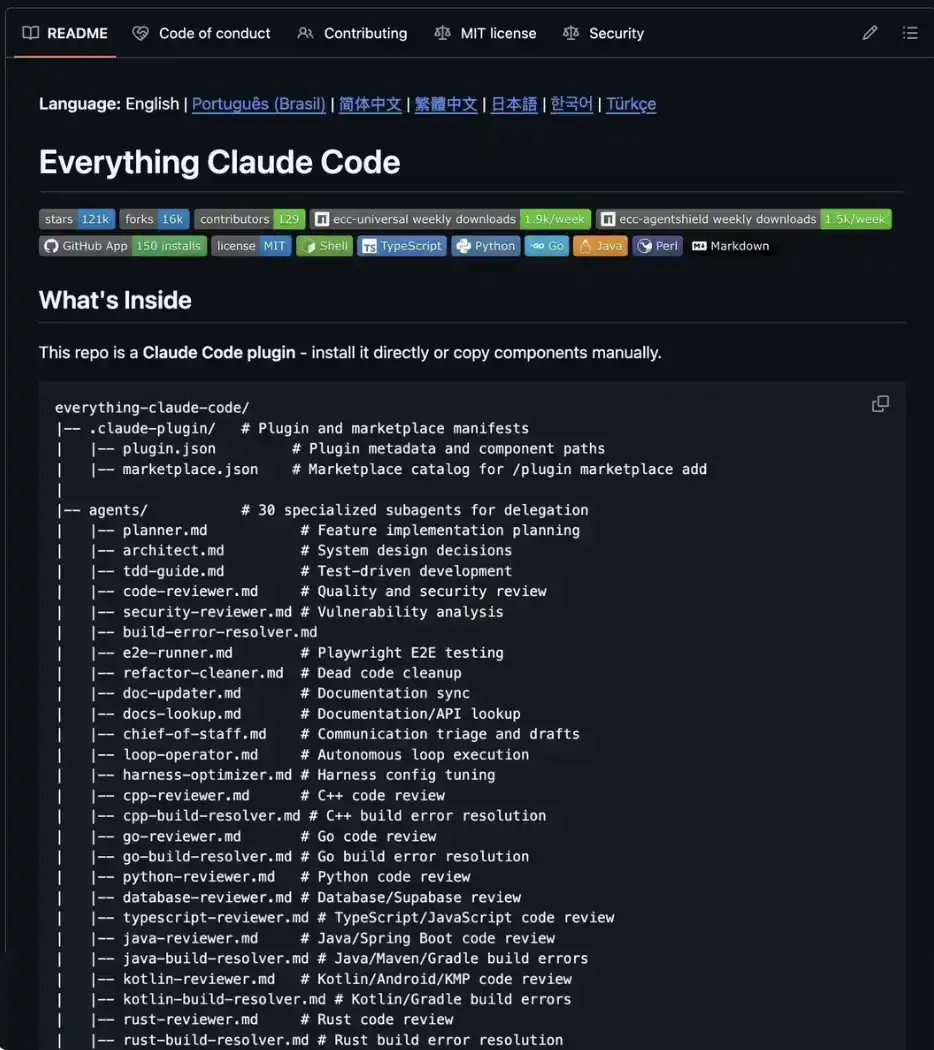
Part2 Everything Claude Code: A Complete Engineering Team in a Repository

Everything Claude Code (Over 153,000 stars on GitHub)

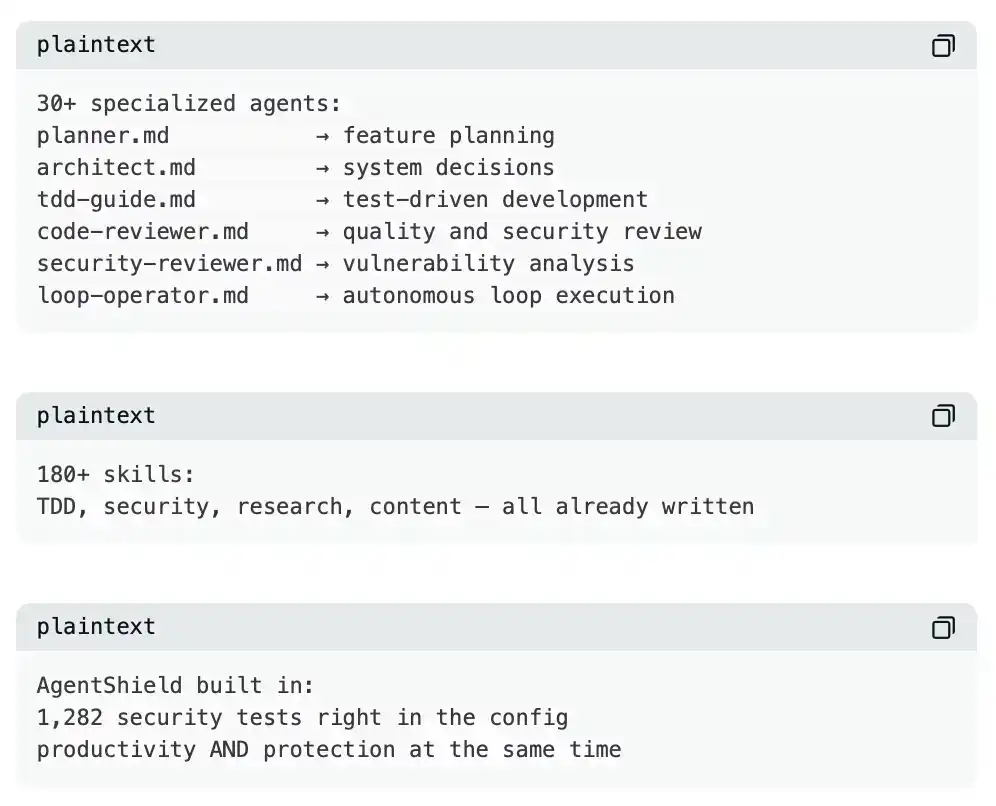
This is not just a collection of prompts; it's more like a complete AI operating system for building products.

Supports running on Claude, Codex, Cursor, OpenCode, Gemini, and more—one system, usable everywhere.

Installation:

/plugin marketplace add affaan-m/everything-claude-code

Or install manually—just copy the components you need into the project's .claude/ directory. Don't load everything at once—loading 27 agents and 64 skills simultaneously will likely exhaust your context allowance before you even input your first prompt. Only keep what you truly need.

The real difference is:

· Before: You were conversing with an AI
· After: You are managing an automatically running AI engineering team

It replaces: The weeks you would have spent building your own agent system, separately setting up different tools for planning/review/security, and the $200–500 monthly cost for various AI services.

Part3 A Hidden "Scandal": Claude Code v2.1.100 Is Quietly Consuming Your Tokens

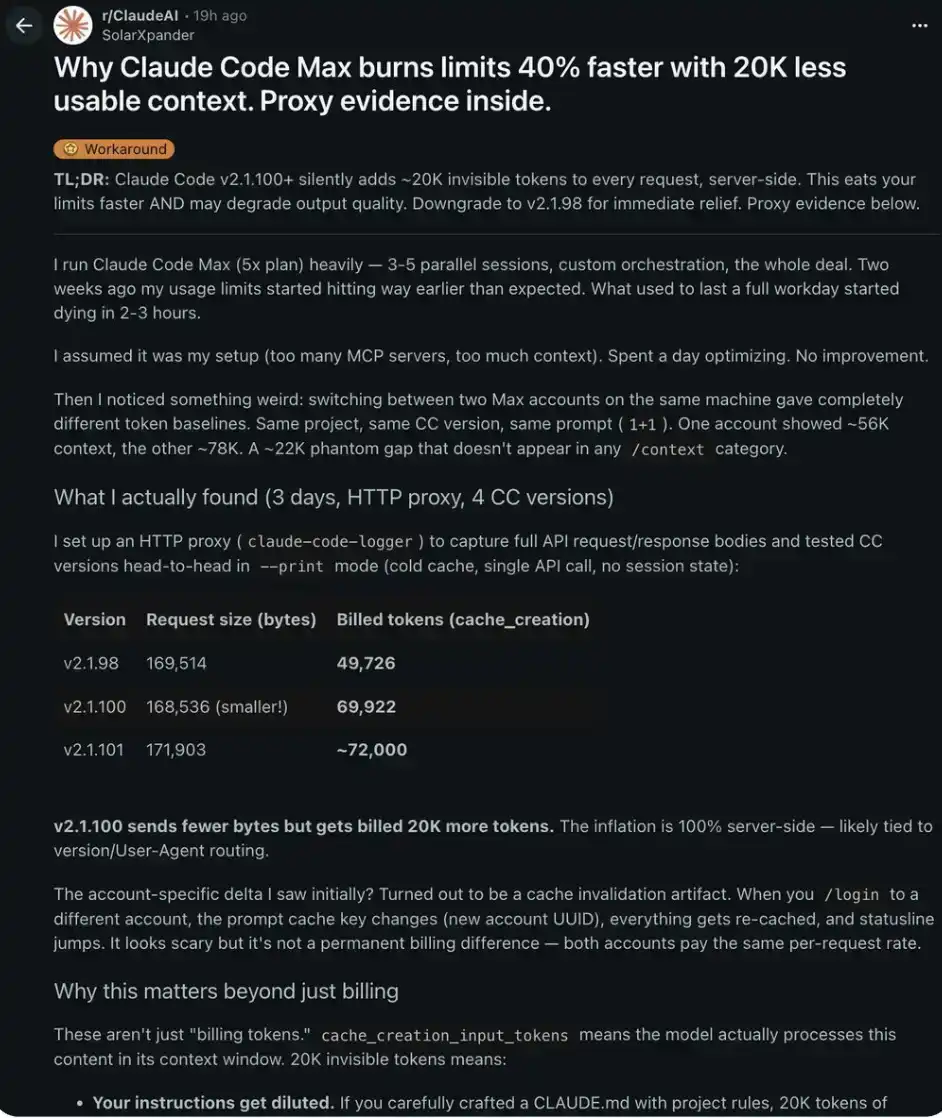
Someone set up an HTTP proxy and intercepted and analyzed the complete API requests of 4 different versions of Claude Code.

They found:

v2.1.98: 169,514 bytes request → 49,726 tokens charged
v2.1.100: 168,536 bytes request → 69,922 tokens charged
difference: -978 bytes but +20,196 tokens

v2.1.100 sent fewer data bytes but charged an extra 20,000 tokens. This "inflation" happens entirely on the server side—you can't see it, nor can you verify it through the /context interface.

Why this matters beyond billing: these extra 20,000 tokens are stuffed into Claude's actual context window.

This means:

→ Your CLAUDE.md instructions get diluted by these 20,000 "hidden contents"

→ Output quality degrades faster in long conversations

→ When Claude ignores your rules, it's hard to find the cause

→ Claude Max usage allowance is consumed about 40% faster than normal

Fix takes only 30 seconds: npx [email protected]

This is a temporary solution before Anthropic officially fixes the issue, but in practice, you can almost immediately feel the change in session effectiveness.

It replaces: You no longer need to guess why Claude suddenly stops following your instructions.

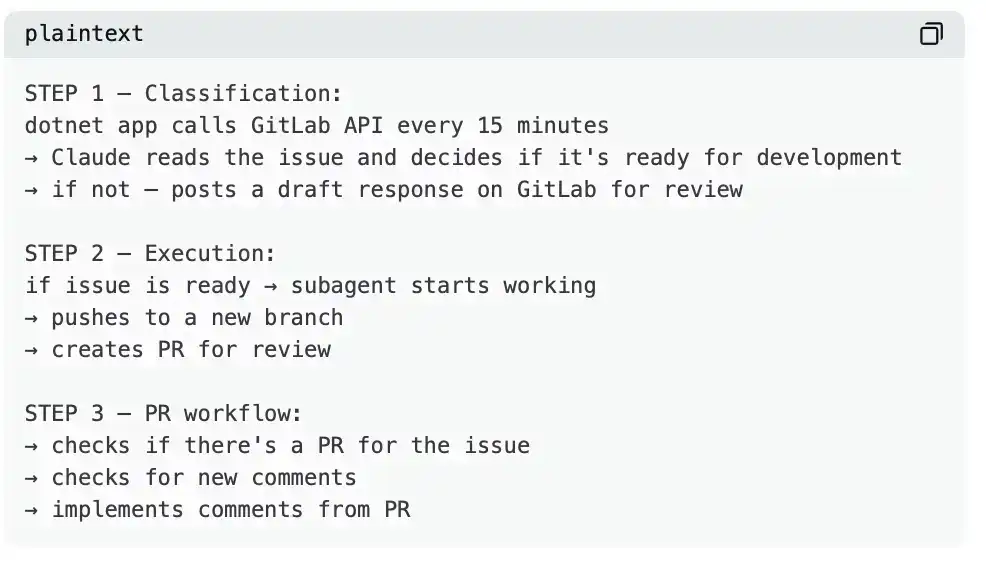
Case Study: What a Complete Automated System Looks Like

An engineer with 11 years of experience built a system consisting of three parts:

Results after one week:

· Before: 8 hours a day writing code
· After: Only 2–3 hours a day doing code review and testing

· Code quality: Basically unchanged—because he reviews each one
· Teams status: Always online—mouse moves automatically every minute
· Remaining time: Free to use all day

This isn't some "magic"; it's the result of CLAUDE.md + the right agents + a loop mechanism running every 15 minutes.

Complete checklist:

What you gain after reading this:

· Before: Claude violated existing specifications 40% of the time
· After: Using Karpathy's CLAUDE.md, violation rate dropped to 3%

· Before: You needed weeks to build agents
· After: 27 agents ready to use out-of-the-box

· Before: Claude Max exhausted its allowance in 2–3 hours
· After: Downgrading to v2.1.98 recovers about 40% of the usage limit

· Before: Needed 8 hours a day to write code
· After: Only 2–3 hours for review, the rest runs automatically

· Setup time: 15–20 minutes
· Daily savings: 5–6 hours
· Monthly savings: 100–120 hours

If your time is worth $30 per hour—you are "invisibly losing" $3000–3600 every month.

If it's $100 per hour—that's $10,000–12,000 flowing away monthly, just because you're still manually writing code that Claude could have done itself.

Most developers will never reach this level—not because they can't, but because they think it's complicated. In reality, between you and "full automation," there are only three commands and one file.

The engineer I mentioned at the beginning isn't some genius, nor is he a senior engineer from Google. He just spent one evening setting up the system—since then, the system does the work, and he lives his life.

You can do the same thing tonight. While others are still arguing whether AI will replace developers, those who have already set up the system are just collecting money and relaxing.

The choice is clear. You are building your own life—so choose the right path.

Связанные с этим вопросы

QWhat is the core concept behind the CLAUDE.md file mentioned in the article?

AThe core concept of the CLAUDE.md file is to provide a structured set of behavioral rules for Claude Code, based on principles like 'Think Before Coding', 'Simplicity First', 'Surgical Changes', and 'Goal-Driven Execution'. This file helps prevent common AI coding errors by setting clear, project-wide instructions, reducing violation rates from around 40% to just 3%.

QHow does the 'Everything Claude Code' system transform the developer's role?

AThe 'Everything Claude Code' system transforms the developer's role from directly coding and interacting with AI to managing an automated AI engineering team. It includes multiple agents and skills that handle tasks like planning, reviewing, and security, allowing the developer to focus on oversight and results rather than manual execution.

QWhat hidden issue was discovered with Claude Code v2.1.100, and what was its impact?

AClaude Code v2.1.100 was found to silently consume approximately 20,000 extra tokens per request compared to v2.1.98, despite sending fewer bytes. This 'hidden inflation' dilutes instructions from files like CLAUDE.md, reduces output quality in long conversations, and depletes usage limits about 40% faster, without any visible indication to the user.

QWhat were the key components of the automated system built by the Google engineer?

AThe automated system built by the Google engineer consisted of three main parts: a CLAUDE.md file for rule-based AI behavior, a set of tailored AI agents from the 'Everything Claude Code' repository, and an automated loop that ran every 15 minutes to handle coding, testing, and review processes with minimal human intervention.

QWhat time and financial benefits did the engineer achieve by automating 80% of his work?

AThe engineer reduced his daily work from 8 hours to just 2-3 hours, saving 5-6 hours per day and 100-120 hours per month. This automation generated $28,000 in monthly passive income. If valued at $30 per hour, this saves $3,000-$3,600 monthly; at $100 per hour, it saves $10,000-$12,000 monthly.

Похожее

"Water Scarcity": The Hidden Fatal Flaw of AI Infrastructure

“Water Scarcity: The Hidden Vulnerability of AI Infrastructure” In June 2026, SpaceX revised its IPO prospectus to highlight a core resource constraint alongside power and processors: water. This move signals a pivotal shift where water scarcity has transformed from an operational cost to a major, uncontrollable investment risk, directly threatening AI data center expansion. The scale of the problem is immense. U.S. data centers consumed an estimated 17 billion gallons of water for direct cooling in 2023, with indirect water use for power generation exceeding 211 billion gallons. Giants like Google alone use billions of gallons annually, with single sites consuming volumes equivalent to a medium-sized city. This water is largely “consumptive,” evaporated into the atmosphere and lost. This massive demand is colliding with scarcity. Tech companies are building “water tigers” in arid regions, sparking community protests in places like Mexico and Arizona, where data centers can legally use millions of gallons daily—enough for tens of thousands of residents. These conflicts are not about illegality, but about a mismatch between historic water allocation frameworks and new, colossal demand. The consequences are real. Community opposition, largely centered on water, has reportedly stalled or canceled $64 billion in U.S. data center projects over two years. Simultaneously, investors are pressuring companies for greater water footprint transparency, viewing it as a financial risk, not just an ESG metric. Technological solutions like air or liquid cooling involve trade-offs between water and electricity use, with final choices dictated by local constraints. The irony is stark: while industry leaders envision AI as a utility “like water,” its physical infrastructure is straining real-world water supplies. The race for AI supremacy may ultimately be governed not by the fastest chip, but by the slowest water meter.

marsbit29 мин. назад

"Water Scarcity": The Hidden Fatal Flaw of AI Infrastructure

marsbit29 мин. назад

Global Card Issuance Enters a Compliance-Driven Era: WasabiCard is Building the Next-Generation Payment Infrastructure

Global card issuance is entering a compliance-driven era, with WasabiCard building next-generation payment infrastructure. The platform asserts that as stablecoins increasingly enter cross-border payments, corporate settlements, and global commerce, the industry is shifting focus from "availability" and "growth-driven" models to long-term, compliant operation under global frameworks. Competition will center on sustainable compliance and global infrastructure capabilities. Stablecoins are evolving from on-chain assets into key payment tools in global business, with card issuance acting as critical infrastructure connecting digital assets to traditional payment networks like Visa and Mastercard. This expansion has revealed structural issues, including cross-regional issuance, BIN resource management, and insufficient AML and risk controls. In response, the industry is moving away from reliance on "grey efficiency" towards prioritizing compliance, risk management, and long-term operational stability. WasabiCard outlines its strategy: collaborating with licensed principals and local partners for localized operations, building robust KYC/AML systems, strictly separating commercial and consumer BIN usage, and enhancing global issuance, payment, and cross-border fund flow infrastructure. The goal is to build stable, scalable payment infrastructure amid evolving global regulations, shifting industry competition from scale to infrastructure capability. As stablecoins integrate further with global commerce, payment infrastructure will become a fundamental, embedded component of internet business. WasabiCard will continue to develop capabilities in global card issuance, stablecoin payments, cross-border fund flows, and API-driven financial workflows.

marsbit40 мин. назад

Global Card Issuance Enters a Compliance-Driven Era: WasabiCard is Building the Next-Generation Payment Infrastructure

marsbit40 мин. назад

Zhou Hang: How Much Is SpaceX Really Worth?

**Zhou Hang: How Much is SpaceX Really Worth?** SpaceX, arguably one of the greatest industrial companies of the past 50 years, is reportedly targeting a staggering $1.75 trillion valuation in its potential IPO. However, the author argues this figure is inflated by approximately $1.25 trillion when assessed through standard financial metrics. The analysis begins by acknowledging SpaceX's undeniable success: drastically reducing launch costs, achieving near-monopoly in commercial launches, and building the strategic Starlink network. Its achievement surpasses even Tesla's, given it disrupted a state-monopolized industry. Despite this greatness, a $1.75 trillion valuation places SpaceX above the combined market cap of Boeing, Lockheed Martin, Northrop Grumman, RTX, and General Dynamics. Projecting optimistic 2030 revenues of $50-80 billion and applying generous tech-sector multiples yields a "reasonable" valuation range of $500 billion to $1.2 trillion. The $1.25 trillion gap is attributed to three non-financial premiums: 1. **Long-term vision premium** for future Starship-enabled markets (e.g., space-based computing). 2. **Sovereign asset/strategic premium**, as SpaceX is deeply integrated into U.S. national security. 3. **Retail narrative/Musk cult premium**, driven by a heroic story and personal following. Post-IPO, three scenarios are outlined: valuation solidifying (25% probability), sideways volatility as narrative outpaces reality (50%), or a re-rating down to $800B-$1.2T if execution falters or Musk-related risks emerge (25%). The probability-weighted expected value is $1.3-1.5 trillion, suggesting negative expected returns for those buying at the IPO price. The conclusion advises investors to separate the company's excellence from its stock price. Buying at the IPO likely prices in excessive optimism. A more prudent strategy would be to wait for key milestones (e.g., Starship V3 stability) or a significant price correction before investing, or to treat an early purchase as a long-term, high-conviction hold with limited position size, not a short-term bet.

链捕手44 мин. назад

Zhou Hang: How Much Is SpaceX Really Worth?

链捕手44 мин. назад

Торговля

Спот
Фьючерсы
活动图片