One Year into the Trump Administration: The Transformation of the U.S. Crypto Industry

marsbitОпубликовано 2025-12-23Обновлено 2025-12-23

Введение

The Trump administration's first year in its new term has marked a dramatic shift in U.S. cryptocurrency policy, moving from a stance of control to one of integration. The core objective is to bring the crypto industry under the same regulatory framework as traditional finance. Key agencies—including the SEC, CFTC, and OCC—have introduced new rules and adjusted existing ones to systematically incorporate crypto into the financial system. The SEC, under new leadership, shifted from enforcement-led regulation to creating clearer standards for token classification. The CFTC recognized Bitcoin and Ethereum as commodities and allowed their use as collateral in derivatives trading. The OCC began granting national trust bank charters to major crypto firms like Circle and Ripple, integrating them into the federal banking system. Congress also passed the GENIUS Act, establishing clear standards for stablecoin issuance and reserves. Despite internal tensions and ongoing debates—such as those around privacy tools like Tornado Cash—the U.S. is advancing on multiple fronts: refining regulations, supporting infrastructure, and encouraging institutional adoption. The overall strategy aims to reduce market uncertainty, foster innovation, and position the U.S. as a global center for the crypto industry.

This report is authored by Tiger Research. In 2025, the U.S. government is implementing a policy supportive of cryptocurrency, with a clear and concise goal: to have the existing cryptocurrency industry operate under regulations in the same manner as the traditional financial industry.

Key Points Summary

  • The U.S. is committed to integrating cryptocurrency into its existing financial infrastructure, rather than simply absorbing the entire industry.

  • Over the past year, Congress, the U.S. Securities and Exchange Commission (SEC), and the Commodity Futures Trading Commission (CFTC) have introduced and adjusted rules to gradually incorporate cryptocurrency into this system.

  • Despite tensions among regulators, the U.S. continues to refine the regulatory framework while supporting industry growth.

1. The U.S. Absorption of the Cryptocurrency Industry

Following President Trump's re-election, the administration launched a series of aggressive pro-cryptocurrency policies. This marks a sharp turn from previous stances—where the cryptocurrency industry was primarily seen as an object of regulation and control. The U.S. has entered a once-unimaginable phase, absorbing the cryptocurrency industry into its existing system at a pace approaching unilateral decision-making.

The shift in stance from the SEC and CFTC, along with traditional financial institutions increasingly engaging in cryptocurrency-related businesses, signals that broad structural changes are underway.

It is particularly noteworthy that all this has occurred just one year since President Trump's re-election. What specific changes have taken place in U.S. regulation and policy so far?

2. A Year of Change in the U.S. Stance on Cryptocurrency

In 2025, with the Trump administration taking office, U.S. cryptocurrency policy reached a major turning point. The executive branch, Congress, and regulatory agencies acted in coordination, focusing on reducing market uncertainty and integrating cryptocurrency into the existing financial infrastructure.

2.1. U.S. Securities and Exchange Commission

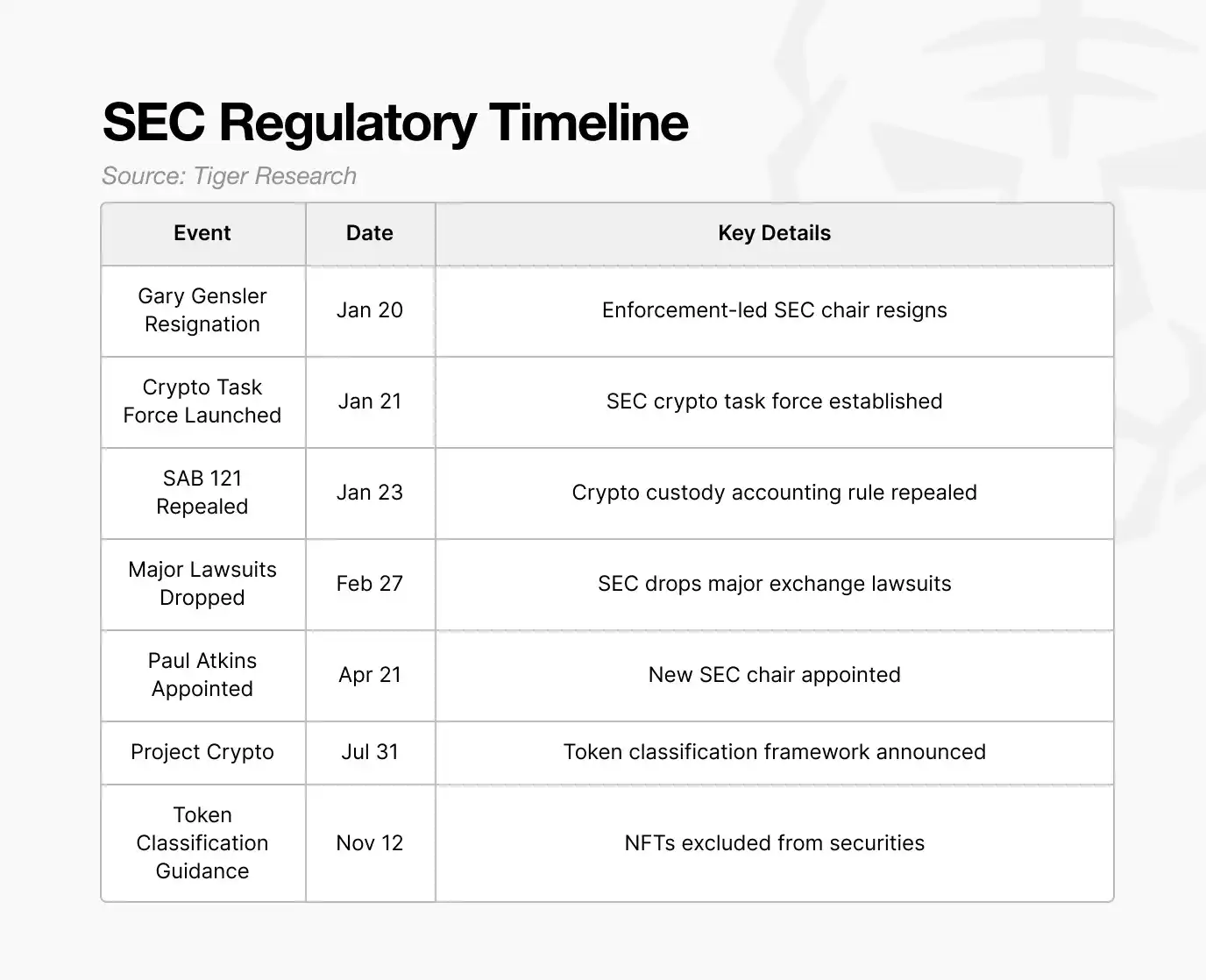
Previously, the SEC primarily relied on enforcement actions to address cryptocurrency-related activities. In major cases involving Ripple, Coinbase, Binance, and Kraken's staking services, the SEC filed lawsuits without providing clear standards on the legal attributes of tokens or which activities were permitted, often interpreting rules after the fact. This led cryptocurrency companies to focus more on managing regulatory risks rather than business expansion.

This stance began to change after the resignation of Chairman Gary Gensler, who held a conservative view of the cryptocurrency industry. Under the leadership of Paul Atkins, the SEC shifted to a more open approach, beginning to build foundational rules aimed at bringing the cryptocurrency industry into the regulatory framework, rather than relying solely on litigation for oversight.

A key example is the announcement of the "Crypto Project." Through this project, the SEC indicated its intent to establish clear standards for defining which tokens are securities and which are not. This once directionless regulator is now beginning to reshape itself into a more inclusive agency.

2.2. Commodity Futures Trading Commission

Source: Tiger Research

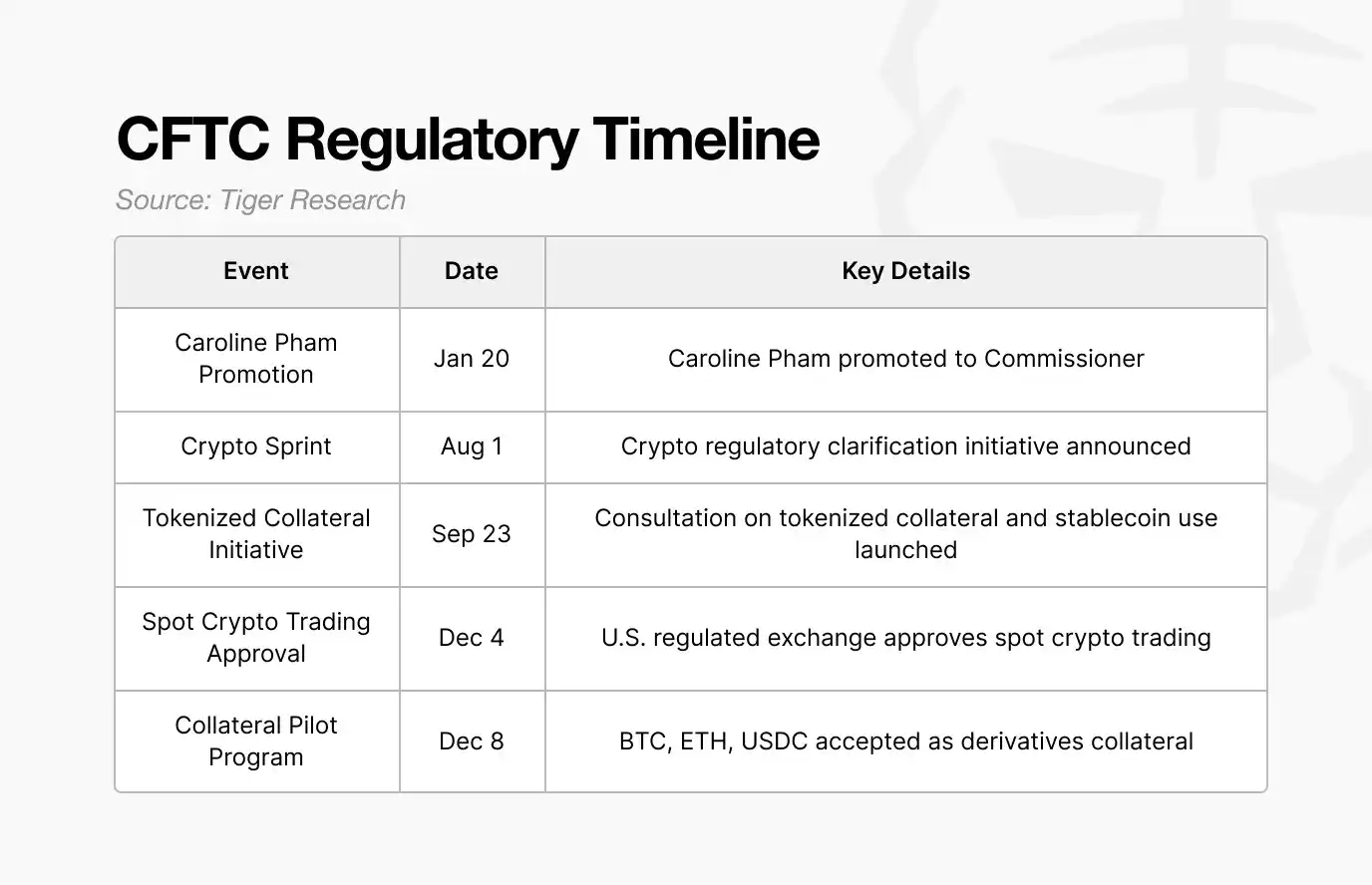
Previously, the CFTC's involvement with cryptocurrency was largely limited to derivatives market regulation. However, this year it adopted a more proactive stance, formally recognizing Bitcoin and Ethereum as commodities and supporting their use by traditional institutions.

The "Digital Asset Collateral Pilot Program" is a key initiative. Through this program, Bitcoin, Ethereum, and USDC were approved as collateral for derivatives trading. The CFTC applied haircut ratios and risk management standards, treating these assets in the same manner as traditional collateral.

This shift indicates that the CFTC no longer views crypto assets purely as speculative instruments but has begun to recognize them as stable collateral assets that can stand alongside traditional financial assets.

2.3. Office of the Comptroller of the Currency

Source: Tiger Research

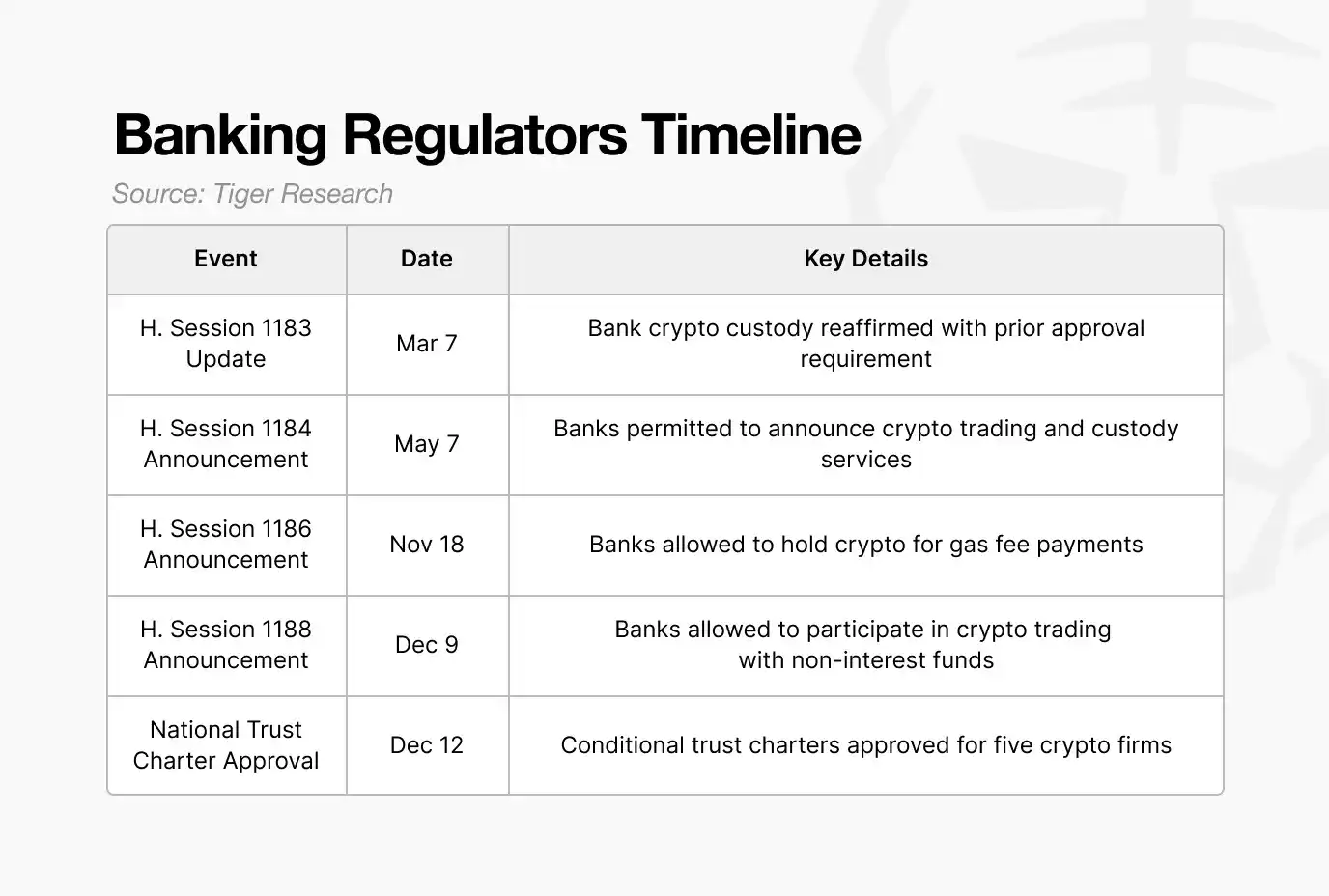
Previously, the OCC kept its distance from the cryptocurrency industry. Crypto companies had to apply for licenses state by state, making it difficult to enter the federal banking regulatory system. Their business expansion was limited, and their connection to the traditional financial system was structurally blocked, forcing most to operate outside the regulated system.

This approach has now changed. The OCC has chosen to incorporate cryptocurrency companies into the existing banking regulatory framework rather than exclude them from the financial system. It issued a series of interpretive letters (formal documents clarifying whether specific financial activities are permitted) that gradually expanded the scope of allowed businesses, including crypto asset custody, trading, and even banks paying on-chain transaction fees.

This series of changes culminated in December: the OCC conditionally approved national trust bank charters for major companies like Circle and Ripple. This move is significant because it grants these crypto companies status equal to that of traditional financial institutions. Under single federal oversight, they can operate nationwide, and transfers that previously required intermediary banks can now be processed directly, just like traditional banks.

2.4. Legislation and Executive Orders

Source: Tiger Research

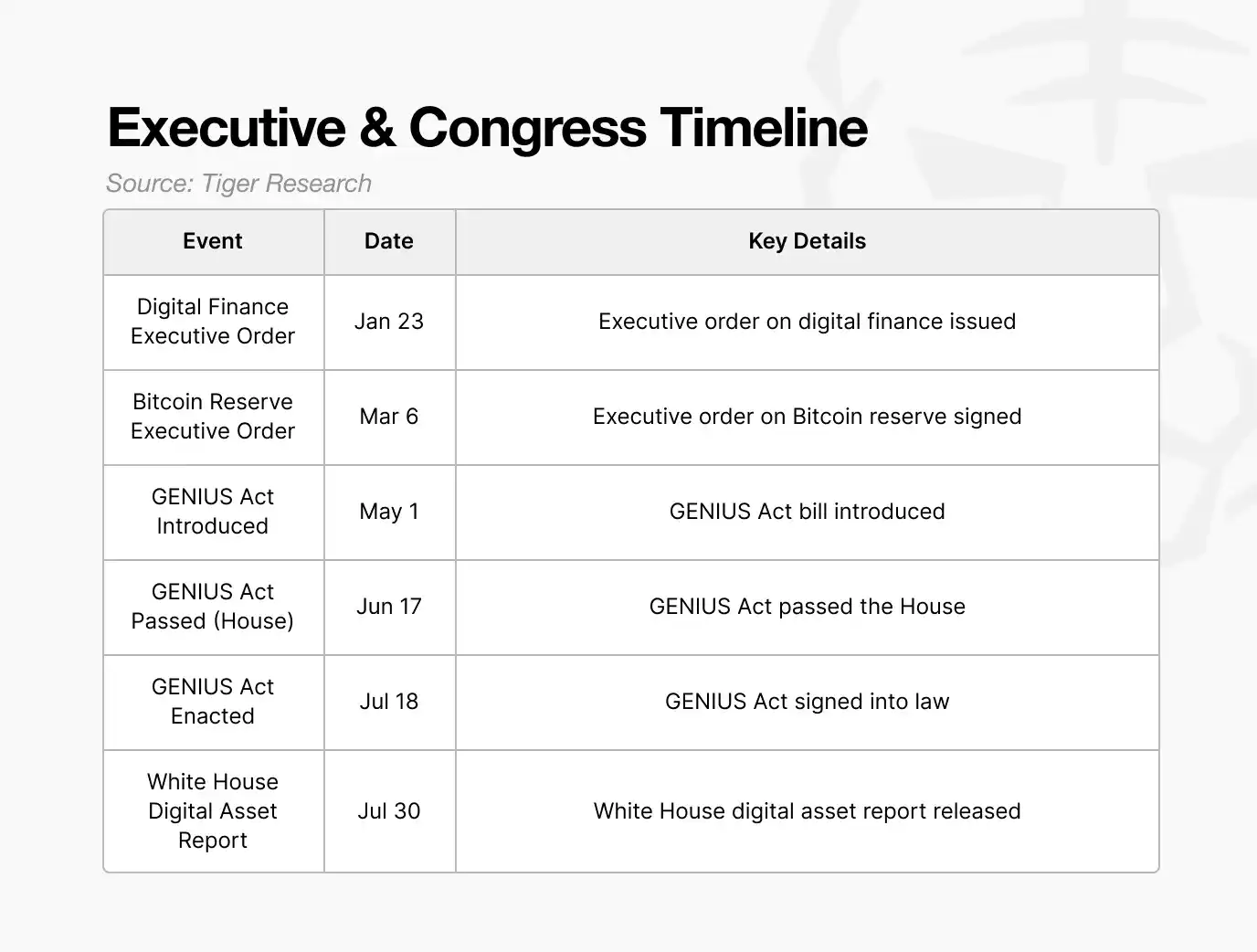
Previously, although the U.S. had begun considering stablecoin legislation since 2022, repeated delays created a regulatory vacuum. There was a lack of clear standards regarding reserve composition, regulatory authority, issuance requirements, etc. Investors could not reliably verify whether issuers held sufficient reserves, raising concerns about the transparency of some issuers' reserves.

The "GENIUS Act" addressed these issues by clearly defining stablecoin issuance requirements and reserve standards. It requires issuers to hold reserves equivalent to 100% of the issued amount, prohibits the re-hypothecation of reserve assets, and unifies regulatory authority under federal financial regulators.

Thus, stablecoins have become digital dollars with legally recognized payment capability guarantees.

3. Direction Set, Competition and Checks and Balances Coexist

Over the past year, the direction of U.S. cryptocurrency policy has been clear: to integrate the cryptocurrency industry into the formal financial system. However, this process is not uniform and frictionless.

Divergent views still exist within the U.S. The debate surrounding the privacy mixing service Tornado Cash is a typical example: the executive branch actively enforces the law to block illegal fund flows, while the SEC chairman publicly warns against excessive suppression of privacy. This indicates that perceptions of cryptocurrency within the U.S. government are not entirely unified.

But these differences do not equate to policy instability; they are more akin to inherent features of the U.S. decision-making system. Agencies with different responsibilities interpret issues from their own perspectives, sometimes publicly expressing dissent, moving forward through checks, balances, and persuasion. The tension between strict enforcement and protecting innovation may cause short-term friction, but in the long run, it helps make regulatory standards more specific and precise.

The key is that this tension has not stalled progress. Even amidst debate, the U.S. continues to advance on multiple fronts: the SEC's rulemaking, the CFTC's infrastructure integration, the OCC's institutional absorption, and Congressional legislation establishing standards. It does not wait for complete consensus but allows competition and coordination to proceed simultaneously, driving the system forward continuously.

Ultimately, the U.S. has neither given cryptocurrency free rein nor attempted to suppress its development. Instead, it has simultaneously reshaped regulation, leadership, and market infrastructure. By transforming internal debate and tension into momentum, the U.S. has chosen a strategy to attract the global cryptocurrency industry center to itself.

The past year has been critical precisely because this direction has moved beyond declarations and been concretely translated into specific policies and execution.

Связанные с этим вопросы

QWhat was the core objective of the U.S. government's cryptocurrency policy in 2025, as described in the article?

AThe core objective was to integrate the cryptocurrency industry into the existing financial infrastructure and regulate it in the same way as the traditional financial industry operates.

QWhich two major regulatory agencies significantly shifted their stance on cryptocurrency under the Trump administration, and what were their key initiatives?

AThe SEC, under new leadership, launched the 'Crypto Project' to define clear standards for tokens. The CFTC formally recognized Bitcoin and Ethereum as commodities and initiated the 'Digital Asset Collateral Pilot Program' to allow them as collateral for derivatives trading.

QWhat significant action did the Office of the Comptroller of the Currency (OCC) take regarding major crypto companies like Circle and Ripple?

AThe OCC conditionally approved national trust bank charters for Circle and Ripple, granting them equal status to traditional financial institutions and allowing them to operate nationwide under a single federal regulator.

QWhat problem did the 'GENIUS Act' specifically address in the stablecoin market, and what were its key requirements?

AThe GENIUS Act addressed the regulatory vacuum and lack of clear standards for stablecoins. Its key requirements mandated that issuers hold 100% reserves against the issued amount and prohibited the re-hypothecation of reserve assets, while placing regulatory authority under federal financial agencies.

QAccording to the article, how did internal tensions between U.S. government agencies, such as the debate over Tornado Cash, ultimately affect the policy direction?

AThe internal tensions and debates did not stall the policy process but were a feature of the U.S. decision-making system. They led to competition and coordination among agencies, helping to refine regulatory standards and push the system forward concurrently on multiple fronts without waiting for full consensus.

Похожее

South Korean Exchanges 'Battle' Regulators, Challenging the Boundaries of Enforcement and Legislation

South Korea's cryptocurrency industry is engaged in a rare, direct confrontation with regulators. The Financial Intelligence Unit (FIU), the primary anti-money laundering (AML) watchdog, has recently imposed heavy penalties on major exchanges like Upbit and Bithumb for alleged violations involving unregistered overseas VASPs and AML procedures. However, exchanges are now actively challenging these actions in court and through industry associations. In a significant shift, the Seoul Administrative Court ruled in favor of Upbit's operator, Dunamu, overturning part of an FIU-ordered business suspension. The court found the FIU's penalty criteria and justification insufficiently clear. Similarly, the court suspended the enforcement of a six-month business suspension against Bithumb pending a final ruling, citing potential irreversible harm to the exchange. Beyond legal battles, the industry is contesting proposed legislative amendments. The Digital Asset eXchange Alliance (DAXA) strongly opposes a draft rule that would mandate Suspicious Transaction Reports (STRs) for all crypto transfers over 10 million KRW (~$6,800). DAXA argues this "poison pill" clause violates legal principles and would overwhelm the STR system, increasing reports from 63,000 to an estimated 5.45 million annually for major exchanges, thereby crippling effective AML monitoring. This conflict highlights a structural tension in South Korea's crypto governance: comprehensive digital asset laws are still developing, while regulators rely heavily on AML enforcement. The industry's move from passive compliance to active legal and legislative challenges signifies a new phase, pressing for clearer rules and more proportionate enforcement. While short-term disputes may intensify, this clash could ultimately lead to a more mature and sustainable regulatory framework for South Korea's vibrant crypto market.

marsbit51 мин. назад

South Korean Exchanges 'Battle' Regulators, Challenging the Boundaries of Enforcement and Legislation

marsbit51 мин. назад

After 50x Storage Surge, Justin Sun Always Looks to the Next Decade

Sun Yuchen, known for his controversial stunts like a $30 million lunch with Warren Buffett (canceled due to a kidney stone) and eating a $6.2 million duct-taped banana, is often overshadowed by a significant fact: his decade-long track record of spotting major investment trends. In 2016, he famously advised young people to invest in Bitcoin, Nvidia, Tesla, and Tencent instead of buying property. A hypothetical $20,000 investment in Nvidia and Tesla from that list would now be worth over 50 million RMB. His latest major call was on November 6, 2025, predicting a "50x storage opportunity" tied to the AI boom, which materialized with Sandisk's stock surging nearly 50-fold by 2026. Looking ahead, Sun now focuses on the next frontier: Physical AI. He identifies four key areas: 1. **Embodied AI/Robotics**: He sees this reaching its "iPhone moment," with companies like UBTech and Galaxy General leading in commercialization. 2. **Drones**: Viewed as the first commercially viable form of Physical AI, revolutionizing sectors from warfare (e.g., AeroVironment's Switchblade) to logistics. 3. **Spatial Computing**: Beyond VR, it's about AI understanding physical space, a foundational technology for robotics and autonomous systems, exemplified by Apple's Vision Pro. 4. **Space Exploration**: After a 2025 suborbital flight with Blue Origin, Sun advocates for space as the ultimate frontier, discussing blockchain's potential role in space asset management and data transactions. His investment philosophy involves betting on entire, inevitable trends rather than single companies. For robotics, he sees Tesla (the body/manufacturer) and Nvidia (the brain/AI platform) as complementary plays. In defense drones, he highlights companies making tanks obsolete (AeroVironment) and those augmenting fighter jets (Kratos). For space, he participated in Blue Origin's flight and anticipates SpaceX's potential IPO to redefine the sector's valuation. Sun Yuchen's vision frames the next two decades not as a revolution in information flow (like the internet), but in the fundamental operation of the physical world through AI-powered robots, autonomous systems, and spatial intelligence, ultimately extending human and AI activity into space. While many still focus on conventional assets, he continues to look toward the next technological horizon.

marsbit1 ч. назад

After 50x Storage Surge, Justin Sun Always Looks to the Next Decade

marsbit1 ч. назад

The Billionaires Behind the Most Expensive Midterm Election in History

"The Most Expensive Midterm Elections and Their Billionaire Backers" This analysis details the unprecedented scale of spending in the 2026 midterm elections, highlighting the key billionaire donors shaping the political landscape. Jeff Yass, founder of Susquehanna International Group, has contributed over $81 million, ranking third among individual donors behind George Soros ($102.6M) and Elon Musk ($84.8M). Yass is a major donor to Trump's MAGA Inc. and supports school choice and various candidates. Overall, federal committees have raised over $4.7 billion this cycle, with political ad spending projected to reach $10.8 billion. Republican-aligned groups are significantly out-raising their Democratic counterparts. "Dark money" from undisclosed sources continues to grow. The core stakes involve control of Congress and policy direction for Trump's final term. Donors are also motivated by specific issues: Sergey Brin and Chris Larsen are funding opposition to a proposed California wealth tax and supporting crypto-friendly policies. Other top donors include OpenAI's Greg Brockman and his wife Anna ($50M total to MAGA Inc. and an AI-focused PAC), Richard Uihlein ($45.3M to conservative causes), venture capitalists Marc Andreessen and Ben Horowitz (each over $44M to crypto/AI PACs and MAGA Inc.), Miriam Adelson ($42.6M to GOP leadership PACs), Paul Singer ($33.9M), and Diane Hendricks ($25.8M to MAGA Inc.). The article notes that the peak fundraising period is still ahead, with major primaries approaching.

marsbit1 ч. назад

The Billionaires Behind the Most Expensive Midterm Election in History

marsbit1 ч. назад

The Largest IPO in History Is Approaching, Surpassing SpaceX, 28 Years of AI Self-Iteration, Countdown to Intelligence Explosion

"Anthropic Nears Trillion-Dollar IPO, Fueled by Explosive Growth and 2028 'Intelligence Explosion' Warning Anthropic is considering a deal valuing the AI company near $1 trillion, potentially leading to one of the largest IPOs ever and surpassing SpaceX. Its revenue has skyrocketed, with Annual Recurring Revenue (ARR) reaching $45 billion in May 2026—a 500% increase in just five months. This vertical growth curve is attributed to its key products, Claude Code and Cowork, dominating AI coding and enterprise collaboration. Beyond commercial success, co-founder Jack Clark issued a pivotal warning in an interview: there is a greater than 50% chance that by the end of 2028, AI systems will achieve recursive self-improvement—the ability to autonomously build a 'better version' of themselves, initiating an 'intelligence explosion.' This prophecy underpins the company's astronomical valuation, as the market prices in the potential for transformative and disruptive AI. Further signaling its ambition, Anthropic formed a $1.5 billion joint venture with Goldman Sachs and Blackstone, aiming to disrupt traditional consulting firms like McKinsey by deploying Claude AI for complex strategic work. This move tests AI's capacity to replace high-level cognitive labor, a precursor to its predicted autonomous evolution. The narrative presents a dual future: unprecedented economic opportunity alongside significant risks like economic restructuring and security threats. Anthropic's meteoric rise and Clark's 2028 prediction frame the coming years as a countdown to a potential technological singularity."

marsbit2 ч. назад

The Largest IPO in History Is Approaching, Surpassing SpaceX, 28 Years of AI Self-Iteration, Countdown to Intelligence Explosion

marsbit2 ч. назад

Торговля

Спот
Фьючерсы

Популярные статьи

Как купить S

Добро пожаловать на HTX.com! Мы сделали приобретение Sonic (S) простым и удобным. Следуйте нашему пошаговому руководству и отправляйтесь в свое крипто-путешествие.Шаг 1: Создайте аккаунт на HTXИспользуйте свой адрес электронной почты или номер телефона, чтобы зарегистрироваться и бесплатно создать аккаунт на HTX. Пройдите удобную регистрацию и откройте для себя весь функционал.Создать аккаунтШаг 2: Перейдите в Купить криптовалюту и выберите свой способ оплатыКредитная/Дебетовая Карта: Используйте свою карту Visa или Mastercard для мгновенной покупки Sonic (S).Баланс: Используйте средства с баланса вашего аккаунта HTX для простой торговли.Третьи Лица: Мы добавили популярные способы оплаты, такие как Google Pay и Apple Pay, для повышения удобства.P2P: Торгуйте напрямую с другими пользователями на HTX.Внебиржевая Торговля (OTC): Мы предлагаем индивидуальные услуги и конкурентоспособные обменные курсы для трейдеров.Шаг 3: Хранение Sonic (S)После приобретения вами Sonic (S) храните их в своем аккаунте на HTX. В качестве альтернативы вы можете отправить их куда-либо с помощью перевода в блокчейне или использовать для торговли с другими криптовалютами.Шаг 4: Торговля Sonic (S)С легкостью торгуйте Sonic (S) на спотовом рынке HTX. Просто зайдите в свой аккаунт, выберите торговую пару, совершайте сделки и следите за ними в режиме реального времени. Мы предлагаем удобный интерфейс как для начинающих, так и для опытных трейдеров.

1.3k просмотров всегоОпубликовано 2025.01.15Обновлено 2025.03.21

Как купить S

Sonic: Обновления под руководством Андре Кронье – новая звезда Layer-1 на фоне спада рынка

Он решает проблемы масштабируемости, совместимости между блокчейнами и стимулов для разработчиков с помощью технологических инноваций.

2.2k просмотров всегоОпубликовано 2025.04.09Обновлено 2025.04.09

Sonic: Обновления под руководством Андре Кронье – новая звезда Layer-1 на фоне спада рынка

HTX Learn: Пройдите обучение по "Sonic" и разделите 1000 USDT

HTX Learn — ваш проводник в мир перспективных проектов, и мы запускаем специальное мероприятие "Учитесь и Зарабатывайте", посвящённое этим проектам. Наше новое направление .

1.8k просмотров всегоОпубликовано 2025.04.10Обновлено 2025.04.10

HTX Learn: Пройдите обучение по "Sonic" и разделите 1000 USDT

Обсуждения

Добро пожаловать в Сообщество HTX. Здесь вы сможете быть в курсе последних новостей о развитии платформы и получить доступ к профессиональной аналитической информации о рынке. Мнения пользователей о цене на S (S) представлены ниже.

活动图片