On the Eve of the Bank of Japan's Interest Rate Hike, Why Did Bitcoin Fall First?

深潮Опубликовано 2025-12-17Обновлено 2025-12-17

Введение

On December 15, Bitcoin fell over 5% to $85,616, while gold remained almost unchanged. The drop was not driven by crypto-specific news but by expectations of the Bank of Japan (BOJ) raising interest rates on December 19—its highest rate in 30 years. The decline is linked to the unwinding of the "yen carry trade," where investors borrowed cheap yen to invest in higher-yielding assets like Bitcoin. BOJ rate hikes increase borrowing costs and strengthen the yen, forcing global funds to sell assets—including Bitcoin—to repay loans. Historically, Bitcoin has seen significant sell-offs following BOJ tightening moves, as it is often liquidated first due to its high liquidity and volatility. Bitcoin’s correlation with risk assets like the Nasdaq has risen sharply since the approval of U.S. spot Bitcoin ETFs, integrating it into traditional risk management frameworks. This has diminished its role as "digital gold" or a safe-haven asset, instead positioning it as a high-beta risk asset sensitive to global macro liquidity. While markets have largely priced in the expected rate hike, the BOJ’s forward guidance could determine the severity of further impacts. If the BOJ signals ongoing tightening, Bitcoin may face continued pressure. However, some analysts suggest the sell-off could be less severe than in previous instances due to shifted market positioning and broader Federal Reserve easing. In the ETF era, Bitcoin’s price is increasingly influenced by global macroeconomic ev...

Author: David, TechFlow Deep Tide

On December 15, Bitcoin fell from $90,000 to $85,616, a single-day drop of over 5%.

There were no major negative events or scandals on this day, and on-chain data showed no abnormal selling pressure. If you only looked at crypto news, it was hard to find a "plausible" reason.

On the same day, gold was quoted at $4,323 per ounce, down only $1 from the previous day.

One fell 5%, the other barely moved.

If Bitcoin is truly "digital gold," a tool to hedge against inflation and fiat currency devaluation, its performance in the face of risk events should be more like gold's. But this time, its movement clearly resembled that of high-beta tech stocks in the Nasdaq.

What is driving this round of decline? The answer may lie in Tokyo.

The Butterfly Effect from Tokyo

On December 19, the Bank of Japan (BOJ) will hold its monetary policy meeting. The expectation is that it will raise interest rates by 25 basis points, increasing the policy rate from 0.5% to 0.75%.

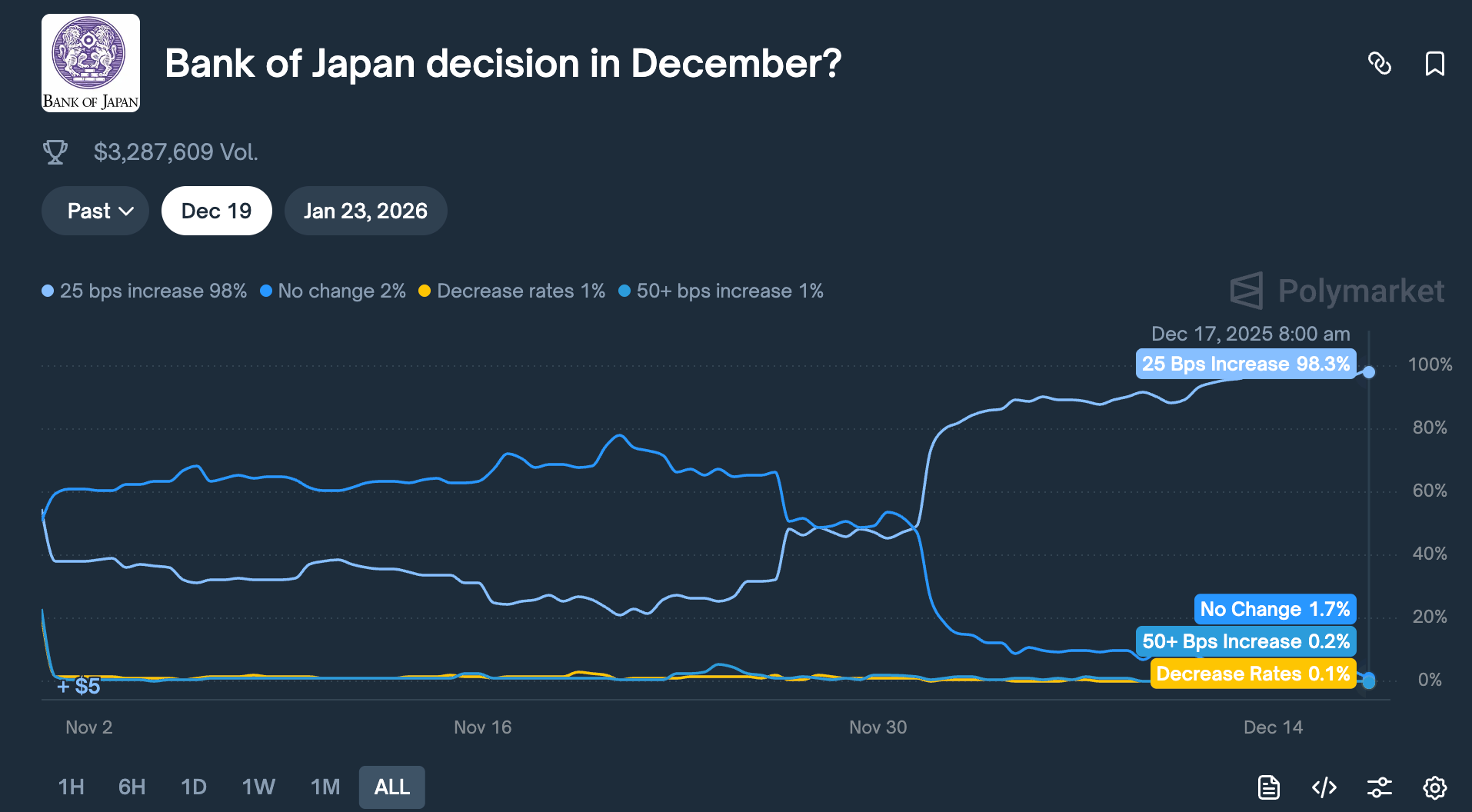
0.75% may not sound high, but this is Japan's highest interest rate in nearly 30 years. On prediction markets like Polymarket, traders have priced the probability of this rate hike at 98%.

Why would a decision by a central bank far away in Tokyo cause Bitcoin to drop 5% within 48 hours?

It starts with something called the "yen carry trade."

The logic is actually quite simple:

Japanese interest rates have long been near zero or even negative, making it almost free to borrow yen. As a result, global hedge funds, asset management institutions, and trading desks borrow large amounts of yen, convert it to US dollars, and then buy higher-yielding assets, such as US Treasury bonds, US stocks, or even cryptocurrencies.

As long as the return on these assets is higher than the cost of borrowing yen, the interest rate differential is profit.

This strategy has existed for decades and is so large its size is difficult to measure precisely. Conservative estimates are in the hundreds of billions of dollars; some analysts believe it could be as high as trillions when including derivative exposures.

Additionally, Japan holds a special status:

It is the largest foreign holder of US Treasury bonds, holding $1.18 trillion in US debt.

This means changes in Japanese fund flows directly impact the world's most important bond market, which in turn affects the pricing of all risk assets.

Now, as the Bank of Japan decides to raise interest rates, the underlying logic of this game is being challenged.

First, the cost of borrowing yen rises, narrowing the carry trade arbitrage space; more troublesome is that rate hike expectations will push the yen to appreciate, and these institutions originally borrowed yen and converted it to dollars to invest.

Now, to repay the loans, they must sell dollar-denominated assets and buy back yen. The more the yen appreciates, the more assets they need to sell.

This "forced selling" doesn't pick a time or choose assets. Whatever has the best liquidity and is easiest to liquidate gets sold first.

Therefore, it's easy to see why Bitcoin, traded 24/7 with no price limits and relatively shallower market depth compared to stocks, is often the first to be sold off.

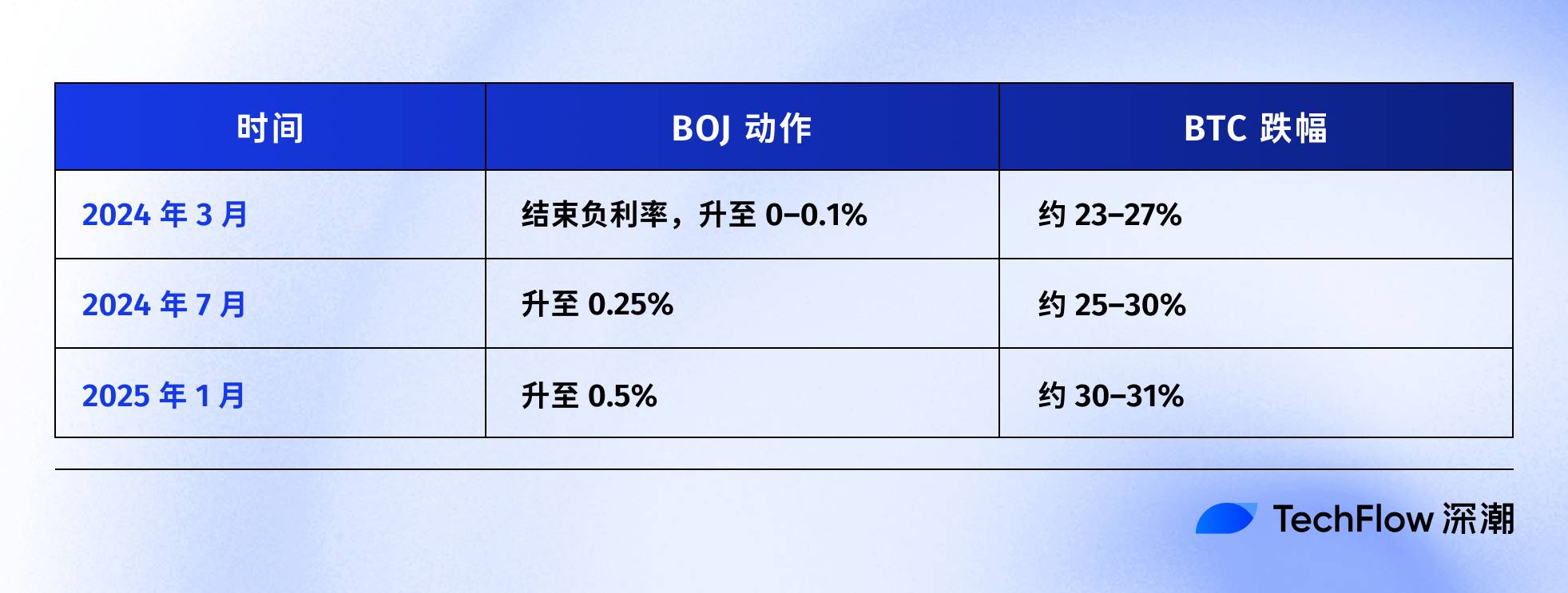
Looking back at the timeline of the Bank of Japan's previous rate hikes, this speculation is also somewhat corroborated by the data:

The most recent instance was on July 31, 2024. After the BOJ announced a rate hike to 0.25%, the yen appreciated against the dollar from 160 to below 140. BTC fell from $65,000 to $50,000 within the following week, a drop of about 23%, wiping $60 billion in market capitalization from the entire crypto market.

According to statistics from multiple on-chain analysts, BTC experienced drawdowns of over 20% following the past three Bank of Japan rate hikes.

The specific start and end points and time windows for these numbers vary, but the direction is highly consistent:

Every time Japan tightens monetary policy, BTC is a major casualty.

Therefore, the author believes that what happened on December 15 was essentially the market "front-running." Even before the decision on the 19th was announced, funds had already begun to withdraw early.

On that day, US BTC ETFs saw a net outflow of $357 million, the largest single-day outflow in nearly two weeks; over $600 million in leveraged long positions were liquidated in the crypto market within 24 hours.

This likely wasn't panic selling by retail investors, but rather the chain reaction of carry trade unwinding.

Is Bitcoin Still Digital Gold?

The previous section explained the mechanism of the yen carry trade, but one question remains unanswered:

Why is BTC always the first to be sold and hurt?

A common explanation is that BTC has "good liquidity and 24/7 trading"—this is true, but it's not sufficient.

The real reason is that BTC has been repriced over the past two years: it is no longer an "alternative asset" independent of traditional finance, but has been welded into Wall Street's risk exposure.

In January of last year, the US SEC approved spot Bitcoin ETFs. This was a milestone the crypto industry had waited a decade for, allowing trillion-dollar asset management giants like BlackRock and Fidelity to compliantly include BTC in their clients' investment portfolios.

The money did come. But along with it came an identity shift: the holders of BTC changed.

Previously, BTC was bought by crypto-native players, retail investors, and some aggressive family offices.

Now, BTC is bought by pension funds, hedge funds, and asset allocation models. These institutions also hold US stocks, US bonds, and gold, and manage "risk budgets."

When the overall portfolio needs to reduce risk, they don't just sell BTC or just sell equities; they reduce positions proportionally across the board.

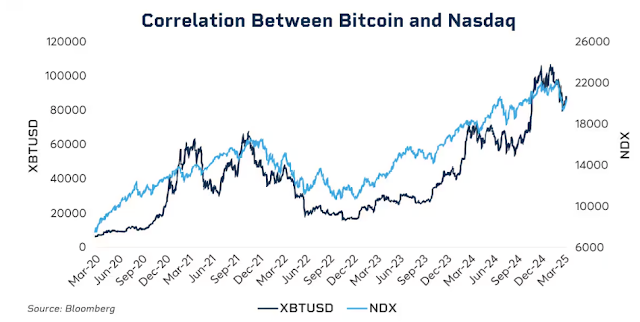
Data shows this binding relationship.

In early 2025, the 30-day rolling correlation between BTC and the Nasdaq 100 index reached 0.80, its highest level since 2022. In contrast, before 2020, this correlation typically hovered between -0.2 and 0.2, essentially uncorrelated.

More notably, this correlation significantly increases during periods of market stress.

The March 2020 pandemic crash, the Fed's aggressive rate hikes in 2022, tariff concerns in early 2025... every time risk-off sentiment heats up, the联动 between BTC and US stocks tightens.

Institutions in panic don't distinguish between "this is a crypto asset" and "this is a tech stock"; they only see one label: risk exposure.

This leads to an awkward question: is the digital gold narrative still valid?

If you extend the timeline, gold has risen over 60% year-to-date in 2025, its best year since 1979; BTC has drawn down over 30% from its high during the same period.

Two assets both hailed as hedges against inflation and fiat devaluation have charted completely opposite curves in the same macro environment.

This isn't to say BTC's long-term value is in question; its five-year compound annual growth rate still far exceeds that of the S&P 500 and Nasdaq.

But at this current stage, its short-term pricing logic has changed: it is a high-volatility, high-beta risk asset, not a safe haven.

Understanding this is key to understanding why a mere 25 basis point hike by the Bank of Japan could cause BTC to drop thousands of dollars in 48 hours.

It's not because Japanese investors are selling BTC, but because when global liquidity tightens, institutions reduce all risk exposures using the same logic, and BTC happens to be the most volatile and easiest-to-liquidate link in that chain.

What Will Happen on December 19?

At the time of writing this article, there are two days left until the Bank of Japan's monetary policy meeting.

The market has already treated the rate hike as a foregone conclusion. Japan's 10-year government bond yield has risen to 1.95%, an 18-year high. In other words, the bond market has already priced in the tightening expectations.

If the rate hike is fully expected, will there still be an impact on the 19th?

Historical experience says: yes, but the intensity depends on the wording.

The impact of a central bank decision is never just about the number itself, but the signal it sends. The same 25 basis point hike will be met with relief if BOJ Governor Ueda says in the press conference, "We will carefully assess future moves based on data";

If he says, "Inflation pressures persist, and further tightening cannot be ruled out," that could be the starting point for another wave of selling.

Japan's current inflation rate is around 3%, above the BOJ's 2% target. The market's fear is not this single rate hike, but whether Japan is entering a sustained tightening cycle.

If the answer is yes, the unwinding of the yen carry trade is not a one-time event, but a process that could last for months.

However, some analysts believe this time might be different.

First, speculative positioning on the yen has shifted from net short to net long. The sharp drop in July 2024 was partly because the market was caught off guard, with large amounts of funds still shorting the yen. Now the positioning direction has reversed, limiting the room for unexpected appreciation.

Second, Japanese government bond yields have been rising for most of the year, from 1.1% at the start of the year to nearly 2% now. In a sense, the market has "already raised rates itself," and the Bank of Japan is merely acknowledging an established fact.

Third, the Federal Reserve just cut rates by 25 basis points; the general direction of global liquidity is easing. Japan is tightening against the trend, but if US dollar liquidity is sufficiently abundant, it might partially offset the pressure from the yen side.

These factors don't guarantee that BTC won't fall, but they might mean the decline won't be as extreme as in prior instances.

Looking at the performance following previous BOJ rate hikes, BTC typically bottomed out within one to two weeks after the decision, then entered a period of consolidation or rebound. If this pattern still holds, the window from late December to early January might see the highest volatility, but it could also present opportunities to position after mispriced sell-offs.

Being Accepted, Being Influenced

Stringing the previous sections together, the logical chain is actually quite clear:

Bank of Japan rate hike → Unwinding of yen carry trade → Tightening of global liquidity → Institutions reduce positions according to risk budget → BTC is sold first as a high-beta asset.

In this chain, BTC didn't do anything wrong.

It was simply placed in a position it cannot control: the end of the global macro transmission chain.

You might find it hard to accept, but this is the new normal in the ETF era.

Before 2024, BTC's price movements were mainly driven by crypto-native factors: halving cycles, on-chain data, exchange dynamics, regulatory news. Back then, its correlation with US stocks and bonds was low, and it somewhat resembled an "independent asset class."

After 2024, Wall Street arrived.

BTC was placed into the same risk management framework as stocks and bonds. Its holder structure changed, and its pricing logic followed suit.

BTC's market cap surged, rising from a few hundred billion dollars to $1.7 trillion. But it also brought a side effect: BTC's immunity to macro events disappeared.

A single sentence from the Fed or a decision by the Bank of Japan can cause it to fluctuate over 5% in a matter of hours.

If you believed in the "digital gold" narrative, believing it could provide shelter in turbulent times, the price action in 2025 is somewhat disappointing. At least at this current stage, the market is not pricing it as a safe-haven asset.

Perhaps this is just a phase of misalignment. Maybe institutionalization is still in its early stages, and once allocation ratios stabilize, BTC will rediscover its own rhythm. Perhaps the next halving cycle will once again prove the dominance of crypto-native factors...

But until then, if you hold BTC, you need to accept a reality:

You are also holding an exposure to global liquidity. What happens in a conference room in Tokyo may determine your account balance next week more than any on-chain metric.

This is the cost of institutionalization. As for whether it's worth it, everyone has their own answer.

Связанные с этим вопросы

QWhy did Bitcoin experience a significant price drop on December 15, 2025, while gold remained stable?

ABitcoin dropped over 5% due to anticipated unwinding of the yen carry trade ahead of the Bank of Japan's expected interest rate hike, as it is now treated as a high-beta asset within institutional risk portfolios. Gold, being a traditional safe-haven asset, was less affected by this specific liquidity event.

QWhat is the 'yen carry trade' and how does it impact global risk assets like Bitcoin?

AThe yen carry trade involves borrowing low-cost Japanese yen to invest in higher-yielding assets like U.S. Treasuries, stocks, or cryptocurrencies. When the BOJ raises interest rates, it increases borrowing costs and can trigger yen appreciation, forcing institutions to sell these investments (including Bitcoin) to repay their yen-denominated loans, thereby impacting global liquidity and risk asset prices.

QHow has the correlation between Bitcoin and traditional risk assets like the Nasdaq changed recently?

AThe 30-day rolling correlation between Bitcoin and the Nasdaq 100 index reached 0.80 in early 2025, a significant increase from the near-zero correlation seen before 2020. This indicates Bitcoin is now become highly correlated with traditional risk assets, especially during periods of market stress, due to increased institutional adoption and ETF integration.

QWhat are the potential market implications if the Bank of Japan signals a sustained tightening cycle on December 19?

AIf the BOJ signals a sustained tightening cycle, it could lead to a prolonged unwinding of yen carry trades, causing continued selling pressure on global risk assets like Bitcoin. The severity would depend on the BOJ's forward guidance, with more hawkish language likely triggering sharper declines, though some analysts believe pre-pricing of rates and offsetting Fed easing may moderate the impact.

QHow has the introduction of U.S. spot Bitcoin ETFs changed Bitcoin's market behavior and vulnerability to macro events?

AThe introduction of U.S. spot Bitcoin ETFs has integrated Bitcoin into institutional portfolios alongside stocks and bonds, making its price more susceptible to macro liquidity events. It is now often sold as part of broad risk-off moves, reducing its previous independence and increasing its sensitivity to decisions from central banks like the BOJ or Fed.

Похожее

The Largest IPO in History Is Approaching, Surpassing SpaceX, 28 Years of AI Self-Iteration, Countdown to Intelligence Explosion

"Anthropic Nears Trillion-Dollar IPO, Fueled by Explosive Growth and 2028 'Intelligence Explosion' Warning Anthropic is considering a deal valuing the AI company near $1 trillion, potentially leading to one of the largest IPOs ever and surpassing SpaceX. Its revenue has skyrocketed, with Annual Recurring Revenue (ARR) reaching $45 billion in May 2026—a 500% increase in just five months. This vertical growth curve is attributed to its key products, Claude Code and Cowork, dominating AI coding and enterprise collaboration. Beyond commercial success, co-founder Jack Clark issued a pivotal warning in an interview: there is a greater than 50% chance that by the end of 2028, AI systems will achieve recursive self-improvement—the ability to autonomously build a 'better version' of themselves, initiating an 'intelligence explosion.' This prophecy underpins the company's astronomical valuation, as the market prices in the potential for transformative and disruptive AI. Further signaling its ambition, Anthropic formed a $1.5 billion joint venture with Goldman Sachs and Blackstone, aiming to disrupt traditional consulting firms like McKinsey by deploying Claude AI for complex strategic work. This move tests AI's capacity to replace high-level cognitive labor, a precursor to its predicted autonomous evolution. The narrative presents a dual future: unprecedented economic opportunity alongside significant risks like economic restructuring and security threats. Anthropic's meteoric rise and Clark's 2028 prediction frame the coming years as a countdown to a potential technological singularity."

marsbit7 мин. назад

The Largest IPO in History Is Approaching, Surpassing SpaceX, 28 Years of AI Self-Iteration, Countdown to Intelligence Explosion

marsbit7 мин. назад

Has Hook Summer Really Arrived? sato, Lo0p, FLOOD Ignite the New Narrative of Uniswap v4

"Hook Summer" Arrives? Sato, Lo0p, FLOOD Ignite Uniswap v4 Narrative Amidst a slight market recovery, attention within the Ethereum ecosystem has shifted to Meme coins built on Uniswap v4's Hook protocol. Following ASTEROID, tokens like sato, sat1, Lo0p, and FLOOD have become market focal points, with market caps ranging from millions to tens of millions, bringing concentrated liquidity to a narrative-dry market. Uniswap v4 Hooks are "plugin smart contracts" that allow developers to inject custom logic at key points in a liquidity pool's lifecycle (initialization, adding/removing liquidity, swaps, etc.), making the AMM programmable. Recent representative projects include: * **sato**: Market cap peaked over $38M; uses a v4 curve mechanism for minting/burning, locking ETH as reserve. * **sat1**: Market cap briefly exceeded $10M, positioning as an "optimized sato," but later declined significantly. * **Lo0p**: Market cap neared $6.6M; a "lending AMM protocol" allowing users to borrow ETH against deposited LO0P tokens without immediate selling pressure. * **FLOOD**: Market cap approached $6M; channels trading reserves into Aave v3 to generate yield, which is retained in the pool. The emergence of these Hook-based tokens could drive long-term growth for the Uniswap ecosystem by attracting users and liquidity to v4 pools. Combined with Uniswap's activated fee switch (partially used to burn UNI), the long-term outlook for UNI appears positive. However, short-term UNI price appreciation is not directly guaranteed. Factors include the sustainability and lifecycle of these new tokens, their price volatility, overall market conditions, and regulatory pressures. Currently, Uniswap v4's TVL ($595M) lags behind v3 and v2, indicating Hook adoption still requires time to mature. In summary, the Hook ecosystem serves as "long-term nourishment" for UNI, but acts more as a "catalyst" than a direct "booster" in the short term. Note: These are early-stage experimental tokens and may carry unknown risks.

marsbit32 мин. назад

Has Hook Summer Really Arrived? sato, Lo0p, FLOOD Ignite the New Narrative of Uniswap v4

marsbit32 мин. назад

Has Hook Summer Truly Arrived? sato, Lo0p, FLOOD Ignite the New Uniswap v4 Narrative

With the broader market showing signs of recovery, a new wave of interest has emerged around Ethereum-based meme coins. Following ASTEROID, tokens like sato, sat1, Lo0p, and FLOOD, built upon the Uniswap v4 Hook protocol, are capturing market attention. Their market capitalizations range from millions to tens of millions of dollars, injecting much-needed focused liquidity into a market lacking narratives. This article explores whether this trend signifies an incoming "Hook Summer" and its potential impact on UNI's price. Hooks are essentially plug-in smart contracts for Uniswap v4 liquidity pools, allowing developers to inject custom logic at key points in a pool's lifecycle (like initialization, adding/removing liquidity, swaps). This transforms the AMM into programmable building blocks. Key highlighted projects include: * **sato**: Peaked over $38M market cap. It utilizes a v4 curve for minting/burning; buying locks ETH as reserve to mint new tokens, while selling redeems ETH from the reserve and burns tokens. * **sat1**: Market cap briefly exceeded $10M, promoted as an "optimized sato," but later declined significantly. * **Lo0p**: Reached nearly $6.6M. It's a lending AMM protocol where buying LO0P tokens locks them as collateral, allowing users to borrow ETH from the pool reserve at 40% LTV, aiming to improve capital efficiency for idle ETH in LPs. * **FLOOD**: Peaked near $6M. Its mechanism directs asset reserves from buys into Aave v3 to generate yield, with fees and interest retained in the pool to potentially influence the token's price long-term. In the long term, the development of the Hook ecosystem can attract users and liquidity to Uniswap v4, benefiting UNI's fundamentals—especially combined with the recent activation of the protocol fee switch, where a portion of fees is used to burn UNI. However, in the short term, these Hook-based tokens are unlikely to directly drive significant UNI price appreciation. Their impact is moderated by factors like token sustainability, price volatility, and broader market and regulatory conditions. Currently, Uniswap v4's TVL ($595M) still trails behind v2 and v3, indicating adoption and growth will take time. The article concludes that while the Hook ecosystem provides long-term "nourishment" for UNI, its short-term role is more of a "catalyst" than a "booster." Readers are cautioned that these are early-stage experimental tokens and may carry unknown risks.

Odaily星球日报44 мин. назад

Has Hook Summer Truly Arrived? sato, Lo0p, FLOOD Ignite the New Uniswap v4 Narrative

Odaily星球日报44 мин. назад

Торговля

Спот
Фьючерсы

Популярные статьи

Как купить S

Добро пожаловать на HTX.com! Мы сделали приобретение Sonic (S) простым и удобным. Следуйте нашему пошаговому руководству и отправляйтесь в свое крипто-путешествие.Шаг 1: Создайте аккаунт на HTXИспользуйте свой адрес электронной почты или номер телефона, чтобы зарегистрироваться и бесплатно создать аккаунт на HTX. Пройдите удобную регистрацию и откройте для себя весь функционал.Создать аккаунтШаг 2: Перейдите в Купить криптовалюту и выберите свой способ оплатыКредитная/Дебетовая Карта: Используйте свою карту Visa или Mastercard для мгновенной покупки Sonic (S).Баланс: Используйте средства с баланса вашего аккаунта HTX для простой торговли.Третьи Лица: Мы добавили популярные способы оплаты, такие как Google Pay и Apple Pay, для повышения удобства.P2P: Торгуйте напрямую с другими пользователями на HTX.Внебиржевая Торговля (OTC): Мы предлагаем индивидуальные услуги и конкурентоспособные обменные курсы для трейдеров.Шаг 3: Хранение Sonic (S)После приобретения вами Sonic (S) храните их в своем аккаунте на HTX. В качестве альтернативы вы можете отправить их куда-либо с помощью перевода в блокчейне или использовать для торговли с другими криптовалютами.Шаг 4: Торговля Sonic (S)С легкостью торгуйте Sonic (S) на спотовом рынке HTX. Просто зайдите в свой аккаунт, выберите торговую пару, совершайте сделки и следите за ними в режиме реального времени. Мы предлагаем удобный интерфейс как для начинающих, так и для опытных трейдеров.

1.3k просмотров всегоОпубликовано 2025.01.15Обновлено 2025.03.21

Как купить S

Sonic: Обновления под руководством Андре Кронье – новая звезда Layer-1 на фоне спада рынка

Он решает проблемы масштабируемости, совместимости между блокчейнами и стимулов для разработчиков с помощью технологических инноваций.

2.2k просмотров всегоОпубликовано 2025.04.09Обновлено 2025.04.09

Sonic: Обновления под руководством Андре Кронье – новая звезда Layer-1 на фоне спада рынка

HTX Learn: Пройдите обучение по "Sonic" и разделите 1000 USDT

HTX Learn — ваш проводник в мир перспективных проектов, и мы запускаем специальное мероприятие "Учитесь и Зарабатывайте", посвящённое этим проектам. Наше новое направление .

1.8k просмотров всегоОпубликовано 2025.04.10Обновлено 2025.04.10

HTX Learn: Пройдите обучение по "Sonic" и разделите 1000 USDT

Обсуждения

Добро пожаловать в Сообщество HTX. Здесь вы сможете быть в курсе последних новостей о развитии платформы и получить доступ к профессиональной аналитической информации о рынке. Мнения пользователей о цене на S (S) представлены ниже.

活动图片