On the Eve of Fed Policy: The Dual Test of "Trillion-Dollar Tariff Ruling" and "Non-Farm Payroll Report"

marsbitОпубликовано 2026-01-09Обновлено 2026-01-09

Введение

Key events this week are set to reshape U.S. markets, with major implications for stocks, bonds, and metals. The Supreme Court may rule on the legality of Trump-era tariffs, potentially requiring refunds of up to $133 billion. A ruling against tariffs could boost S&P 500 profits but worsen the deficit, complicating Fed policy. Separately, the U.S. may decide on metals tariffs under Section 232 by January 10, affecting silver, platinum, and palladium. Meanwhile, the Bloomberg Commodity Index rebalancing is forcing significant sell-offs in gold and silver, adding volatility. Finally, the December nonfarm payrolls report on January 9 will be a critical data point for the Fed’s upcoming policy decision. Investors should brace for heightened market swings.

Written by: Wall Street Insights

This weekend is bound to be eventful.

The market is holding its breath for a true "major test." From the Supreme Court's "trillion-dollar tariff ruling" to the "tariff stick" targeting metals, and the "forced selling" by passive funds, the market is in the midst of multiple storm eyes this week.

The outcomes of these three key events, erupting in quick succession, will profoundly reshape market trends and directly impact the pricing logic of U.S. stocks, U.S. bonds, and precious metals markets.

Additionally, at 21:30 Beijing time on January 9 (Friday), the U.S. Bureau of Labor Statistics (BLS) will release the December non-farm payroll report.

After weeks of data vacuum caused by the government shutdown, this report will serve as a "reliable reading" for the economy's health and the most decisive reference before the Fed's January policy meeting, directly influencing its choice between "standing pat" or "continuing rate cuts."

At this "major test" juncture, fastening your seatbelt and guarding against volatility risks might be the best strategy.

Below, we break down these heavyweight changes one by one.

01 1,000 Companies "Besiege" the White House: Will the Trillion-Dollar Tariffs Be Refunded?

An unprecedented legal "siege" is underway in Washington.

According to the latest statistics, over 1,000 companies have officially filed lawsuits attempting to overturn the current tariff policies and demanding refunds totaling up to a hundred billion dollars in tariffs.

This includes listed giants like Costco and Goodyear Tire & Rubber Co. Dozens of entities joined the fray just in the first few days of 2026.

The focus of this lawsuit is the final ruling by the U.S. Supreme Court on the legality of the comprehensive tariff plan introduced by Trump.

According to CCTV News, the Supreme Court has set this Friday (U.S. Eastern Time) as the opinion release day. Although it is not yet confirmed whether it includes the tariff case, the market widely expects the ruling to be announced as early as this week.

What happens if the court rules the tariffs illegal?

  • Bullish for U.S. Stocks: Wells Fargo chief equity strategist Ohsung Kwon estimates that if tariffs are overturned, the EBIT of S&P 500 component companies in 2026 could increase by about 2.4% compared to last year. Canceling tariffs would directly improve corporate profits, benefiting the stock market.
  • Bearish for U.S. Bonds: The flip side of the coin is that canceling tariffs would削弱 an important source of government revenue, exacerbating federal deficit concerns and potentially triggering a sell-off in U.S. bonds.
  • Policy Complication: If refunds form additional economic stimulus, the Fed's rate-cutting path will become more complex.

Even if the Supreme Court rules it illegal, the specific refund process (involving approximately $133 billion) may still need to be handled by lower courts, and the White House might invoke other laws to re-impose restrictions, meaning policy uncertainty will persist long-term.

02 Critical Minerals Tariff Countdown: Silver, Platinum Face "Nerve-Wracking Moment"

Besides the comprehensive tariff case, the results of the U.S. "Section 232" investigation on critical minerals are expected to be announced this Saturday (January 10). This decision directly affects the fate of Comex silver and platinum group metals.

The Citi research team provided a detailed scenario analysis:

If tariffs are imposed: The market will have an implementation window of about 15 days, triggering a short-term "rush to ship to the U.S." behavior. This will push up domestic U.S. benchmark pricing and the Exchange for Physical (EFP) premium.

As of January 7, EFP pricing indicates the market expects a platinum tariff of about 12.5%, palladium about 7%, and silver about 5.5%. These implied tariff rates reflect market uncertainty amidst high volatility.
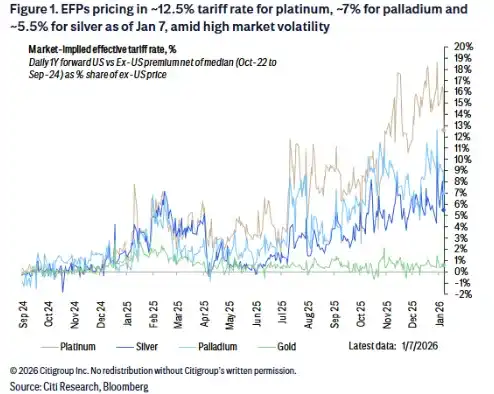
(Expected Tariff Rates from EFP Pricing)

If no tariffs are imposed: Metals will flow out of the U.S. to other global regions, easing pressure on London spot prices and potentially causing a price pullback.

What's the view on specific varieties?

  • Silver (Likely Safe): Due to heavy U.S. reliance on silver imports, Citi believes no tariff is the base case, and even if imposed, Canada and Mexico might be exempt. However, in a "no tariff" scenario, silver prices could face temporary downward pressure.
  • Palladium (High Risk): Most likely to face tariffs (e.g., 50%). If imposed, U.S. domestic import costs would rise sharply, pushing up futures prices.
  • Platinum (A Coin Toss): Whether tariffs will be imposed is currently extremely uncertain.

The investigation results were originally due on October 12, 2025, and President Trump has 90 days to take action, meaning the deadline is around January 10 (this Saturday). However, Citi believes that given the large number of commodities involved, President Trump's action might be indefinitely delayed, in which case silver and PGM prices are likely to continue rising during this period.

03 Technical Sell-off Approaches: The "Bloody Week" of Commodity Index Rebalancing

Beyond fundamental news, a "passive storm" on the funding side has already begun.

The highly anticipated annual weight rebalancing of the Bloomberg Commodity Index (BCOM) started after the close on January 8 and will continue until January 14. To maintain the diversification rule that no single commodity weight exceeds 15%, this adjustment poses significant selling pressure on the precious metals sector.

Gold: Weight reduced from 20.4% to 14.9%, facing selling pressure equivalent to 3% of total holdings.

Silver: Faces particularly huge pressure! Weight will be drastically cut from 9.6% to 3.94%, with expected selling volume reaching up to 9% of total holdings.

This "non-fundamental" selling triggered by index rules forces speculative funds to stay on the sidelines, exacerbating short-term volatility.
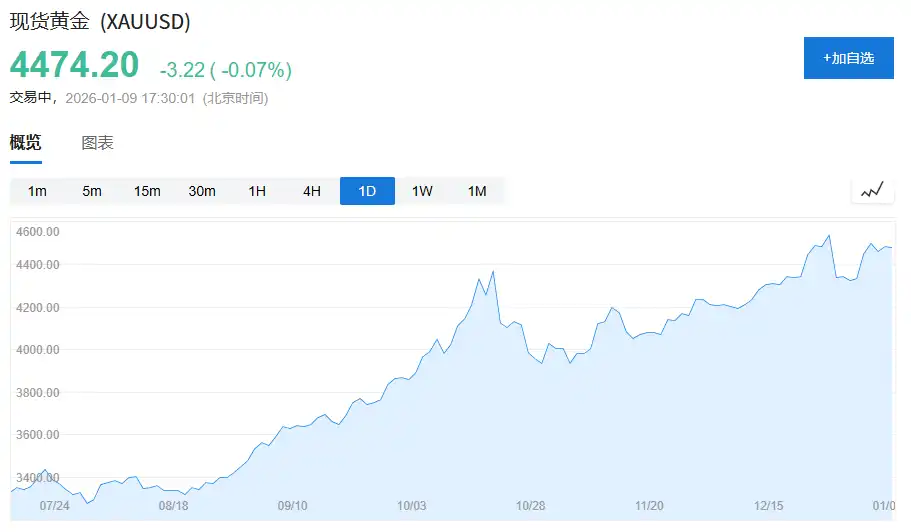
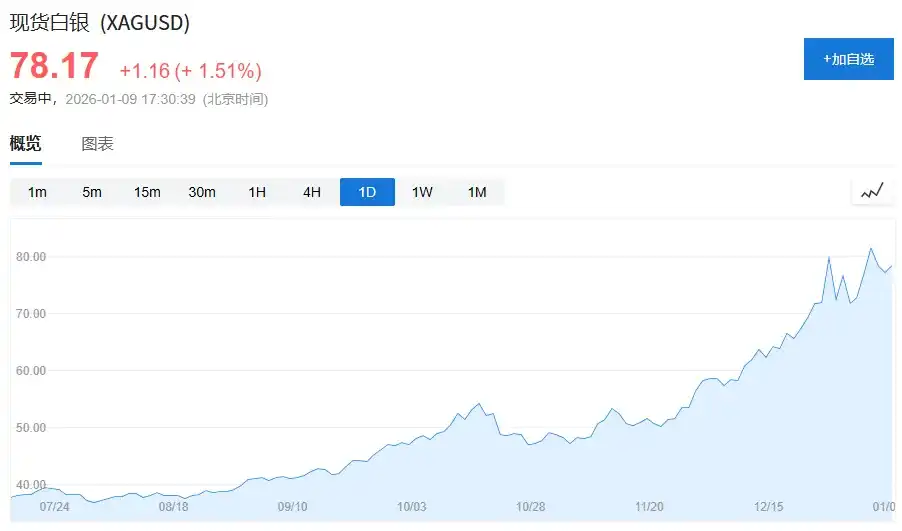
It's worth noting that the decline in gold, silver, and other precious metals comes after a rare epic rally. Spot gold surged over 70% throughout 2025, and silver gains once reached about 150%, entering a frenzy mode from December 23 last year and continuously hitting record highs. Such massive short-term profit accumulation makes the market extremely fragile when facing liquidity events.

Although Goldman Sachs analysts believe that as long as the tight London inventory situation persists, liquidity is the key determinant of prices, in the short term, investors' nerves must be strained in the face of such large-scale passive fund "repositioning."


Связанные с этим вопросы

QWhat are the three major events that are creating a 'storm' for the markets this week, according to the article?

AThe three major events are: 1) The U.S. Supreme Court's ruling on the legality of the 'trillion-dollar tariff' policy. 2) The expected announcement of the 'Section 232' investigation results on critical minerals, which could impose new tariffs. 3) The technical selling pressure from the Bloomberg Commodity Index (BCOM) annual rebalancing.

QWhy is the upcoming U.S. non-farm payrolls report on January 9th considered so crucial for the Federal Reserve?

AThe non-farm payrolls report is considered a 'reliable reading' of the economy's health after a data vacuum caused by the government shutdown. It is the most decisive reference point for the Fed's January policy meeting, directly influencing its choice to either 'stand pat' or 'continue with interest rate cuts'.

QWhat are the potential market impacts if the Supreme Court rules the broad tariff policy is illegal?

AA ruling that the tariffs are illegal could: 1) Boost U.S. stocks (e.g., lift S&P 500 companies' EBIT by ~2.4% by improving corporate profits). 2) Be negative for U.S. Treasuries by reducing a key government revenue source and worsening deficit concerns. 3) Complicate the Fed's rate-cutting path if refunds act as an additional economic stimulus.

QAccording to Citigroup's analysis, which metal is at the highest risk of having new tariffs imposed, and which is least likely?

AAccording to Citigroup: Palladium is at the highest risk, with a high probability of a significant tariff (e.g., 50%) being imposed. Silver is the least likely ('low probability') to see tariffs, as the U.S. heavily relies on imports and any potential tariffs would likely exempt Canada and Mexico.

QWhat is causing the significant technical selling pressure on gold and silver this week?

AThe selling pressure is caused by the annual rebalancing of the Bloomberg Commodity Index (BCOM). To maintain its diversification rule that no single commodity can exceed a 15% weight, the index is forced to sell significant amounts of gold (reducing its weight from 20.4% to 14.9%) and silver (reducing its weight drastically from 9.6% to 3.94%), creating non-fundamental, passive fund-driven selling.

Похожее

South Korean Exchanges 'Battle' Regulators, Challenging the Boundaries of Enforcement and Legislation

South Korea's cryptocurrency industry is engaged in a rare, direct confrontation with regulators. The Financial Intelligence Unit (FIU), the primary anti-money laundering (AML) watchdog, has recently imposed heavy penalties on major exchanges like Upbit and Bithumb for alleged violations involving unregistered overseas VASPs and AML procedures. However, exchanges are now actively challenging these actions in court and through industry associations. In a significant shift, the Seoul Administrative Court ruled in favor of Upbit's operator, Dunamu, overturning part of an FIU-ordered business suspension. The court found the FIU's penalty criteria and justification insufficiently clear. Similarly, the court suspended the enforcement of a six-month business suspension against Bithumb pending a final ruling, citing potential irreversible harm to the exchange. Beyond legal battles, the industry is contesting proposed legislative amendments. The Digital Asset eXchange Alliance (DAXA) strongly opposes a draft rule that would mandate Suspicious Transaction Reports (STRs) for all crypto transfers over 10 million KRW (~$6,800). DAXA argues this "poison pill" clause violates legal principles and would overwhelm the STR system, increasing reports from 63,000 to an estimated 5.45 million annually for major exchanges, thereby crippling effective AML monitoring. This conflict highlights a structural tension in South Korea's crypto governance: comprehensive digital asset laws are still developing, while regulators rely heavily on AML enforcement. The industry's move from passive compliance to active legal and legislative challenges signifies a new phase, pressing for clearer rules and more proportionate enforcement. While short-term disputes may intensify, this clash could ultimately lead to a more mature and sustainable regulatory framework for South Korea's vibrant crypto market.

marsbit50 мин. назад

South Korean Exchanges 'Battle' Regulators, Challenging the Boundaries of Enforcement and Legislation

marsbit50 мин. назад

After 50x Storage Surge, Justin Sun Always Looks to the Next Decade

Sun Yuchen, known for his controversial stunts like a $30 million lunch with Warren Buffett (canceled due to a kidney stone) and eating a $6.2 million duct-taped banana, is often overshadowed by a significant fact: his decade-long track record of spotting major investment trends. In 2016, he famously advised young people to invest in Bitcoin, Nvidia, Tesla, and Tencent instead of buying property. A hypothetical $20,000 investment in Nvidia and Tesla from that list would now be worth over 50 million RMB. His latest major call was on November 6, 2025, predicting a "50x storage opportunity" tied to the AI boom, which materialized with Sandisk's stock surging nearly 50-fold by 2026. Looking ahead, Sun now focuses on the next frontier: Physical AI. He identifies four key areas: 1. **Embodied AI/Robotics**: He sees this reaching its "iPhone moment," with companies like UBTech and Galaxy General leading in commercialization. 2. **Drones**: Viewed as the first commercially viable form of Physical AI, revolutionizing sectors from warfare (e.g., AeroVironment's Switchblade) to logistics. 3. **Spatial Computing**: Beyond VR, it's about AI understanding physical space, a foundational technology for robotics and autonomous systems, exemplified by Apple's Vision Pro. 4. **Space Exploration**: After a 2025 suborbital flight with Blue Origin, Sun advocates for space as the ultimate frontier, discussing blockchain's potential role in space asset management and data transactions. His investment philosophy involves betting on entire, inevitable trends rather than single companies. For robotics, he sees Tesla (the body/manufacturer) and Nvidia (the brain/AI platform) as complementary plays. In defense drones, he highlights companies making tanks obsolete (AeroVironment) and those augmenting fighter jets (Kratos). For space, he participated in Blue Origin's flight and anticipates SpaceX's potential IPO to redefine the sector's valuation. Sun Yuchen's vision frames the next two decades not as a revolution in information flow (like the internet), but in the fundamental operation of the physical world through AI-powered robots, autonomous systems, and spatial intelligence, ultimately extending human and AI activity into space. While many still focus on conventional assets, he continues to look toward the next technological horizon.

marsbit1 ч. назад

After 50x Storage Surge, Justin Sun Always Looks to the Next Decade

marsbit1 ч. назад

The Billionaires Behind the Most Expensive Midterm Election in History

"The Most Expensive Midterm Elections and Their Billionaire Backers" This analysis details the unprecedented scale of spending in the 2026 midterm elections, highlighting the key billionaire donors shaping the political landscape. Jeff Yass, founder of Susquehanna International Group, has contributed over $81 million, ranking third among individual donors behind George Soros ($102.6M) and Elon Musk ($84.8M). Yass is a major donor to Trump's MAGA Inc. and supports school choice and various candidates. Overall, federal committees have raised over $4.7 billion this cycle, with political ad spending projected to reach $10.8 billion. Republican-aligned groups are significantly out-raising their Democratic counterparts. "Dark money" from undisclosed sources continues to grow. The core stakes involve control of Congress and policy direction for Trump's final term. Donors are also motivated by specific issues: Sergey Brin and Chris Larsen are funding opposition to a proposed California wealth tax and supporting crypto-friendly policies. Other top donors include OpenAI's Greg Brockman and his wife Anna ($50M total to MAGA Inc. and an AI-focused PAC), Richard Uihlein ($45.3M to conservative causes), venture capitalists Marc Andreessen and Ben Horowitz (each over $44M to crypto/AI PACs and MAGA Inc.), Miriam Adelson ($42.6M to GOP leadership PACs), Paul Singer ($33.9M), and Diane Hendricks ($25.8M to MAGA Inc.). The article notes that the peak fundraising period is still ahead, with major primaries approaching.

marsbit1 ч. назад

The Billionaires Behind the Most Expensive Midterm Election in History

marsbit1 ч. назад

The Largest IPO in History Is Approaching, Surpassing SpaceX, 28 Years of AI Self-Iteration, Countdown to Intelligence Explosion

"Anthropic Nears Trillion-Dollar IPO, Fueled by Explosive Growth and 2028 'Intelligence Explosion' Warning Anthropic is considering a deal valuing the AI company near $1 trillion, potentially leading to one of the largest IPOs ever and surpassing SpaceX. Its revenue has skyrocketed, with Annual Recurring Revenue (ARR) reaching $45 billion in May 2026—a 500% increase in just five months. This vertical growth curve is attributed to its key products, Claude Code and Cowork, dominating AI coding and enterprise collaboration. Beyond commercial success, co-founder Jack Clark issued a pivotal warning in an interview: there is a greater than 50% chance that by the end of 2028, AI systems will achieve recursive self-improvement—the ability to autonomously build a 'better version' of themselves, initiating an 'intelligence explosion.' This prophecy underpins the company's astronomical valuation, as the market prices in the potential for transformative and disruptive AI. Further signaling its ambition, Anthropic formed a $1.5 billion joint venture with Goldman Sachs and Blackstone, aiming to disrupt traditional consulting firms like McKinsey by deploying Claude AI for complex strategic work. This move tests AI's capacity to replace high-level cognitive labor, a precursor to its predicted autonomous evolution. The narrative presents a dual future: unprecedented economic opportunity alongside significant risks like economic restructuring and security threats. Anthropic's meteoric rise and Clark's 2028 prediction frame the coming years as a countdown to a potential technological singularity."

marsbit2 ч. назад

The Largest IPO in History Is Approaching, Surpassing SpaceX, 28 Years of AI Self-Iteration, Countdown to Intelligence Explosion

marsbit2 ч. назад

Торговля

Спот
Фьючерсы
活动图片




