Odaily's On-Site Experience at Polymarket's First New York Store: The Most Timely Charity and Marketing

Odaily星球日报Опубликовано 2026-02-13Обновлено 2026-02-13

Введение

Polymarket, a crypto prediction market platform, opened a free pop-up grocery store named "The Polymarket" in Lower Manhattan, New York, on February 12th. The initiative, framed as a charity event, offered all items—from fresh produce to household essentials—completely free until February 16th. Despite a delayed opening, hundreds of New Yorkers queued for hours, with lines stretching multiple blocks. Most attendees were unaware of Polymarket's core business as a prediction market, learning of the event through social media or community groups. The operation was meticulously organized, with staff assisting shoppers and a limit of one bag per person. In addition to the pop-up, Polymarket donated $1 million to the Food Bank For New York City. The timing was notable, coinciding with a proposal by the new mayor to open city-run low-cost grocery stores. A competitor, Kalshi, ran a similar promotion days earlier. While clearly a marketing effort, the event provided tangible relief to residents grappling with high living costs, with many expressing gratitude for the support.

Original | Odaily Planet Daily (@OdailyChina)

Author | jk

On-site Interview | Connie

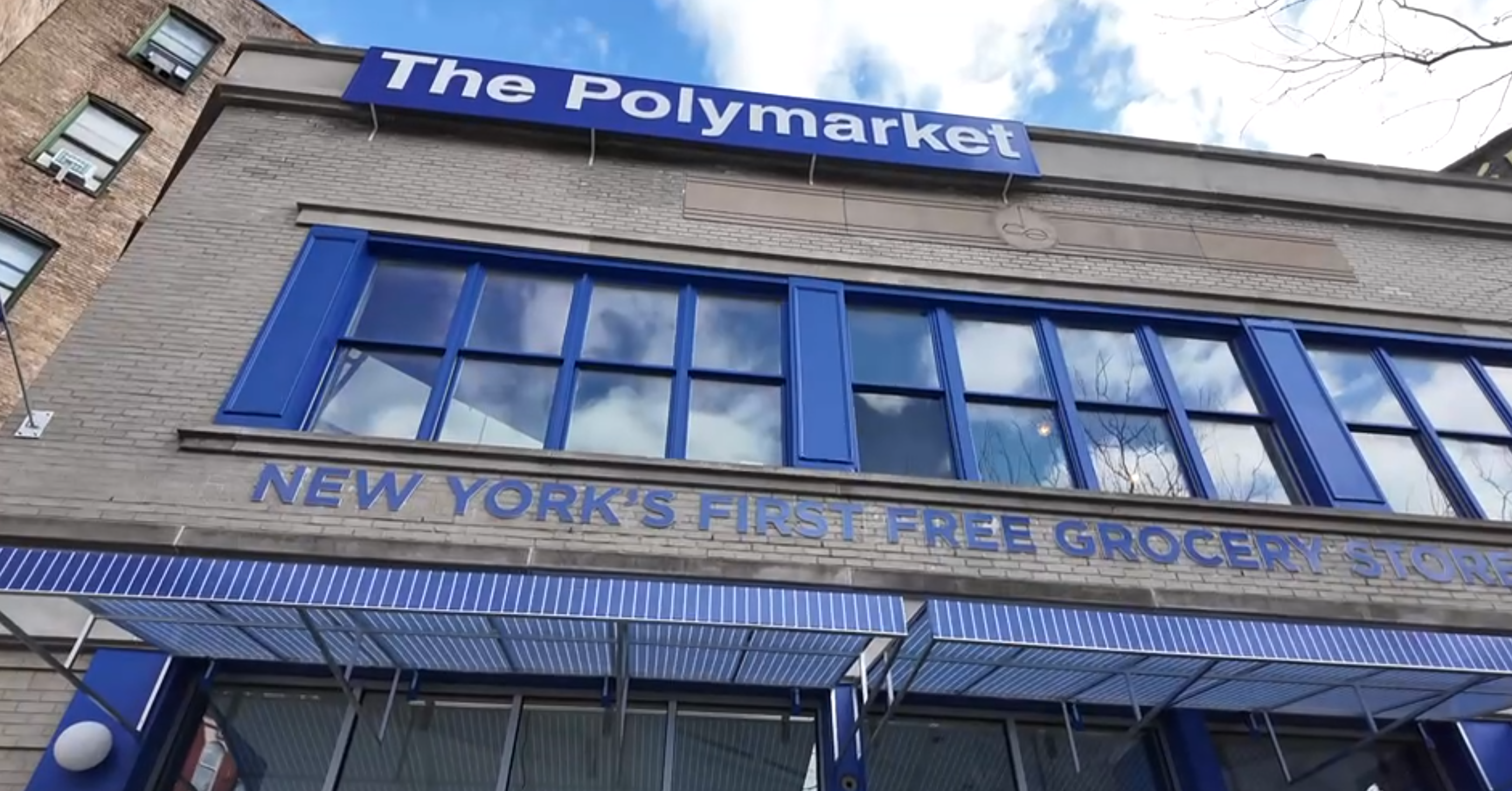
On February 12th local time in the US, the crypto prediction market platform Polymarket held a charity event in Lower Manhattan, New York, opening a free grocery store named "The Polymarket," the first completely free grocery store in New York City. From fresh produce to daily necessities, all items were provided free of charge. The event will last until February 16th.

Connie from Odaily Planet Daily in New York visited the store on its opening day, experienced the environment, and interviewed staff and many queuing New Yorkers. Let's take a look at what the scene was like on the first day of Polymarket's first "offline physical store."

Opened at 2 PM, but People Started Queuing at 6 AM, with the Line Wrapping Around the Entire Block

The event was originally scheduled to open at 12 PM, but due to delayed shipments, the opening time was postponed to 2 PM. Despite this, New Yorkers arrived early to queue. On-site staff revealed that when he arrived at 7 AM, the first three people in line were already there.

The first person in line was a woman named Tori. She told on-site reporter Connie that she had been there since 6 AM, even though it was winter.

"We arrived at 6 AM," said Tori Hall. "We thought it would open at 12 PM, but now we have to wait until 2 PM. But free is free, times are tough these days." Because the line was so long, by 11 AM, the queue had stretched four blocks away. Polymarket staff occasionally provided free coffee to the waiting crowd.

The queue extended four blocks away

It is reported that by the time the on-site reporter left, the crowd was so large that the New York Police Department had sent officers to inquire about the situation.

Most People in Line Didn't Know What Polymarket Was

Interestingly, the vast majority of citizens coming to collect free groceries had no idea what Polymarket was. Ryan from Brooklyn learned about the event from the "New York City for Free" Instagram account. When asked if he had heard of prediction markets, he admitted: "No. What is Polymarket?" After learning it was a prediction market platform, he said, "Oh, I've heard of it, seems like a prediction website." (Not bad, at least the brand impression should stick this time.)

According to Odaily Planet Daily's observations, there were some Chinese people in the queue who learned about the event through WeChat groups. "They had no idea what a prediction market was or what Polymarket is," Connie discovered during interviews. "When I asked them if they knew what Polymarket was, they said, 'It's just supermarket, right?'. Some even thought it was a welfare initiative from the new mayor."

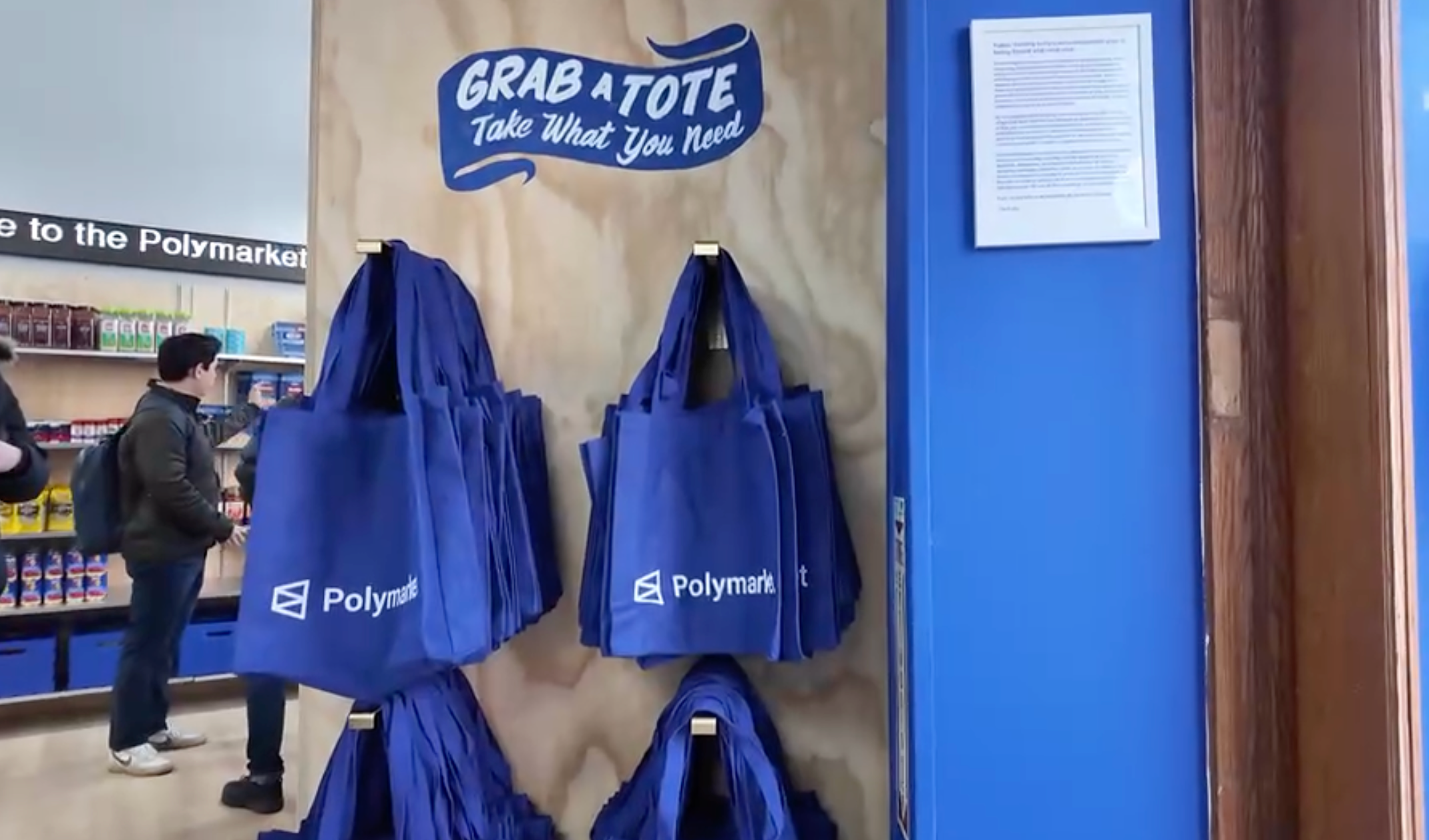
Polymarket-branded tote bag

Meticulously Planned Details and a Million-Dollar Donation

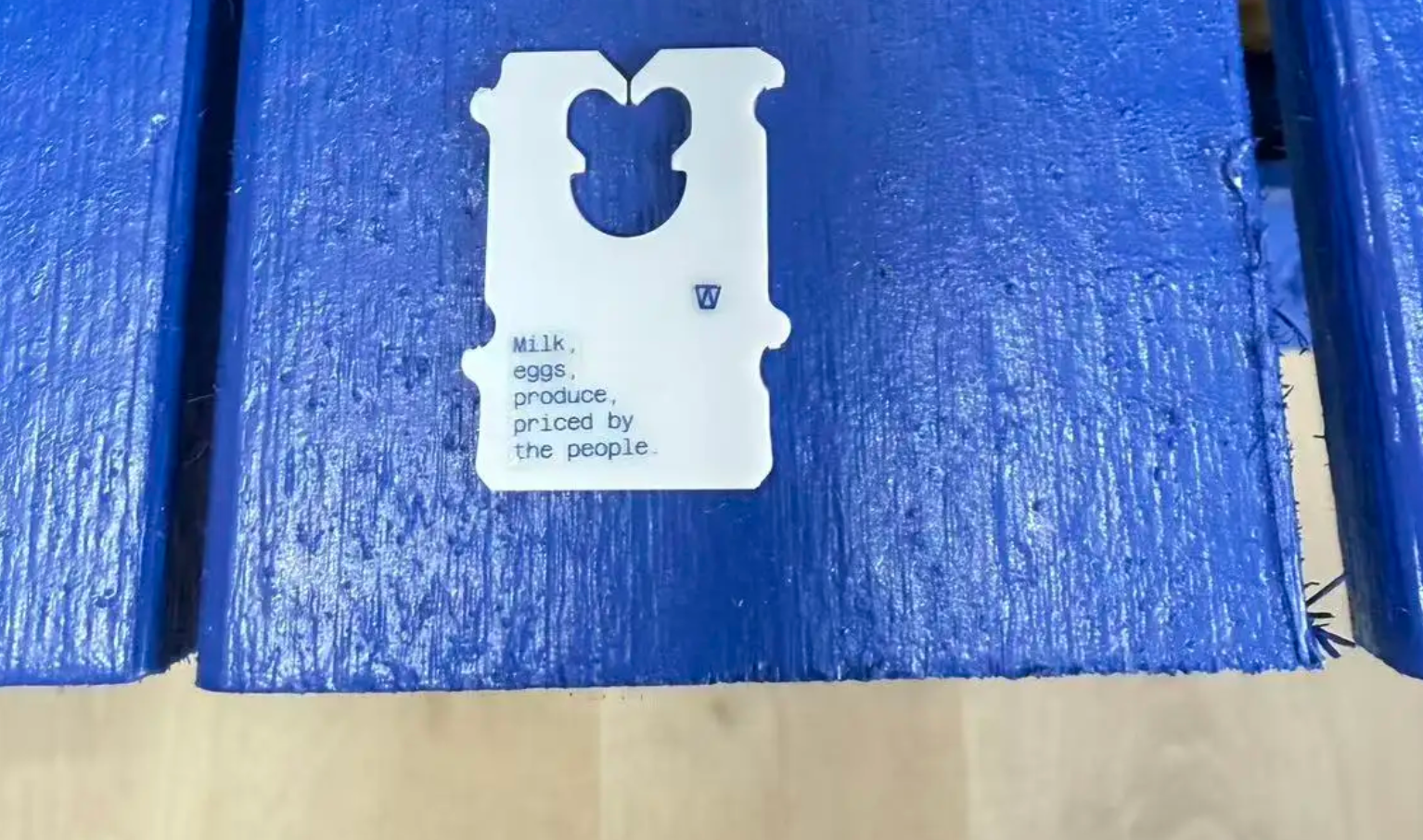
Every detail of this pop-up grocery store was carefully designed. According to Polymarket staff, the blue price tags in the store read "Milk, eggs, produce priced by the people," the onion stickers were printed with Polymarket's logo, and even the store location was thoughtfully chosen.

"Milk, eggs, produce priced by the people"

This staff member, who previously worked at the NFL and for MrBeast, revealed: "CEO Shayne Coplan and the CMO both grew up in New York public schools. This is the company's first charity event since its founding, and they wanted to give back to the city that raised the company." The CEO was also on site that day.

The entire store was built from scratch in just two days. The store was stocked with a wide variety of items: fresh fruits, vegetables, meat, eggs, dairy, pasta, tomato sauce, olive oil, peanut butter, canned goods, snacks, beverages, and daily necessities like paper towels. Notably, with Valentine's Day approaching, the store also had a free flower section.

Upon entering the store, customers received a tote bag, and market staff acted as personal shopping assistants, helping them select the items they needed.

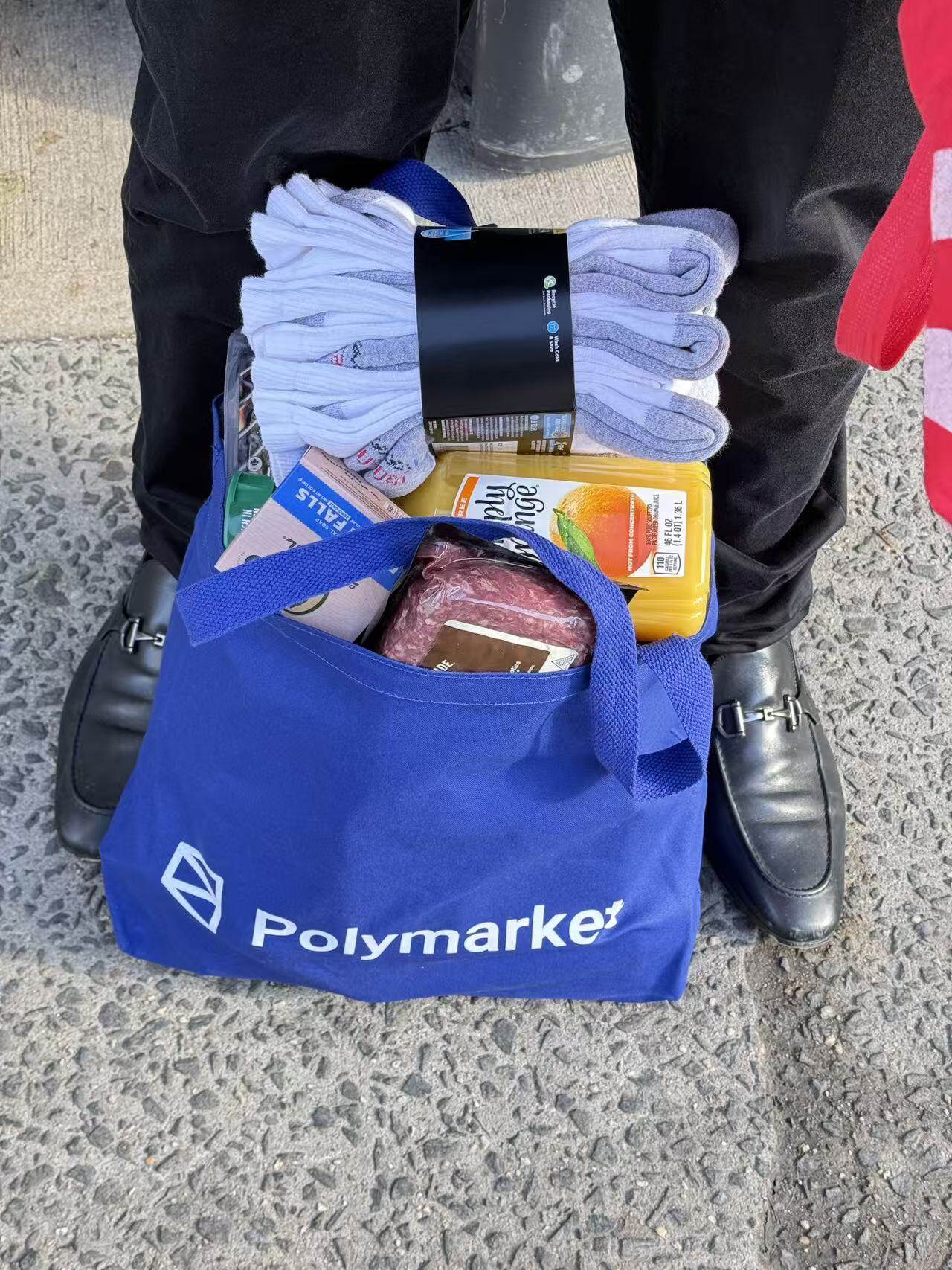
Staff told Odaily that each customer could fill the shopping bag they were given, taking as much as they wanted within that limit, preferably items they would actually use.

One customer's haul

In terms of maintaining order, there were 9 security personnel managing the queue and controlling the flow of people today. Citizens took turns to enter the store and shop; once inside, staff guided them, making the actual shopping process very quick—there was no sense of chaos. (New Yorkers are generally quite orderly when it comes to queuing.)

In addition to the physical grocery store, Polymarket also donated $1 million to the Food Bank For New York City. According to staff, this donation is equivalent to 3 million meals and will help address food shortages for people across New York's five boroughs. However, when asked about the total cost of the event, staff declined to disclose it.

The "Coincidence" with the Mayor's Proposal

Polymarket's move was very timely: New York City's new Mayor, Zohran Mamdani, promised during his campaign to open at least one government-operated low-price grocery store in each borough, selling food at wholesale prices. Polymarket's free grocery store seemed like a response to this proposal, or a preemptive move, certainly capitalizing on the hype.

In response, Mayor Mamdani posted a screenshot from The Onion on social media: "Heartbreaking: The Worst Person You Know Just Made a Great Point." Polymarket later expressed hope that the mayor would visit, stating, "We've been trying to get in touch."

More intriguingly, Polymarket isn't the only prediction market platform engaging in such marketing. Its competitor, Kalshi, also offered $50 worth of free groceries per person at Westside Market in the East Village on February 3rd, attracting large crowds.

Despite the obvious marketing motives, this event provided real, tangible help to New Yorkers. Tori Hall said she spends between $150 and $200 on groceries each month. "Toilet paper is $30 to $40, a case of good water is $20 to $30, eggs are $8 to $9. It all really adds up. Prices are getting more and more expensive."

She praised the event highly: "This is amazing, so good. I highly recommend them, thank you very much for helping the community and the public."

Ryan from Brooklyn, who spends about $80 to $90 on groceries monthly, thought: "This is a great opportunity for those who are struggling financially or don't have money."

After the event concludes, Polymarket plans to shift to accepting community donations. On the afternoon of February 15th and all day on the 16th (Presidents' Day), the focus will be on collecting non-perishable food items. All collected supplies will be distributed to partner organizations in New York City to help neighbors in need.

For more on-site videos and interviews, please follow Odaily's video channel.

Related Reading

Odaily Exclusive丨Polymarket Opens Store in NY, Kalshi Gives Out $50 Supermarket Vouchers, Are Prediction Markets Also Giving Out Eggs Now?

Связанные с этим вопросы

QWhat was the main purpose of Polymarket's pop-up grocery store in New York City?

AThe main purpose was to conduct a charity event by offering free groceries to New Yorkers, while simultaneously raising brand visibility for the prediction market platform Polymarket.

QHow did most people in line learn about the free grocery event?

AMost people learned about the event through social media platforms like Instagram accounts such as 'New York City for Free' or through community WeChat groups, with many unaware of what Polymarket was.

QWhat significant donation did Polymarket make alongside the pop-up store event?

APolymarket donated $1 million to the Food Bank For New York City, which is equivalent to providing 3 million meals to help address food shortages across the five boroughs.

QHow did the timing of Polymarket's event relate to local politics?

AThe event coincided with New York City's new mayor Zohran Mamdani's campaign promise to open at least one government-run low-price grocery store per borough, making Polymarket's free store a timely and attention-grabbing initiative.

QWhat was the response from the public and officials regarding the event?

AThe public response was highly positive, with long lines forming hours before opening, while Mayor Mamdani responded sarcastically on social media, though Polymarket expressed hope for his visit and engagement.

Похожее

Will the Next Crypto Bull Run Start with On-Chain Trading of SpaceX?

This article presents a scenario-based forecast for the crypto industry from 2026 to 2029, arguing that the next major cycle will be driven not by technological narratives but by legal access to real-world assets. The author predicts that by mid-2026, pre-IPO perpetual contracts for top private companies like SpaceX, OpenAI, and Anthropic on platforms like Hyperliquid will become the primary gateway for accessing quality assets, as most crypto-native tokens fail to capture real value. The much-hyped AI x Crypto intersection largely fails except for prediction markets, which thrive on betting on AI model supremacy. By 2027, public blockchain foundations are forced to choose between catering to retail speculation or building compliant infrastructure for institutions, with many opting for the latter. Growth in stablecoins and tokenized private credit/equity hits a "triple ceiling" due to regulatory and political uncertainty rather than market demand. The pivotal shift is forecast for 2028. A major liquidation event in pre-IPO perpetuals exposes the structural flaw of synthetic markets lacking a real underlying asset anchor. In response, regulatory changes finally allow the public solicitation of private securities resales to verified accredited investors. This creates a legitimate secondary market for real company equity, which then becomes the core asset class of the new bull market, relegating synthetic perps to a niche role. By 2029, the industry becomes "boring" but foundational. Tokens without claims on real cash flows or assets cease trading. Stablecoin growth is steady but politically capped. Crypto infrastructure fades from view as it gets absorbed into traditional finance backends. The article's central thesis is that the key bottleneck for crypto's next phase is legal and regulatory channels for real asset ownership, not technology.

marsbit15 мин. назад

Will the Next Crypto Bull Run Start with On-Chain Trading of SpaceX?

marsbit15 мин. назад

The Value Distribution of Stablecoins

**Summary: The Value Distribution of Stablecoins** The article argues that stablecoins are evolving from mere trading tools into broader channels for dollar access. It divides the stablecoin ecosystem into four layers to analyze how value is distributed: 1. **Issuance Layer:** Mints stablecoins, holds reserve assets, and captures the spread between reserve yield and user costs (e.g., Tether, Circle). This layer currently earns the largest profit margin. 2. **Infrastructure Layer:** Connects stablecoins to the traditional financial system, handling fiat on/off-ramps, banking integration, compliance (KYC/AML), and asset management (e.g., Bridge, BVNK). This is the "unglamorous" but critical work, building the essential bridges between crypto and real-world finance. 3. **Acquiring/Distribution Layer:** Integrates stablecoins into merchant systems, manages payment flows, and provides enterprise financial software (e.g., Stripe, Coinbase). They act as the access point for businesses. 4. **Application Layer:** The end-users and businesses that ultimately use stablecoins for payments, settlements, or as a store of value. They benefit from convenience but have little pricing power. The core thesis is that while the issuance layer currently dominates profits, the often-overlooked **infrastructure layer holds significant long-term potential**. The real challenge and barrier to mass adoption is not the on-chain transfer of stablecoins (which is simple), but the complex "last mile" integration into existing business workflows, banking systems, and regulatory frameworks across different countries. Companies in this layer are currently in a "land grab" phase, investing heavily to build networks, secure bank partnerships, and establish compliance pathways. While their position is currently pressured by the profitable issuers above and distribution platforms below, the article suggests that if stablecoins become a default financial rail for businesses, the infrastructure providers who have done the hard work of integration will ultimately gain strong pricing power and become entrenched, essential players.

marsbit6 ч. назад

The Value Distribution of Stablecoins

marsbit6 ч. назад

The Value Distribution of Stablecoins

The Value Distribution of Stablecoins The article argues that stablecoins are evolving from a mere trading tool into a broad "dollar channel." It analyzes the industry's value chain through four layers: 1. **Issuance Layer (e.g., Tether, Circle):** The top layer that mints stablecoins, holds reserve assets, and captures the thickest interest rate spread. 2. **Infrastructure Layer (e.g., Bridge, BVNK):** Connects stablecoins to the traditional financial system, handling critical but complex "dirty work" like fiat on/off-ramps, banking integration, compliance (KYC/AML), and cross-border settlement. 3. **Acquiring/Distribution Layer (e.g., Stripe, Coinbase):** Embeds stablecoins into merchant systems, manages payment flows, and integrates with enterprise software. 4. **Application Layer:** End-users and businesses that ultimately use stablecoins for payments, settlement, or storing value. The author posits that while the issuance layer currently captures the most profit, the most overlooked and potentially critical layer is infrastructure. The core challenge for stablecoin adoption isn't the on-chain transfer (which is simple), but bridging the gap between blockchain and the real-world financial system. This involves solving practical problems for businesses: fiat conversion, reconciliation, tax handling, and user onboarding. Infrastructure companies are currently in a difficult "land-grab" phase—building networks, securing banking relationships, and achieving compliance country-by-country. They face pressure from both the profitable issuance layer above and distribution platforms below. However, the author suggests this layer is building a crucial moat. Once stablecoins become a default business rail, the infrastructure players who have done the hard work of integration may gain significant, durable value and pricing power.

链捕手7 ч. назад

The Value Distribution of Stablecoins

链捕手7 ч. назад

Торговля

Спот
Фьючерсы

Популярные статьи

Как купить S

Добро пожаловать на HTX.com! Мы сделали приобретение Sonic (S) простым и удобным. Следуйте нашему пошаговому руководству и отправляйтесь в свое крипто-путешествие.Шаг 1: Создайте аккаунт на HTXИспользуйте свой адрес электронной почты или номер телефона, чтобы зарегистрироваться и бесплатно создать аккаунт на HTX. Пройдите удобную регистрацию и откройте для себя весь функционал.Создать аккаунтШаг 2: Перейдите в Купить криптовалюту и выберите свой способ оплатыКредитная/Дебетовая Карта: Используйте свою карту Visa или Mastercard для мгновенной покупки Sonic (S).Баланс: Используйте средства с баланса вашего аккаунта HTX для простой торговли.Третьи Лица: Мы добавили популярные способы оплаты, такие как Google Pay и Apple Pay, для повышения удобства.P2P: Торгуйте напрямую с другими пользователями на HTX.Внебиржевая Торговля (OTC): Мы предлагаем индивидуальные услуги и конкурентоспособные обменные курсы для трейдеров.Шаг 3: Хранение Sonic (S)После приобретения вами Sonic (S) храните их в своем аккаунте на HTX. В качестве альтернативы вы можете отправить их куда-либо с помощью перевода в блокчейне или использовать для торговли с другими криптовалютами.Шаг 4: Торговля Sonic (S)С легкостью торгуйте Sonic (S) на спотовом рынке HTX. Просто зайдите в свой аккаунт, выберите торговую пару, совершайте сделки и следите за ними в режиме реального времени. Мы предлагаем удобный интерфейс как для начинающих, так и для опытных трейдеров.

1.5k просмотров всегоОпубликовано 2025.01.15Обновлено 2026.06.02

Как купить S

Sonic: Обновления под руководством Андре Кронье – новая звезда Layer-1 на фоне спада рынка

Он решает проблемы масштабируемости, совместимости между блокчейнами и стимулов для разработчиков с помощью технологических инноваций.

2.3k просмотров всегоОпубликовано 2025.04.09Обновлено 2025.04.09

Sonic: Обновления под руководством Андре Кронье – новая звезда Layer-1 на фоне спада рынка

HTX Learn: Пройдите обучение по "Sonic" и разделите 1000 USDT

HTX Learn — ваш проводник в мир перспективных проектов, и мы запускаем специальное мероприятие "Учитесь и Зарабатывайте", посвящённое этим проектам. Наше новое направление .

1.8k просмотров всегоОпубликовано 2025.04.10Обновлено 2025.04.10

HTX Learn: Пройдите обучение по "Sonic" и разделите 1000 USDT

Обсуждения

Добро пожаловать в Сообщество HTX. Здесь вы сможете быть в курсе последних новостей о развитии платформы и получить доступ к профессиональной аналитической информации о рынке. Мнения пользователей о цене на S (S) представлены ниже.

活动图片