NYSE Can't Sit Still, Plans to Launch 24/7 Tokenized Trading

比推Опубликовано 2026-01-19Обновлено 2026-01-19

Введение

The New York Stock Exchange (NYSE) is reportedly planning to launch a tokenized securities trading and on-chain settlement platform that would enable 7x24 hour trading of stocks and ETFs. This move, seen as a response to competitor Nasdaq's own application for tokenized stock trading submitted last year, represents a significant step by traditional finance into the digital asset space. The proposed "on-chain stock tokenization solution" includes features such as fractional share trading, stablecoin-based fund settlement, instant settlement, and plans to grant tokenized stocks equal dividend and governance rights as traditional securities. NYSE's parent company, ICE, is also collaborating with major banks to explore supporting infrastructure. Market reactions are mixed. Proponents view it as an inevitable fusion of traditional and crypto finance, bringing enhanced liquidity and modernized infrastructure like atomic settlement. Critics, however, express concerns that it primarily benefits exchanges and could negatively impact younger investors by creating a relentless trading environment. The approval process by the SEC is expected to take time, potentially not until late 2026, leaving a window of opportunity for existing crypto platforms that offer features like non-KYC trading and high leverage, which the NYSE platform is unlikely to provide. The core driver for traditional exchanges remains trading volume and fees, and their success is not guaranteed in this new competitiv...

Source: Odaily Planet Daily

Author: Wenser

Original Title: NYSE Plans to Launch 24/7 Tokenized Stock Trading, Leaving "Competitors" Stunned


As "Flash Crash Monday" continues, the crypto market has just been hit with another bombshell—according to multiple media sources, the New York Stock Exchange plans to launch a tokenized securities trading and on-chain settlement platform supporting 24/7 trading. After investing $2 billion in Polymarket last year, the ICE Group is once again leveraging its stock exchange to join the century-defining wave of cryptocurrency transformation.

It is worth noting that as early as last September, the "competitor" Nasdaq had already submitted an application to the SEC for tokenized stock trading. NYSE's move is also interpreted by the outside world as a response to competition among stock exchanges.

This article will briefly summarize market views related to this event and explore its potential impact.

NYSE Can't Sit Still: A More Aggressive "On-Chain Tokenization Solution for Stocks" Compared to Nasdaq

After Trump took office, the U.S. cryptocurrency regulatory environment underwent a significant shift. As a result, crypto IPOs, stablecoins, PayFi, and DeFi have developed rapidly, sweeping away the policy gloom of the Biden era. According to statistics, stablecoin trading volume reached $33 trillion last year, a sharp increase of 72% year-on-year. Behind this lies the substantial profits earned by stablecoin issuers Tether and Circle, as well as the massive liquidity that can be directed to the stock securities market.

Moreover, unlike Nasdaq's application to the SEC for tokenized stock trading last September, nearly half a year later, NYSE's moves related to "tokenized stock trading" are not just an application to regulators but a comprehensive "on-chain solution."

Specifically, NYSE's "on-chain tokenization solution for stocks" includes the following three aspects:

  • This is a tokenized securities trading and on-chain settlement platform, planning to support 24/7 trading of U.S. stocks and ETF funds, fractional share trading, stablecoin-based fund settlement, and instant delivery, while integrating NYSE's existing matching engine with a blockchain settlement system.

  • According to NYSE's plan, tokenized stocks will have the same dividends and governance rights as traditional securities.

  • NYSE's parent company, ICE, is also collaborating with banking giants such as BNY Mellon and Citigroup to explore tokenized deposits and clearing infrastructure to support cross-time zone, round-the-clock fund and margin management.
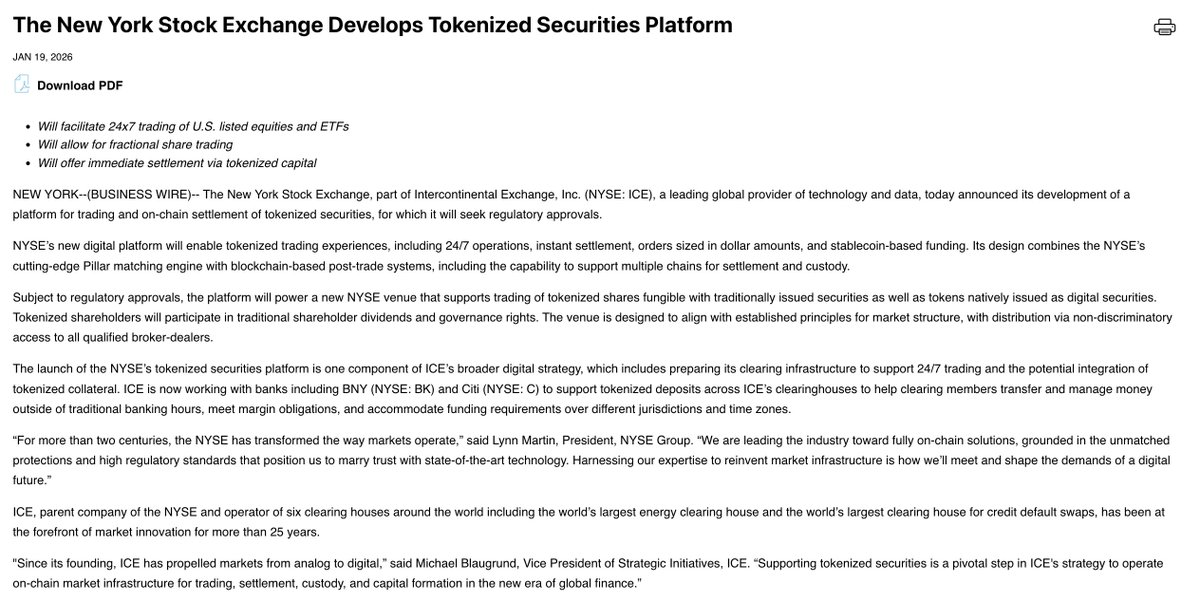
In comparison, if Nasdaq's tokenized stock application seems like a "new bottle for old wine" move in response to policy, NYSE's plan appears to be a "new retail trading platform" that integrates all aspects of "production-packaging-distribution-recycling."

Most importantly, NYSE's "tokenized stock" trading platform supports 24/7 trading, which was originally one of the advantages of various cryptocurrencies over securities and stocks. Now, this advantage becomes a joke in the face of the massive asset targets and liquidity of the world's largest stock exchange, NYSE.

As a result, there are some pessimistic views in the crypto market: "The RWA sector of the crypto market and its increasingly tight liquidity will face the strictest 'father.' Compared to NYSE's annual trading volume of over a hundred trillion dollars, crypto RWA projects can almost be said to not exist."

What Crypto Practitioners Think: Mixed Impacts, the Past Is the Past, the Present Is the Present

In 1792, 24 securities brokers signed the Buttonwood Agreement under a buttonwood tree outside 68 Wall Street in New York, marking the birth of the predecessor of the New York Stock Exchange. At that time, due to limited investment targets and market activity, stock trading hours were relatively flexible, with no strict continuous trading sessions. Brokers primarily conducted transactions through auctions or informal methods.

On March 8, 1817, the organization drafted a charter and officially changed its name to the New York Stock and Exchange Board.

In May 1887, NYSE standardized stock trading hours to "Monday to Friday: 10:00 AM to 3:00 PM; Saturday: 10:00 AM to 12:00 PM."

In 1952, Saturday trading was officially canceled.

In 1985, stock trading opening time was moved forward to 9:30 AM, and closing time extended to 4:00 PM, forming the current 9:30–16:00 session, which has lasted for about 41 years.

If NYSE's application for 24/7 tokenized stock trading is approved, it would mean that this decades- or even centuries-old "limited-time trading model" will become history. From this perspective, the crypto market has gained high recognition from mainstream finance.

Pro Views: The Era's Momentum Is Unstoppable

BTC OG and BankToTheFuture founder Simon Dixon posted, "Nothing can stop this (era's) train. Tokens are IOUs for actual assets held by custodians, supplementing DTCC claims. All-day trading is achievable without tokens. This is an upgraded version of the surveillance state. You will own nothing and be happy." The accompanying image showed BlackRock CEO Larry Fink and Coinbase CEO Brain Armstrong embracing.

Indian crypto KOL Open4profit posted, "(This will) allow the market to react immediately to global news; AI and algorithms will play a greater role in pricing and risk management; this is a significant change for the stock market—keep a close eye on liquidity changes."

Redstone DeFi co-founder Marcin saw a "startup opportunity," saying, "This is a good start and aligns with what we are going to do next."

Wintermute OTC head Jake O also highly affirmed the move: "Traditional infrastructure can extend trading hours but cannot solve T+1/2 friction or eliminate rent-seeking behaviors that increase costs and delays. Ironically, crypto solved this years ago: 24/7 trading, instant settlement, global access, no gatekeepers or (traditional banks') 'data fees.' Convergence is inevitable: equity trading on-chain, atomic settlement, the line between 'crypto' assets and 'traditional' assets will completely disappear. Welcome to the 21st century..."

Of course, some see it as an opportunity, while others see it as a threat.

Con Views: Exchanges Reap the Benefits, the Younger Generation Suffers

Unlike those in the industry who believe NYSE's move will stimulate the crypto market and promote cryptocurrency adoption, some insiders also see potential problems.

L1D partner LouisT posted: "The entire global financial system is moving on-chain, but somehow, they don’t seem to be bidding for our 'bear-drug-like' tokens." In other words, traditional financial market does not buy into the so-called RWA assets of cryptocurrencies.

MoonRock Capital founder expressed concern about the living conditions of the younger generation: "This is not good news for the baby boomers; your lives have become more difficult." He likely meant that compared to previous generations with more increments, baby boomers face a more complex investment environment and a round-the-clock "liquidity gaming stage."

BingX advisor Nebraskangooner also raised doubts: "Why make the stock market trade 24 hours? No one wants this except the exchanges. The only benefit is that without after-hours trading interference, stop-loss and take-profit points can truly function. Not sure what impact this will have on stock price movements after earnings reports?" This view focuses more on information impact and exchange profits.

Summary: A Gap Still Exists Between Traditional Finance and Crypto Natives, Opportunities for Users and Entrepreneurs Remain

Finally, I would like to share some personal views based on the above information:

First, based on current information, NYSE's related application may be approved as early as the end of 2026, with the main approval authority still being the U.S. SEC. For crypto platforms, this is an important time gap.

Second, NYSE's tokenized stock trading and on-chain settlement platform will likely primarily serve conventional investment institutions and compliant investors. For crypto-native groups and global investors, what they need is not just functional satisfaction but also the ability to achieve "KYC-free registered trading, global asset liquidity allocation, and riskier high-leverage" through tokenized stocks and RWA platforms. This may be the advantage of crypto RWA projects.

Finally, the core purpose of NYSE, Nasdaq, and others in promoting stock tokenization remains trading volume and fees. Like CEXs continuously listing new token projects, in the short term, they may still need to learn from CEXs, DEXs, and even on-chain Perp DEXs. This is also the basis for existing mature platforms to potentially counterattack. By then, it is not impossible for U.S. stock exchanges like NYSE and Nasdaq to fall from grace. The focus is still on where the liquidity is, where the attention is, and where the user base is.


Twitter:https://twitter.com/BitpushNewsCN

Bitpush TG Discussion Group:https://t.me/BitPushCommunity

Bitpush TG Subscription: https://t.me/bitpush

Original link:https://www.bitpush.news/articles/7603876

Связанные с этим вопросы

QWhat is the New York Stock Exchange (NYSE) planning to launch according to the article?

AThe NYSE is planning to launch a tokenized securities trading and on-chain settlement platform that supports 7x24 hour trading, fractional share trading, stablecoin-based fund settlement, and instant settlement for U.S. stocks and ETF funds.

QHow does the NYSE's tokenized stock trading plan differ from Nasdaq's application submitted last year?

AUnlike Nasdaq's application, which was seen as a superficial response to policy changes, the NYSE's plan is a comprehensive 'on-chain solution' that integrates trading, settlement, and banking infrastructure, offering full-chain functionality rather than just a tokenized representation of existing stocks.

QWhat are some potential positive impacts of the NYSE's 7x24 hour tokenized trading platform as viewed by crypto industry insiders?

APositive impacts include immediate market reaction to global news, greater role of AI and algorithms in pricing and risk management, elimination of traditional settlement delays and friction, and the blurring of boundaries between crypto and traditional assets, marking a significant step into modern financial infrastructure.

QWhat concerns do critics have about the NYSE's proposed 24/7 trading platform?

ACritics worry that it primarily benefits exchanges by increasing trading fees, complicates risk management for retail investors (especially younger generations), and may negatively impact post-earnings price movements due to constant trading availability, with little actual demand for such extended hours from most market participants.

QWhat advantages might crypto-native RWA projects still hold over traditional exchanges like the NYSE entering tokenized trading?

ACrypto RWA projects can offer advantages like non-KYC registration, global liquidity allocation, higher leverage options, and riskier trading environments, which may appeal to crypto-native users and global investors seeking more flexible and permissionless access compared to the NYSE's likely focus on institutional and compliant investors.

Похожее

ПОСЛЕДНИЕ НОВОСТИ: Дональд Трамп сделал резкое заявление по поводу Ирана! Он остановил атаки

Президент США Дональд Трамп заявил о приостановке запланированных масштабных военных действий против Ирана. Это решение было принято после обращения к нему Саудовской Аравии, ОАЭ, Катара и самого Ирана с просьбой предоставить время для дипломатических переговоров. Союзники в регионе полагают, что соглашение близко. Первоначальный этап переговоров будет сосредоточен на вопросах безопасности и возобновлении нормальной работы Ормузского пролива — ключевого маршрута для мировой нефтеторговли, чья безопасность критически важна для глобальных цен на энергоносители. После решения этих вопросов планируется начать переговоры по иранской ядерной программе. Новый раунд переговоров с Ираном начнётся завтра. В своём выступлении Трамп также коснулся темы валютного рынка, заявив, что США вмешались в поддержку японской иены, подчеркнув крепкие союзнические и взаимовыгодные экономические отношения с Японией.

cryptonews.ru51 мин. назад

ПОСЛЕДНИЕ НОВОСТИ: Дональд Трамп сделал резкое заявление по поводу Ирана! Он остановил атаки

cryptonews.ru51 мин. назад

Банк Италии не увидел системных преимуществ стейблкоинов в переводах

Исследование Банка Италии показало, что стейблкоины (на примере USDC) не демонстрируют устойчивых системных преимуществ в стоимости и скорости международных денежных переводов по сравнению с традиционными сервисами. Анализ транзакций на 200 USDC в 10 платежных коридорах (Италия — Бразилия, Аргентина, Япония, ОАЭ, ЮАР и др.) выявил, что финальная стоимость переводов варьировалась от 0,3% до почти 9%. Сроки исполнения колебались от менее 20 минут в коридорах с инфраструктурой мгновенных платежей до 1-2 рабочих дней в ее отсутствие. Ключевые издержки и задержки связаны не с комиссиями блокчейна, а с процессами конвертации в фиатные валюты и работой локальных платежных систем. Хотя в большинстве изучных направлений стоимость переводов со стейблкоинами была ниже среднемирового показателя в 6,65%, по сравнению с сервисом Wise преимущество наблюдалось только в трех из семи сопоставимых случаев. Авторы отмечают, что преимущества стейблкоинов могли бы быть более заметны, если бы их можно было напрямую тратить без конвертации. Также подчеркивается, что запретительное регулирование не устраняет спрос на стейблкоины, а излишне жесткие правила лишь усложняют их использование для розничных клиентов. В контексте исследования упоминается значительное снижение общей капитализации рынка стейблкоинов в июле.

cryptonews.ru1 ч. назад

Банк Италии не увидел системных преимуществ стейблкоинов в переводах

cryptonews.ru1 ч. назад

«Биткойн-бум» в разгаре: новое заявление Сэйлора вызвало спекуляции о покупках

Исполнительный председатель MicroStrategy Майкл Сэйлор 2 августа опубликовал сообщение «Bitcoin Drive engaged», что вызвало спекуляции о новой покупке биткойнов компанией. Его отчет показал, что резерв MicroStrategy составляет 843 775 BTC стоимостью около $53,25 млрд, со средней себестоимостью $75 653 и нереализованным убытком в $10,58 млрд. Ранее аналогичный сигнал предшествовал объявлению о пополнении долларового резерва. В то же время, реестр компании отразил две недавние продажи на общую сумму 3 588 BTC, сократив запасы. Эти продажи, согласно документам SEC, были проведены для финансирования выплат по привилегированным акциям. Неделей ранее компания не покупала биткойны, увеличив свой долларовый резерв примерно до $3,75 млрд. Финансовые риски остаются высокими после отчетности об операционном убытке в $8,33 млрд за второй квартал 2026 года. Ожидается, что обновление данных в понедельник покажет, означает ли сообщение Сэйлора возврат к накоплению биткойнов, поскольку компания балансирует между своими крупными запасами криптовалюты и растущими денежными обязательствами.

cryptonews.ru1 ч. назад

«Биткойн-бум» в разгаре: новое заявление Сэйлора вызвало спекуляции о покупках

cryptonews.ru1 ч. назад

Паттерн на графике биткоина «голоса и плечи» сулит подъём к $67,200

Несмотря на медленное снижение в начале августа, на графике биткоина формируется перевёрнутая разворотная модель «голова и плечи». Цена $BTC колеблется около $63,200, формируя правое плечо, что является основным поводом для краткосрочного оптимизма. Ключевой вопрос — хватит ли покупателям сил для рывка к уровню $67,200 для подтверждения разворота. В то же время в паре ETH/BTC уже пробито разворотное дно. Ethereum демонстрирует относительную силу, закрепился в восходящем тренде и движется к цели 0,0312, а против доллара тестирует уровень $1875, открывая путь к $2163. Эта ротация капитала в пользу ETH лишает биткоин объёма, необходимого для быстрого роста. Таким образом, ситуация для биткоина остаётся напряжённой: либо он в ближайшие дни последует примеру Ethereum и осуществит быстрый рост выше $67,200, либо, если атака на «шею» паттерна не состоится, медведи возьмут контроль и отправят цену к уровням поддержки $60,000 и $58,000.

cryptonews.ru1 ч. назад

Паттерн на графике биткоина «голоса и плечи» сулит подъём к $67,200

cryptonews.ru1 ч. назад

Акции компаний, занимающихся искусственным интеллектом, торгуются как «мемокоины», в то время как биткоин практически не меняет цены — обзор недели

В еженедельном обзоре рассматривается волатильность на рынках, вызванная распродажей в секторе ИИ и проблемами крупного хедж-фонда «Situational Awareness», что привело к значительным падениям на азиатских фондовых рынках. Акцентируется внимание на макроэкономических факторах, включая политику ФРС и интервенции Банка Японии. В криптосфере обсуждаются закрытие бирж BitMart и банкротство Storj Labs, трудности компаний вроде Coinbase, а также действия MicroStrategy по наращиванию резервов. Поднимаются темы инсайдерской торговли на Hyperliquid и отключения малопопулярных активов в Aave. Отдельно выделяется энтузиазм венчурных инвесторов вокруг Bittensor ($TAO). Завершается обзор серьёзным предупреждением об уязвимости аппаратных кошельков Coldcard, призывая пользователей к немедленным действиям и повышенной бдительности при самохранении активов.

cryptonews.ru2 ч. назад

Акции компаний, занимающихся искусственным интеллектом, торгуются как «мемокоины», в то время как биткоин практически не меняет цены — обзор недели

cryptonews.ru2 ч. назад

Торговля

Спот
活动图片





