Nvidia's Wednesday 'Big Test': The Battle That Will Determine the Fate of the AI Bull Market is Here!

marsbitОпубликовано 2026-05-19Обновлено 2026-05-19

Введение

NVIDIA Faces Key AI Bull Market Test with Wednesday Earnings Report NVIDIA is set to release its quarterly earnings after the market close on Wednesday, May 20th (US Eastern Time). This report is seen as a critical stress test for the current AI-driven bull market cycle. The semiconductor sector is technically severely overbought, with extremely bullish options positioning. The rare signal of stock prices and implied volatility rising simultaneously indicates significantly amplified two-way risk around this earnings event. The core tension identified by analysts is strong fundamental demand for AI versus mounting technical pressures. The Philadelphia Semiconductor Index (SOX) is trading approximately 60% above its 200-day moving average, a deviation not seen since the peak of the dot-com bubble in 1999/2000. While NVIDIA's current quarter revenue is expected to beat estimates by a substantial margin, market focus is intensely on the guidance for the next quarter. Historically, NVIDIA's stock has frequently declined on the day following its last five earnings reports. The options market presents contradictory signals: extreme bullish call skew persists, yet there is notable activity in tail-risk hedging via put options on broader indices and semiconductor ETFs. This suggests traders are chasing gains while simultaneously preparing for potential sharp volatility. A broader market concern is narrowing breadth. Despite the S&P 500's YTD gain, only about half of its constitue...

Nvidia will release its quarterly report after the market closes on Wednesday, May 20th (Eastern Time), marking a crucial stress test for the current AI bull market cycle.

The semiconductor sector is severely overbought technically, options positioning is heavily skewed towards bullish bets, and a rare signal of "stock price and implied volatility rising simultaneously" has significantly amplified two-way risks around this earnings window compared to the past.

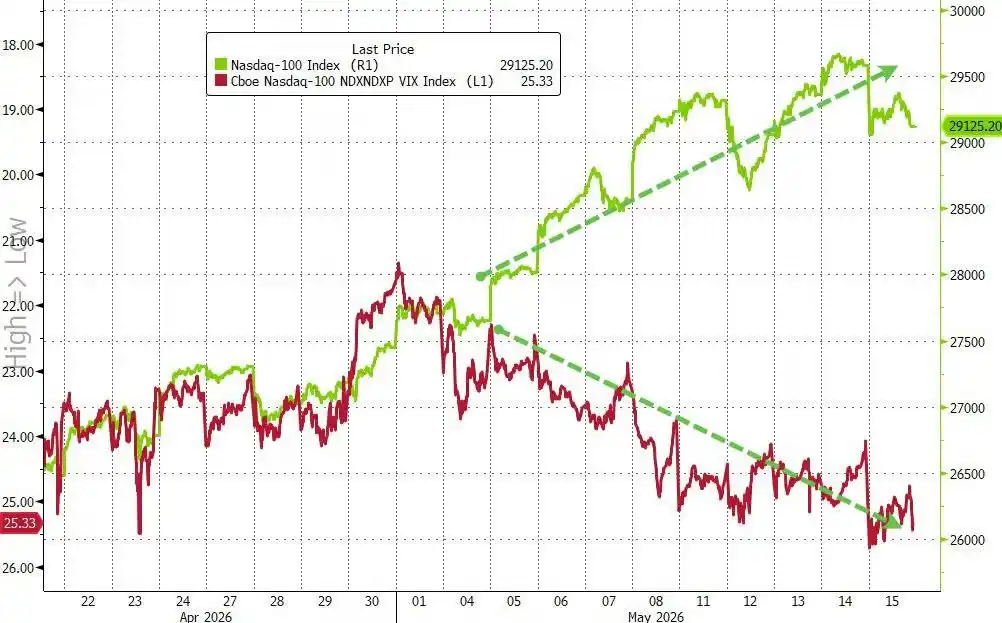
Peter Callahan, Goldman Sachs' TMT chief expert, released a brief titled "Yellow Light" on Monday, noting that the Nasdaq 100 Index (NDX) and the Philadelphia Semiconductor Index (SOX) recorded their first weekly decline of the quarter last week; the 10-year US Treasury yield rose to about 4.60%, marking its largest weekly gain in over a year; oil prices rebounded to around $109 per barrel; and the VIX also climbed.

He pointed out that the core contradiction facing the AI and semiconductor themes currently is: fundamentals remain strong, while technical pressure continues to accumulate.

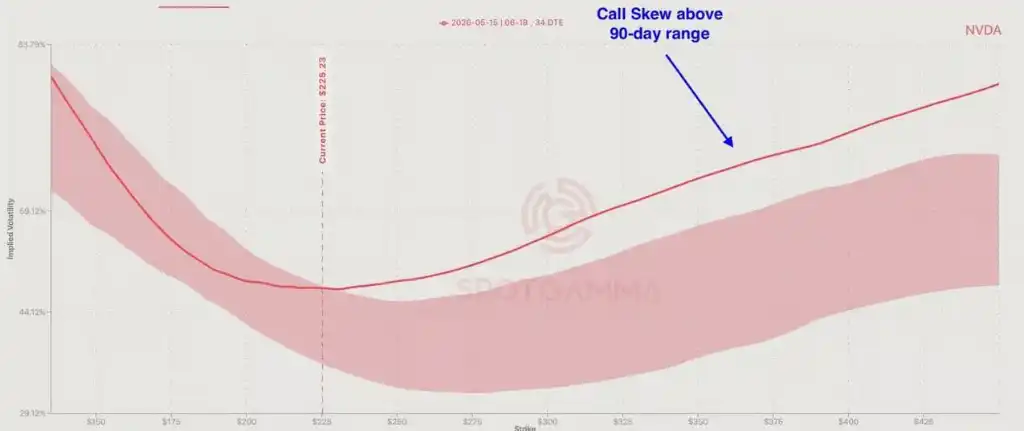
Options analysis firm SpotGamma noted in a recent report that the market is displaying a rare concurrent pattern of "rising stock prices with simultaneously climbing volatility"—typically, the two should have an inverse relationship. This signal indicates that traders are chasing the rally while also paying a premium for protection against significant volatility.

Nvidia's earnings report currently implies a volatility move of around 6%, with market attention highly concentrated on this timing.

The earnings results and forward guidance will directly test the market's conviction in the AI computing super-cycle thesis. Given Nvidia's high correlation with the semiconductor and broader technology sectors, its earnings performance, whether positive or negative, is expected to trigger widespread ripple effects across the market.

1. Technical Indicators Flash Most Extreme Warning Since 1999/2000

The magnitude and speed of the recent semiconductor rally have pushed technical indicators to historically overbought levels.

Goldman Sachs data shows that the SOX index has surged approximately 70% from its late March low, adding over $5 trillion in market value along the way.

Driving factors include a temporary easing of geopolitical tensions, better-than-expected corporate earnings—such as AMAT raising its full-year guidance more than expected, CSCO reporting a 35% year-over-year growth in product orders—and investors' growing confidence in AI computing demand; earnings expectations for the semiconductor industry have been revised upwards by over 25% year-to-date.

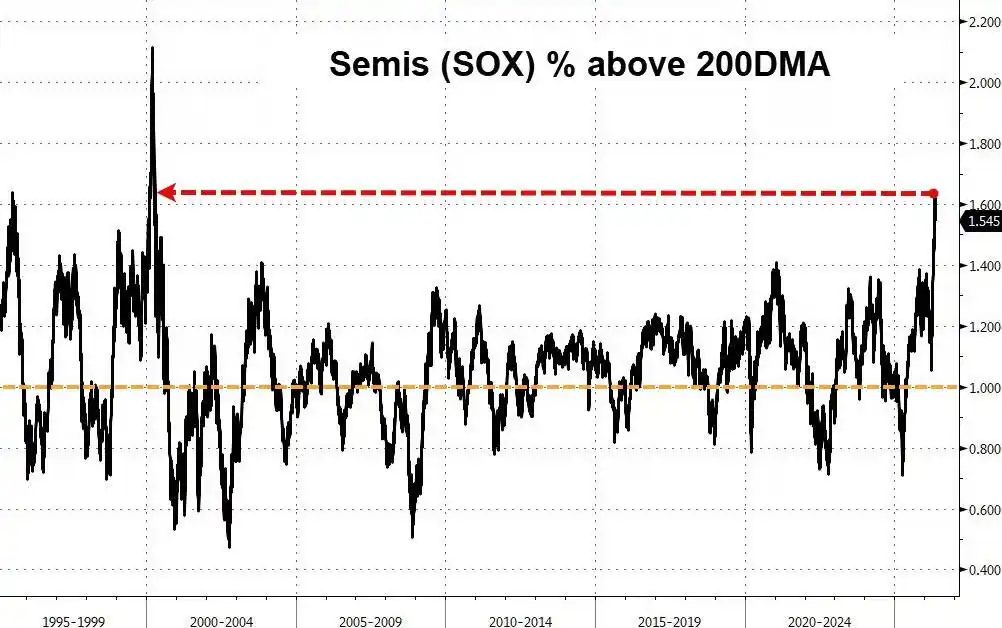
However, Peter Callahan specifically pointed out that the SOX index is currently about 60% above its 200-day moving average, a deviation magnitude not seen since the peak of the dot-com bubble in 1999/2000.

He also noted that Goldman Sachs' high-momentum factor portfolio has experienced 12 trading days with intraday swings exceeding ±5% year-to-date, accounting for nearly 15% of the year's trading sessions; the rapid expansion of leveraged ETFs and options products has further amplified this two-way elasticity.

"It's worth keeping these tactical dynamics in mind heading into summer trading as this week's earnings season (Nvidia, May 20th) concludes," Callahan wrote. While Goldman's trading desk maintains a constructive medium-term stance on the AI and semiconductor theme, it advises investors to remain tactically cautious about technical challenges.

2. Nvidia Earnings: Forward Guidance May Be More Critical Than Current Quarter Results

The market remains optimistic about Nvidia's fundamental outlook, but recent stock price movements have already priced in some of these expectations to an extent.

According to Goldman Sachs' Nvidia earnings preview report, analysts generally expect Nvidia's revenue this quarter to exceed market estimates by about $2 billion—historically, the company's beat margin has typically been between 2% and 3%.

The market is more focused on the forward guidance for the next quarter, with the current analyst consensus estimate around $86 billion, representing a sequential increase of about 9%.

Other areas of focus include: whether there is further upside to Nvidia's cumulative data center revenue guidance of approximately $1 trillion, and the narrative of accelerating Agentic AI inference demand—especially its pure CPU rack products expected to begin shipping in the second half of 2026.

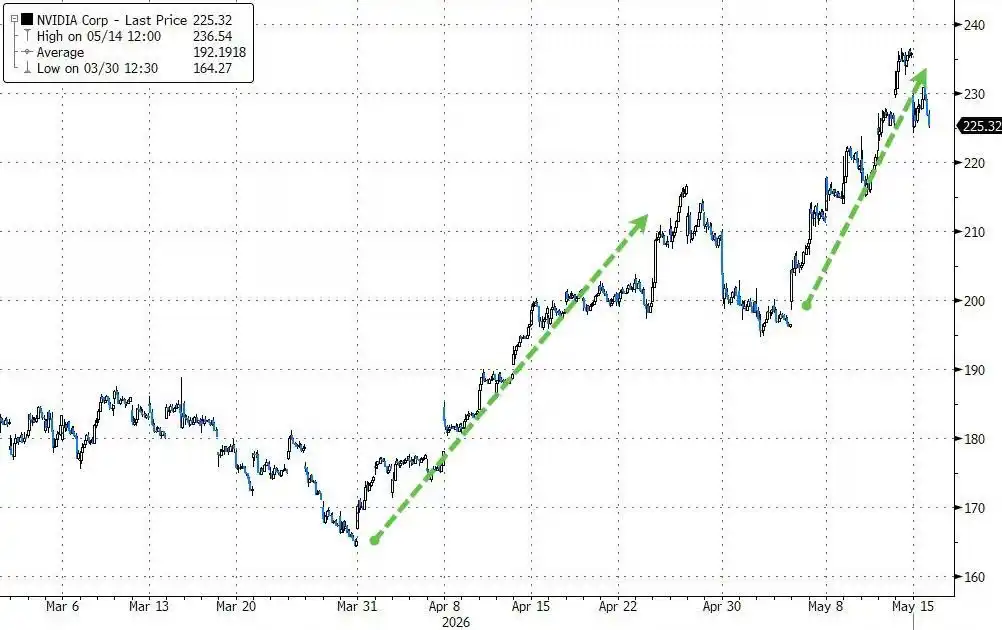
Looking at recent price action, Nvidia has risen for seven consecutive trading days, gaining 20% over that period, marking its longest winning streak in nearly two years; the stock has added about $1.7 trillion in market value since its late March low.

However, Goldman Sachs data also shows that in the trading session (T+1) following Nvidia's past five earnings releases, the stock declined four times. In fact, significant single-day rallies triggered by earnings reports have not occurred since May 2022.

3. Options Market: Extreme Bullish Bets and Tail Hedging Simultaneously in Place

The options positioning structure presents a set of inherently contradictory signals.

According to SpotGamma data, the overall positioning direction remains extremely skewed towards bullish bets, with traders continuously rolling Nvidia call options to higher strike prices. Call skew remains at the high end of its 90-day historical range, while demand for downside protection is extremely limited.

Citing data, 22V Research reported that last Friday saw a record $2.6 trillion in notional call option volume for the S&P 500, with call options making up a high 60% of total options volume; the Philadelphia Semiconductor Index's RSI also rose to its highest level since March 2000.

At the same time, hedging against downside risks is also quietly underway.

SpotGamma points out that significant put option structures and buying activity have noticeably increased around the S&P 500 (SPY), semiconductor ETF (SMH), and DRAM-related assets, concentrated in deep out-of-the-money strike price ranges, indicating their function is closer to tail risk hedging rather than purely directional bets. "Market participants are not bearish on Nvidia, but preparation for downside scenarios is not trivial," SpotGamma wrote in its report. "Any directional shift will almost immediately ripple through the broader market."

SpotGamma added, Nvidia has risen over 35% since its March low, and the size of current call option positioning implies that if earnings disappoint the market or trigger large-scale profit-taking, it could potentially trigger a significant directional reversal.

4. Market Breadth Concerns: Rally Supported by a Handful of Stocks

Beneath the strong performance of semiconductors and large-cap tech stocks, a lack of broad market participation is creating structural concerns.

Peter Callahan noted in his report that while the S&P 500 is up about 8% year-to-date, only about 52% of its constituents have posted positive returns. Sectors that have significantly lagged year-to-date span residential real estate, medical devices, engineering & construction without government exposure, federal IT services, software & services, independent power producers, restaurant chains, commercial real estate brokers, and insurance brokers, among others.

Callahan admits that when reviewing the charts of these sectors, it makes him question whether the current market performance reflects overall "health" or is merely a "funding source" effect where investors are forced to concentrate capital in a few large-cap AI stocks.

Oppenheimer's equity derivatives team also pointed out that only about one-fifth of S&P 500 constituents outperformed the index over the past month, the dispersion index rose to its highest level in over a year, while implied correlation hovered near year-to-date lows.

Latest data from Goldman Sachs' Prime Brokerage (PB) department also shows clear signs of "risk-off" activity in the technology sector recently.

Связанные с этим вопросы

QAccording to the article, what is the core contradiction currently faced by the AI and semiconductor theme?

AThe core contradiction is that the fundamentals remain strong while technical pressure continues to build up.

QWhat does the article state is a key technical warning sign for the semiconductor sector, comparing it to a historical period?

AThe SOX index is currently trading about 60% above its 200-day moving average, a deviation magnitude not seen since the peak of the 1999/2000 internet bubble.

QRegarding Nvidia's upcoming earnings, what does the article suggest might be even more crucial than the actual quarterly results?

AThe market's focus is more on the forward guidance for the next quarter, which analysts currently expect to be around $86 billion, representing a sequential growth of about 9%.

QWhat contradictory signals are observed in the options market positioning around Nvidia?

AThe positioning is extremely bullish with call skew at the high end of its historical range, but there is also a noticeable build-up of deep out-of-the-money put options on related assets for tail-risk hedging.

QWhat concern does the article raise about the breadth of the current US stock market rally?

AThe concern is that the rally is being supported by only a few large-cap AI stocks, with many sectors underperforming, raising questions about the overall health of the market versus a 'funding source' effect.

Похожее

Warsh's First Day in Office, Markets Deliver a 'Wake-up Call': Rate Hike Expected This Year

On his first day in office, newly inaugurated Federal Reserve Chairman Warsh received a stark market warning, with expectations now fully pricing in a 25-basis-point interest rate hike this year. The shift was triggered by hawkish remarks from Fed Governor Waller, who stated that inflation is now the key policy "driver" and that the odds of a hike or cut are evenly split. This sent short-term Treasury yields higher. Waller signaled a significant pivot in his stance, citing disappointing inflation and labor data. He suggested removing "easing bias" language from Fed statements and did not rule out future rate increases if inflation fails to recede, though he noted immediate action isn't warranted without signs of unanchored inflation expectations. Chairman Warsh faces immediate pressure at his first FOMC meeting in June. With the preferred inflation gauge at a three-year high, analysts warn that failing to hike could be interpreted as an implicit easing of policy. The geopolitical situation in the Middle East is adding to existing price pressures. The market's expectation for a hike contrasts sharply with earlier forecasts for multiple cuts. While long-term Treasury yields have been contained by lower energy prices recently, analysts note they remain under structural upward pressure. Warsh's swearing-in at the White House highlights political scrutiny over Fed independence. However, the market has made it clear that inflation is the most urgent challenge, leaving the new chairman little time to settle in.

marsbit1 ч. назад

Warsh's First Day in Office, Markets Deliver a 'Wake-up Call': Rate Hike Expected This Year

marsbit1 ч. назад

Has Microsoft Lost Its Way in the AI Race, and Can Copilot Bring It Back on Track?

Microsoft, once seen as an early AI frontrunner due to its investment in OpenAI, is navigating a strategic shift amid increased competition. Its initial reliance on OpenAI’s GPT models has been complicated by OpenAI’s growing ambitions as a direct competitor, rapid advancements from rivals like Claude and Gemini, and the disruptive rise of AI agents, which challenge its traditional SaaS business model. These factors contributed to stock declines and slower-than-expected adoption of its flagship Copilot products. In response, CEO Satya Nadella has taken a hands-on role in product development, signaling the urgency of change. Microsoft is pivoting from a model-centric strategy to a "model-agnostic" enterprise platform approach. It aims to become the foundational layer connecting various AI models—from OpenAI, Anthropic, or its own new "Superintelligence" team—with enterprise workflows, data, security, and cloud services. Recent organizational changes merged consumer and enterprise Copilot teams to accelerate innovation, exemplified by new products like Copilot Tasks and Copilot Cowork. However, this transformation comes at a high cost. Microsoft faces massive capital expenditures, potentially reaching ~$190 billion by 2026, to support AI infrastructure. While its platform strategy shows early signs of traction with growing Azure AI revenue, it must balance startup-like agility with the reliability expected by enterprise clients. The core challenge is no longer being the sole AI winner but defending its position as the essential enterprise software entry point amidst rapid technological commoditization and the shift towards always-on AI agents.

marsbit1 ч. назад

Has Microsoft Lost Its Way in the AI Race, and Can Copilot Bring It Back on Track?

marsbit1 ч. назад

Why Haven't Forex Stablecoins Taken Off?

Why FX Stablecoins Never Took Off: A Path Forward via Synthetic FX Despite the explosive growth of stablecoin-powered digital banking, which has seen ~$6B in VC investment and a 24x surge in crypto card spending in under a year, a major limitation persists: these banks are essentially dollar-only accounts. This leaves 95-99% of global accounts, which are denominated in non-USD currencies, underserved. Attempts to create native foreign currency (FX) stablecoins (like EURC) have largely failed, with total FX stablecoin TVL at ~$600M compared to $400B for USD stablecoins—a 700x gap. These FX tokens face critical challenges: fragile pegs due to low liquidity, limited exchange/FinTech acceptance, poor on/off-ramps, complex regional compliance, and a chicken-and-egg adoption problem. The article argues that the solution lies not in competing with entrenched USD stablecoin networks (USDT/USDC), but in adopting a synthetic FX model inspired by traditional finance. Specifically, it advocates for Mark-to-Market Non-Deliverable Forwards (NDFs)—cash-settled FX derivatives that allow users to maintain underlying USD stablecoin holdings while having their account balance and P&L denominated in a foreign currency. This approach offers key advantages: strong oracle-based pegs, retention of deep USD stablecoin liquidity and yield, superior on/off-ramps, scalability to any currency with a reliable feed, and capital efficiency. It mirrors how modern institutional FX markets operate. Primary use cases for on-chain NDFs include: 1. **Digital Banks/Wallets:** Enabling multi-currency accounts for international users without leaving the USD stablecoin ecosystem, boosting deposits and retention. 2. **FX Carry Trade Vaults:** Offering access to sovereign interest rate differentials (e.g., earning yield on BRL) in a more stable and scalable format than crypto-native products like Ethena. 3. **Global Enterprise Payments:** Allowing merchants to receive payments in local currency equivalents while settling in USD stablecoins, similar to services offered by Stripe for fiat. The conclusion is that synthetic FX, not native FX stablecoins, is the viable path to integrating foreign exchange into the growing stablecoin digital banking landscape, potentially unlocking the next phase of institutional DeFi and multi-trillion-dollar global adoption.

链捕手2 ч. назад

Why Haven't Forex Stablecoins Taken Off?

链捕手2 ч. назад

Торговля

Спот
Фьючерсы

Популярные статьи

Как купить S

Добро пожаловать на HTX.com! Мы сделали приобретение Sonic (S) простым и удобным. Следуйте нашему пошаговому руководству и отправляйтесь в свое крипто-путешествие.Шаг 1: Создайте аккаунт на HTXИспользуйте свой адрес электронной почты или номер телефона, чтобы зарегистрироваться и бесплатно создать аккаунт на HTX. Пройдите удобную регистрацию и откройте для себя весь функционал.Создать аккаунтШаг 2: Перейдите в Купить криптовалюту и выберите свой способ оплатыКредитная/Дебетовая Карта: Используйте свою карту Visa или Mastercard для мгновенной покупки Sonic (S).Баланс: Используйте средства с баланса вашего аккаунта HTX для простой торговли.Третьи Лица: Мы добавили популярные способы оплаты, такие как Google Pay и Apple Pay, для повышения удобства.P2P: Торгуйте напрямую с другими пользователями на HTX.Внебиржевая Торговля (OTC): Мы предлагаем индивидуальные услуги и конкурентоспособные обменные курсы для трейдеров.Шаг 3: Хранение Sonic (S)После приобретения вами Sonic (S) храните их в своем аккаунте на HTX. В качестве альтернативы вы можете отправить их куда-либо с помощью перевода в блокчейне или использовать для торговли с другими криптовалютами.Шаг 4: Торговля Sonic (S)С легкостью торгуйте Sonic (S) на спотовом рынке HTX. Просто зайдите в свой аккаунт, выберите торговую пару, совершайте сделки и следите за ними в режиме реального времени. Мы предлагаем удобный интерфейс как для начинающих, так и для опытных трейдеров.

1.3k просмотров всегоОпубликовано 2025.01.15Обновлено 2025.03.21

Как купить S

Sonic: Обновления под руководством Андре Кронье – новая звезда Layer-1 на фоне спада рынка

Он решает проблемы масштабируемости, совместимости между блокчейнами и стимулов для разработчиков с помощью технологических инноваций.

2.2k просмотров всегоОпубликовано 2025.04.09Обновлено 2025.04.09

Sonic: Обновления под руководством Андре Кронье – новая звезда Layer-1 на фоне спада рынка

HTX Learn: Пройдите обучение по "Sonic" и разделите 1000 USDT

HTX Learn — ваш проводник в мир перспективных проектов, и мы запускаем специальное мероприятие "Учитесь и Зарабатывайте", посвящённое этим проектам. Наше новое направление .

1.8k просмотров всегоОпубликовано 2025.04.10Обновлено 2025.04.10

HTX Learn: Пройдите обучение по "Sonic" и разделите 1000 USDT

Обсуждения

Добро пожаловать в Сообщество HTX. Здесь вы сможете быть в курсе последних новостей о развитии платформы и получить доступ к профессиональной аналитической информации о рынке. Мнения пользователей о цене на S (S) представлены ниже.

活动图片