Nvidia Vs. Dogecoin: A Historic Ratio Suggests A Possible Rotation, Says Trader

bitcoinistОпубликовано 2026-01-21Обновлено 2026-01-21

Введение

Cryptocurrency trader Cryptollica suggests a major capital rotation may be imminent from AI-related equities, like Nvidia, into meme coins, particularly Dogecoin. The key signal is the DOGE/NVIDIA ratio, which has returned to a long-term support level that previously preceded massive Dogecoin outperformance in 2017 (100x) and 2021 (50x). The trader frames this as a shift from "The World’s Most Valuable Company" to "The World’s Most Famous Meme," arguing that when the AI trade cools, liquidity rotates into high-beta crypto assets. Supporting this view, Dogecoin's weekly RSI has hit a historically oversold level, which has only occurred four times in 12 years, each marking a significant cycle bottom and a major buying opportunity. While no explicit price target is given, the trader previously forecasted a medium-term goal of $1.30 for DOGE. At the time of writing, Dogecoin was trading at $0.1258.

Trader Cryptollica (@Cryptollica) is arguing that an old relative-value signal is “back” in crypto markets, pointing to the DOGE/NVIDIA ratio and an unusually depressed Dogecoin RSI reading as evidence that capital could rotate from AI-linked equities into high-beta meme coins.

Dogecoin Vs. Nvidia: Rotation Incoming?

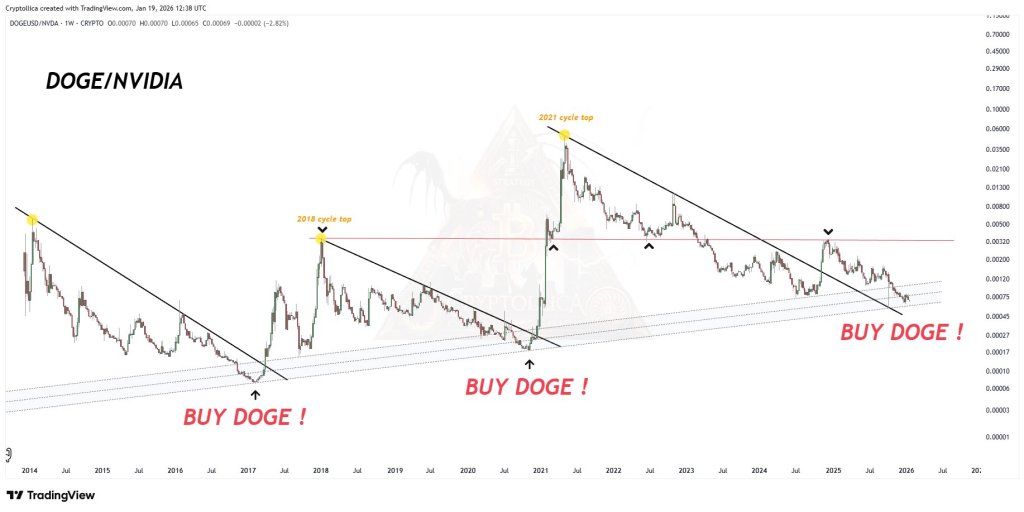
In a post on X, Cryptollica said the DOGE/NVIDIA chart has returned to a long-term support zone that previously preceded outsized Dogecoin outperformance versus Nvidia in prior cycles. “THE SIGNAL IS BACK. IT’S HAPPENING AGAIN (2017... 2021... NOW),” the trader wrote.

“The last two times this specific signal flashed on the DOGE/NVIDIA chart, we saw the biggest wealth transfer in history. The crowd is chasing the AI top. The algorithm is loading the Meme bottom. (Altcoin bottom).”

Dogecoin vs Nvidia chart | Source: X @Cryptollica

The core claim is less about Dogecoin in isolation and more about positioning on a ratio between what Cryptollica framed as two cultural extremes: “You are watching the wrong chart. This is the ratio of ‘The World’s Most Valuable Company’ (AI) vs. ‘The World’s Most Famous Meme’.” From that framing, the trader leans into a cycle-rhymes narrative, asserting that the ratio has repeatedly found channel support before a DOGE-led surge.

“Structure is repeating history,” Cryptollica wrote, attaching specific historical comparisons. “2017: Ratio hit channel support – DOGE outperformed NVDA by 100x. 2021: Ratio hit channel support – DOGE outperformed NVDA by 50x. NOW: We are back at the exact same support line.”

The posts also attach a broader liquidity-rotation story that has circulated in various forms across risk markets: when one trade stops working, capital seeks the next high-beta outlet: “When the AI Bubble exhales, that liquidity doesn’t vanish. It rotates into High-Beta Speculation,” the trader wrote. “The crowd is buying NVDA at the top. The algorithm is positioning for the DOGE reversal.”

Is Dogecoin An ‘Epic Buying Opportunity’?

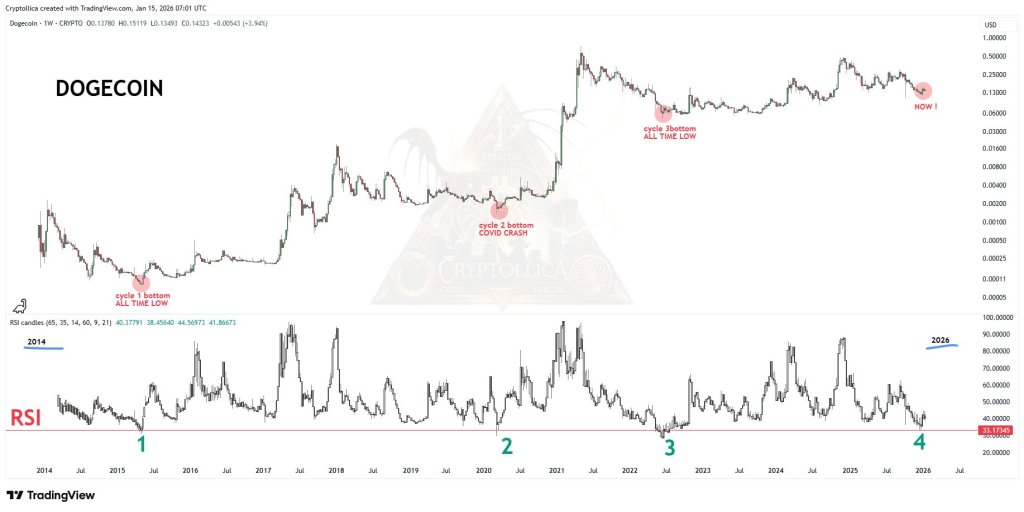
In another post, Cryptollica shifted from the ratio to Dogecoin’s weekly momentum indicator, sharing a second chart highlighting RSI levels and labeling prior cycle lows. “Here you are witnessing an opportunity that only comes around once every 12 years,” the trader wrote. “Over the past 12 years (2014–2026), Dogecoin’s RSI has dropped this low only 4 times. Every single one was an epic buying opportunity.”

The post describes those four moments as a sequence of cycle bottoms, including an “all-time low” first cycle bottom, a “cycle bottom + COVID crash,” a “last cycle bottom,” and “RIGHT NOW!” Cryptollica concluded with a blunt decision frame: “Math or emotions — which one decides for you?”

Dogecoin weekly RSI | Source: X @Cryptollica

While neither post includes an explicit price target, the analyst said in early December that he expects Dogecoin to reach $1.30 over the medium term, citing a parallel channel top on the 3-day DOGE/USD chart.

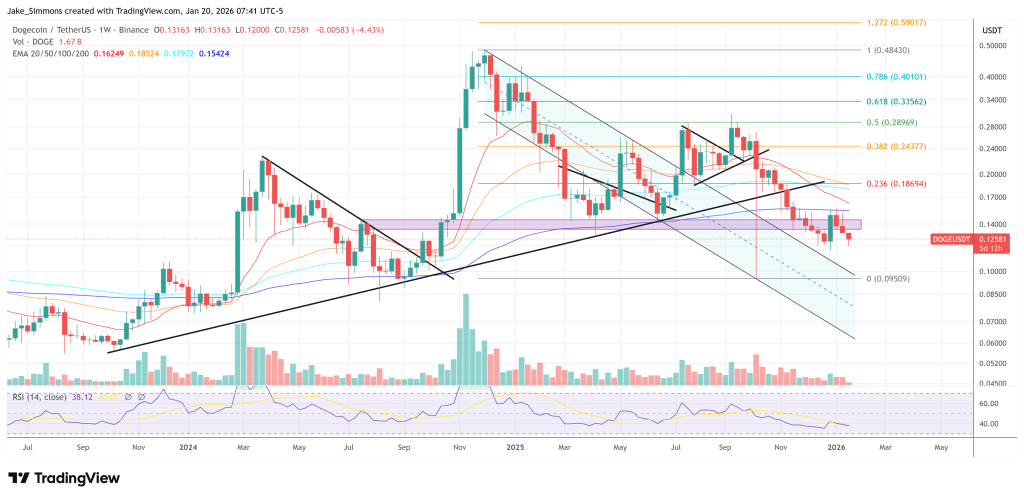
At press time, DOGE traded at $0.12581.

DOGE continues to fall after 200-week EMA rejection, 1-week chart | Source: DOGEUSDT on TradingView.com

Связанные с этим вопросы

QWhat is the main argument presented by trader Cryptollica regarding the DOGE/NVIDIA ratio?

ACryptollica argues that the DOGE/NVIDIA ratio has returned to a long-term support zone, which historically preceded massive outperformance of Dogecoin versus Nvidia, suggesting a potential capital rotation from AI-linked equities into high-beta meme coins like Dogecoin.

QAccording to the trader, what were the historical outcomes when the DOGE/NVIDIA ratio hit this channel support in 2017 and 2021?

AIn 2017, when the ratio hit channel support, DOGE outperformed NVDA by 100x. In 2021, when it hit the same support, DOGE outperformed NVDA by 50x.

QWhat broader market narrative does Cryptollica attach to this potential rotation signal?

ACryptollica attaches a broader liquidity-rotation narrative, stating that when the AI bubble 'exhales,' the capital doesn't vanish but instead rotates into high-beta speculation, like meme coins.

QWhat does Cryptollica claim about Dogecoin's weekly RSI reading, and how does he frame it?

ACryptollica claims that Dogecoin's weekly RSI has dropped to a very low level only 4 times in the past 12 years (2014-2026), and he frames each of these instances as an 'epic buying opportunity' that marked a cycle bottom.

QWhat was Cryptollica's medium-term price target for Dogecoin mentioned in the article?

AIn early December, Cryptollica cited a parallel channel top on the 3-day DOGE/USD chart and expected Dogecoin to reach $1.30 over the medium term.

Похожее

WeChat Agent Issues a 'Heroic Summons,' Half of the Internet Responds

WeChat AI Agent is on the horizon. The WeChat Open Platform has issued a guide for developers, offering them ways to integrate into the WeChat AI ecosystem. This will enable mini-programs to be discovered and invoked by the AI. Meituan has already announced its integration, allowing users to access services like food delivery through WeChat AI. Other platforms like Ctrip and Tongcheng have followed suit. Furthermore, WeChat is collaborating with major smartphone manufacturers to enable their native AI assistants to perform actions within WeChat, such as initiating calls or sending messages, through a controlled protocol called Agent-to-Agent (A2A). Reports indicate the WeChat AI Agent will be accessible by swiping right on the main interface. It aims to understand user intent within the rich context of chats, groups, and past interactions, then automatically call upon relevant mini-programs to complete tasks like ordering coffee or booking restaurants. This positions it as a potential "super app" with direct access to WeChat's vast ecosystem of services, social connections, and payment systems. Technically, this is a complex endeavor. It requires advanced natural language understanding, a "world model" to predict interactions within mini-programs (UI-Oceanus), multi-model orchestration for cost efficiency, and careful coordination with millions of third-party service providers. Tencent's development follows a "Co-Design" approach, where product teams and the Hunyuan model team collaborate closely, allowing capabilities honed in other AI products (like Yuanbao for chat, ima for search, WorkBuddy for office tasks) to be transferred to the WeChat Agent. Tencent is strategically opting for the A2A protocol over GUI-based automation (which it has blocked in the past), maintaining control over its ecosystem. To manage the immense scale and cost of serving 1.4 billion monthly active users, Tencent is deepening its ties with DeepSeek, known for its cost-effective training, to secure a low-cost inference backbone. The ultimate goal is to solve practical, everyday problems for users within the WeChat ecosystem, moving beyond technical benchmarks to deliver real utility, which Tencent sees as the key to winning in the long-term AI game.

marsbit1 ч. назад

WeChat Agent Issues a 'Heroic Summons,' Half of the Internet Responds

marsbit1 ч. назад

Humanity Loses $31 Million in Attack, Token Price Plummets 90% Due to a Single Private Key

On June 9th, the digital identity project Humanity Protocol suffered a major security breach resulting in over $31 million in losses. According to on-chain analyst Specter, hundreds of wallets holding the project's H token were drained. The attack was confirmed by founder Terence Kwok to be caused by the compromise of a foundation member's private key. As a precaution, users are advised to avoid interacting with Humanity's cross-chain bridge or liquidity pools. The incident caused the H token price to crash over 90%, from around $0.70 to a low of $0.052, wiping its market cap from $2 billion to approximately $35.7 million. The attacker allegedly minted 100 million new H tokens and is selling them for BNB. This breach adds to existing controversies surrounding Humanity Protocol. Founded in 2024, it aimed to verify human users via palm-print biometrics and zero-knowledge proofs. However, a leaked conversation in 2025 revealed that only about 1 million of its 9 million claimed Human IDs had completed biometric verification, suggesting 88% might be bots. Furthermore, the project has faced allegations of being a repackaged product from a Chinese access control vendor, raising privacy and authenticity concerns. Founder Terence Kwok's previous venture, Tink Labs, a hotel smartphone startup that raised $170 million, failed and entered bankruptcy in 2020 after burning through its funding. The current attack highlights the persistent critical issue of private key management in crypto. Unlike smart contract exploits, a private key compromise bypasses all on-chain security mechanisms. With no user compensation plan announced yet, this $31 million breach may be a final blow to the project's credibility, already weakened by previous controversies and a heavily depreciated token.

marsbit2 ч. назад

Humanity Loses $31 Million in Attack, Token Price Plummets 90% Due to a Single Private Key

marsbit2 ч. назад

Торговля

Спот
Фьючерсы
活动图片