New AMD Paper Overturns Conventional Wisdom: FP4 Training Instability's Cause Is Not Insufficient Randomness

marsbitОпубликовано 2026-05-27Обновлено 2026-05-27

Введение

AMD's new research challenges the conventional understanding of FP4 training instability. While reducing precision from FP8 to FP4 promises doubled computational throughput and is supported by new hardware like NVIDIA Blackwell and AMD MI350 series, training large language models natively with FP4 has been notoriously unstable, often attributed to insufficient stochasticity. The paper "Pretraining large language models with MXFP4 on Native FP4 Hardware" demonstrates successful end-to-end FP4 pre-training of Llama 3.1-8B on AMD MI355X GPUs using the MXFP4 format, achieving a 9-10% overall speedup over FP8. Crucially, it identifies the root cause of instability: not randomness, but the accumulation of *structural micro-scaling errors* along the sensitive weight gradient (Wgrad) path. Through controlled experiments, researchers found that quantizing the Wgrad operation to FP4 caused significant convergence degradation. Counterintuitively, common stochasticity-based mitigation techniques like stochastic rounding and randomized Hadamard transforms worsened performance. In contrast, applying a *deterministic* Hadamard transform successfully stabilized training by ensuring consistent error patterns, reducing the extra token cost from 26-27% to just 8-9%. This work has significant implications: 1) It provides a clear diagnostic for low-precision training instability, steering focus towards structural errors. 2) It pushes FP4 from a primarily inference-focused format into the realm...

As is well known, training large models is extremely costly.

However, it's also widely understood that reducing training precision can significantly lower training costs. DeepSeek-V3's use of FP8 training brought the cost down to $5.6 million, already capturing the attention of the entire industry.

Following the success of FP8, the industry continues to explore the boundaries of lower precision: from FP8 down to FP4, how much more can training costs be reduced?

Theoretically, FP4 computational throughput could be twice that of FP8. Both NVIDIA's Blackwell and AMD's MI350 series have already natively supported FP4 operations at the hardware level, with the former claiming FP4 performance up to 4500 TOPS (sparse) on the B200. The hardware is ready, but the software and algorithm side has been stuck on one problem:

Training large models from scratch with FP4 is highly unstable.

Over the past two years, works like LLM-FP4 and NVFP4 pre-training have attempted this path, but few solutions have cleanly and efficiently executed full pipeline pre-training at 4-bit precision while maintaining convergence quality close to FP8.

More troublesome is that the cause of the collapse has been unclear. Analysis suggested the instability in FP4 training was likely due to insufficient randomness.

But recently, AMD, in collaboration with Pennsylvania State University, published a paper that overturns this traditional understanding, offering a new and clear diagnosis for native FP4 training.
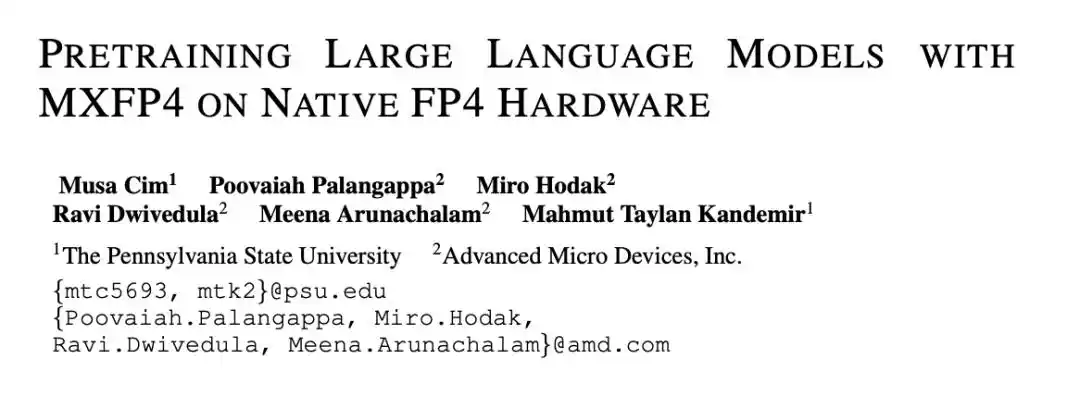
  • Paper Title: Pretraining large language models with MXFP4 on Native FP4 Hardware
  • Paper Link: https://arxiv.org/abs/2605.09825

This paper successfully completed the full-pipeline pre-training of Llama 3.1-8B using the MXFP4 format on AMD Instinct MI355X GPUs, achieving 9-10% faster end-to-end training speed compared to the FP8 baseline, with only an 8-9% additional token cost. This is the first complete experiment to finish large model pre-training on native FP4 hardware (not software simulation).

More importantly, the paper reveals the core issue: The source of FP4 training instability is not insufficient randomness, but the cumulative amplification of structural microscaling errors along sensitive gradient paths.

What is MXFP4

Before dissecting the paper, it's necessary to understand the MXFP4 data format.

Traditional integer quantization typically uses a single scaling factor for an entire tensor. The core design of MXFP4 is called "Micro-scaling": splitting a tensor into small blocks (e.g., groups of 32 elements), assigning a shared exponent (E8M0 format) to each block, where each element within the block is represented by a 4-bit floating-point number. The reconstruction formula can be written as:

Where E_shared is the maximum exponent within the block, and Q_FP4 is the value rounded to the nearest representable 4-bit floating-point value.

The benefit of micro-scaling is that each small block has its own dynamic range and won't be "held hostage" by global outliers. This significantly improves the representational quality of 4-bit floating-point numbers compared to naive global quantization.

However, even with micro-scaling, FP4 training remains unstable.

Troubleshooting Experiments: The Root of Instability

The research team first designed a step-by-step controlled troubleshooting experiment.

A complete Transformer linear layer computation involves three general matrix multiplication operations:

Fprop (Forward Propagation): Computes Y = XW^T, producing activation values.

Dgrad (Activation Gradient): Computes ∇X = ∇Y · W, propagating gradients back to the input.

Wgrad (Weight Gradient): Computes ∇W = (∇Y)^T · X, producing the gradient used to update the weights.

Keeping all other factors constant, the research team gradually replaced these three operations from FP8 to MXFP4, observing the impact of each step on convergence. All experiments were executed using native FP4 tensor cores on AMD Instinct MI355X, without relying on software simulation.

The training task followed the MLPerf standard setup, pre-training Llama 3.1-8B on the C4 dataset, with a convergence target of achieving a validation perplexity of 3.3.

The first two steps only incurred a modest additional token cost. However, once Wgrad was also switched to MXFP4, the cost directly jumped to 26-27%.

Wgrad is the bottleneck for FP4 training. Forward propagation and activation gradient have considerable tolerance for FP4 quantization, but once the weight gradient is quantized to 4 bits, convergence quality degrades significantly.

The industry's prevailing intuition was that FP4 quantization error is essentially a noise problem, which could be "smoothed" by injecting randomness. Two common strategies are:

Stochastic Rounding: Introduces randomness during quantization to make the expected value of rounding error zero.

Randomized Hadamard Rotation: Uses a Hadamard transform with random sign flips to scatter the data distribution before quantization.
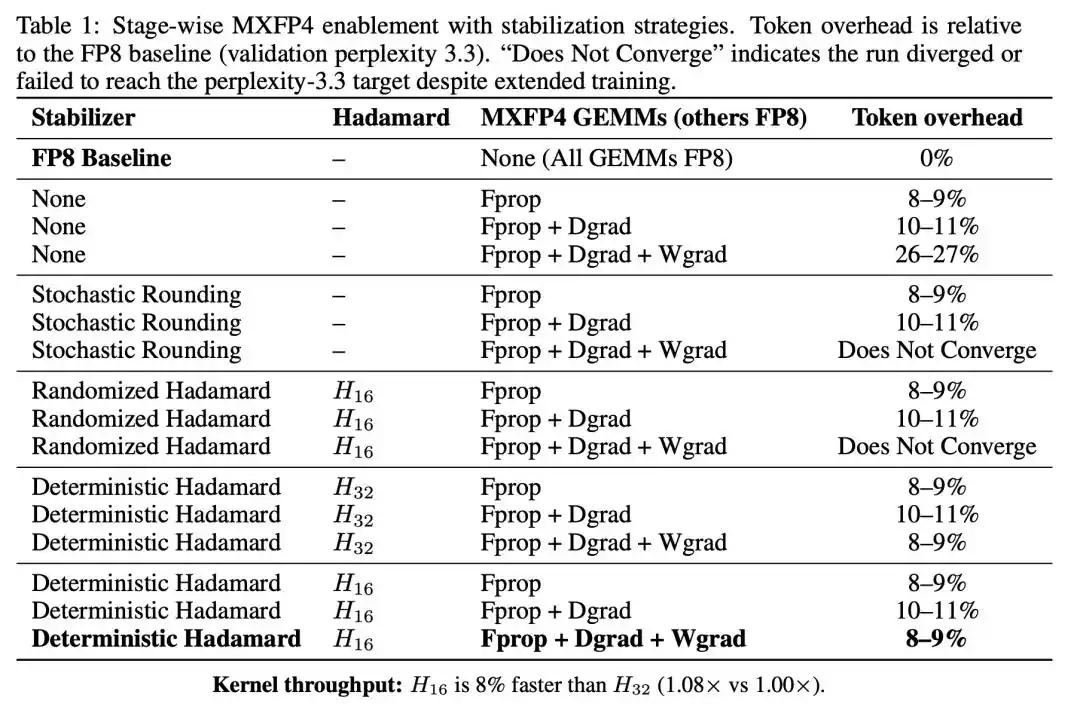
When Wgrad is quantized, both randomness strategies not only failed to stabilize training but directly caused non-convergence. Randomness didn't help; instead, it introduced more effective quantization error on the critical gradient path.

In contrast, deterministic Hadamard rotation dramatically reduced the full-pipeline token cost from 26-27% back to 8-9%, with the training trajectory closely tracking the FP8 baseline.

This is a highly diagnostic result. Both random and deterministic Hadamard rotations are orthogonal transformations that can scatter outlier energy distribution; theoretically, their effects on mitigating quantization error should be similar. Yet, their performance in the Wgrad scenario is completely opposite, revealing the nature of the problem:

FP4 training instability is driven by structural errors generated by MXFP4 micro-scaling on sensitive gradient paths. Randomness strategies failed because they introduced varying error patterns at each step, and these changing patterns accumulated along the gradient path, amplifying instability. Deterministic rotation was effective precisely because it applied the same transformation at every step, keeping the error pattern consistent and preventing error accumulation.

End-to-End Efficiency: Training Step Throughput +20%, Comprehensive Speedup 9-10%

After applying deterministic Hadamard rotation to the full-pipeline MXFP4, the efficiency data is as follows:
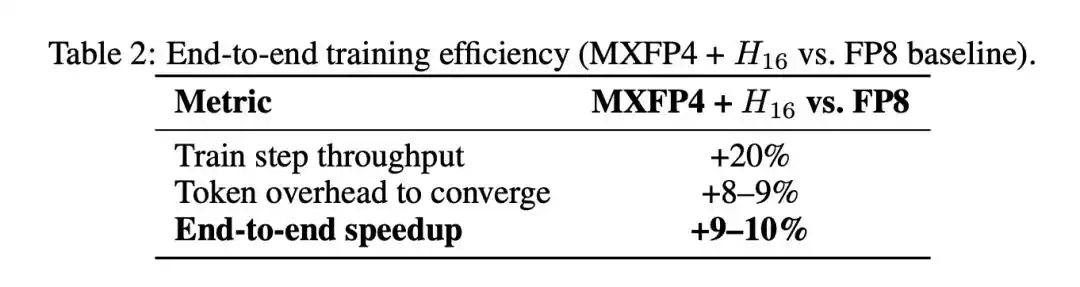
Training step throughput increased by 20%. After accounting for the additional 8-9% token cost, the end-to-end comprehensive speedup remains 9-10%.

Considering this directly halves precision from 8 bits to 4 bits, this convergence quality and speedup magnitude are quite significant.
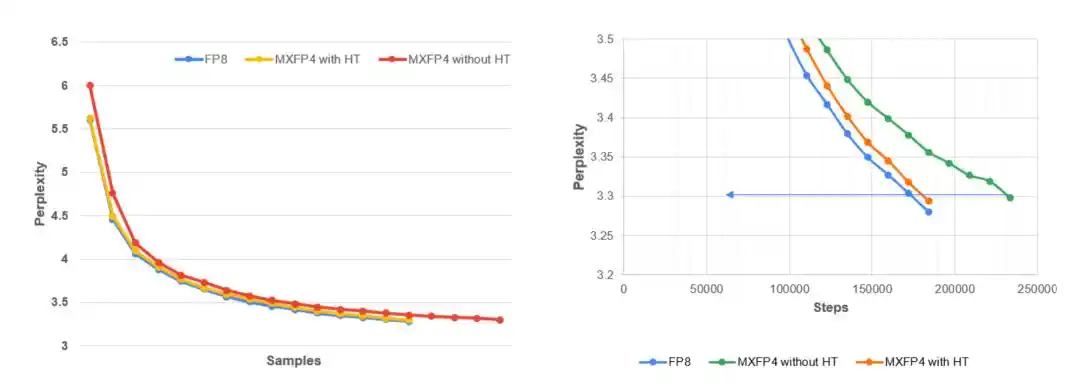
Left: Curve showing the validation perplexity of Llama 3.1–8B versus training token count during MLPerf pre-training on the C4 dataset. Results show MXFP4 + deterministic Hadamard performs very close to FP8, while unstabilized full-pipeline MXFP4 converges slower and is less stable. Right: Zoomed-in view of the later training stage. The MLPerf target perplexity is 3.3. Compared to the unstabilized MXFP4 run, deterministic Hadamard (H16) maintains much tighter alignment with the FP8 baseline.

Notably, the authors explicitly emphasize an important limitation in the paper: The effectiveness of this FP4 training scheme (MLPerf C4 dataset + Llama 3.1-8B) has been verified, but it cannot be assumed to seamlessly transfer to all models, all datasets, and all training methods. FP4 training behavior might be highly setting-dependent, and specific stabilization strategies need re-validation per scenario.

Conclusion

Placing this paper within the broader industry context reveals at least three layers of significance.

First layer: It answers a fundamental "why". Previous FP4 training work mostly focused on "how to make it not crash." This paper provides the first clear causal diagnosis: collapse stems from structural microscaling errors on the Wgrad path, not insufficient randomness. This diagnosis itself holds methodological value, telling subsequent researchers that when encountering instability in low-precision training, they should prioritize investigating structural error sources rather than blindly adding randomness.

Second layer: It pushes FP4 from "inference-only" towards "usable for training". Previously, the industry consensus was that FP4 was only suitable for inference quantization, with FP8 being the minimum for training. NVIDIA's emphasis on FP4 inference rather than training on Blackwell also reflects this judgment. This paper successfully ran full-pipeline pre-training on native FP4 hardware, meaning that the FP4 compute power prepared for inference on MI355X and Blackwell could theoretically also be used for training. If FP4 training proves viable on larger models and more scenarios, it effectively doubles the usable training compute of existing hardware.

Third layer: It utilizes the OCP open standard. MXFP4 is part of the OCP Microscaling format standard, jointly supported by seven companies: AMD, NVIDIA, Intel, Meta, Microsoft, Arm, and Qualcomm. Basing on an open standard means this method has portability across different vendors' hardware and won't be locked into a single ecosystem.

From FP16 to FP8, DeepSeek-V3 has already proven that halving precision can dramatically reduce training costs. From FP8 to FP4, this paper takes the critical first step. With each slash in precision, the entire economics of large model training are shifting.

This article is from the WeChat public account "Machine Heart" (ID: almosthuman2014), edited by Leng Mao.


Связанные с этим вопросы

QAccording to AMD's new research, what is the root cause of training instability when using FP4 precision for large language models, and why do common randomization strategies fail to address it?

AAccording to the AMD and Penn State University paper, the root cause of instability in native FP4 training is not insufficient randomness, but rather the amplification of structural microscaling error accumulation along the sensitive gradient path, specifically the weight gradient (Wgrad) path. Common randomization strategies like stochastic rounding and randomized Hadamard transforms fail because they introduce varying error patterns at each step. When these inconsistent patterns accumulate along the gradient path, they amplify instability instead of mitigating it. In contrast, a deterministic Hadamard transform is effective because it applies the same consistent transformation at every step, preventing the accumulation of divergent error patterns.

QWhat is MXFP4, and how does its 'micro-scaling' design differ from traditional quantization methods?

AMXFP4 is a 4-bit floating-point data format part of the OCP Microscaling (MSFP) standard. Its core design feature is 'micro-scaling', which differs from traditional tensor-level quantization that uses a single scaling factor for an entire tensor. In MXFP4, a tensor is divided into small blocks (e.g., groups of 32 elements). Each block is assigned a shared exponent (E8M0 format), and each element within the block is represented by a 4-bit mantissa. This approach allows each block to have its own dynamic range, preventing the representation quality of the entire block from being 'held hostage' by a few global outliers, thereby improving representation quality compared to naive global quantization.

QIn the diagnostic experiment, which specific operation (Fprop, Dgrad, or Wgrad) was identified as the bottleneck when quantized to MXFP4, and what was the observed impact on training efficiency?

AIn the step-by-step diagnostic experiment, quantizing the Weight Gradient (Wgrad) operation to MXFP4 was identified as the bottleneck. While replacing the Forward Propagation (Fprop) and Activation Gradient (Dgrad) operations with MXFP4 incurred only a modest additional token overhead, replacing Wgrad with MXFP4 caused the token overhead to jump significantly to 26-27%, indicating a substantial degradation in convergence quality and training stability.

QWhat were the key performance results of the end-to-end MXFP4 training with the deterministic Hadamard stabilization on the Llama 3.1-8B model?

AThe end-to-end MXFP4 training with deterministic Hadamard stabilization on the Llama 3.1-8B model achieved a 20% improvement in training step throughput. After accounting for the additional 8-9% token overhead required for convergence compared to the FP8 baseline, the net end-to-end training speedup was 9-10%. The validation perplexity curve closely tracked that of the FP8 baseline, successfully meeting the MLPerf target perplexity of 3.3 on the C4 dataset.

QWhat are the broader implications of this research for the AI hardware and training ecosystem, according to the article's conclusion?

AThe research has three key broader implications for the ecosystem. First, it provides a fundamental diagnostic methodology, shifting the focus from adding randomness to identifying and addressing structural error sources in low-precision training. Second, it potentially moves FP4 from a 'inference-only' to a 'training-viable' precision, effectively doubling the usable training compute on native FP4 hardware like AMD MI355X and NVIDIA Blackwell if validated at scale. Third, by building on the OCP Microscaling (MXFP) open standard supported by multiple major companies, the approach promotes hardware portability and avoids vendor lock-in, benefiting the wider industry.

Похожее

AI PC Battle: Bet on the Toll Booth, Not the Camp

**Title:** The AI PC Battle: Don't Bet on Sides, Bet on the Tollbooth **Summary:** The AI PC competition is moving beyond simple "x86 vs. Arm" narratives. The core investment thesis should focus on identifying which players can sustain margins, cash flow, and pricing power throughout the upgrade cycle, rather than backing a particular architecture. The opportunity is analyzed in three layers: 1. **The Advanced Foundry Tollbooth:** TSMC is positioned to collect "tolls" regardless of which chip designer wins, due to its dominant ~70% share in advanced semiconductor manufacturing, which is essential for high-end AI PC chips. 2. **Compute & Platform Spillover:** AMD represents an offensive in the x86 CPU+GPU space, while NVIDIA leverages its GPU and CUDA software stack dominance. Both benefit from the demand for increased local AI compute. 3. **Architecture Diffusion & Turnaround Plays:** ARM and Intel offer potential for significant upside (elasticity), but investments here require stricter discipline due to higher execution risks and competitive challenges. The industry is transitioning from concept to shipment validation. While short-term forecasts for AI PC adoption have been revised down slightly due to tariffs and procurement delays, the long-term trend towards AI becoming a standard PC feature remains intact. The key driver for upgrade cycles will be whether compelling enterprise applications (e.g., privacy-sensitive computing, low-latency inference) emerge beyond consumer-focused features like meeting summarization. Investment strategy should prioritize companies with platform-level advantages and recurring revenue streams. TSMC offers high certainty as the foundational tollbooth. AMD presents a strong offensive play within the established ecosystem. ARM and Intel are higher-risk, higher-potential-reward turnaround bets. The report cautions against chasing short-term hype and emphasizes a disciplined, long-term approach focused on buying ecosystem strength and cash-flow certainty after market enthusiasm subsides. **Key Risks:** Underwhelming AI PC applications slowing upgrade cycles; slow improvement in Windows on Arm compatibility; macro/tariff impacts on PC demand; potential advanced node supply-demand mismatches affecting TSMC; high overall AI sector valuations making stocks vulnerable to a risk-off shift in markets.

marsbit14 мин. назад

AI PC Battle: Bet on the Toll Booth, Not the Camp

marsbit14 мин. назад

Ten-Thousand-Word Analysis: From $10 to $290, MRVL Wins the Entire AI Era by 'Not Making GPUs'

Marvell Technology's stock price surged from under $10 in 2016 to a record $290 in June 2026, fueled not by making GPUs, but by dominating AI infrastructure connectivity. This analysis argues the market misvalues MRVL as merely a smaller Broadcom in custom AI chips, overlooking its true, unique position. Marvell's core strength lies in enabling high-speed data flow for AI clusters through three interconnected businesses. First, it holds a commanding ~70% market share in high-speed optical DSPs (essential for data center light modules), a deep-moat business with accelerating growth. Second, its custom AI chip design business serves hyperscalers like AWS, Microsoft, and Google, with a significant revenue pipeline despite lower margins. Third, stable cash flows come from Ethernet switch chips and enterprise storage controllers. Together, they form a full-stack "AI data movement" platform. CEO Matt Murphy's transformative leadership since 2016, involving strategic divestments, key acquisitions (like Inphi for optical DSPs), and securing long-term agreements with major cloud providers, repositioned the company. A pivotal $2 billion strategic investment from NVIDIA in 2026 underscored Marvell's critical role in the AI ecosystem, particularly through collaborations like NVLink Fusion. While Marvell faces risks—including client concentration (losing the Amazon Trainium3 design), lower-margin business mix, competitive threats, insider selling, and complex supply chains—its fundamentals remain strong. The optical interconnect moat is widening with the acquisition of Celestial AI (photonics fabric), and financial metrics show accelerating revenue growth and operating leverage. With a PEG ratio suggesting undervaluation relative to its growth, the thesis is that the market undervalues Marvell's monopolistic position in AI "plumbing" while overemphasizing its competitive custom chip segment. The story transcends investing, symbolizing how in any complex system—from the internet to AI—the value of "connection" ultimately surpasses that of individual "nodes."

marsbit43 мин. назад

Ten-Thousand-Word Analysis: From $10 to $290, MRVL Wins the Entire AI Era by 'Not Making GPUs'

marsbit43 мин. назад

AI Relay Stations Spark Heated Debate on Zhihu: Behind Cheap Tokens, What Are Users Really Worried About?

A discussion on Zhihu about "AI relay stations" shifted the niche developer topic of "cheap tokens" into broader user awareness. Users moved beyond simply questioning the legitimacy of these services to focus on practical concerns: Where do cheap tokens truly come from? Is the model being accessed the real one? Can relay stations see prompts, code, and API keys? For occasional users, are the risks worth it? The core debate centered less on price and more on trust. A primary worry is model authenticity—the risk of "model swapping," where users paying for a premium model might be routed to a cheaper one, creating an information asymmetry. Others argued that cost comparisons matter; while cheaper than official pay-as-you-go APIs, relay stations may not be the lowest-cost option versus subscriptions, domestic models, or free tiers, making user needs assessment crucial. Speculation about token sources ranged from legitimate bulk discounts to gray-area methods like account sharing or exploiting regional pricing. This opacity makes risk assessment difficult for users. Data security emerged as a critical concern, especially for enterprise use. When processing sensitive information like code, contracts, or client data, the inability to verify a relay station's data handling, retention, or access policies poses significant compliance and confidentiality risks. The evolving consensus suggests relay stations can be used cautiously for low-sensitivity, disposable tasks (e.g., summarizing public info, simple translation). However, they should not be the default for sensitive, professional, or production workflows involving proprietary data, Agents, or automated systems. Recommendations include avoiding large prepayments, not relying on a single service, using test prompts to monitor quality, anonymizing data where possible, and keeping official channels as backups. Ultimately, the discussion framed tokens not just as a billing unit but as a measure of real cost encompassing price, model integrity, data security, and service stability. The popularity of relay stations highlights user demand for affordable access, but the debate underscores a key trade-off: the savings from cheap tokens may come at the price of trust, transparency, and control over one's data and AI experience.

marsbit1 ч. назад

AI Relay Stations Spark Heated Debate on Zhihu: Behind Cheap Tokens, What Are Users Really Worried About?

marsbit1 ч. назад

In-Depth Research Report on TradFi: The Convergence Wave of Crypto and Traditional Finance

In 2026, the crypto industry is undergoing a profound infrastructure-level transformation—TradFi assets are migrating on-chain at an unprecedented pace. According to CoinGecko's Q1 2026 report, the total value locked (TVL) of tokenized real-world assets (RWA) has surpassed $31 billion, a nearly 4x increase from $7.8 billion at the beginning of 2025, with the sector’s aggregate market capitalization reaching $19.3 billion. Among these, the market cap of tokenized stocks surged from $2 million to $486 million, with Q1 spot trading volume reaching $15.1 billion—a single quarter already surpassing the entire second half of 2025. RWA perpetual contract Q1 trading volume reached a staggering $524.8 billion, far exceeding the $313 billion for all of 2025. Meanwhile, BlackRock's BUIDL fund has reached $2.3 billion in scale and has filed for two new tokenized funds, signaling that the world's largest asset manager's tokenization strategy is evolving from pilot to product suite expansion. HTX, as a core participant in the crypto exchange sector, officially launched TradFi perpetual futures products including NVDA, AAPL, MSFT, META, and SPY in 2026, enabling crypto users to gain 24/7 trading access to core U.S. equities. Boston Consulting Group predicts that global tokenized asset scale could reach $16 trillion by 2030, while McKinsey offers a conservative estimate of approximately $2 trillion. The on-chain migration of TradFi assets is no longer a "future narrative" but a structural transformation unfolding in real time, as crypto exchanges evolve from single crypto asset trading platforms toward "multi-asset-class trading infrastructure."

HTX Learn1 ч. назад

In-Depth Research Report on TradFi: The Convergence Wave of Crypto and Traditional Finance

HTX Learn1 ч. назад

Торговля

Спот
Фьючерсы

Популярные статьи

Как купить S

Добро пожаловать на HTX.com! Мы сделали приобретение Sonic (S) простым и удобным. Следуйте нашему пошаговому руководству и отправляйтесь в свое крипто-путешествие.Шаг 1: Создайте аккаунт на HTXИспользуйте свой адрес электронной почты или номер телефона, чтобы зарегистрироваться и бесплатно создать аккаунт на HTX. Пройдите удобную регистрацию и откройте для себя весь функционал.Создать аккаунтШаг 2: Перейдите в Купить криптовалюту и выберите свой способ оплатыКредитная/Дебетовая Карта: Используйте свою карту Visa или Mastercard для мгновенной покупки Sonic (S).Баланс: Используйте средства с баланса вашего аккаунта HTX для простой торговли.Третьи Лица: Мы добавили популярные способы оплаты, такие как Google Pay и Apple Pay, для повышения удобства.P2P: Торгуйте напрямую с другими пользователями на HTX.Внебиржевая Торговля (OTC): Мы предлагаем индивидуальные услуги и конкурентоспособные обменные курсы для трейдеров.Шаг 3: Хранение Sonic (S)После приобретения вами Sonic (S) храните их в своем аккаунте на HTX. В качестве альтернативы вы можете отправить их куда-либо с помощью перевода в блокчейне или использовать для торговли с другими криптовалютами.Шаг 4: Торговля Sonic (S)С легкостью торгуйте Sonic (S) на спотовом рынке HTX. Просто зайдите в свой аккаунт, выберите торговую пару, совершайте сделки и следите за ними в режиме реального времени. Мы предлагаем удобный интерфейс как для начинающих, так и для опытных трейдеров.

1.4k просмотров всегоОпубликовано 2025.01.15Обновлено 2026.06.02

Как купить S

Sonic: Обновления под руководством Андре Кронье – новая звезда Layer-1 на фоне спада рынка

Он решает проблемы масштабируемости, совместимости между блокчейнами и стимулов для разработчиков с помощью технологических инноваций.

2.3k просмотров всегоОпубликовано 2025.04.09Обновлено 2025.04.09

Sonic: Обновления под руководством Андре Кронье – новая звезда Layer-1 на фоне спада рынка

HTX Learn: Пройдите обучение по "Sonic" и разделите 1000 USDT

HTX Learn — ваш проводник в мир перспективных проектов, и мы запускаем специальное мероприятие "Учитесь и Зарабатывайте", посвящённое этим проектам. Наше новое направление .

1.8k просмотров всегоОпубликовано 2025.04.10Обновлено 2025.04.10

HTX Learn: Пройдите обучение по "Sonic" и разделите 1000 USDT

Обсуждения

Добро пожаловать в Сообщество HTX. Здесь вы сможете быть в курсе последних новостей о развитии платформы и получить доступ к профессиональной аналитической информации о рынке. Мнения пользователей о цене на S (S) представлены ниже.

活动图片