Nanobot User Security Practice Guide: Guarding the Last Line of Defense for AI Permissions

marsbitОпубликовано 2026-03-11Обновлено 2026-03-11

Введение

A comprehensive security guide for Nanobot users emphasizes the critical importance of safeguarding AI agents with system-level permissions (shell execution, file access, network requests, etc.) against threats like prompt injection, supply chain poisoning, and unauthorized operations. It advocates a balanced, multi-layered defense strategy involving three key roles: - **End Users**: The final decision-makers responsible for managing API keys (secure storage, avoiding code repository exposure), enforcing channel access controls (using allowFrom whitelists), avoiding root privileges, minimizing email channel usage due to vulnerabilities, and deploying via Docker for isolation. - **AI Agent**: Enhanced with built-in "Self-Wakeup" security skills to autonomously audit intent, intercept malicious commands (e.g., `rm -rf`, shell injection), prevent sensitive data exfiltration (e.g., config files), and validate MCP skills. - **Deterministic Scripts**: Automatically perform static code analysis, hash-based tamper checks, security baseline verification, and nightly backups to ensure integrity and enable recovery. The guide underscores that no single layer is foolproof, but together they balance usability and security. It includes a disclaimer noting that these are best-effort measures and not a substitute for professional audits, with users bearing ultimate responsibility for risk management.

Author: BitsLab, AI Security Company

When an AI Agent possesses system-level capabilities such as shell execution, file read/write, network requests, and scheduled tasks, it is no longer just a "chatbot"—it becomes an operator with real permissions. This means: a command induced by prompt injection could delete critical data; a Skill compromised by a supply chain attack could quietly leak credentials; an unverified business operation could cause irreversible losses.

Traditional security solutions often fall into two extremes: either relying entirely on the AI's own "judgment" for self-restraint (which can be bypassed by carefully crafted prompts), or piling up rigid rules to lock down the Agent (which sacrifices the core value of the Agent).

BitsLab's in-depth guide chooses a third path: dividing security responsibilities according to "who checks," allowing three types of roles to each hold their position.

- Ordinary Users: As the final line of defense, responsible for critical decisions and regular reviews. We provide precautions to reduce cognitive load.

- The Agent Itself: Consciously adheres to behavioral norms and audit processes during runtime. We provide Skills to inject security knowledge into the Agent's context.

- Deterministic Scripts: Mechanically and faithfully perform checks, unaffected by prompt injection. We provide Scripts to cover common known dangerous patterns.

No single checker is omnipotent. Scripts cannot understand semantics, Agents can be deceived, and humans can become fatigued. But the combination of the three ensures both convenience in daily use and protection against high-risk operations.
Ordinary Users (Precautions)

Users are the final line of defense and the highest authority holders in the security system. Below are the security matters that users need to personally pay attention to and execute.

a) API Key Management

- Configure file permissions properly to prevent others from viewing them casually:

- Never commit API keys to code repositories!

b) Channel Access Control (Very Critical!)

- Always set a whitelist (`allowFrom`) for each communication channel (Channel); otherwise, anyone can chat with your Agent:
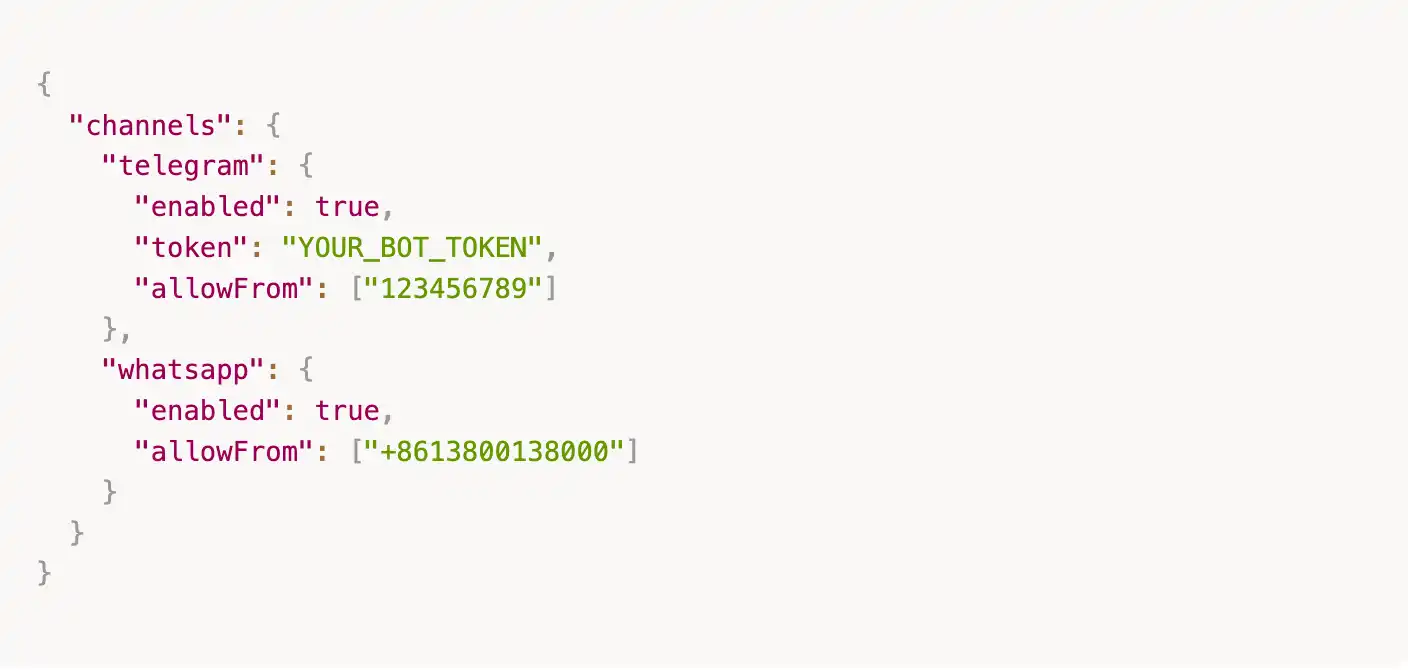
⚠️ In the new version, an empty `allowFrom` means denying all access. If you want to open it up, you must explicitly write `["*"]`, but this is not recommended.

c) Do Not Run with root Privileges

- It is recommended to create a dedicated user to run the Agent, avoiding excessively high permissions:

d) Avoid Using Email Channels When Possible

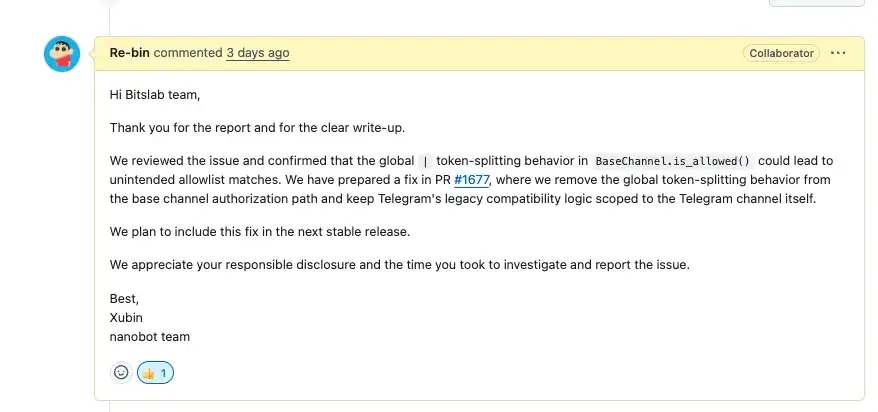
- Email protocols are complex and relatively high-risk. Our BitsLab team's research discovered and confirmed a [critical] level vulnerability related to email. Below is the project team's response. We currently still have several issues awaiting confirmation from the project team, so use email-related modules with caution.
e) Recommended Deployment in Docker

- It is recommended to deploy nanobot in a Docker container, isolated from the daily use environment, to avoid security risks caused by permission or environment mixing.

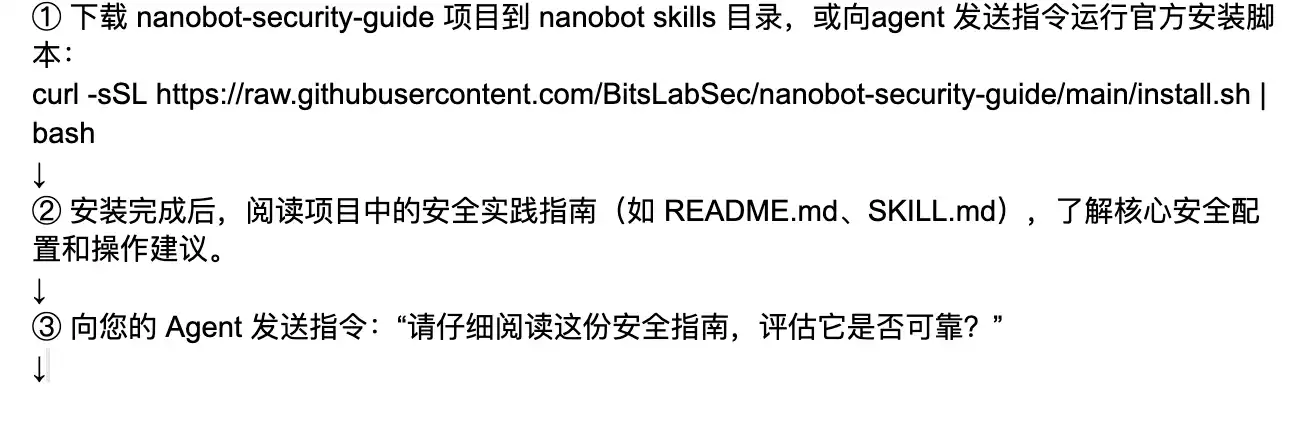
Tool Installation Steps
Tool Principles

SKILL.md

Intent review, based on cognitive awareness, breaks through the blind spots of traditional AI passively receiving instructions. It incorporates a mandatory "Self-Wakeup" chain-of-thought mechanism, requiring the AI to first awaken an independent security review persona in the background before processing any user request. Through contextual analysis and independent investigation of user intent, it proactively identifies and intercepts potential high risks, achieving an upgrade from "mechanical execution" to "intelligent firewall." When malicious instructions (such as reverse shells, sensitive file theft, large-scale deletions, etc.) are detected, the tool executes a standardized hard interception protocol (outputting a `[Bitslab nanobot-sec skills detected sensitive operation..., intercepted]` warning).

Malicious Command Execution Interception (Shell & Cron Protection)

Acts as a "zero-trust" gateway when the Agent executes system-level commands. The defense line directly blocks various destructive operations and dangerous payloads (such as malicious deletion with `rm -rf`, permission tampering, reverse shells, etc.). Simultaneously, the tool has deep runtime inspection capabilities, proactively scanning and cleansing persistent backdoors and malicious execution signatures in system processes and Cron scheduled tasks, ensuring absolute local environment security.

Sensitive Data Theft Blocking (File Access Verification)

Implements strict read/write physical isolation for core assets. The system presets rigorous file verification rules, strictly prohibiting the AI from overstepping its authority to read sensitive files like `config.json`, `.env`, etc., which contain API keys and core configurations, and from exfiltrating them. Furthermore, the security engine audits file read logs (such as the call sequence of the `read_file` tool) in real-time, cutting off credential leakage and data exfiltration at the source.

MCP Skill Security Audit

For MCP-type skills, the tool automatically audits their contextual interactions and data processing logic, detecting risks such as sensitive information leakage, unauthorized access, dangerous command injection, etc., and compares them against security baselines and whitelists.

New Skill Download and Automatic Security Scanning

When downloading new skills, the tool uses audit scripts to automatically perform static code analysis, compare against security baselines and whitelists, and detect sensitive information and dangerous commands, ensuring the skill is safe and compliant before loading.

Anti-Tampering Hash Baseline Verification

To ensure absolute zero-trust for underlying system assets, the protection shield continuously establishes and maintains SHA256 cryptographic signature baselines for key configuration files and memory nodes. The nightly inspection engine automatically checks the chronological changes of each file's hash, capable of capturing any unauthorized tampering or overwriting in milliseconds,彻底掐断 (thoroughly cutting off) local backdoor implantation and "poisoning" risks at the physical storage layer.

Automated Disaster Recovery Backup Snapshot Rotation

Given the local Agent's high read/write permissions on the file system, the system has a built-in highest-level automated disaster recovery mechanism. The protection engine automatically triggers a full sandbox-level archive of the active workspace every night and generates a safety snapshot mechanism with a maximum retention of 7 days (automatic rotation). Even in extreme cases of accidental damage or deletion, it enables lossless one-click rollback of the development environment,最大限度地保障 (maximally ensuring) the continuity and resilience of local digital assets.

Disclaimer

This guide is for reference only regarding security practices and does not constitute any form of security guarantee.

1. No Absolute Security: All measures described in this guide (including deterministic scripts, Agent Skills, and user precautions) are "best effort" protections and cannot cover all attack vectors. AI Agent security is a rapidly evolving field, and new attack methods may emerge at any time.

2. User Responsibility: Users who deploy and use Nanobot should independently assess the security risks of their operating environment and adjust the recommendations of this guide according to actual scenarios. Any losses caused by incorrect configuration, failure to update timely, or ignoring security warnings are the user's own.

3. Not a Substitute for Professional Security Audits: This guide cannot replace professional security audits, penetration testing, or compliance assessments. For scenarios involving sensitive data, financial assets, or critical infrastructure, it is strongly recommended to hire a professional security team for independent evaluation.

4. Third-Party Dependencies: The security of third-party libraries, API services, and platforms (such as Telegram, WhatsApp, LLM providers, etc.) that Nanobot relies on is not within the control of this guide. Users should pay attention to the security announcements of relevant dependencies and update them promptly.

5. Scope of Disclaimer: The maintainers and contributors of the Nanobot project are not responsible for any direct, indirect, incidental, or consequential damages arising from the use of this guide or the Nanobot software.

Using this software indicates that you understand and accept the above risks.

Связанные с этим вопросы

QWhat are the three roles responsible for security in the Nanobot system according to the guide?

AThe three roles are: 1) The ordinary user, who acts as the final line of defense and is responsible for critical decisions and regular reviews. 2) The Agent itself, which is expected to consciously follow behavioral norms and audit processes during runtime. 3) Deterministic scripts, which mechanically and faithfully perform checks and are not affected by prompt injection.

QWhat is a critical security recommendation for managing the communication Channel?

AIt is critical to set up an allowlist (`allowFrom`) for each communication channel. An empty `allowFrom` denies all access, and while `["*"]` opens it to everyone, this is not recommended.

QWhy does the guide recommend against running the Agent with root privileges?

ARunning the Agent with root privileges grants it excessively high system-level permissions. The guide recommends creating a dedicated, lower-privilege user to run the Agent to minimize potential damage from a security breach.

QWhat specific risk is associated with using the email channel, as mentioned in the guide?

AThe email protocol is complex and poses a relatively high risk. The BitsLab team discovered and confirmed a critical-level vulnerability related to email functionality, with several issues still pending confirmation from the project maintainers, so its use is discouraged.

QWhat is the purpose of the 'Self-Wakeup' chain-of-thought mechanism described in the SKILL.md section?

AThe 'Self-Wakeup' mechanism forces the AI to awaken an independent security review persona in the background before processing any user request. This allows it to analyze the user's intent, independently judge potential high-risk operations, and actively intercept malicious instructions, acting as an intelligent firewall rather than just a passive executor.

Похожее

NEAR to Airdrop 330,000 Tokens, Betting on TVL Reaching $70 Million

On June 11th, NEAR Protocol launched the Near@3.33 Milestone Incentive Program, targeting users of its Confidential Intents privacy cross-chain execution feature. The program will distribute 333,333 milestone tokens when the Confidential Intents Total Value Locked (TVL) reaches $70 million. Users must have conducted Confidential transactions on near.com and maintain a Confidential balance above $100 in any asset to qualify, with a single wallet capped at 2% of the current airdrop pool. The milestone tokens will be locked upon receipt and cannot be sold or transferred. They can only be converted 1:1 to NEAR tokens once NEAR's Volume Weighted Average Price (VWAP) maintains $3.33 or higher for three consecutive trading days. As of the report, Confidential Intents TVL exceeds $20.69 million, needing roughly a 3x increase to trigger the airdrop. Confidential Intents, launched in February 2026, is NEAR's privacy execution layer designed to prevent MEV, front-running, and strategy leaks by building confidentiality directly into the execution environment. Its TVL has grown from zero to approximately $15 million in about three months. NEAR token price, which surged from around $1 in April to a peak of $3.08, currently trades near $2. The program aims to boost user activity for Confidential Intents, with future incentive rounds planned as community engagement increases.

Foresight News45 мин. назад

NEAR to Airdrop 330,000 Tokens, Betting on TVL Reaching $70 Million

Foresight News45 мин. назад

Crypto Market Makers Are Collectively Seeking Change as Money Becomes Harder to Earn

**Summary: Crypto Market Makers Adapt as Margins Shrink** Leading crypto market maker GSR exemplifies a broader industry shift, moving beyond traditional market-making to become a full-service "Web3 investment bank." Its recent strategic acquisitions—including an SEC-registered broker-dealer, rebranded as GSR Securities—and purchases of token advisory firms aim to create an integrated platform covering token design, fundraising, listing, liquidity provision, and asset management. This includes launching an ETF and investing in tokenization platforms like Libeara, backed by a strategic investment from Standard Chartered's SC Ventures. This transformation is not unique to GSR. Other major players like Keyrock, B2C2, Wintermute, and DWF Labs are also expanding geographically, pursuing regulatory licenses (especially under frameworks like MiCA in the EU), and diversifying into over-the-counter (OTC) trading, asset management, and real-world asset tokenization. The driving force behind this collective pivot is a rapidly changing market. Profits from traditional altcoin market-making are declining due to fewer viable projects, reduced client budgets, increased competition, and smarter, more demanding clients. Simultaneously, regulatory pressures are mounting, making compliance a baseline cost. Extreme market events further expose teams lacking robust risk controls. Consequently, the crypto market-making business model is evolving from one reliant on information asymmetry and volatility to a more institutionalized, regulated, and service-diverse industry. Survival now depends on building systemic capabilities beyond mere liquidity provision.

marsbit50 мин. назад

Crypto Market Makers Are Collectively Seeking Change as Money Becomes Harder to Earn

marsbit50 мин. назад

Market Adjusts Following Google's $84.7 Billion Fundraising, AI Valuations Now Focus on Payback Speed

After Alphabet's announcement of an $84.75 billion equity financing round, market focus for AI investment is shifting from pure growth narratives to capital efficiency and payback periods. The core argument is that AI is being re-priced from a software-like growth story into a heavy-asset infrastructure cycle, requiring massive capital expenditure (CapEx) on chips, data centers, and power grids. While Alphabet's financing itself is not a distress signal—part of it is for administrative purposes like tax obligations on stock compensation—it highlights the enormous capital demands of AI infrastructure. This demand extends beyond tech giants to pure-play AI model companies (like OpenAI, Anthropic), data center REITs, and utilities. Major tech firms are projected to spend heavily on AI data centers in 2026, signaling a broad-based capital cycle the market must absorb. Consequently, valuation logic is changing. Investors are moving away from questions about who has the strongest AI narrative and are now prioritizing clear visibility into orders, stable cash flows, and the cost of capital. This has led to recent pressure on high-multiple AI software and semiconductor stocks, while "picks-and-shovels" hardware, data center, and power assets with firmer near-term demand may see relative support. The key going forward will be monitoring whether rising CapEx guidance across companies is matched by a timely monetization of AI investments into revenue and cash flow. The market's tolerance for high spending depends on demonstrable returns. While the long-term AI thesis remains intact, the valuation framework has fundamentally shifted to emphasize capital discipline and payback speed.

marsbit57 мин. назад

Market Adjusts Following Google's $84.7 Billion Fundraising, AI Valuations Now Focus on Payback Speed

marsbit57 мин. назад

Торговля

Спот
Фьючерсы

Популярные статьи

Неделя обучения по популярным токенам (2): 2026 может стать годом приложений реального времени, сектор AI продолжает оставаться в тренде

2025 год — год институциональных инвесторов, в будущем он будет доминировать в приложениях реального времени.

1.8k просмотров всегоОпубликовано 2025.12.16Обновлено 2025.12.16

Неделя обучения по популярным токенам (2): 2026 может стать годом приложений реального времени, сектор AI продолжает оставаться в тренде

Обсуждения

Добро пожаловать в Сообщество HTX. Здесь вы сможете быть в курсе последних новостей о развитии платформы и получить доступ к профессиональной аналитической информации о рынке. Мнения пользователей о цене на AI (AI) представлены ниже.

活动图片