Mixed Signals for Ethereum: Technical Milestones and Rising Adoption Offset Market Pressure

bitcoinistОпубликовано 2026-01-06Обновлено 2026-01-06

Введение

Despite entering 2026 with mixed signals, Ethereum shows significant progress amid market pressure. The network is advancing technically with upgrades like PeerDAS and zkEVMs improving scalability and reducing validator burdens, while moving toward stronger security goals. Adoption is growing, with stablecoin transfers hitting $8 trillion in Q4 2025 and record activity in transactions and smart contract deployments. However, selling pressure persists, limiting price gains. Overall, Ethereum is in a phase of consolidation, balancing strong foundational growth against a cautious market.

The first week of the year has not been unkind to the market, with Ethereum (ETH) entering 2026 with a mixed narrative that reflects both progress and restraint. On one hand, the network is pushing through long-standing technical limits and seeing broader real-world usage.

On the other hand, market data indicate continued selling pressure, which has kept price action subdued. Together, these trends suggest Ethereum is less in decline than in transition, balancing structural growth against a cautious market environment.

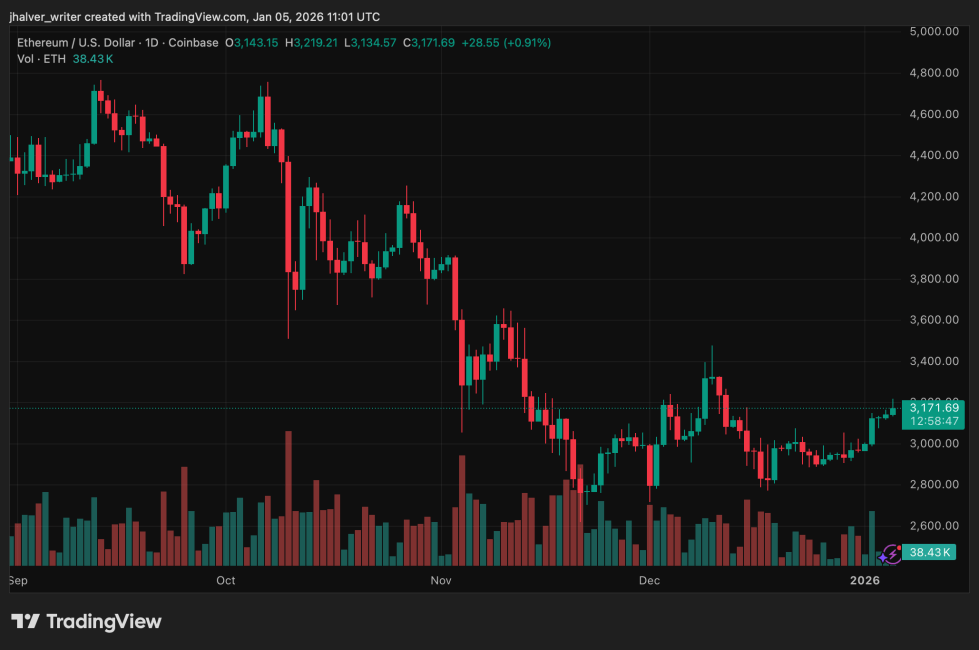
ETH's price trends slightly to the upside on the daily chart. Source: ETHUSD on Tradingview

Technical Progress and Network Upgrades

Recent comments from Ethereum co-founder Vitalik Buterin have drawn renewed attention to the progress on the blockchain trilemma, which is the challenge of balancing decentralization, security, and scalability.

According to Buterin, upgrades such as Peer Data Availability Sampling (PeerDAS) and zero-knowledge Ethereum Virtual Machines (zkEVMs) have moved this goal from theory into live conditions on the mainnet.

PeerDAS, introduced with the Fusaka upgrade in December, reduces the burden on validators by allowing them to verify data availability through sampling rather than processing full datasets. This improves scalability while maintaining accessibility to participation.

At the same time, zkEVMs have reached an early operational stage, with proof generation times falling sharply and verification costs dropping significantly. While still in alpha, these systems are expected to assume a larger validation role between 2027 and 2030, following further security enhancements.

Alongside performance gains, Ethereum’s roadmap is shifting toward protocol safety. The Ethereum Foundation has set a target of achieving 128-bit provable security by late 2026, indicating that recent speed and cost improvements are now being matched with increasingly stringent security goals.

Ethereum (ETH) Adoption Shifts Toward Utility

Beyond core protocol work, Ethereum’s usage metrics point to expanding adoption. Stablecoin transfer volume on the network exceeded $8 trillion in the fourth quarter of 2025, nearly doubling from earlier in the year.

Active addresses and daily transactions also reached record levels, reinforcing Ethereum’s role as a primary settlement layer for payments and tokenized assets.

Industry figures increasingly point to crypto-native neobanks as a key growth driver for 2026. These platforms combine self-custody, stablecoins, and yield products with familiar banking interfaces, lowering barriers for mainstream users.

Institutional participation in 2025, particularly through digital asset treasuries and staking-related structures, has helped lay the groundwork for this shift toward everyday financial use rather than short-term trading.

Market Pressure and Developer Momentum

Despite these developments, market flow data indicate that Ethereum remains under dominant selling pressure, reflecting a broader de-risking trend across cryptocurrency assets. This has limited upside and led to choppy price action, despite the emergence of positive narratives.

Similarly, developer activity tells a different story. An estimated 8.7 million smart contracts were deployed in the fourth quarter of 2025, the highest quarterly figure on record.

Taken together, Ethereum’s current signals point to consolidation rather than contraction. While market conditions continue to weigh on price, technical progress and rising adoption indicate the network is positioning itself for the next phase of growth once broader pressure eases.

Cover image from ChatGPT, ETHUSD chart from Tradingview

Похожее

Lowering Expectations for BTC's Next Bull Market

The author, Alex Xu, explains his decision to significantly reduce his Bitcoin holdings (from full to ~30% of his portfolio) during the current bull cycle, citing a lowered long-term outlook for BTC's price appreciation in the next cycle. He outlines six key reasons for this reduced expectation: 1. **Diminished Growth Drivers:** The narrative of exponential user adoption has largely played out with institutional ETF adoption. The next major growth phase—adoption by sovereign national reserves or central banks—seems unlikely in the near future. 2. **Personal Opportunity Cost:** More attractive investment opportunities have emerged in other assets, such as undervalued companies. 3. **Industry-Wide Contraction:** The broader crypto industry is struggling, with most Web3 business models (SocialFi, GameFi, DePIN) failing. This overall萧条 (depression) reduces the fundamental demand and consensus for Bitcoin. 4. **Strain on Major Buyer:** MicroStrategy, a major corporate buyer of BTC, faces rising financing expenses for its debt, which could slow its purchasing rate and create significant marginal pressure on the market. 5. **Increased Competition from Gold:** The emergence of "tokenized gold" has closed the functional gap (portability, divisibility) between physical gold and Bitcoin, offering a strong competitor in the non-sovereign store-of-value space. 6. **Security Budget Concerns:** The block reward halving continues to exacerbate the long-standing issue of funding Bitcoin's network security, with new fee source explorations like Ordinals and L2s largely failing. The author's decision to hold a significant (though reduced) position reflects a cautious, not bearish, outlook. He remains open to increasing his exposure if the fundamental reasons for his skepticism change or if new positive catalysts emerge.

marsbit35 мин. назад

Lowering Expectations for BTC's Next Bull Market

marsbit35 мин. назад

Can Iran 'Control' the Strait of Hormuz?

Iran has announced a comprehensive plan to assert control over the strategic Strait of Hormuz, a critical global oil shipping chokepoint. The proposed measures include requiring all vessels to obtain Iranian permission for passage, imposing fees for security, environmental protection, and navigation management—preferably paid in Iranian rials—and absolutely banning Israeli ships. Vessels from countries deemed hostile by Iran’s top security bodies may also be barred. Analysts suggest Iran’s motives are multifaceted: increasing pressure on the U.S. and Israel by leveraging control over oil transit to influence global prices and inflation; creating a new revenue stream, potentially exceeding $7.7 billion annually, to counter Western sanctions and support postwar reconstruction; and using transit permissions as bargaining chips in future negotiations, notably with the U.S. However, the plan faces significant practical and diplomatic challenges. Enforcing comprehensive interception and fee collection in the busy waterway, patrolled by international military forces, would be difficult. The U.S. has already countering with a blockade of Iranian ports and threats to intercept any ship paying fees, potentially strangling Iran’s oil exports and fee revenue. Broad international opposition, led by European and Gulf states, and legal controversies further complicate implementation. The proposal may ultimately serve more as a negotiating tactic than a feasible policy, with its execution remaining highly uncertain.

marsbit1 ч. назад

Can Iran 'Control' the Strait of Hormuz?

marsbit1 ч. назад

Торговля

Спот
Фьючерсы

Популярные статьи

Manyu: восходящая мем-звезда на Ethereum, готовая открыть новую эру культуры Shiba

Manyu - это мемтокен на Ethereum, который приносит децентрализованную культурную и развлекательную ценность через вирусное влияние в соцсетях и вовлечённость сообщества.

1.9k просмотров всегоОпубликовано 2025.11.27Обновлено 2025.11.27

Manyu: восходящая мем-звезда на Ethereum, готовая открыть новую эру культуры Shiba

Обсуждения

Добро пожаловать в Сообщество HTX. Здесь вы сможете быть в курсе последних новостей о развитии платформы и получить доступ к профессиональной аналитической информации о рынке. Мнения пользователей о цене на ETH (ETH) представлены ниже.

活动图片