Meta's Big Bet on AI: Investing $135 Billion, Is Zuckerberg in 2026 Worth Believing?

比推Опубликовано 2026-01-30Обновлено 2026-01-30

Введение

Meta is making a massive $135 billion bet on AI by 2026, a near-doubling of its capital expenditures from the previous year. This aggressive investment comes after the company reported strong Q4 2025 and Q1 2026 results that exceeded market expectations, with revenue reaching $59.9 billion (up 24% YoY) and EPS at $8.88 (up 11% YoY). The market responded positively, with Meta's stock surging over 10%. Unlike its previous metaverse gamble, which resulted in nearly $80 billion in cumulative losses for its Reality Labs division, this AI investment is already showing tangible returns by directly improving Meta's core advertising business. AI-driven enhancements to recommendation and ad delivery systems have increased ad prices by 6% and impressions by 18% in Q4. Key growth drivers include the strong performance of Instagram Reels and the accelerated commercialization of WhatsApp, which is expected to become a major revenue stream. CEO Mark Zuckerberg emphasized that the company's goal is to develop "superintelligence," and this investment is part of a long-term strategy involving talent acquisition, computational infrastructure, and organizational restructuring. To fund this, Meta is reallocating resources, including cutting about 10% of Reality Labs staff. The company's approach differs from competitors like Google and Microsoft by focusing on internalizing AI to enhance its existing massive user traffic and monetization engines, rather than primarily selling external AI produ...

Strong cash flow foundation, billions poured into AI, the market seems to applaud the "splurge," but will this time be different from the metaverse?

Written by: Frank, M Tong MSX

$135 billion—this is the amount Meta (META.M) plans to spend in 2026.

The Q4 2025 earnings and Q1 2026 guidance, both exceeding expectations, let many who were anxious about "falling behind" breathe a sigh of relief. But at the same time, the full-year 2026 capital expenditure (CapEx) soaring to $135 billion, nearly double last year's, is hard not to worry about—could this be another aggressive gamble?

Surprisingly, the market seemed to choose to buy, with Meta's stock surging over 10% after hours and continuing to rise overnight.
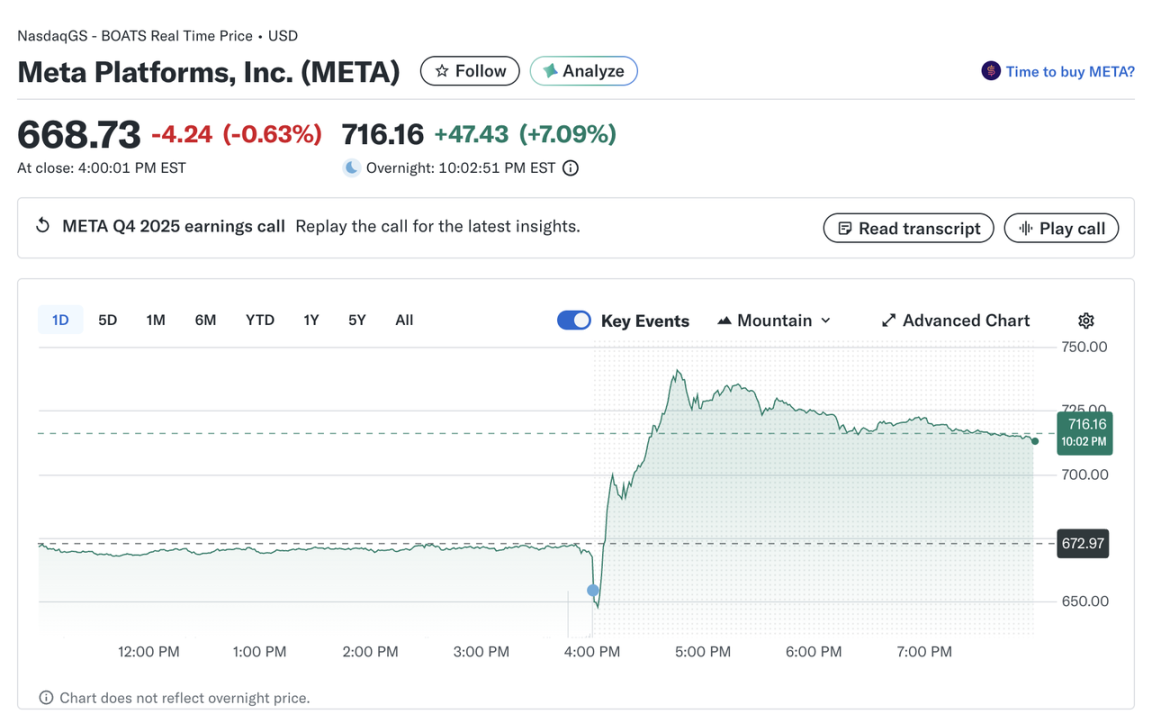
Meta Stock Price Data Source: Yahoo Finance

The answer lies hidden in this earnings report: at least at this stage, it shows the market that AI investment isn't just a future vision but is already tangibly improving the current core cash cow—advertising business. So Wall Street started betting on Meta's narrative reversal and is willing to buy into this super spending plan.

Ultimately, "daring to spend, daring to bet" has always been the底色 of Meta and Zuckerberg. This also means that winning could be a huge narrative reversal; losing, at least under the current financial structure, is unlikely to turn into an uncontrollable disaster.

I. Earnings Quick Read: Earnings & Guidance "Double Beat"

From the results, this is an earnings report足以改变市场情绪.

Among them, Q4 2025 core financial indicators almost all exceeded expectations across the board: revenue of $59.893 billion, up 24% YoY, above market expectations of $586 billion; net profit of $22.768 billion, up 9% YoY; diluted earnings per share (EPS) of $8.88, up 11% YoY, above market expectations of $8.23.

It can be said that whether in terms of growth resilience on the revenue side or profit release节奏 on the profit side, Meta delivered a solid, stable Q4 report card.

Extending the perspective to the full year, the growth logic同样成立: 2025 full-year revenue of $200.966 billion, up 22% YoY; operating profit of $83.276 billion, up 20% YoY, core indicators still maintaining double-digit expansion.

The only seemingly "against the trend" was the full-year net profit recording $60.458 billion, down 3% YoY, but this change wasn't due to恶化 of main business but mainly from a one-time tax factor—affected by the "Big and Beautiful Act," the company recognized about $16 billion in one-time non-cash income tax expense.

Excluding this factor, full-year net profit and EPS would still achieve可观增长, also explaining the surface contradiction between the full-year data and the quarter's strong performance.
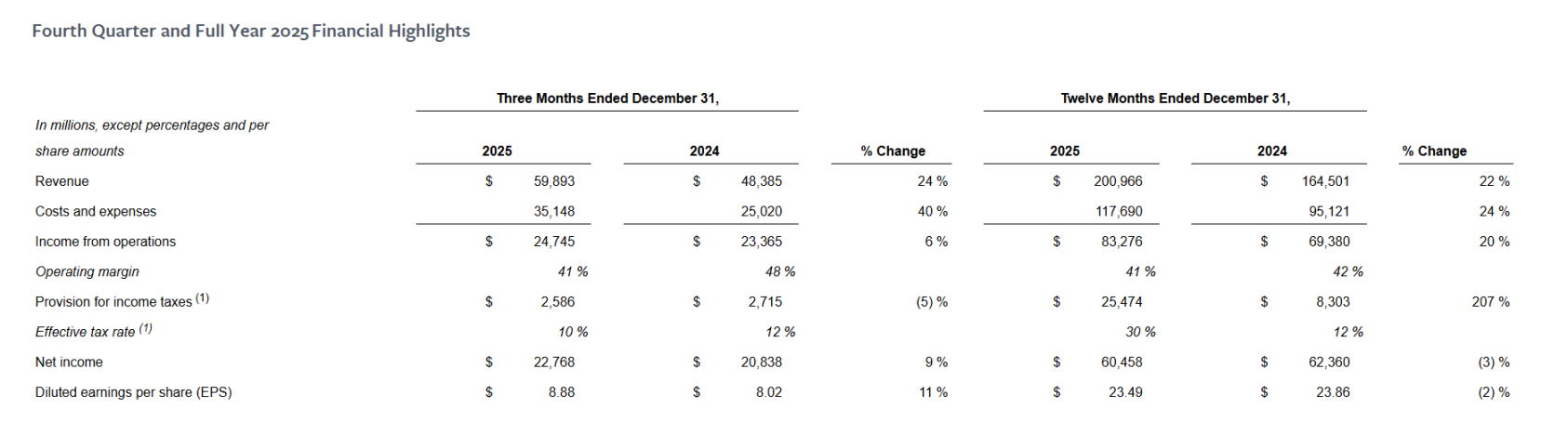
Source: Meta

At the same time, operational metrics also showed typical "volume and price rising together" characteristics:

  • Family app daily active users (DAP) reached 3.58 billion, up 7% YoY, meeting market expectations;

  • Ad impressions up 18% YoY; average price per ad up 6% YoY;

  • Average revenue per user (ARPU) was $16.73, up 16% YoY;

This set of data points to one conclusion: Meta's advertising moat not only hasn't slowed down but is continuously evolving in efficiency and monetization capability.

Furthermore, what further stimulated market sentiment turning wasn't just the realized超预期业绩, but also management's optimistic guidance for the future: Meta expects Q1 2026 revenue to reach $535-565 billion, corresponding to YoY growth of 26%-34%, significantly higher than the previous market expectation of about 21% growth. This pricing implies management's judgment that Reels' high growth momentum will continue, and Threads' commercialization progress is better than the market's previous cautious expectations.

With the advertising base盘稳固, this guidance directly strengthened market confidence in AI-driven advertising efficiency improvement having sustainability.
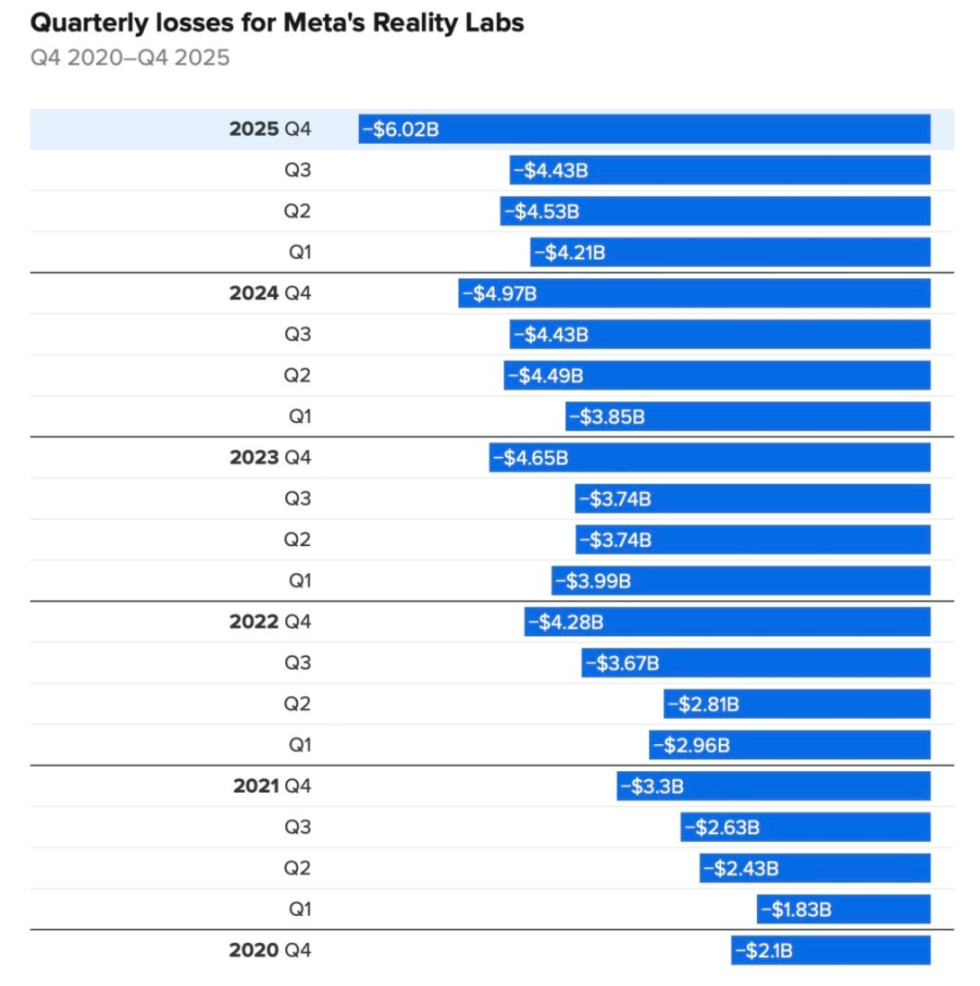
Reality Labs Five-Year Loss Details

Of course, it's worth mentioning that the "metaverse" is still Meta's bleeding edge, with its元宇宙部门 Reality Labs recording an operating loss of $6.02 billion in Q4, expanding 21% YoY. Revenue was $955 million, up 13% YoY. Since late 2020, this department's cumulative operating loss has approached $80 billion.

But different from the past, Reality Labs' role in the current earnings report is no longer the core variable左右公司整体叙事, but is gradually being marginalized.

II. Social Base盘稳固, AI Deepens the "Moat"

At least at the main business level, AI has indeed started creating value for Meta's (META.M)商业化真金白银.

It can be said that to some extent, unlike Google (GOOGL.M) or Microsoft (MSFT.M), Meta is currently the most direct and already earnings-reported player with "AI investment directly feeding back to main business cash flow".

First体现在广告效率的系统性提升上, this benefits from AI directly嵌入推荐系统与广告投放系统, making Meta's Q4 average ad price up 6% YoY, with impressions大增 18%. Management has also多次强调, AI recommendation algorithms and投放系统的升级, significantly improved ad conversion rates and投放效率.

Among them, Instagram Reels' watch time in the US market grew over 30% YoY, becoming the core engine driving ad inventory and monetization capability.

Second is the accelerated推进 of WhatsApp commercialization. Meta plans to fully introduce ads into WhatsApp Status this year, seen as the company's next potential billion-dollar revenue growth point, also a key step for AI recommendation and ad systems to expand to more traffic scenarios.

Overall, against the backdrop of ongoing external competition like TikTok, Meta's social base盘 hasn't loosened; instead, through deep AI embedding into recommendation and ad systems, it has further deepened its moat.

Source: Meta

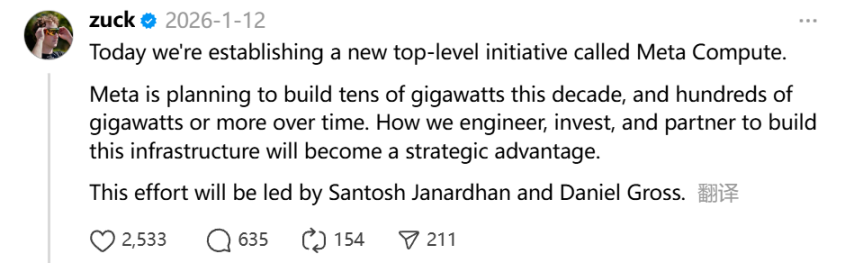
Looking back over the past year, Meta's actions in the AI direction can be described as激进—from spending billions to acquire Scale AI equity, inviting Alexandr Wang to lead the "Meta Superintelligence Lab (MSL)", to continuously high-salary poaching, restructuring AI organizational structure, then investing tens of billions to acquire Manus, and launching Meta Compute, planning to build tens of GW-level computing and power infrastructure within this decade...

This series of actions reminds many of that familiar script: aggressive investment, grand narrative, long payback period. In other words, we seem to see the "Zuckerberg of the metaverse era" again.

But different from the metaverse period, management this time gave a clear bottom expectation, stating that even with大幅提升基础设施投入, 2026 operating profit will still be higher than 2025, and the cost growth path for the huge 2026 investment is highly transparent, mainly concentrated on computing power, depreciation, third-party cloud services, and high-end technical personnel.

In short, in Meta's strategic framework, AI isn't just a technological narrative押注未来, but a real tool持续改善主营现金流, its logic isn't complicated: when AI is deeply embedded into recommendation systems and ad systems, even marginal improvements, like making 3.6 billion users stay几十秒 longer daily, or improving ad conversion rate by 1%, on Meta's current traffic scale and ad base, will be rapidly放大为可观、可重复的现金流增量.

It is under this high-leverage structure that the efficiency improvement brought by AI is实实在在地对冲甚至覆盖高达 135 billion annual capital expenditure. In other words, Wall Street is no longer afraid of Meta burning money, to some extent because it has seen the real silver brought by AI.

Interestingly, from a more macro perspective, in Silicon Valley's AI arms race, besides the mainstream path of忙着向外输出算力、模型与工具, "selling shovels and tools" to the world, another is the Meta model—internalizing AI as the heart of its own commercial system, directly amplifying existing traffic and monetization engines.

It is this model of not relying on external sales of new products, but improving self-monetization efficiency to achieve回报, that makes Meta's AI investment path明显区别于其他大型科技公司以大模型或云服务为核心的变现逻辑, also because of this, the market began重新审视 Meta's pricing basis:

AI here isn't a long-term story waiting to be realized, but can already through the advertising system,持续、量化地反馈到主营现金流中的现实变量.

This或许也正是市场愿意重新给 Meta 定价的根本原因.

III. Violent Betting, an Unloseable War?

"Superintelligence" has become one of the highest frequency keywords in Zuckerberg and Meta management's mouths.

Zuckerberg on this earnings call also didn't hide his ambition: "I look forward to promoting superintelligence for global users", this也成为一场涵盖人才、算力与基础设施的 Meta 长期战略.

First from capital expenditure numbers, as mentioned above, Meta started an uncompromising violent betting, 2026 full-year operating expenses will reach $162-169 billion, up 37%-44% YoY,明显高于市场买方此前约 1500-1600 billion expectation range.

At the same time, Meta is also using actions to release "abandonment signals" to the market. This month, media revealed its plan to cut about 10% of Reality Labs employees again, involving about 1,500 people, meaning元宇宙相关业务正被进一步压缩,为 AI 与核心业务腾挪资源.

More strategically significant is Meta's redefinition of computing power and infrastructure. Zuckerberg personally posted on January 12,表示 "started a new top-level strategic project named Meta Compute". According to disclosed information, Meta plans to cumulatively invest at least $600 billion in US data centers and related infrastructure by 2028.

However, Meta CFO Susan Li later clarified this number, saying this investment isn't solely for AI server procurement but covers US本土数据中心建设、算力与电力设施, as well as supporting new employees and配套成本 needed for US business operations.
Objectively, whether from talent density, computing scale, or infrastructure intensity, Meta's investment in AI direction已经不逊于、甚至某些维度上超过了主要竞争对手.

Of course, this path is also naturally a double-edged sword. Once revenue growth, advertising efficiency, or new model progress cannot持续跑在成本扩张之前, the market's tolerance will rapidly decline, valuation and profit expectations都可能面临反噬.

In other words, this isn't an experiment that can be tried repeatedly, but a strategic war once the bow is drawn, it's hard to turn back.

Written at the End

As early as a blog program in September 2025, Zuckerberg直言, if ultimately几千亿美元浪费掉, that would be very unfortunate, but on the other hand,假设在 AI 浪潮中掉队, the risk for Meta might be higher.

"For Meta, the real risk isn't whether the investment is too aggressive, but whether it will hesitate at key moments", this remark, in today's context, can almost be seen as the footnote for all Meta's strategic actions over the past year.

Of course, history isn't easily forgotten. In the last metaverse narrative, Zuckerberg同样选择了提前下注、全力推进, but the final result didn't meet the market's initial expectations.

The difference is that this time Meta holds the world's densest, most commercializable user traffic entrance; and AI is正在以前所未有的方式, directly重塑人与内容、人与商业之间的连接效率.

As for 135 billion, whether it's a historic strategic sprint or another costly lesson, the answer still needs time to tell.


Original link:https://msx.com/news-details/246/?code=MPoint
Disclaimer: All Bitpush articles only represent author's views and do not constitute investment advice.
MetaRWA

Трендовые криптовалюты

Связанные с этим вопросы

QWhat is the total amount Meta plans to invest in 2026, and how does it compare to the previous year?

AMeta plans to invest $135 billion in capital expenditures (CapEx) in 2026, which is nearly double the amount from the previous year.

QHow did Meta's Q4 2025 financial performance compare to market forecasts?

AMeta's Q4 2025 performance exceeded market expectations: revenue was $59.893 billion (up 24% YoY), net profit was $22.768 billion (up 9% YoY), and diluted EPS was $8.88 (up 11% YoY), all above market forecasts.

QIn what ways is AI already contributing to Meta's core advertising business?

AAI is improving Meta's advertising efficiency by being integrated into recommendation and ad delivery systems, leading to a 6% YoY increase in average ad price and an 18% rise in ad impressions in Q4 2025.

QWhat is Meta's strategic focus for AI, and how does it differ from other tech giants like Google or Microsoft?

AMeta's AI strategy focuses on internalizing AI to enhance its existing traffic and monetization engines, such as improving ad systems and user engagement, rather than primarily selling AI models or cloud services externally like Google or Microsoft.

QWhat is the long-term financial outlook for Meta despite its massive AI investments?

AMeta expects its operating profit in 2026 to be higher than in 2025, even with significant infrastructure investments, as AI-driven efficiencies in advertising and user engagement are already generating measurable cash flow improvements.

Похожее

1996 или 1999? Первым испытанием Уолша стало «Как смотреть на ИИ»

Назначенный председателем ФРС Вош столкнулся с ключевой дилеммой: как оценить текущий бум искусственного интеллекта? Экономисты разделились на два лагеря. Одни считают, что рост производительности благодаря ИИ скоро подавит инфляцию, позволяя ФРС бездействовать. Другие предупреждают, что спрос опережает предложение, и промедление с повышением ставок приведёт к необходимости более резких мер в будущем. Вош, судя по заявлениям, склоняется к подходу 1996 года, когда Алан Гринспен не стал повышать ставки во время бума производительности, что оказалось верным решением. Однако нынешняя ситуация отличается: растущие тарифы, большой дефицит бюджета и снижение выгод глобализации создают дополнительное инфляционное давление. Критики, такие как глава Чикагского ФРС Гулсби, утверждают, что ожидаемый всеми рост производительности от ИИ уже сейчас вызывает перегрев экономики, так как люди и компании увеличивают расходы в ожидании будущих выгод. Это требует более жёсткой денежно-кредитной политики. Оппоненты отмечают, что многие домохозяйства не могут брать кредиты под будущий рост доходов, что ослабляет этот эффект. Вош также сталкивается с парадоксом: он хочет отказаться от практики «прогнозирующего руководства» (forward guidance), установленной как раз в 1999 году для предупреждения рынков о ужесточении политики. Если экономика пойдёт по сценарию 1999 года, ему придётся либо использовать эту практику, либо рисковать вызвать рыночные потрясения молчанием. Таким образом, первый серьёзный вызов для Воша — определить, повторяет ли экономика оптимистичный сценарий 1996 года или ведёт к необходимости жёстких мер по образцу 1999 года. От этого выбора зависит не только ближайшая политика ФРС, но и его историческая репутация.

marsbit1 ч. назад

1996 или 1999? Первым испытанием Уолша стало «Как смотреть на ИИ»

marsbit1 ч. назад

Отчет по Ethereum за первый квартал 2026 года: снижение комиссий, рекордное количество пользователей и транзакций

В первом квартале 2026 года сеть Ethereum продемонстрировала парадоксальную динамику: количество активных пользователей, транзакций и пропускная способность достигли исторических максимумов, в то время как комиссии за транзакции, общая заблокированная стоимость (TVL), объем торгов и рыночная капитализация ETH снизились. Этот феномен объясняется стратегическим переходом к этапу «низких комиссий для роста масштаба» после обновления Fusaka, которое удешевило блок-пространство. Парадокс Джевонса проявляется в том, что снижение стоимости использования высвобождает новый спрос. Ключевой тренд — смещение нарратива от DeFi-платформы к глобальному расчетному слою для институциональных финансов. Ethereum сохраняет доминирующую позицию в сегментах стейблкоинов (61,8% среди топ-5 сетей), токенизированных фондов (73%) и товаров (84%), привлекающих таких гигантов, как BlackRock и JPMorgan. Инвестиции в масштабирование и снижение комиссий нацелены на укрепление сетевых эффектов и долгосрочную ценность ETH как базового актива для расчетов в цифровой экономике.

marsbit3 ч. назад

Отчет по Ethereum за первый квартал 2026 года: снижение комиссий, рекордное количество пользователей и транзакций

marsbit3 ч. назад

Первое подкаст-интервью CEO Intel: наша цель — "10x за 5-10 лет", ставка на передовую упаковку, стеклянные подложки и искусственный алмаз

Интелл CEO Чэнь Лиу впервые выступил в подкасте, поставив цель увеличить доходность компании в 10 раз за 5-10 лет. Основные стратегические направления включают инвестиции в передовые технологии упаковки (EMIB), стеклянные подложки и новые материалы, такие как нитрид галлия (GaN), карбид кремния (SiC), фосфид индия (InP) и синтетические алмазы, для преодоления физических ограничений традиционного масштабирования процессоров. Он отметил, что всплеск спроса на ИИ-агентов и задачи логического вывода увеличил значимость CPU, изменив соотношение CPU/GPU в серверах с 1:8 до 1:4 и ниже. Лиу подчеркнул важность восстановления баланса, фокуса на продуктах и клиентах, а также стратегической ценности внутреннего американского производства для безопасности цепочек поставок. Ключевыми показателями для фаундри-бизнеса названы выход годных изделий и время цикла. Совместный проект с Илоном Маском Terafab направлен на решение проблемы отставания инфраструктуры полупроводников от роста потребностей ИИ. Лиу считает, что истинный потенциал Intel, выходящий за рамки традиционного рынка ПК, начнет реализовываться в период 2030-2032 годов в таких областях, как периферийные вычисления, физический ИИ и ИИ-агенты, благодаря интеграции технологий XPU, передовой упаковки и фаундри-услуг.

marsbit3 ч. назад

Первое подкаст-интервью CEO Intel: наша цель — "10x за 5-10 лет", ставка на передовую упаковку, стеклянные подложки и искусственный алмаз

marsbit3 ч. назад

Только что привлек $2,7 миллиарда, и Ли Фэйфэй тоже вложила деньги

В венчурном рынке «мировые модели» стали горячей темой, но Пит Флоренс, сооснователь и бывший ведущий исследователь Google DeepMind, публично отверг этот ярлык для своей компании Generalist AI. Несмотря на то, что он был ключевым разработчиком архитектуры VLA, лежащей в основе многих современных «мировых моделей», Флоренс считает, что акцент должен делаться на конкретных целях, а не на модных терминах. Его цель — создать роботов, способных с высокой надежностью выполнять самые разные задачи без специального обучения для каждой. Недавно Generalist AI привлекла $4 млрд в ходе раунда финансирования при оценке в $20 млрд. Среди инвесторов — NVentures (Nvidia), Bezos Expeditions, фонд NFDG, сооснователь Xiaomi Линь Бинь, основатель Zoom Эрик Юань и известный ученый в области ИИ Ли Фэйфэй. Подход Флоренса сформировался под влиянием его научного руководителя в MIT, Рус Тедрейка, который делал акцент на понимании физики. В Generalist AI этот подход выражается в последовательной разработке моделей, нацеленных на практическую полезность. Их первая модель, GEN-0, продемонстрировала, что законы масштабирования, как у больших языковых моделей, применимы и к физическим действиям. В апреле 2026 года была представлена GEN-1, обученная на более чем 50 тысячах часов данных, собранных с помощью специальных перчаток. Она достигает 99% успеха в таких задачах, как складывание коробок, и работает в три раза быстрее предыдущей версии. Флоренс считает, что производительность GEN-1 приближается к переломному моменту, необходимому для коммерческого развертывания. Финансирование, полученное после ее демонстрации, подтверждает веру инвесторов в его целеориентированный подход к созданию универсальных роботов, которые могут изменить экономику физического труда.

marsbit3 ч. назад

Только что привлек $2,7 миллиарда, и Ли Фэйфэй тоже вложила деньги

marsbit3 ч. назад

За три дня потеряли двух легенд: дамба AI-талантов Google трещит по швам?

За последние три дня Google потеряла двух ведущих специалистов по ИИ: Ноама Шазера, одного из авторов архитектуры Transformer, присоединившегося к OpenAI, и Джона Джампера, руководителя проекта AlphaFold и нобелевского лауреата, перешедшего в Anthropic. Эти события не являются изолированными случаями — они отражают устойчивую тенденцию оттока ключевых талантов из Google в сторону OpenAI и Anthropic. Основная причина — фундаментальное несоответствие миссий. Коммерческие цели Google, ориентированные на рекламный бизнес, ограничивают фундаментальные исследования, в то время как OpenAI и Anthropic предлагают фокус на развитии ИИ и безопасности. Кроме того, перспектива скорого IPO OpenAI и Anthropic сулит сотрудникам значительный финансовый рост, чего не может предложить зрелый гигант вроде Google. Слияние Google Brain и DeepMind в 2023 году, предназначенное для консолидации усилий, на практике усилило внутренние трения между исследовательской и продуктовой культурами, увеличив давление коммерциализации на науку. Этот структурный отток талантов перекраивает ландшафт индустрии. Несмотря на сохраняющиеся преимущества в вычислительных ресурсах и данных, Google рискует проиграть в гонке, где ключевым активом являются люди, продвигающие технологические границы. Способность удерживать этих людей становится для компании самой сложной задачей.

marsbit5 ч. назад

За три дня потеряли двух легенд: дамба AI-талантов Google трещит по швам?

marsbit5 ч. назад

Торговля

Спот
Фьючерсы

Популярные статьи

Как купить S

Добро пожаловать на HTX.com! Мы сделали приобретение Sonic (S) простым и удобным. Следуйте нашему пошаговому руководству и отправляйтесь в свое крипто-путешествие.Шаг 1: Создайте аккаунт на HTXИспользуйте свой адрес электронной почты или номер телефона, чтобы зарегистрироваться и бесплатно создать аккаунт на HTX. Пройдите удобную регистрацию и откройте для себя весь функционал.Создать аккаунтШаг 2: Перейдите в Купить криптовалюту и выберите свой способ оплатыКредитная/Дебетовая Карта: Используйте свою карту Visa или Mastercard для мгновенной покупки Sonic (S).Баланс: Используйте средства с баланса вашего аккаунта HTX для простой торговли.Третьи Лица: Мы добавили популярные способы оплаты, такие как Google Pay и Apple Pay, для повышения удобства.P2P: Торгуйте напрямую с другими пользователями на HTX.Внебиржевая Торговля (OTC): Мы предлагаем индивидуальные услуги и конкурентоспособные обменные курсы для трейдеров.Шаг 3: Хранение Sonic (S)После приобретения вами Sonic (S) храните их в своем аккаунте на HTX. В качестве альтернативы вы можете отправить их куда-либо с помощью перевода в блокчейне или использовать для торговли с другими криптовалютами.Шаг 4: Торговля Sonic (S)С легкостью торгуйте Sonic (S) на спотовом рынке HTX. Просто зайдите в свой аккаунт, выберите торговую пару, совершайте сделки и следите за ними в режиме реального времени. Мы предлагаем удобный интерфейс как для начинающих, так и для опытных трейдеров.

1.5k просмотров всегоОпубликовано 2025.01.15Обновлено 2026.06.02

Как купить S

Sonic: Обновления под руководством Андре Кронье – новая звезда Layer-1 на фоне спада рынка

Он решает проблемы масштабируемости, совместимости между блокчейнами и стимулов для разработчиков с помощью технологических инноваций.

2.3k просмотров всегоОпубликовано 2025.04.09Обновлено 2025.04.09

Sonic: Обновления под руководством Андре Кронье – новая звезда Layer-1 на фоне спада рынка

HTX Learn: Пройдите обучение по "Sonic" и разделите 1000 USDT

HTX Learn — ваш проводник в мир перспективных проектов, и мы запускаем специальное мероприятие "Учитесь и Зарабатывайте", посвящённое этим проектам. Наше новое направление .

1.8k просмотров всегоОпубликовано 2025.04.10Обновлено 2025.04.10

HTX Learn: Пройдите обучение по "Sonic" и разделите 1000 USDT

Обсуждения

Добро пожаловать в Сообщество HTX. Здесь вы сможете быть в курсе последних новостей о развитии платформы и получить доступ к профессиональной аналитической информации о рынке. Мнения пользователей о цене на S (S) представлены ниже.

活动图片