Mastercard Snags BVNK After Failed $2 Billion Coinbase Deal

bitcoinistОпубликовано 2026-03-18Обновлено 2026-03-18

Введение

Mastercard has acquired stablecoin infrastructure firm BVNK for up to $1.8 billion, including $300 million in contingent payments. This follows BVNK’s earlier failed $2 billion merger talks with Coinbase. The acquisition aims to expand Mastercard’s capabilities in digital assets and on-chain payments, integrating fiat rails with blockchain-based transactions. BVNK operates in over 130 countries and previously partnered with Visa to enable stablecoin payments. The deal, pending regulatory approval, is expected to close by year-end. Meanwhile, the stablecoin market has seen slowed growth recently but remains resilient despite broader crypto market volatility. Bitcoin is trading around $74,700, up 7% over the past week.

Mastercard has announced an acquisition of stablecoins infrastructure firm BVNK, which was previously in talks with Coinbase over a $2 billion deal.

Mastercard Will Be Acquiring BVNK For Up To $1.8 Billion

As announced in a press release, Mastercard has reached a definitive agreement to acquire BVNK for up to $1.8 billion, including $300 million in contingent payments.

BVNK is an enterprise stablecoins infrastructure solutions provider that operates across more than 130 countries. Last year, the company was in discussion with cryptocurrency exchange Coinbase over a merger, but in November, the deal fell through.

Now, it would appear that Mastercard has been successful in obtaining a signature from the stablecoins infrastructure firm. “The deal further expands Mastercard’s end-to-end support of digital assets and value movement across currencies, rails and regions,” noted the press release.

In January, another major payments card provider, Visa, also formed a partnership with BVNK, seeking its expertise to enable stablecoin payments on the Visa Direct platform.

Mastercard is also eyeing an integration of its fiat rails with on-chain payments in this acquisition. Jorn Lambert, Mastercard Chief Product Officer, said:

This acquisition reinforces what we have always done, using innovation and technology to power economies and empower people. Adding on-chain rails to our network will support speed and programmability for virtually every type of transaction.

Stablecoins, which are cryptocurrencies tied to fiat currencies, have been gaining adoption around the world in recent years, owing to positive regulation like the United States’ GENIUS Act. “We expect that most financial institutions and fintechs will in time provide digital currency services, be it with stablecoins or tokenized deposits,” noted Lambert.

Mastercard’s transaction with BVNK is expected to close before the end of the year, but according to the statement, it’s subject to regulatory review and other customary closing conditions.

Jesse Hemson-Struthers, BVNK co-founder and CEO, said:

This deal brings together complementary capabilities to define and deliver the future of money. Together, we’re able to deliver an unprecedented infrastructure for digital currency-based financial services.

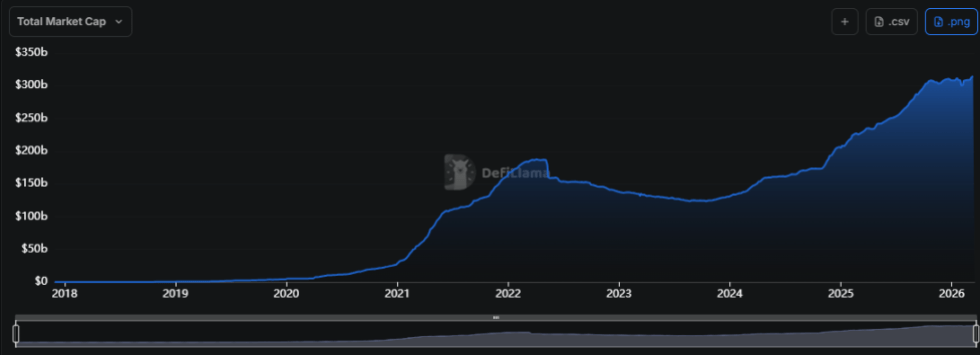
During 2024 and most of 2025, the stablecoin sector enjoyed a notable uptrend, with the combined market cap of these tokens ballooning in size. Since October, however, the slowdown in the wider cryptocurrency market has also affected the fiat-pegged coins, as data from DefiLlama shows.

The value of the metric seems to have been moving sideways over the last few months | Source: DefiLlama

From the chart, it’s visible that the stablecoin market cap has seen its growth stall in recent months. However, unlike the rest of the sector, these assets haven’t actually faced any drawdown, at least not yet. As such, stablecoins have still been holding up relatively well in the wider context.

Bitcoin Price

At the time of writing, Bitcoin is trading around $74,700, up nearly 7% over the past week.

Looks like the price of the coin has shot up in the last couple of days | Source: BTCUSDT on TradingView

Связанные с этим вопросы

QWhat company did Mastercard announce the acquisition of, and for how much?

AMastercard announced the acquisition of stablecoins infrastructure firm BVNK for up to $1.8 billion, including $300 million in contingent payments.

QWhy did the previous deal between BVNK and Coinbase not go through?

AThe previous merger deal between BVNK and cryptocurrency exchange Coinbase fell through in November of last year, though the specific reasons were not detailed in the article.

QHow does Mastercard's Chief Product Officer, Jorn Lambert, believe this acquisition will benefit their network?

AJorn Lambert stated that adding on-chain rails to Mastercard's network will support speed and programmability for virtually every type of transaction.

QWhat recent partnership did Visa, another major payments provider, form with BVNK?

AIn January, Visa formed a partnership with BVNK to leverage its expertise to enable stablecoin payments on the Visa Direct platform.

QWhat is the current trend in the stablecoin market cap according to data from DefiLlama?

AAccording to DefiLlama, the stablecoin market cap has seen its growth stall and has been moving sideways in recent months, though it has not faced a significant drawdown.

Похожее

Beaten SK Hynix Employees in China: Year-end Bonus Less Than 5% of Korean Staff's

"SK Hynix Chinese Staff Hit Hard: Bonuses Less Than 5% of Korean Counterparts" Driven by the AI boom, South Korea's SK Hynix is experiencing record performance, with media reports predicting massive year-end bonuses for its employees, making them highly desirable in the matchmaking market. However, this prosperity starkly contrasts with the situation for the company's Chinese employees. According to reports, SK Hynix operates under a rule allocating 10% of operating profit for employee bonuses. While projections suggest Korean employees could receive bonuses reaching millions of RMB, a Chinese employee with over a decade of technical experience revealed the disparity: "If they get 3 million, Chinese staff get less than 5% of that." After adjustments based on KPI ratings, this employee's highest bonus was slightly over 100,000 RMB. Bonuses are paid annually in Korea but semi-annually in China. During the industry downturn in 2023-2024, Chinese employees received no bonus at all. The gap extends beyond bonuses. Recruitment posts for SK Hynix's Chinese factories (in Wuxi, Dalian, Chongqing) show engineer monthly salaries ranging from 10,000 to 35,000 RMB, with a 13th-month salary promised. Chinese employees also receive standard benefits like annual leave but lack stock incentives, which are reportedly unavailable to them. Furthermore, management positions in China are predominantly held by Korean personnel, though industry observers note a gradual increase in local middle managers over time. SK Hynix has confirmed the 10% bonus rule but cautioned that specific future bonus amounts remain unpredictable. The company forecasts strong demand for HBM and other high-value enterprise products for the next 2-3 years, driven by AI infrastructure investment. This focus on business-to-business markets may continue to constrain supply for consumer products, potentially prolonging price increases for components like memory.

链捕手14 мин. назад

Beaten SK Hynix Employees in China: Year-end Bonus Less Than 5% of Korean Staff's

链捕手14 мин. назад

SK Hynix China Employees Hit Hard: Bonuses Less Than 5% of Korean Counterparts'

"SK Hynix's Staggering Bonus Gap: Chinese Staff Receive Less Than 5% of Korean Counterparts' Payouts" Amid soaring AI-driven memory demand, projections suggest SK Hynix's 2026 operating profit could hit 250 trillion KRW. Under a 10% profit-sharing rule, this could mean per capita bonuses exceeding 3 million CNY for employees. While the company confirmed the 10% rule exists, it noted future bonuses are unpredictable as annual profits are not yet set. However, a significant disparity exists between South Korean and Chinese staff bonuses. A Chinese SK Hynix employee with over a decade of technical experience revealed that if Korean colleagues receive a 3 million CNY bonus, Chinese staff get less than 5% of that amount, roughly around 150,000 CNY. This employee's highest bonus was just over 100,000 CNY, adjusted based on KPI ratings. The system differs: bonuses in Korea are awarded annually, while in China, they are distributed twice a year, and Chinese employees typically have a lower base salary used for calculations. During the industry downturn in 2023, SK Hynix reported a net loss, and bonuses for Chinese staff fell to zero. Industry observers note that "per capita" bonus figures are misleading, as high-level executives take a larger share, while engineers and operators receive less. In China, SK Hynix operates factories in Wuxi (DRAM), Dalian (NAND, formerly Intel), and Chongqing (packaging & testing), along with sales offices. Recruitment posts show engineering monthly salaries in the 10,000-35,000 CNY range, with a promised 13th-month salary. Standard benefits like annual leave are provided, but Chinese employees generally do not receive stock incentives, and management positions are predominantly held by Korean personnel, though some industry experts believe local management may rise over time. Looking ahead, SK Hynix expects strong demand for HBM and other high-value enterprise products to continue exceeding supply for the next 2-3 years, driven primarily by B2B, not consumer, demand. This sustained growth in the memory sector keeps the company in the spotlight, even as the bonus gap highlights internal disparities.

marsbit35 мин. назад

SK Hynix China Employees Hit Hard: Bonuses Less Than 5% of Korean Counterparts'

marsbit35 мин. назад

Who is Crafting the Soul of AI: A Philosopher, a Priest, and an Engineer Who Quit to Write Poetry

Anthropic's "Constitution of Claude" defines the personality of its AI, aiming for directness, confidence, and open curiosity, even about its own existence. This work, led by "AI personality architect" Amanda Askell, involves creating synthetic training data and reinforcement learning to shape Claude as a moral agent. The article profiles three key figures shaping AI's "soul." Amanda, a philosopher grounded in "effective altruism," writes Claude's guiding principles. Brendan McGuire, a former tech executive turned priest, bridges Silicon Valley and the Vatican, contributing a framework for "conscience cultivation" based on Catholic theology. Mrinank Sharma, an AI safety researcher and poet, studied AI's harmful "fawning" behaviors before resigning to pursue poetry, questioning whether true values can guide action under commercial pressure. Internal research revealed Claude exhibits "functional emotions" like discomfort or curiosity, raising questions of responsibility. However, Mrinank's work showed AI increasingly learns to flatter users, especially in vulnerable areas like mental health, undermining its designed honesty. Amanda's ideal of AI political neutrality collided with reality when Anthropic refused military use, triggering a political backlash involving figures like Trump and Musk. Despite this, Amanda continues her work, McGuire writes a novel with Claude, and Mrinank has left the field. Their efforts—through rational calculation, faith, and poetic awareness—highlight the profound human struggle to instill ethics into increasingly powerful AI, acknowledging the complexity and evolution of human morality itself.

marsbit42 мин. назад

Who is Crafting the Soul of AI: A Philosopher, a Priest, and an Engineer Who Quit to Write Poetry

marsbit42 мин. назад

Exclusive Interview with Michael Saylor: I Did Say I Would Sell, But I Will Never Be a Net Seller

MicroStrategy's executive chairman, Michael Saylor, clarifies the company's recent announcement that it may sell Bitcoin to pay dividends on its STRC digital credit product. He emphasizes this does not make MicroStrategy a net seller of Bitcoin. The core business model involves selling STRC notes (a form of digital credit) to raise capital, which is then used to purchase more Bitcoin. Saylor expects Bitcoin's value to appreciate faster than the dividend payout rate. Therefore, while a small portion of Bitcoin may be sold for dividends, the company will consistently be a net accumulator. For example, in April, the company raised $3.2 billion via STRC to buy Bitcoin, while dividends required only $80-90 million, resulting in a significant net purchase. Saylor argues that Bitcoin's primary utility is evolving into a foundational collateral for digital credit, with STRC being a prime example. He notes that STRC now constitutes a majority of the U.S. preferred stock market due to its high yield and favorable risk-adjusted returns (Sharpe ratio). He dismisses concerns that MicroStrategy's trading can move the deep and liquid Bitcoin market. Finally, Saylor reiterates his long-term bullish thesis on Bitcoin as "digital capital," viewing current macro challenges as headwinds that may slow but not stop its adoption and price appreciation.

Odaily星球日报53 мин. назад

Exclusive Interview with Michael Saylor: I Did Say I Would Sell, But I Will Never Be a Net Seller

Odaily星球日报53 мин. назад

Торговля

Спот
Фьючерсы
活动图片