Lagarde Says ECB Needs Tokenised Money, Not Crypto Stablecoins

bitcoinistОпубликовано 2026-05-08Обновлено 2026-05-08

Введение

ECB President Christine Lagarde argues Europe should not respond to dominant US dollar stablecoins by creating its own euro-denominated versions. Instead, she advocates for building tokenised financial infrastructure based on central bank money. Lagarde acknowledges stablecoins' growth and role in crypto settlement and cross-border payments, but identifies key risks: financial stability vulnerabilities, as shown by USDC's depegging during the Silicon Valley Bank collapse, and potential disruption to monetary policy transmission in the euro area. She contends that promoting private euro stablecoins under MiCAR would offer limited benefits for the euro's international role while introducing material trade-offs. A more effective path to strengthening the euro involves deeper capital market integration and developing a safe asset base. Lagarde is constructive on the transformative potential of DLT-based market infrastructure for Europe's fragmented financial system. The ECB's strategy focuses on public solutions like the Pontes project for wholesale settlement in central bank money and the Appia roadmap for an interoperable tokenised ecosystem by 2028. The goal is to harness innovation's benefits without replicating fragile instruments from elsewhere.

ECB President Christine Lagarde has pushed back against the idea that Europe should answer dollar crypto stablecoin dominance by promoting euro-denominated stablecoins of its own, arguing instead that the region should build tokenised financial infrastructure anchored in central bank money.

In a speech at the Banco de España LatAm Economic Forum in Roda de Bará, Spain, Lagarde framed stablecoins as one of the fastest-moving policy questions in global finance. The market, she said, has grown from less than $10 billion six years ago to more than $300 billion today, with close to 98% of stablecoins denominated in US dollars and nearly 90% controlled by Tether and Circle.

Lagarde: ECB Must Not Copy US Crypto Stablecoin Model

That concentration has turned crypto stablecoins into more than a crypto-market instrument. In Lagarde’s view, they now sit at the intersection of monetary power, financial stability and tokenised-market infrastructure.

“The growing argument is that to remain relevant, Europe must respond by promoting euro-denominated stablecoins of its own,” Lagarde said. “Otherwise, it faces a future of digital dollaritation and a loss of monetary sovereignty.”

But she argued that this framing misses the central issue. Stablecoins, according to Lagarde, perform two separate functions that are often conflated: a monetary function, by extending the reach of a currency, and a technological function, by acting as the cash leg for settlement on distributed ledger infrastructure.

“The argument I want to develop today is that once we disentangle those two functions, the case for promoting euro-denominated stablecoins is far weaker than it appears,” she said. “And a more fundamental question comes into view: do we actually need stablecoins to obtain the benefits they are said to provide? Or are we mistaking the instrument for the outcome?”

Lagarde acknowledged that stablecoins have become central to crypto settlement and increasingly relevant for cross-border payments, particularly in regions where access to stable currencies is limited. She also noted that dollar-backed stablecoins can reinforce demand for US Treasuries, especially if they become yield-bearing instruments.

That dynamic is now openly part of US policy. Lagarde pointed to the GENIUS Act, which the US administration has described not only as a consumer protection and financial stability measure, but also as a tool to support “the continued global dominance of the U.S. dollar” and strengthen demand for Treasuries.

For Europe, however, Lagarde said the monetary case for euro stablecoins is weak once risks are included. Under MiCAR, euro-denominated stablecoins could create additional demand for euro-area safe assets and marginally extend the euro’s international reach. Yet she argued that the trade-offs would be material.

The first is financial stability. Lagarde cited Circle’s USDC depeg during the Silicon Valley Bank collapse in March 2023, when Circle disclosed that $3.3 billion of USDC reserves were held at the failed bank and the token briefly fell to $0.877.
“The promise of par redemption depends on the very market confidence that can vanish when financial stability deteriorates,” she said. “And a mass redemption can accelerate that deterioration.”

The second risk is monetary policy transmission. If retail deposits migrate into non-bank stablecoins and return to banks as wholesale funding, the ECB’s rate decisions may transmit less effectively through the banking system. Lagarde said this matters particularly in the euro area, where banks remain the dominant source of credit to the real economy.

Her conclusion was blunt: stablecoins are not an efficient way to strengthen the euro’s international role. The better route, she said, is deeper capital-market integration through Europe’s savings and investments union, alongside a safe asset base that matches the euro’s global ambitions.

Where Lagarde was more constructive was on tokenisation itself. She described DLT-based market infrastructure as genuinely transformative, especially for Europe’s fragmented financial system. In 2023, the EU had 295 trading venues, 14 central clearing counterparties and 32 central securities depositories, compared with two clearing houses and one central securities depository in the US.

Stablecoins currently fill the settlement gap in tokenized markets because they provide an on-chain unit of value for atomic settlement. But Lagarde argued that private stablecoins are fragile and fragmented foundations for that role.

The ECB’s answer is public infrastructure. From September, the Eurosystem plans to offer wholesale settlement through the Pontes project, linking DLT platforms to TARGET so transactions can settle in central bank money. Lagarde also pointed to the Appia roadmap, published in March, which aims to support a fully interoperable European tokenised financial ecosystem by 2028.

“Europe knows which port it is sailing to,” Lagarde concluded. “Our task is not to replicate instruments developed elsewhere, but to build the foundations and the infrastructure that serve our own objectives, so that we can harness the benefits of innovation without importing the fragilities.”

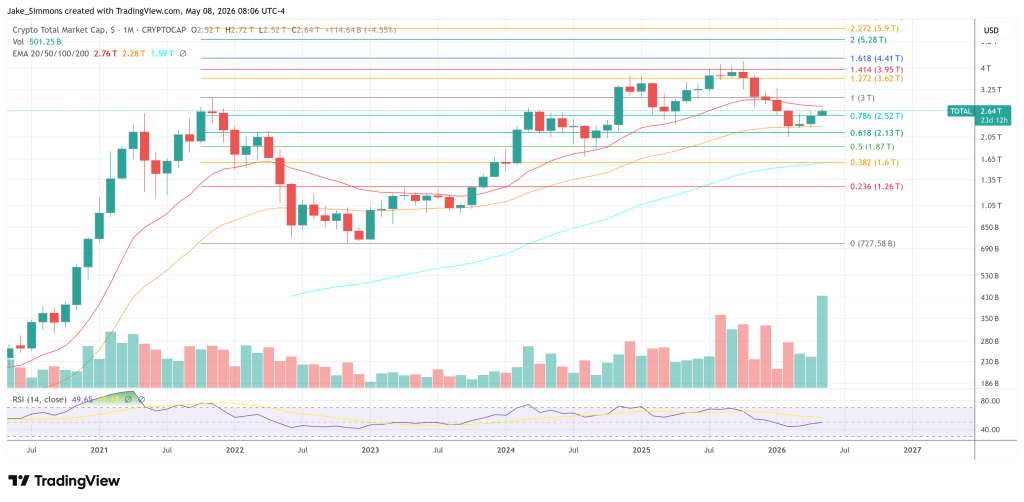
At press time, the total crypto market cap stood at $2.64 trillion.

Total crypto market cap faces the 20-month EMA, 1-week chart | Source: TOTAL on TradingView.com

Связанные с этим вопросы

QWhat is Christine Lagarde's main argument against promoting euro-denominated stablecoins?

AShe argues that the monetary case for euro stablecoins is weak once financial stability and monetary policy transmission risks are considered, and that Europe should instead build tokenized financial infrastructure anchored in central bank money.

QAccording to Lagarde, what two functions do stablecoins perform that are often conflated?

AStablecoins perform a monetary function, by extending the reach of a currency, and a technological function, by acting as the cash leg for settlement on distributed ledger infrastructure.

QWhat are the two main risks Lagarde associates with private stablecoins?

AThe two main risks are financial stability (as demonstrated by the USDC depeg during the Silicon Valley Bank collapse) and the impairment of monetary policy transmission if retail deposits migrate into stablecoins.

QWhat European public infrastructure projects does Lagarde mention as alternatives to stablecoins for tokenized markets?

AShe mentions the Pontes project (starting in September) to offer wholesale settlement in central bank money, and the Appia roadmap, which aims to support a fully interoperable European tokenized financial ecosystem by 2028.

QHow does Lagarde describe the current dominance of US dollar stablecoins in the market?

AShe states that close to 98% of stablecoins are denominated in US dollars, with nearly 90% of the market controlled by Tether and Circle.

Похожее

SpaceX, OpenAI, Anthropic: The Three AI Giants Racing for IPO, Which One Is Worth Betting On?

SpaceX, OpenAI, and Anthropic are poised for historic IPOs within weeks, potentially raising a combined $180 billion—a sum exceeding the entire internet bubble's fundraising. The hosts of the Limitless Podcast argue this isn't just individual company financing but an unprecedented capital concentration for AI infrastructure, driven by an insatiable need for compute, data centers, power, and chips. SpaceX's IPO is notable for reportedly changing market index rules to allow faster inclusion, potentially funneling trillions in passive retirement funds into its stock, despite its unproven space-based data center business model. In contrast, Anthropic demonstrates explosive growth, with ARR reportedly hitting $45 billion and approaching profitability, fueled by strong enterprise adoption of products like Claude Code. Google's separate $80 billion raise highlights the immense capital pressure, even for giants. The discussion acknowledges bubble risks but leans optimistic. The hosts contend the massive spending is building essential physical infrastructure for the next technological era. A key bottleneck isn't capital but the real-world limits of chip manufacturing and construction speed. As long as demand for AI compute outstrips supply, this investment cycle represents a foundational build-out rather than a purely financial bubble. All three companies are seen as foundational bets on the future, with Anthropic often cited as the most immediately compelling due to its proven revenue trajectory.

marsbit55 мин. назад

SpaceX, OpenAI, Anthropic: The Three AI Giants Racing for IPO, Which One Is Worth Betting On?

marsbit55 мин. назад

From 'Old Guys' to 'New Favorites': How AI Is Revaluing Old Infrastructure from Dell to Nokia?

From "Vintage Tech" to "New AI Darlings": How AI Revalues Old Infrastructure One year ago, tech giants like Dell, Nokia, Cisco, and Western Data were seen as slow-growth, low-valuation stories, far from the AI spotlight dominated by players like Nvidia. Now, these legacy tech stocks are gaining market attention, sparking debate on whether this is genuine industry revaluation or a temporary narrative. As AI moves from model parameters to real-world data centers, the market is recognizing companies with proven delivery and infrastructure capabilities. This shift marks a change in the AI investment thesis: from pure model and GPU focus to the complex systems engineering required for deployment. Companies like Dell, HPE, and Corning are being revalued not for being "sexy" AI innovators, but for their decades of accumulated expertise in supply chains, enterprise delivery, and infrastructure—assets that have become critical in the AI buildout phase. The revaluation is unfolding across three key infrastructure lines: 1. **Servers & System Integration:** Dell and HPE are emerging as crucial system integrators or "general contractors" for AI data centers, translating GPU orders into complete, deployable server racks integrated with power, cooling, and networking. 2. **Networking & Connectivity:** AI's scale demands robust high-speed connections. Corning (fiber optics), Nokia (AI-RAN, 6G), and Cisco (data center switches) are gaining importance for enabling efficient data transfer within and between AI clusters. 3. **Storage:** Beyond high-speed memory (HBM/DRAM), the AI data explosion is driving demand for high-capacity hard drives (HDDs) from companies like Western Digital and Seagate to handle training data, logs, and cold storage cost-effectively. For this revaluation to be substantive and not just a narrative, three criteria are key: 1) Concrete AI-related order and revenue growth (e.g., Dell's AI server sales), 2) Upward revisions to company financial guidance, and 3) Sustainable improvements in profit quality, not just top-line revenue spikes. In essence, AI's transition to a real construction phase is re-pricing "old assets" against "new demand." The opportunity, however, is selective. Only those legacy firms that are demonstrably integrated into the capital expenditure chains of data center and enterprise AI deployment are likely to experience a true "logic re-rating" rather than just a temporary valuation bounce.

marsbit1 ч. назад

From 'Old Guys' to 'New Favorites': How AI Is Revaluing Old Infrastructure from Dell to Nokia?

marsbit1 ч. назад

The Merger of Codex and ChatGPT Marks the Beginning of a Major Reshuffle in Programming Tools

OpenAI is shifting its strategic focus from ChatGPT to Codex, merging them along with the browser tool Atlas into a unified desktop super-app. This move signals an internal belief that Codex, originally a programming tool, represents the next evolution of AI more than conversational models like ChatGPT. Over the past year, Codex's weekly active users have surged past 5 million. The key distinction is that while ChatGPT answers questions, Codex executes tasks. Enterprises increasingly value this ability to get work done over simply receiving advice. Consequently, Codex is attracting professionals beyond developers, including analysts, bankers, marketers, and product managers. OpenAI's reorganization and increased investment in Codex stem from recognizing that the future of AI competition lies in execution capabilities, not just conversation. The company is launching role-specific plugins (e.g., for data analysis, sales, design) to transform Codex into a broad knowledge work platform that automates and redefines white-collar workflows. Beyond being a tool, Codex reflects OpenAI's ambition to redefine software. New features like "Sites"—which generates interactive websites from documents—and collaborative "Annotations" aim to create a paradigm where the AI understands the goal and handles the tools and steps, functioning more like a digital colleague than traditional software. The ultimate goal is a unified experience where the user cares only about the completed task.

marsbit1 ч. назад

The Merger of Codex and ChatGPT Marks the Beginning of a Major Reshuffle in Programming Tools

marsbit1 ч. назад

Interpreting Investment Opportunities in the Age of Great Navigation, Invesco Great Wall Fund Releases '2026 Report on Chinese Enterprises Going Global'

Invesco Great Wall Fund has released its "2026 China Corporate Globalization Report," titled "The 'Great Navigation Era' of Chinese Enterprises." The report analyzes the new trends and investment opportunities as Chinese companies expand globally, moving from simple product exports to comprehensive overseas operations involving services, branding, and local production. Driven by factors like trade friction, the pursuit of higher profit margins abroad, and policy support, globalization is becoming essential for Chinese companies. The report outlines an evolution: from early product export ("Globalization 1.0") to the current "Globalization 2.0," characterized by overseas capacity, capital goods investment, consumer brand expansion, and service exports. Chinese firms' competitive advantages are highlighted, including a vast engineer talent pool, low-cost and robust infrastructure, and complete industrial clusters. Specific sectors with significant出海 potential are identified: * **Capital Goods** (e.g., engineering machinery, power equipment): Benefiting from global demand, especially in Belt & Road markets and the AI-driven power grid upgrade cycle. * **Consumer Brands**: Transitioning from cost to brand advantage, leveraging供应链 efficiency. * **Technology & Innovation**: Including AI applications, optical modules within global tech supply chains, and new energy vehicles focusing on local production. * **Pharmaceuticals**: Chinese biotech firms are becoming preferred partners for global pharma, with potential for breakthrough drugs in areas like oncology and weight loss. The report concludes that corporate globalization represents a sustained, core theme for China's capital markets, though companies must navigate challenges like geopolitics and localization.

marsbit1 ч. назад

Interpreting Investment Opportunities in the Age of Great Navigation, Invesco Great Wall Fund Releases '2026 Report on Chinese Enterprises Going Global'

marsbit1 ч. назад

Торговля

Спот
Фьючерсы
活动图片