L2's 'Card Swipe' Era: When the Scaling Narrative Ends, Payments Become the Lifeline

marsbitОпубликовано 2026-01-22Обновлено 2026-01-22

Введение

The article discusses the growing "payment card" trend among Layer-2 (L2) networks as a strategy to survive a severe user activity and transaction crisis. It begins with Solana's criticism of Starknet's low usage (allegedly only 8 daily active users and 10 transactions) despite its high valuation, highlighting a broader issue of low traffic across many L2s, as evidenced by data from L2BEAT and DefiLlama. Key examples include Zero Network, which stopped producing blocks for weeks with minimal impact, and networks like Linea, Starknet, Scroll, and ZKsync exhibiting very low Transactions Per Second (TPS). With Base and Arbitrum dominating 80% of the Total Value Locked (TVL), other L2s face a significant valuation-to-usage disparity. Facing a lack of killer dApps, L2s are turning to cryptocurrency payment cards to generate consistent on-chain activity. Unlike custodial cards from exchanges (which use chains like Tron or Solana for batch settlement), L2s are leveraging non-custodial cards that require on-chain settlement for each transaction. Examples include: - **Scroll**: Partnered with Etherfi for gasless transactions and cashback subsidies. - **Gnosis**: Its Gnosis Pay card converts user assets to stablecoins for euro payments. - **Linea**: Used as a primary settlement layer for the MetaMask card. This shift provides a high-frequency, sustainable use case, driving transaction volume. Even Polygon is pivoting to payments, citing significant non-USD stablecoin transfer volume...

Original Author: Eric, Foresight News

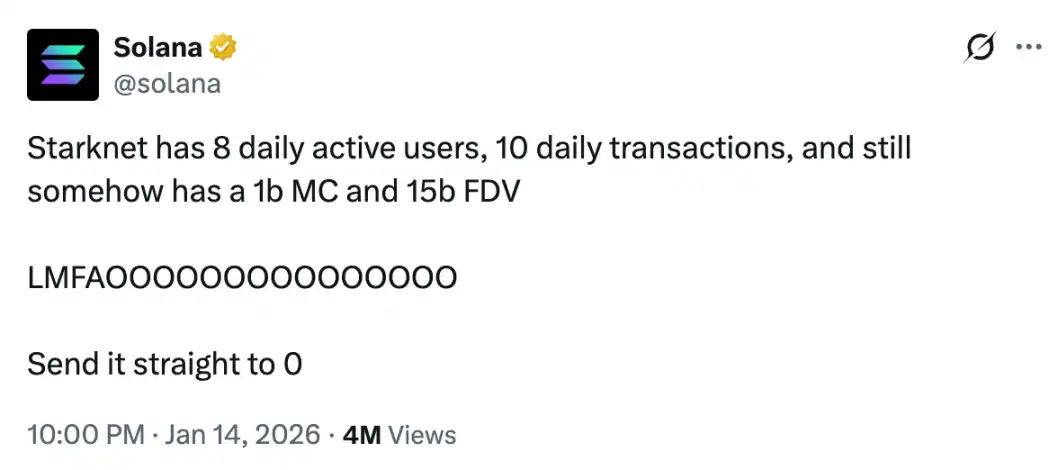
Recently, Solana made a joke about Starknet, mocking an L2 with only 8 daily active users and 10 transactions per day that still has a $15 billion FDV.

Although, in hindsight, this salt-in-the-wound joke was meant to attract attention and introduce the news of Starknet's token STRK launching on Solana via NEAR Intents. But Solana's criticism is not without reason; the L2s that have sprung up like mushrooms in the past two years are indeed facing a traffic crisis.

The most convincing recent example is on January 8th, when Zero Network, an L2 network incubated by Web3 wallet company Zerion, was exposed to have stopped producing blocks for over 3 weeks, but it seemed to have no impact. The official reaction was even more subtle; Zero Network stopped producing blocks on December 19, 2025, but the official statement on fixing the issue only came on December 23. The last original content posted by Zero Network's official Twitter was in May of the same year.

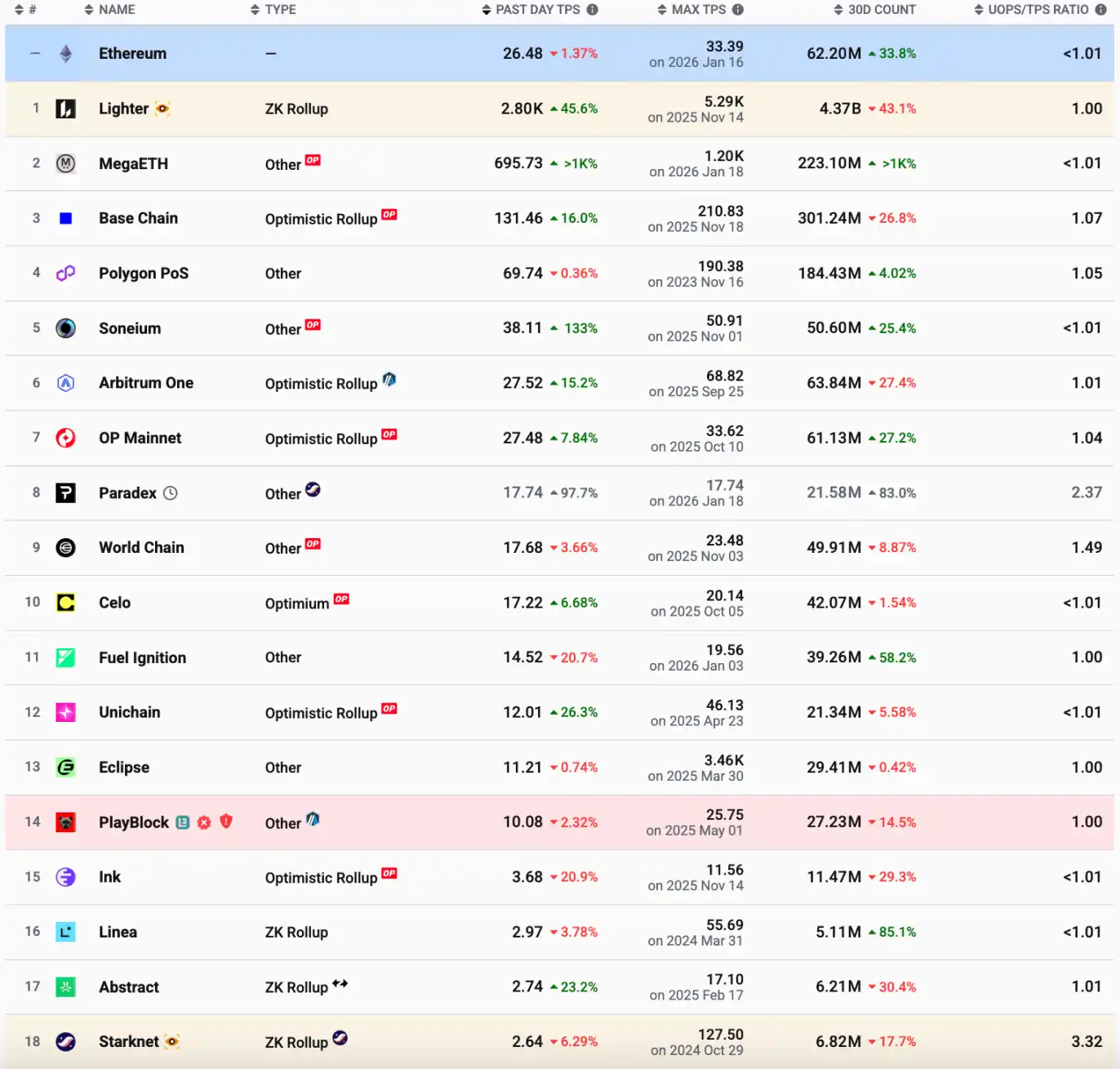
Despite this, the claim of only 8 users executing 10 transactions per day is an exaggeration. According to data from L2BEAT, Starknet's TPS yesterday was 2.64, meaning there were over 200,000 transactions on the network in a day. But this number is still extremely low; even the Ethereum mainnet's daily transaction volume is 10 times that of Starknet.

Data shows that among general-purpose L2s, aside from Base and Polygon, even Arbitrum and OP Mainnet's TPS are not significantly higher than Ethereum's. Linea and Starknet have a TPS of less than 3. The parts not shown in the screenshot include Scroll with a TPS slightly over 1, and ZKsync, Blast, etc., with less than 1.

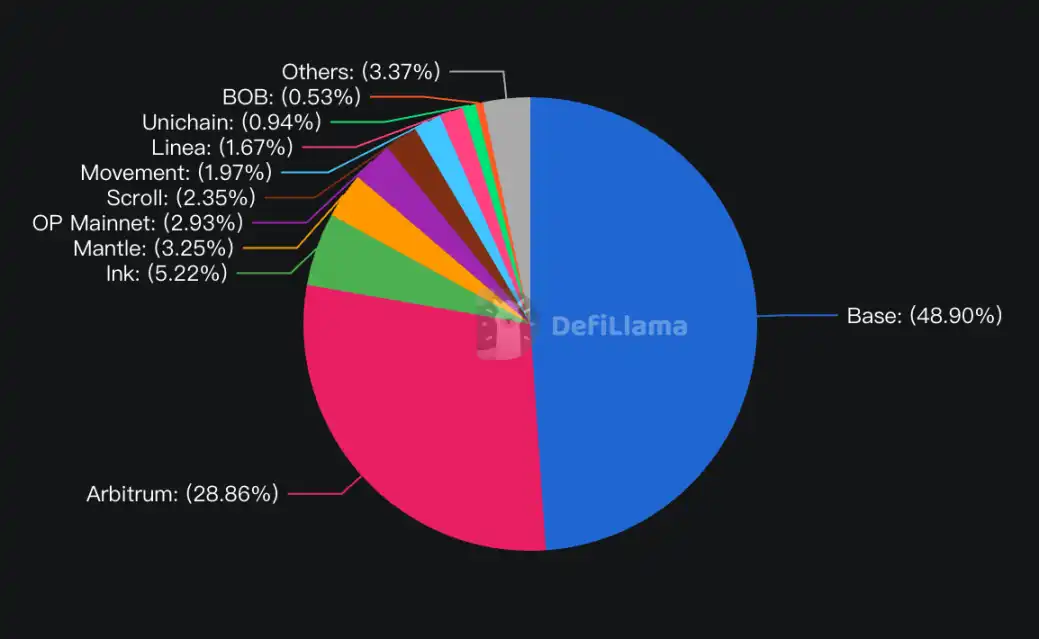
Looking at the TVL data from DefiLlama, Base and Arbitrum together account for nearly 80% of all L2 TVL. The remaining L2s, not in the "Others" category, had a combined valuation conservatively estimated at nearly $10 billion during their private funding rounds, but their combined TVL is less than $2 billion.

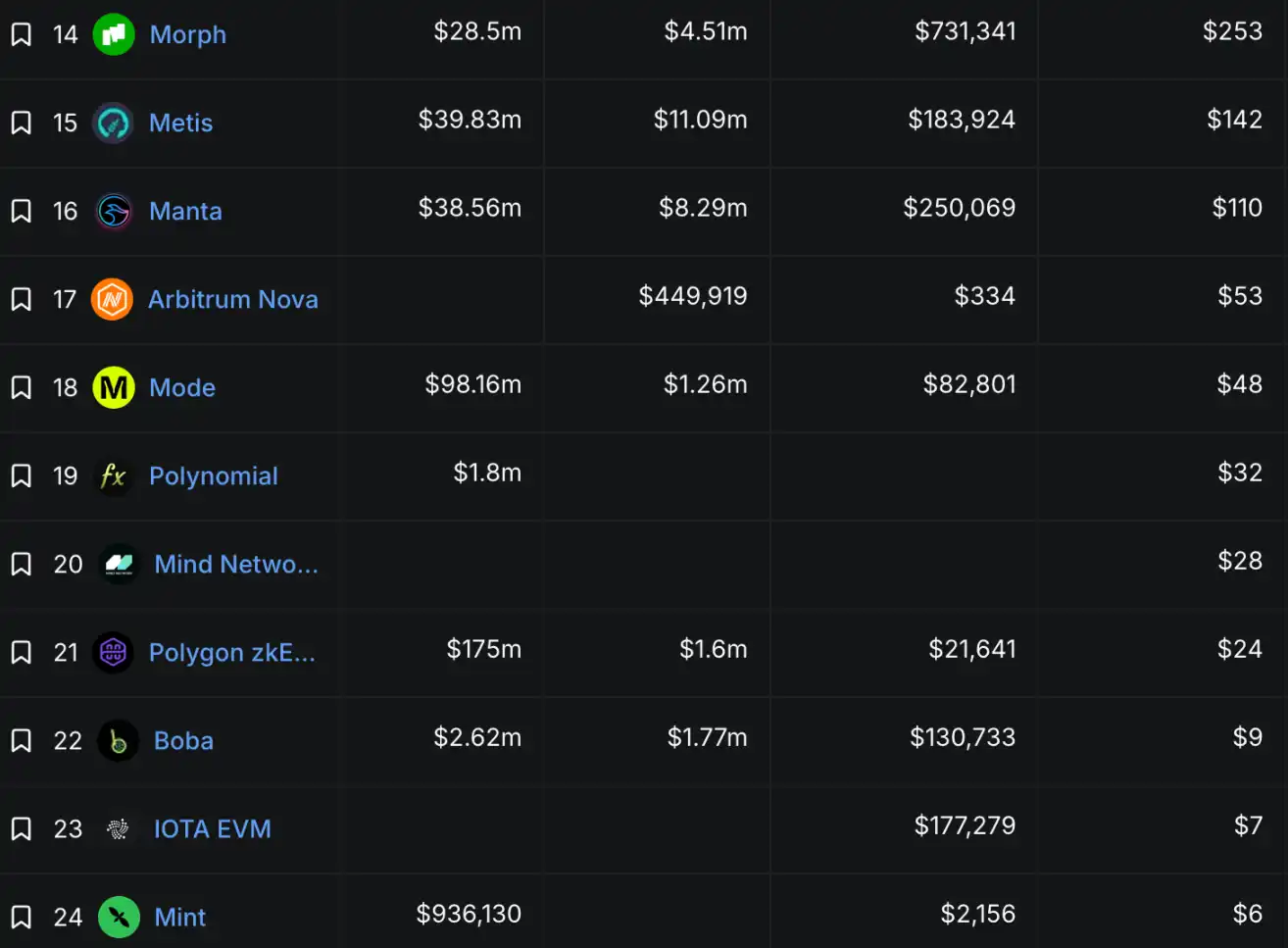
In terms of protocol revenue, only the top 7 protocols had revenues above $1,000 in the past 24 hours. Daily protocol revenues in the three-digit or even two-digit range might not even compare to the interest some large holders earn daily from placing assets in exchange wealth management.

This data very直观地展示了 (intuitively shows) the current predicament of L2s: against the backdrop of a lack of application narratives, hoping for a killer app that doesn't operate as an appchain and willingly runs on a general-purpose L2 has become a pipe dream. On the question of finding an application scenario that can provide stable transaction data, L2s have found the same answer: cryptocurrency cards.

Pavel Paramonov, founder of cryptocurrency research institution Hazeflow, once criticized that cryptocurrency cards are essentially not "cryptocurrency payments" but still fiat payments, not truly promoting cryptocurrency adoption. But he also mentioned that many projects or public chains launching crypto cards are doing so out of necessity, with the goal merely being to keep users within their ecosystem.

Many cryptocurrency cards launched by exchanges currently are a form of "custodial" card. User assets are held in exchange or institutional custody accounts, and upon consumption, settlement is handled by the exchange, off-ramp companies, and the card issuer. The settlement chains for such cards are usually Tron, Solana, or even the slightly higher-cost Ethereum. On one hand, the存量 (存量 - inventory/supply) of stablecoin assets on these chains is sufficient; on the other hand, some cards reduce costs through batch settlement rather than per-transaction settlement. For institutions, liquidity and stability might be more important than the low cost of L2s.

The crypto cards that L2s are eyeing are various forms of "non-custodial cards." Before using such a card for payment, assets reside in the user's own wallet, and each payment is settled individually, which can effectively increase on-chain activity. Typical examples include Scroll (Etherfi card settlement layer), Gnosis, and Linea (MetaMask card settlement layer).

In September 2024, Etherfi announced that its payment card would use Scroll as the settlement layer. Scroll can help Etherfi achieve "gasless transactions" and provide a higher cashback percentage subsidized by the SCR token. Besides the traditional method of directly spending assets on Scroll, the Etherfi card has a special mechanism: users can borrow fiat currency using yield-bearing assets on Scroll as collateral for payments. Supported assets include eETH, weETH, wETH, eBTC, etc.

Gnosis, as a sidechain that has long lacked presence, has successfully made a comeback with its payment card. Its card, Gnosis Pay, primarily operates in Europe. Users can connect non-custodial wallets like MetaMask and Gnosis Safe in the Gnosis Pay App. During spending, Gnosis Pay converts the user's wallet's supported assets (certain Euro, Pound, and Dollar stablecoins) into EURe, a Euro stablecoin issued by Monerium, which is then converted 1:1 into Euros for payment.

The crypto card issued by MetaMask uses ConsenSys's L2 Linea as the primary settlement network, additionally supporting Solana and Base. Users need to deposit supported payment assets (various USD or Euro stablecoins) into their MetaMask wallet before spending. During payment, user assets are transferred to the off-ramp service provider, converted into fiat currency, and then paid to the merchant.

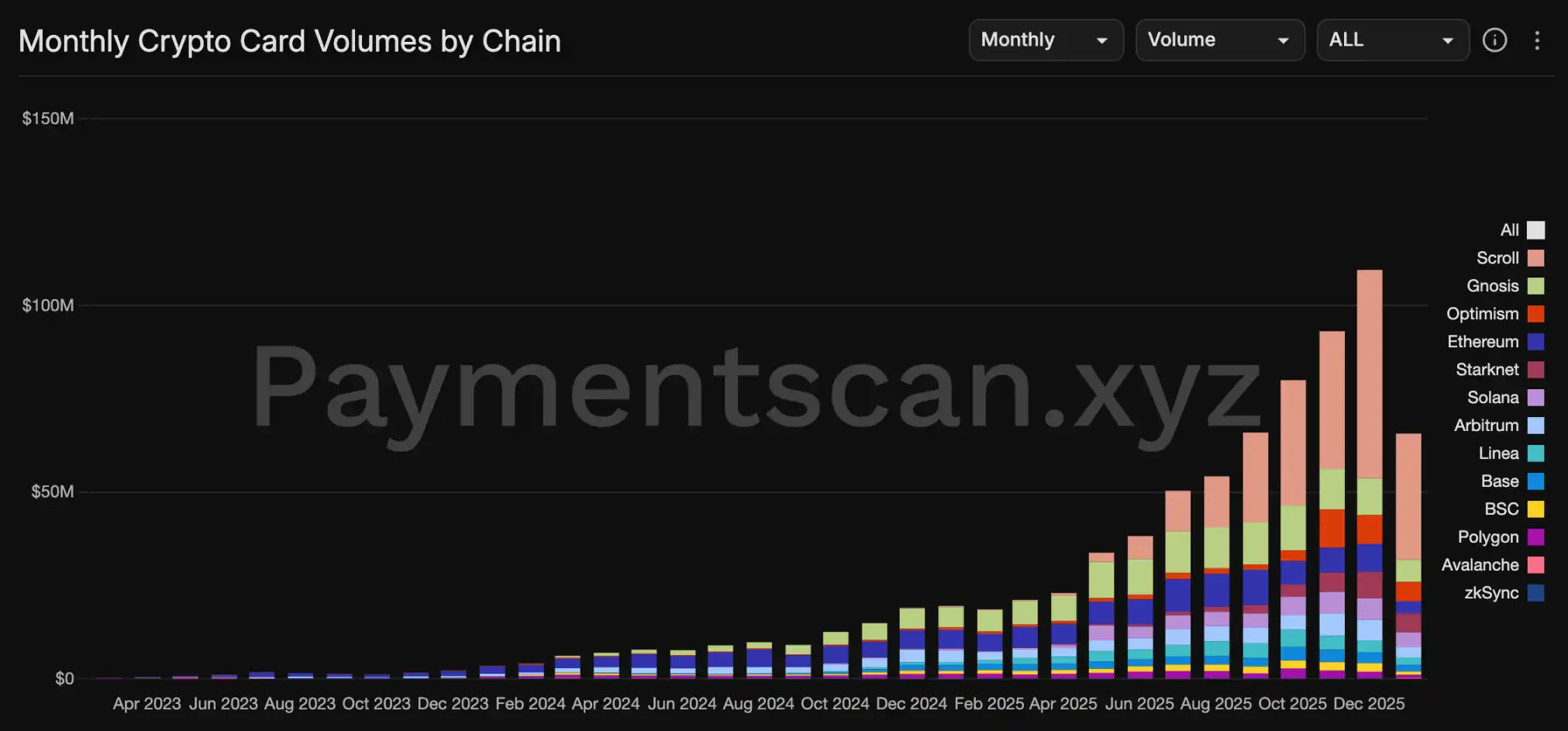
Due to the per-transaction settlement nature of non-custodial cards, each user消费 (消费 - consumption/spending) corresponds to a contract call to verify the remaining asset balance and the on-chain asset transfer. Thus, L2s can rely on payments, an absolutely high-frequency and sustainable scenario, to ensure a certain level of on-chain activity. According to Paymentscan data, Scroll, through its partnership with Etherfi and SCR subsidies, has captured a significant market share in card payments. However, this data is not entirely accurate, as many card payments might not involve on-chain transfers but are settled internally by institutions. Regardless, it's an indisputable fact that L2s have found a practical application scenario through payments.

It's not just emerging L2s that are anxious; Polygon, which cannot be strictly classified as an L2, also recently shifted its strategic focus to payments. By the end of 2025, the transfer volume of non-USD stablecoins on Polygon exceeded $11.1 billion, with the new stablecoin XSGD reaching $2.24 billion in trading volume and the Australian Dollar stablecoin AUDF reaching $2.46 billion. Additionally, Polygon has become one of the main chains used for Stripe's stablecoin payments; its announcement on January 13th to acquire cryptocurrency payment infrastructure Coinme and blockchain development platform Sequence for a consideration of $250 million更是将 (更是将 - further writes) "all in on payments" plainly on its face.

After experiencing the bombardment of various concepts, L2s have come to recognize reality. While they still await novel applications, the urgent task at hand is to utilize their low-cost, high-efficiency characteristics and survive first through payments.

Связанные с этим вопросы

QWhat is the main issue facing Layer 2 (L2) networks according to the article?

AThe main issue facing L2 networks is a severe lack of user activity and transaction volume, leading to a 'traffic crisis' where many L2s have extremely low TPS and TVL, making it difficult to sustain themselves without finding practical, high-frequency use cases.

QWhat specific example does the article use to illustrate the inactivity of some L2 networks?

AThe article cites Zero Network, an L2 incubated by Web3 wallet company Zerion, which stopped producing blocks for over three weeks without any noticeable impact, and whose official Twitter account had not posted original content since May of the same year.

QWhat solution have many L2 networks turned to generate consistent on-chain activity?

AMany L2 networks have turned to cryptocurrency payment cards, specifically non-custodial cards, as a solution. Each payment with these cards requires an on-chain settlement, creating a high-frequency and sustainable source of transactions.

QWhich L2 networks are mentioned as having partnered with specific crypto cards to increase transactions?

AThe article mentions Scroll (partnering with Etherfi card), Gnosis (with its Gnosis Pay card), and Linea (used as a settlement layer for the MetaMask card) as examples of L2s leveraging payment cards to boost on-chain activity.

QWhy does the article state that Polygon is also shifting its strategic focus?

APolygon is shifting its strategic focus to payment solutions because it has seen significant transaction volume from non-USD stablecoins and has made major acquisitions, such as buying cryptocurrency payment infrastructure company Coinme and blockchain development platform Sequence, effectively going 'all in on payments'.

Похожее

Has Hook Summer Really Arrived? sato, Lo0p, FLOOD Ignite the New Narrative of Uniswap v4

"Hook Summer" Arrives? Sato, Lo0p, FLOOD Ignite Uniswap v4 Narrative Amidst a slight market recovery, attention within the Ethereum ecosystem has shifted to Meme coins built on Uniswap v4's Hook protocol. Following ASTEROID, tokens like sato, sat1, Lo0p, and FLOOD have become market focal points, with market caps ranging from millions to tens of millions, bringing concentrated liquidity to a narrative-dry market. Uniswap v4 Hooks are "plugin smart contracts" that allow developers to inject custom logic at key points in a liquidity pool's lifecycle (initialization, adding/removing liquidity, swaps, etc.), making the AMM programmable. Recent representative projects include: * **sato**: Market cap peaked over $38M; uses a v4 curve mechanism for minting/burning, locking ETH as reserve. * **sat1**: Market cap briefly exceeded $10M, positioning as an "optimized sato," but later declined significantly. * **Lo0p**: Market cap neared $6.6M; a "lending AMM protocol" allowing users to borrow ETH against deposited LO0P tokens without immediate selling pressure. * **FLOOD**: Market cap approached $6M; channels trading reserves into Aave v3 to generate yield, which is retained in the pool. The emergence of these Hook-based tokens could drive long-term growth for the Uniswap ecosystem by attracting users and liquidity to v4 pools. Combined with Uniswap's activated fee switch (partially used to burn UNI), the long-term outlook for UNI appears positive. However, short-term UNI price appreciation is not directly guaranteed. Factors include the sustainability and lifecycle of these new tokens, their price volatility, overall market conditions, and regulatory pressures. Currently, Uniswap v4's TVL ($595M) lags behind v3 and v2, indicating Hook adoption still requires time to mature. In summary, the Hook ecosystem serves as "long-term nourishment" for UNI, but acts more as a "catalyst" than a direct "booster" in the short term. Note: These are early-stage experimental tokens and may carry unknown risks.

marsbit9 мин. назад

Has Hook Summer Really Arrived? sato, Lo0p, FLOOD Ignite the New Narrative of Uniswap v4

marsbit9 мин. назад

Has Hook Summer Truly Arrived? sato, Lo0p, FLOOD Ignite the New Uniswap v4 Narrative

With the broader market showing signs of recovery, a new wave of interest has emerged around Ethereum-based meme coins. Following ASTEROID, tokens like sato, sat1, Lo0p, and FLOOD, built upon the Uniswap v4 Hook protocol, are capturing market attention. Their market capitalizations range from millions to tens of millions of dollars, injecting much-needed focused liquidity into a market lacking narratives. This article explores whether this trend signifies an incoming "Hook Summer" and its potential impact on UNI's price. Hooks are essentially plug-in smart contracts for Uniswap v4 liquidity pools, allowing developers to inject custom logic at key points in a pool's lifecycle (like initialization, adding/removing liquidity, swaps). This transforms the AMM into programmable building blocks. Key highlighted projects include: * **sato**: Peaked over $38M market cap. It utilizes a v4 curve for minting/burning; buying locks ETH as reserve to mint new tokens, while selling redeems ETH from the reserve and burns tokens. * **sat1**: Market cap briefly exceeded $10M, promoted as an "optimized sato," but later declined significantly. * **Lo0p**: Reached nearly $6.6M. It's a lending AMM protocol where buying LO0P tokens locks them as collateral, allowing users to borrow ETH from the pool reserve at 40% LTV, aiming to improve capital efficiency for idle ETH in LPs. * **FLOOD**: Peaked near $6M. Its mechanism directs asset reserves from buys into Aave v3 to generate yield, with fees and interest retained in the pool to potentially influence the token's price long-term. In the long term, the development of the Hook ecosystem can attract users and liquidity to Uniswap v4, benefiting UNI's fundamentals—especially combined with the recent activation of the protocol fee switch, where a portion of fees is used to burn UNI. However, in the short term, these Hook-based tokens are unlikely to directly drive significant UNI price appreciation. Their impact is moderated by factors like token sustainability, price volatility, and broader market and regulatory conditions. Currently, Uniswap v4's TVL ($595M) still trails behind v2 and v3, indicating adoption and growth will take time. The article concludes that while the Hook ecosystem provides long-term "nourishment" for UNI, its short-term role is more of a "catalyst" than a "booster." Readers are cautioned that these are early-stage experimental tokens and may carry unknown risks.

Odaily星球日报21 мин. назад

Has Hook Summer Truly Arrived? sato, Lo0p, FLOOD Ignite the New Uniswap v4 Narrative

Odaily星球日报21 мин. назад

Interview with Michael Saylor: I Did Say I Would Sell Bitcoin, But Never a Net Sale

Interview with Michael Saylor: I Said We'd Sell Bitcoin, But Never Be a Net Seller In a recent podcast, MicroStrategy Executive Chairman Michael Saylor clarified the company's stance on potentially selling Bitcoin. Following MicroStrategy's earnings call statement about being prepared to sell BTC to fund dividends for its STRC (Strategic) credit product, Saylor emphasized the distinction between selling and being a "net seller." Saylor explained the core business model: MicroStrategy sells credit instruments like STRC and uses the proceeds to buy Bitcoin, which is viewed as "digital capital" expected to appreciate around 30-40% annually. A portion of these capital gains can then be used to pay the dividends on the credit products. He stressed that even if the company sells some Bitcoin for dividends, it simultaneously buys much more with new credit issuance. For example, after raising $3.2 billion from STRC sales in April, the dividend obligation was only $80-90 million, making the company a net buyer. The clarification aims to counter market narratives questioning the value of Bitcoin on MicroStrategy's balance sheet if it were never sold, and to dismiss claims of a "Ponzi scheme." Saylor reiterated his personal philosophy for investors: "Don't be a net seller of bitcoin" and ensure your Bitcoin holdings increase each year. Saylor also discussed Bitcoin's role as the foundation for "digital credit," noting that STRC has become the largest and most liquid preferred stock issue in the U.S., offering high risk-adjusted returns (Sharpe ratio). He highlighted Bitcoin's deep liquidity, stating that even large purchases by MicroStrategy do not move the market significantly, which is driven by macro factors, geopolitical tensions, and capital flows from ETFs and credit products. Finally, Saylor reflected on his early inspiration from sci-fi books, which motivated his path to MIT, and maintained his fundamental thesis on Bitcoin remains unchanged: it is superior digital capital enabling superior digital credit.

链捕手25 мин. назад

Interview with Michael Saylor: I Did Say I Would Sell Bitcoin, But Never a Net Sale

链捕手25 мин. назад

Beaten SK Hynix Employees in China: Year-end Bonus Less Than 5% of Korean Staff's

"SK Hynix Chinese Staff Hit Hard: Bonuses Less Than 5% of Korean Counterparts" Driven by the AI boom, South Korea's SK Hynix is experiencing record performance, with media reports predicting massive year-end bonuses for its employees, making them highly desirable in the matchmaking market. However, this prosperity starkly contrasts with the situation for the company's Chinese employees. According to reports, SK Hynix operates under a rule allocating 10% of operating profit for employee bonuses. While projections suggest Korean employees could receive bonuses reaching millions of RMB, a Chinese employee with over a decade of technical experience revealed the disparity: "If they get 3 million, Chinese staff get less than 5% of that." After adjustments based on KPI ratings, this employee's highest bonus was slightly over 100,000 RMB. Bonuses are paid annually in Korea but semi-annually in China. During the industry downturn in 2023-2024, Chinese employees received no bonus at all. The gap extends beyond bonuses. Recruitment posts for SK Hynix's Chinese factories (in Wuxi, Dalian, Chongqing) show engineer monthly salaries ranging from 10,000 to 35,000 RMB, with a 13th-month salary promised. Chinese employees also receive standard benefits like annual leave but lack stock incentives, which are reportedly unavailable to them. Furthermore, management positions in China are predominantly held by Korean personnel, though industry observers note a gradual increase in local middle managers over time. SK Hynix has confirmed the 10% bonus rule but cautioned that specific future bonus amounts remain unpredictable. The company forecasts strong demand for HBM and other high-value enterprise products for the next 2-3 years, driven by AI infrastructure investment. This focus on business-to-business markets may continue to constrain supply for consumer products, potentially prolonging price increases for components like memory.

链捕手39 мин. назад

Beaten SK Hynix Employees in China: Year-end Bonus Less Than 5% of Korean Staff's

链捕手39 мин. назад

Торговля

Спот
Фьючерсы

Популярные статьи

Как купить ERA

Добро пожаловать на HTX.com! Мы сделали приобретение Caldera (ERA) простым и удобным. Следуйте нашему пошаговому руководству и отправляйтесь в свое крипто-путешествие.Шаг 1: Создайте аккаунт на HTXИспользуйте свой адрес электронной почты или номер телефона, чтобы зарегистрироваться и бесплатно создать аккаунт на HTX. Пройдите удобную регистрацию и откройте для себя весь функционал.Создать аккаунтШаг 2: Перейдите в Купить криптовалюту и выберите свой способ оплатыКредитная/Дебетовая Карта: Используйте свою карту Visa или Mastercard для мгновенной покупки Caldera (ERA).Баланс: Используйте средства с баланса вашего аккаунта HTX для простой торговли.Третьи Лица: Мы добавили популярные способы оплаты, такие как Google Pay и Apple Pay, для повышения удобства.P2P: Торгуйте напрямую с другими пользователями на HTX.Внебиржевая Торговля (OTC): Мы предлагаем индивидуальные услуги и конкурентоспособные обменные курсы для трейдеров.Шаг 3: Хранение Caldera (ERA)После приобретения вами Caldera (ERA) храните их в своем аккаунте на HTX. В качестве альтернативы вы можете отправить их куда-либо с помощью перевода в блокчейне или использовать для торговли с другими криптовалютами.Шаг 4: Торговля Caldera (ERA)С легкостью торгуйте Caldera (ERA) на спотовом рынке HTX. Просто зайдите в свой аккаунт, выберите торговую пару, совершайте сделки и следите за ними в режиме реального времени. Мы предлагаем удобный интерфейс как для начинающих, так и для опытных трейдеров.

616 просмотров всегоОпубликовано 2025.07.17Обновлено 2025.07.17

Как купить ERA

Обсуждения

Добро пожаловать в Сообщество HTX. Здесь вы сможете быть в курсе последних новостей о развитии платформы и получить доступ к профессиональной аналитической информации о рынке. Мнения пользователей о цене на ERA (ERA) представлены ниже.

活动图片