Kraken Partners With Nasdaq In New Tokenized Stocks Move

bitcoinistОпубликовано 2026-03-10Обновлено 2026-03-10

Введение

Kraken's parent company Payward has partnered with Nasdaq to develop an "equities transformation gateway," a new infrastructure layer connecting regulated tokenized equity markets with permissionless blockchain networks. The collaboration centers on Kraken's xStocks product, which has surpassed $25 billion in transaction volume with over $4 billion settled on-chain. Scheduled to become operational in H1 2027, Nasdaq's equity token design will use xStocks as its permissionless infrastructure layer, maintaining issuer control and regulatory compliance while enabling interoperability with DeFi environments. The gateway will allow seamless movement of tokenized equities between traditional markets and blockchain networks, with Kraken handling KYC/AML requirements. Payward's co-CEO Arjun Sethi emphasized that tokenization transforms equities into programmable instruments capable of serving as cross-platform collateral for trading, margin, derivatives, and lending—significantly enhancing capital efficiency beyond traditional brokerage limitations.

Kraken parent Payward has partnered with Nasdaq to build what the companies describe as an “equities transformation gateway,” a new infrastructure layer designed to connect regulated tokenized equity markets with permissionless blockchain networks. For crypto markets, the significance is clear: one of the largest traditional market operators is now working directly with a crypto-native tokenization framework to move equities between institutional rails and DeFi environments.

The partnership centers on xStocks, Kraken’s tokenized equities product, which Payward said has surpassed $25 billion in total transaction volume less than a year after launch. More than $4 billion of that volume has been settled on-chain, and the framework now counts over 85,000 unique holders across supported networks, giving Kraken a sizable footprint as tokenized stocks move from concept toward market structure.

Nasdaq And Kraken Join Forces

Under the proposed setup, xStocks will power the permissionless infrastructure layer for Nasdaq’s upcoming issuer-sponsored equity token design. That design, which Nasdaq expects to become operational starting in the first half of 2027, is meant to preserve issuer control, existing regulatory frameworks, and the rights attached to the underlying shares while still allowing those assets to interact with blockchain-based financial systems.

In practical terms, the gateway is supposed to let eligible users swap tokenized equities between a regulated, permissioned market environment and open on-chain ecosystems. Payward said this would allow assets to move “fluidly” between institutional trading infrastructure and decentralized financial networks, while Payward Services handles KYC and AML onboarding for participants accessing the bridge through Kraken.

Arjun Sethi, co-CEO of Payward and Kraken, framed the effort as a structural change to how equities can be used once they are placed on programmable rails. “Tokenization upgrades market infrastructure at the asset layer by allowing equities to exist as programmable financial instruments that can operate across both regulated capital markets and open blockchain networks,” he said. “Today most equities sit inside brokerage systems where their utility is largely limited to directional exposure and, in some cases, broker-specific margin arrangements.”

He argued that the current model leaves capital trapped inside siloed venues. “That structure fragments liquidity across venues and leaves a meaningful amount of capital static relative to its potential utility,” Sethi said. “With xStocks, our goal is to make equities natively interoperable across trading venues, financial applications and blockchain networks while preserving issuer rights, regulatory protections and price integrity.”

Sethi went further, tying tokenized equities to a broader capital-efficiency thesis that will be familiar to crypto derivatives traders. “Bringing equities onto programmable infrastructure expands how they can function within a portfolio,” he said. “Instead of simply representing exposure to a company, tokenized equities can operate as collateral within unified trading systems that support spot markets, cross-margin trading, derivatives, perpetual futures, and financing environments.”

That point sits at the heart of the announcement. Payward is not pitching tokenized stocks merely as wrappers for traditional shares, but as collateral that can move across trading, lending and hedging systems under a unified margin framework. In jurisdictions where xStocks are already available, Payward will also serve for an initial period as the primary settlement layer for transactions tied to Nasdaq’s equity token design.

At press time, the total crypto market cap stood at $2.32 trillion.
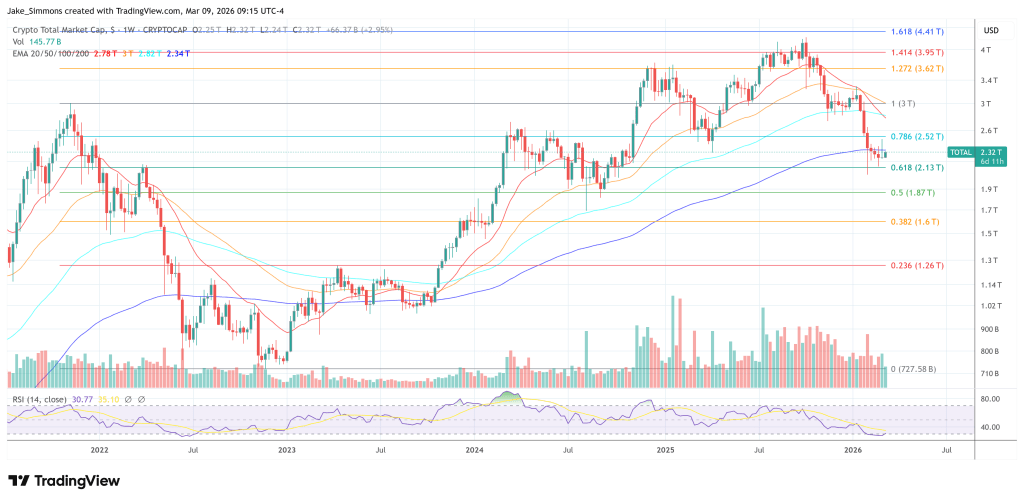
Total crypto market cap, 1-week chart | Source: TOTAL on TradingView.com

Связанные с этим вопросы

QWhat is the main purpose of the partnership between Kraken's parent company Payward and Nasdaq?

AThe partnership aims to build an 'equities transformation gateway,' a new infrastructure layer designed to connect regulated tokenized equity markets with permissionless blockchain networks, allowing equities to move between institutional rails and DeFi environments.

QWhat is xStocks and what milestone has it achieved according to the article?

AxStocks is Kraken's tokenized equities product, which has surpassed $25 billion in total transaction volume less than a year after launch, with over $4 billion settled on-chain and more than 85,000 unique holders.

QWhen does Nasdaq expect its issuer-sponsored equity token design to become operational?

ANasdaq expects its issuer-sponsored equity token design to become operational starting in the first half of 2027.

QHow does Arjun Sethi describe the current limitation of traditional equities in brokerage systems?

AArjun Sethi states that in traditional brokerage systems, equities' utility is largely limited to directional exposure and some broker-specific margin arrangements, which fragments liquidity and leaves capital trapped in siloed venues.

QWhat broader function does Payward envision for tokenized equities beyond being wrappers for traditional shares?

APayward envisions tokenized equities functioning as collateral within unified trading systems that support spot markets, cross-margin trading, derivatives, perpetual futures, and financing environments, enhancing capital efficiency and interoperability.

Похожее

Anthropic Starts Poaching Scientists? $27K Weekly Onsite Stipend to Fix Claude's Expert-Level Errors

Anthropic has launched a new STEM Fellow program, offering $3,800 per week for a three-month, in-person residency in San Francisco. The role targets experts from science, technology, engineering, and mathematics (STEM) fields—machine learning experience is helpful but not required. Instead, Anthropic values scientific judgment and a willingness to learn quickly. Fellows will work with Claude models and internal tools under the guidance of an Anthropic researcher. Example projects include a materials scientist identifying errors in Claude’s reasoning or a climate scientist integrating atmospheric modeling software with Claude. The goal is to have experts "tell Claude where it's wrong" and improve its scientific capabilities. This initiative is part of Anthropic’s broader strategy to strengthen its scientific ecosystem, following earlier programs like the AI Safety Fellows and AI for Science programs. The company acknowledges that current AI models, while powerful, still produce high-confidence errors and lack end-to-end research autonomy. The program aims to embed domain expertise directly into model development, turning scientists into "high-level reviewers" for AI. Anthropic CEO Dario Amodei has previously emphasized AI’s potential to accelerate scientific breakthroughs, particularly in biology and healthcare. The company believes that the next phase of AI competition will depend not on scaling parameters, but on integrating human expertise to refine model accuracy and reliability.

marsbit27 мин. назад

Anthropic Starts Poaching Scientists? $27K Weekly Onsite Stipend to Fix Claude's Expert-Level Errors

marsbit27 мин. назад

On the Eve of X Money's Launch, Musk Dismantles the Referee First

"X Money Launches After Dismantling Regulator: Musk's 9-Day Power Play" In February 2025, a team from the "Department of Government Efficiency" (DOGE), led by Elon Musk, entered the Consumer Financial Protection Bureau (CFPB) headquarters. Shortly after, the CFPB was effectively dismantled—its funding frozen, activities suspended, and nearly 90% of staff laid off. This move came just nine days after X announced a partnership with Visa and as X Money prepared to launch. The article contrasts this with the decade-long regulatory battles faced by companies like Coinbase and PayPal. Coinbase spent over $75 million in political contributions and endured a major SEC lawsuit to operate legally. PayPal complied with strict state and federal rules for its stablecoin PYUSD, including 100% reserve requirements and monthly audits. However, Musk’s approach was different. After the CFPB introduced a rule placing large digital payment apps under federal oversight, Musk tweeted "Delete CFPB." Within months, the rule was revoked by Congress. Meanwhile, DOGE operatives gained "god-tier" access to CFPB databases, potentially obtaining sensitive competitive information from rivals like Apple, Google, and PayPal. The article also highlights a "suspicious exemption clause" in the GENIUS Act, which allows private companies like X to issue stablecoins with fewer restrictions. Senator Elizabeth Warren questioned whether Musk, who was a senior presidential advisor during the Act’s drafting, influenced this clause. X Money offers a 6% APY on deposits, despite FDIC warnings that stablecoin users are not insured. As X Money launches to 600 million monthly users, the article questions the fairness of a system where Musk can bypass regulations that others spent years and millions to comply with. The dismantling of the CFPB and the alleged regulatory advantages raise concerns about the future of equitable rule-making in the U.S. financial system.

marsbit36 мин. назад

On the Eve of X Money's Launch, Musk Dismantles the Referee First

marsbit36 мин. назад

Торговля

Спот
Фьючерсы
活动图片