Korean Stock Market Crashes, Are Koreans Rushing into Crypto Again? This Project Team Got Slammed...

比推Опубликовано 2026-03-05Обновлено 2026-03-05

Введение

Amid a significant downturn in the South Korean stock market, there is growing discussion about Korean retail investors shifting heavily into cryptocurrency as an alternative. Observers note that Koreans have a strong cultural tendency toward leverage and speculative investment, which may be driving renewed interest in crypto assets like Bitcoin, seen as a potential safe haven during economic instability. Bitcoin’s price recovery and increased institutional buying are also highlighted, with price targets such as $87,000 and even $100,000 being discussed. Some attribute Bitcoin’s strength to its perceived reliability during times of geopolitical tension. Additionally, former U.S. President Donald Trump is mentioned as pushing for clearer cryptocurrency regulation, which could bring more certainty to the market—though some express skepticism about his motives. The article also covers controversy around the project "Opinion" on the BSC chain, which has drawn criticism for its handling of user rewards and airdrops, leading to broader discussions about the sustainability of airdrop models and the need for genuine user engagement rather than speculative farming. The content is compiled from social media platforms and does not constitute investment advice.

Hello dear readers~

What were the crypto KOLs talking about in the past 24 hours?

Note: The following content is compiled from the X platform and represents personal opinions. It does not represent the stance of this platform and certainly does not constitute investment advice.

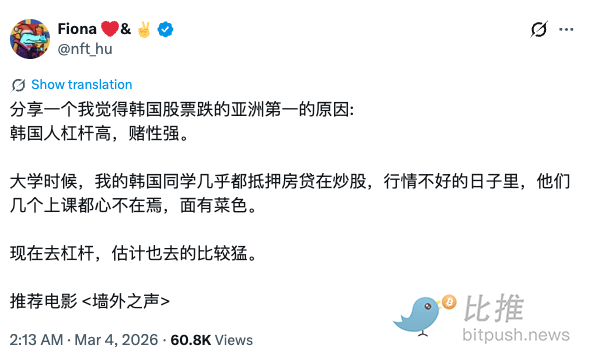
Koreans' Love for Leverage is in Their DNA

Popular Replies:

Koreans' love for leverage is in their DNA. The stock market crashes, the crypto market picks up the slack.

Addicted to gambling. Koreans' speculative nature is number one in Asia.

South Korea's household debt level has always been high. The impact of the past few major deleveraging operations has been very significant.

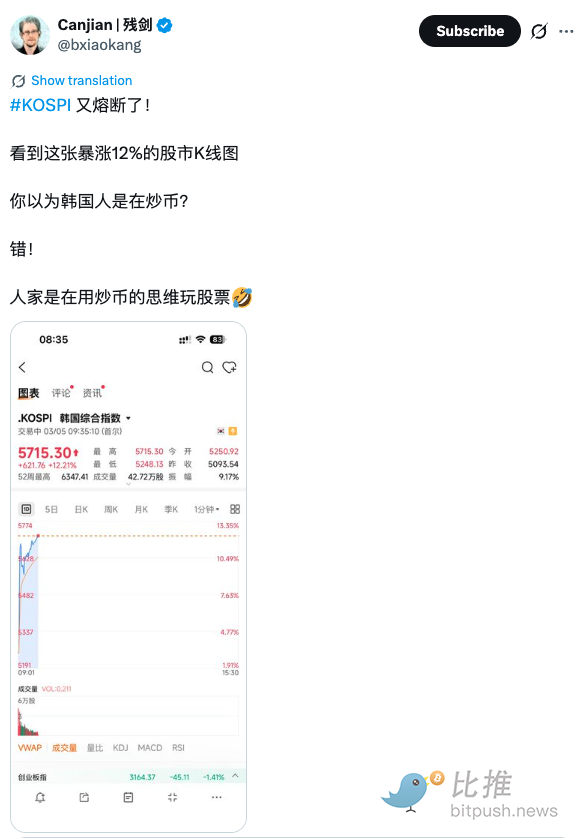
This wave of Korean Won depreciation + stock market爆仓 (liquidation), BTC's safe-haven属性 (attribute) has been verified again, Koreans are rushing in.

Koreans should already be on their way, Upbit trading volume is about to explode, right?

FOMO indiscriminately, classic Korean retail investor style.

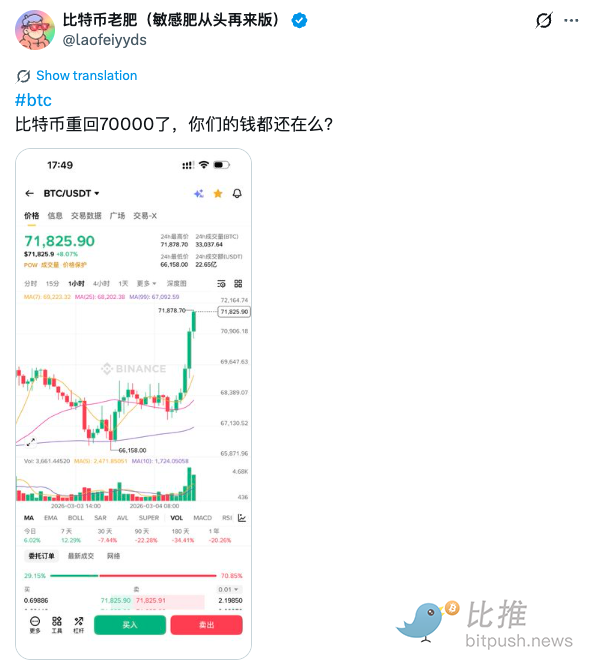
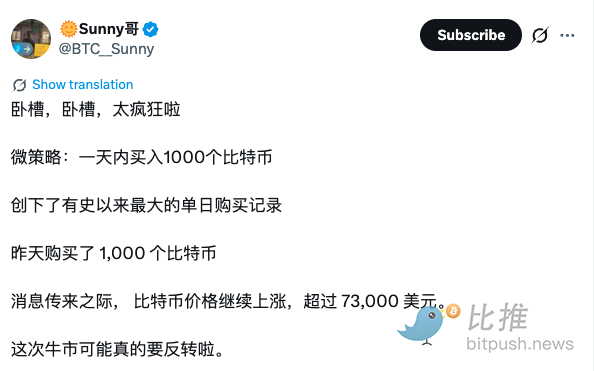
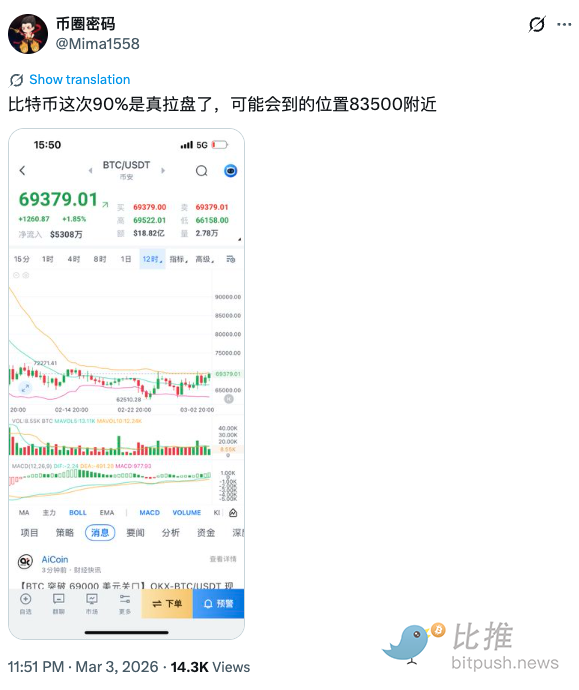
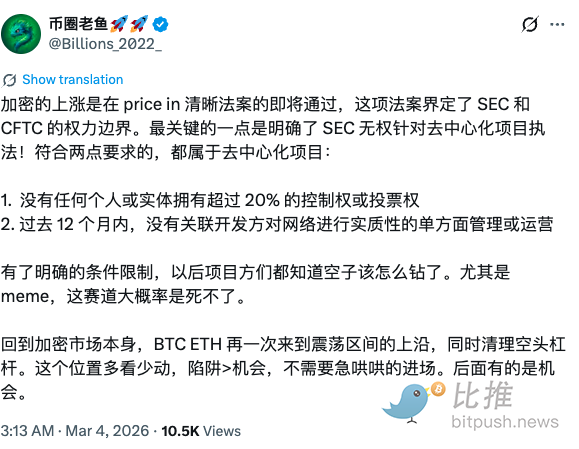
BTC Price Rebounds, Institutions Buying

Popular Replies:

71000—78000—87000, these are all key points if it rallies.

First break 73500, if that happens, next is 83300.

Money in, people in, target $100k,绝对不提前下车 (absolutely not getting off early this time)!

War has made people understand that Bitcoin is reliable.

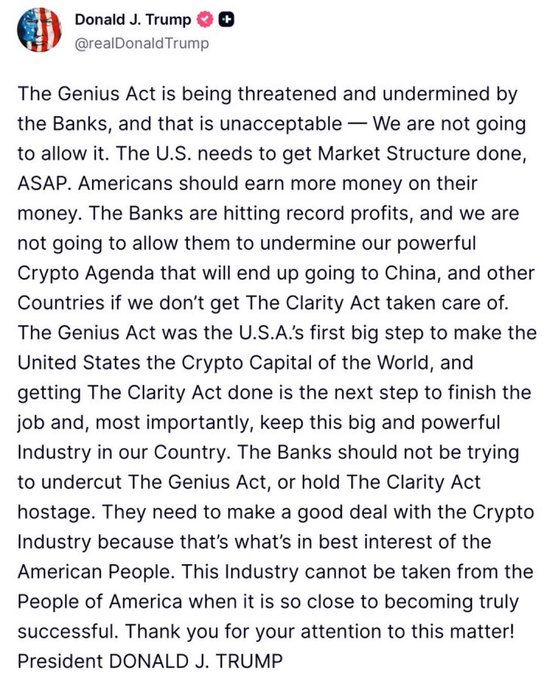
Trump Personally Pushing Crypto Bill!


Popular Replies:

If a clear bill isn't pushed forward, the market might徘徊 (linger) for a long time again. The crypto industry is actually welcoming the most friendly president now. If it's not pushed during Trump's term, there's a high probability of getting beaten up again later.

Feels like Trump's tweet means the talks broke down, seems like a negative?

不会是缺军费,再来收割一波把? (Could it be lacking military funds, coming to harvest another wave?)

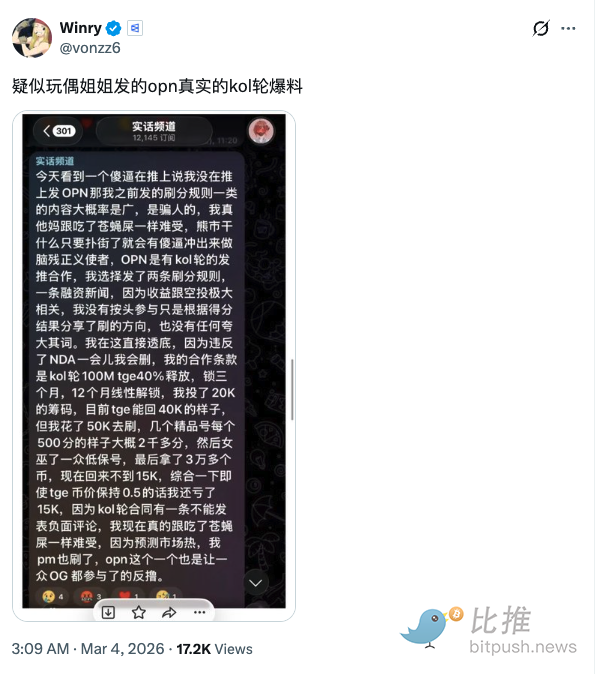
Opinion Controversy

Popular Replies:

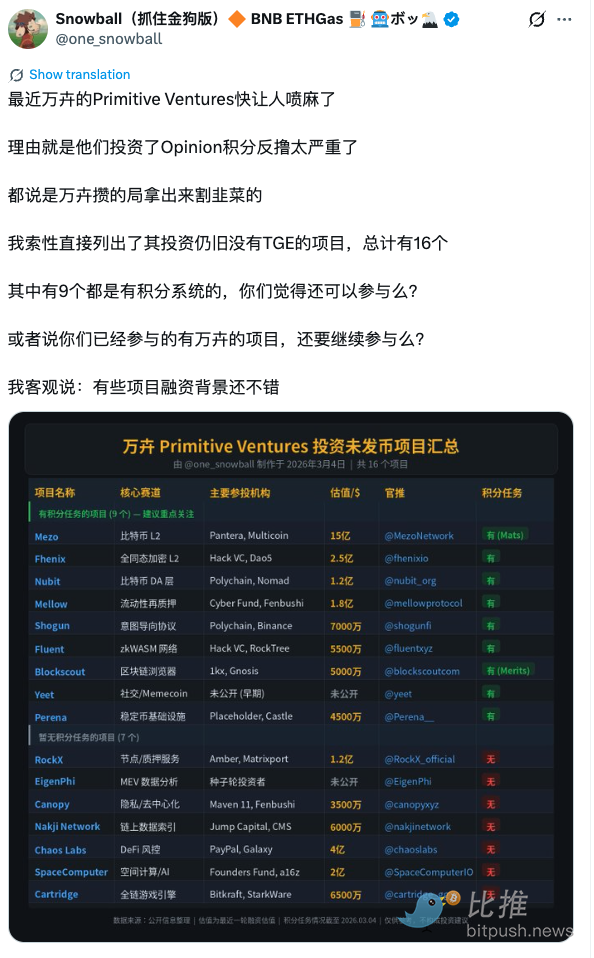
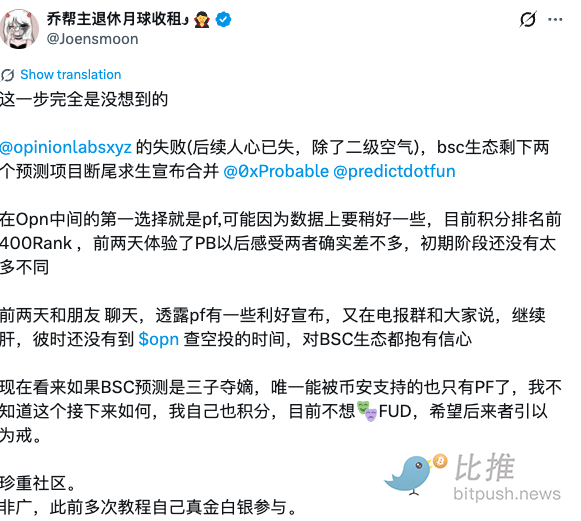
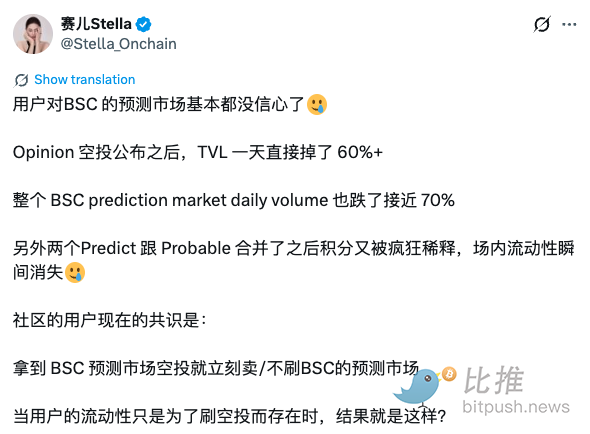
Opinion ruined the prediction track on BSC, who dares to touch BNB Chain prediction projects in the future;

Learn from River, they compensated for二级 (secondary market) losses, Opinion directly反撸 (screwed people over);

I actually think there's no need to骂 (curse) the investment institutions:

  1. These were all the project's decisions

  2. Couldn't get on bn without前期数据 (early data)

  3. Tokens given out were basically picked up by the secondary market, no one is picking them up now

  4. The logic of airdrops has changed, those bringing data without real cash flow will be淘汰 (eliminated), and no one will use them either

  5. The farming era has ended, what's next is real payment for tokens


Twitter:https://twitter.com/BitpushNewsCN

Bitpush TG Discussion Group:https://t.me/BitPushCommunity

Bitpush TG Subscription: https://t.me/bitpush

Original article link:https://www.bitpush.news/articles/7616877

Связанные с этим вопросы

QWhat is the main reason discussed in the article for Koreans turning to the cryptocurrency market?

AThe article suggests that Koreans are turning to the cryptocurrency market as a safe haven after the Korean stock market crash, leveraging their inherent tendency for high-risk investments and speculation.

QHow did the community react to the Opinion project mentioned in the article?

AThe community criticized the Opinion project for mismanaging the BSC prediction track, accusing it of exploiting users without compensation, unlike other projects that offered reimbursements for losses.

QWhat role is former President Trump playing in the cryptocurrency space according to the article?

AThe article states that former President Trump is personally advancing cryptocurrency legislation, which is seen as a positive development for the industry, though some speculate it might be a tactic to raise funds.

QWhat are the key Bitcoin price levels mentioned by traders in the article?

ATraders identified key Bitcoin price levels at $71,000, $78,000, and $87,000, with $73,500 and $83,300 being critical resistance points to watch for further gains.

QWhat is the article's perspective on the changing dynamics of airdrops and token distribution?

AThe article notes that the era of meaningless airdrops is ending, and future token distributions will require genuine user engagement and financial contributions, rather than just data farming.

Похожее

Has Hook Summer Really Arrived? sato, Lo0p, FLOOD Ignite the New Narrative of Uniswap v4

"Hook Summer" Arrives? Sato, Lo0p, FLOOD Ignite Uniswap v4 Narrative Amidst a slight market recovery, attention within the Ethereum ecosystem has shifted to Meme coins built on Uniswap v4's Hook protocol. Following ASTEROID, tokens like sato, sat1, Lo0p, and FLOOD have become market focal points, with market caps ranging from millions to tens of millions, bringing concentrated liquidity to a narrative-dry market. Uniswap v4 Hooks are "plugin smart contracts" that allow developers to inject custom logic at key points in a liquidity pool's lifecycle (initialization, adding/removing liquidity, swaps, etc.), making the AMM programmable. Recent representative projects include: * **sato**: Market cap peaked over $38M; uses a v4 curve mechanism for minting/burning, locking ETH as reserve. * **sat1**: Market cap briefly exceeded $10M, positioning as an "optimized sato," but later declined significantly. * **Lo0p**: Market cap neared $6.6M; a "lending AMM protocol" allowing users to borrow ETH against deposited LO0P tokens without immediate selling pressure. * **FLOOD**: Market cap approached $6M; channels trading reserves into Aave v3 to generate yield, which is retained in the pool. The emergence of these Hook-based tokens could drive long-term growth for the Uniswap ecosystem by attracting users and liquidity to v4 pools. Combined with Uniswap's activated fee switch (partially used to burn UNI), the long-term outlook for UNI appears positive. However, short-term UNI price appreciation is not directly guaranteed. Factors include the sustainability and lifecycle of these new tokens, their price volatility, overall market conditions, and regulatory pressures. Currently, Uniswap v4's TVL ($595M) lags behind v3 and v2, indicating Hook adoption still requires time to mature. In summary, the Hook ecosystem serves as "long-term nourishment" for UNI, but acts more as a "catalyst" than a direct "booster" in the short term. Note: These are early-stage experimental tokens and may carry unknown risks.

marsbit11 мин. назад

Has Hook Summer Really Arrived? sato, Lo0p, FLOOD Ignite the New Narrative of Uniswap v4

marsbit11 мин. назад

Has Hook Summer Truly Arrived? sato, Lo0p, FLOOD Ignite the New Uniswap v4 Narrative

With the broader market showing signs of recovery, a new wave of interest has emerged around Ethereum-based meme coins. Following ASTEROID, tokens like sato, sat1, Lo0p, and FLOOD, built upon the Uniswap v4 Hook protocol, are capturing market attention. Their market capitalizations range from millions to tens of millions of dollars, injecting much-needed focused liquidity into a market lacking narratives. This article explores whether this trend signifies an incoming "Hook Summer" and its potential impact on UNI's price. Hooks are essentially plug-in smart contracts for Uniswap v4 liquidity pools, allowing developers to inject custom logic at key points in a pool's lifecycle (like initialization, adding/removing liquidity, swaps). This transforms the AMM into programmable building blocks. Key highlighted projects include: * **sato**: Peaked over $38M market cap. It utilizes a v4 curve for minting/burning; buying locks ETH as reserve to mint new tokens, while selling redeems ETH from the reserve and burns tokens. * **sat1**: Market cap briefly exceeded $10M, promoted as an "optimized sato," but later declined significantly. * **Lo0p**: Reached nearly $6.6M. It's a lending AMM protocol where buying LO0P tokens locks them as collateral, allowing users to borrow ETH from the pool reserve at 40% LTV, aiming to improve capital efficiency for idle ETH in LPs. * **FLOOD**: Peaked near $6M. Its mechanism directs asset reserves from buys into Aave v3 to generate yield, with fees and interest retained in the pool to potentially influence the token's price long-term. In the long term, the development of the Hook ecosystem can attract users and liquidity to Uniswap v4, benefiting UNI's fundamentals—especially combined with the recent activation of the protocol fee switch, where a portion of fees is used to burn UNI. However, in the short term, these Hook-based tokens are unlikely to directly drive significant UNI price appreciation. Their impact is moderated by factors like token sustainability, price volatility, and broader market and regulatory conditions. Currently, Uniswap v4's TVL ($595M) still trails behind v2 and v3, indicating adoption and growth will take time. The article concludes that while the Hook ecosystem provides long-term "nourishment" for UNI, its short-term role is more of a "catalyst" than a "booster." Readers are cautioned that these are early-stage experimental tokens and may carry unknown risks.

Odaily星球日报24 мин. назад

Has Hook Summer Truly Arrived? sato, Lo0p, FLOOD Ignite the New Uniswap v4 Narrative

Odaily星球日报24 мин. назад

Interview with Michael Saylor: I Did Say I Would Sell Bitcoin, But Never a Net Sale

Interview with Michael Saylor: I Said We'd Sell Bitcoin, But Never Be a Net Seller In a recent podcast, MicroStrategy Executive Chairman Michael Saylor clarified the company's stance on potentially selling Bitcoin. Following MicroStrategy's earnings call statement about being prepared to sell BTC to fund dividends for its STRC (Strategic) credit product, Saylor emphasized the distinction between selling and being a "net seller." Saylor explained the core business model: MicroStrategy sells credit instruments like STRC and uses the proceeds to buy Bitcoin, which is viewed as "digital capital" expected to appreciate around 30-40% annually. A portion of these capital gains can then be used to pay the dividends on the credit products. He stressed that even if the company sells some Bitcoin for dividends, it simultaneously buys much more with new credit issuance. For example, after raising $3.2 billion from STRC sales in April, the dividend obligation was only $80-90 million, making the company a net buyer. The clarification aims to counter market narratives questioning the value of Bitcoin on MicroStrategy's balance sheet if it were never sold, and to dismiss claims of a "Ponzi scheme." Saylor reiterated his personal philosophy for investors: "Don't be a net seller of bitcoin" and ensure your Bitcoin holdings increase each year. Saylor also discussed Bitcoin's role as the foundation for "digital credit," noting that STRC has become the largest and most liquid preferred stock issue in the U.S., offering high risk-adjusted returns (Sharpe ratio). He highlighted Bitcoin's deep liquidity, stating that even large purchases by MicroStrategy do not move the market significantly, which is driven by macro factors, geopolitical tensions, and capital flows from ETFs and credit products. Finally, Saylor reflected on his early inspiration from sci-fi books, which motivated his path to MIT, and maintained his fundamental thesis on Bitcoin remains unchanged: it is superior digital capital enabling superior digital credit.

链捕手28 мин. назад

Interview with Michael Saylor: I Did Say I Would Sell Bitcoin, But Never a Net Sale

链捕手28 мин. назад

Beaten SK Hynix Employees in China: Year-end Bonus Less Than 5% of Korean Staff's

"SK Hynix Chinese Staff Hit Hard: Bonuses Less Than 5% of Korean Counterparts" Driven by the AI boom, South Korea's SK Hynix is experiencing record performance, with media reports predicting massive year-end bonuses for its employees, making them highly desirable in the matchmaking market. However, this prosperity starkly contrasts with the situation for the company's Chinese employees. According to reports, SK Hynix operates under a rule allocating 10% of operating profit for employee bonuses. While projections suggest Korean employees could receive bonuses reaching millions of RMB, a Chinese employee with over a decade of technical experience revealed the disparity: "If they get 3 million, Chinese staff get less than 5% of that." After adjustments based on KPI ratings, this employee's highest bonus was slightly over 100,000 RMB. Bonuses are paid annually in Korea but semi-annually in China. During the industry downturn in 2023-2024, Chinese employees received no bonus at all. The gap extends beyond bonuses. Recruitment posts for SK Hynix's Chinese factories (in Wuxi, Dalian, Chongqing) show engineer monthly salaries ranging from 10,000 to 35,000 RMB, with a 13th-month salary promised. Chinese employees also receive standard benefits like annual leave but lack stock incentives, which are reportedly unavailable to them. Furthermore, management positions in China are predominantly held by Korean personnel, though industry observers note a gradual increase in local middle managers over time. SK Hynix has confirmed the 10% bonus rule but cautioned that specific future bonus amounts remain unpredictable. The company forecasts strong demand for HBM and other high-value enterprise products for the next 2-3 years, driven by AI infrastructure investment. This focus on business-to-business markets may continue to constrain supply for consumer products, potentially prolonging price increases for components like memory.

链捕手41 мин. назад

Beaten SK Hynix Employees in China: Year-end Bonus Less Than 5% of Korean Staff's

链捕手41 мин. назад

Торговля

Спот
Фьючерсы
活动图片