Kelp DAO's $400 Million Bad Debt Was Covered, But at a $12 Billion Cost to Aave

marsbitОпубликовано 2026-05-26Обновлено 2026-05-26

Введение

On May 26th, Kelp DAO successfully transferred its final batch of rsETH, completing the 37-day process of fully backing rsETH 1:1 after a security incident. However, the resolution came at a significant cost to Aave. The protocol's TVL plummeted by over $12 billion in the following month. Furthermore, a separate legal battle over 30,766 frozen ETH continues in court, posing ongoing reputational risk. The recovery was enabled by an unprecedented, one-time coalition dubbed "DeFi United," involving major contributions from Aave's founder, treasury, Consensys, Mantle, and others. Despite this, the event triggered a major outflow of funds, with whales like Justin Sun moving capital to competitors like Spark. Aave's path to regaining its position relies heavily on the successful execution of its multi-pronged strategy. Its new V4 protocol, designed for open, heterogeneous asset markets, faces delays due to internal governance disputes. Meanwhile, the V3 version remains the core revenue generator, and the permissioned Horizon fork is targeting institutional RWA (Real-World Assets) growth—a segment less impacted by the rsETH incident but dependent on traditional finance adoption timelines. The key takeaway is that while the immediate bad debt was covered, Aave paid a steep price in lost trust and capital. Recovering market share depends on accelerating V4's rollout and advancing its institutional RWA offerings, both of which face external and internal hurdles. The "DeFi United" sa...

Original Author: Sanqing, Foresight News

On May 26, Kelp DAO transferred the final batch of 20,373.72 rsETH to the LayerZero OFT Adapter, while Aave simultaneously announced that rsETH and all affected markets had returned to normal. In 37 days, the full replenishment of 116,500 rsETH was completed.
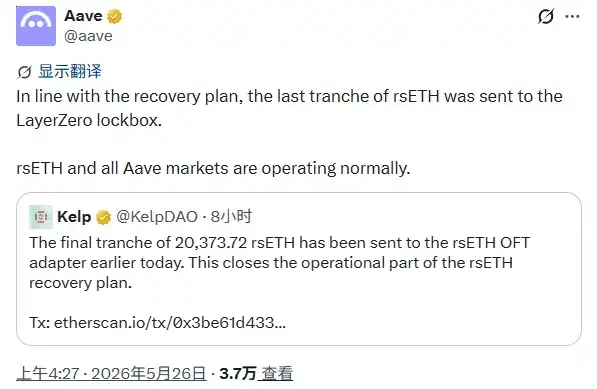
However, this only means rsETH is once again backed 1:1; it does not mean Aave's books are cleared. The 30,766 ETH frozen by the Arbitrum Security Council is still stuck in the U.S. District Court for the Southern District of New York, with ownership undecided. The TVL lost by Aave hasn't returned along with rsETH.

The Bill Extends Beyond the TVL Column

According to DefiLlama data, Aave's TVL was $26.396 billion on April 18, the day of the incident; on May 25, it was $14.181 billion. The amount that hasn't returned after a month exceeds $12 billion.

The more difficult part lies ahead. The U.S. District Court for the Southern District of New York will hold a hearing on June 5 regarding the ownership of the 30,766 ETH frozen by the Arbitrum Security Council. Both Aave LLC and Gerstein Harrow had submitted supplemental briefs by May 22. The judge previously modified the restraining notice on May 8 to allow fund transfers, but the substantive ruling is still pending confirmation on June 5.

Gerstein Harrow represents families of North Korean terrorism victims, holding an unexecuted judgment of $877 million. Regardless of the outcome, this lawsuit consumes Aave's brand.

This time, DeFi United was able to form because multiple parties were willing to provide backing: Stani Kulechov contributed 5,000 ETH from his own pocket, Consensys and Joseph Lubin committed up to 30,000 ETH, the Aave treasury allocated up to 25,000 ETH, plus a credit line of up to 30,000 ETH provided by Mantle and support from multiple parties like Lido and Ether.fi.

The scale of community mobilization was unprecedented, but Aave exhausted this one-time-only card. If another upstream contamination event occurs, assembling a similar list may not be possible again.

For example, after the incident, Sun Yuchen moved approximately $174 million (including 65,854 ETH and some stablecoins) from Aave to Spark, with cumulative deposits in Spark exceeding $1.3 billion. Whales voted with their feet, and funds have already migrated.

The Openness of V4 is Being Slowed Down by Governance

Aave has more than just V4 as a countermeasure card, but V4 is the most crucial one.

V4 was already launched on the Ethereum mainnet on March 30, with a Hub-and-Spoke architecture and three initial Liquidity Hubs. Aave Labs promised "security-first growth," with deposit limits gradually increasing. Deposits surpassed $10 million on April 8, crossed $50 million on May 9, and total deposits reached $86.13 million on May 26, with active borrowing positions at $27.77 million.
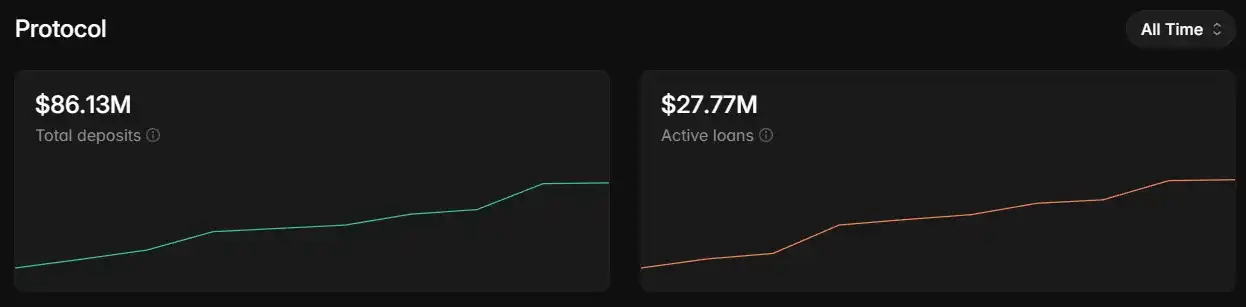
This pacing was a responsible design choice before rsETH; after rsETH, it became a stress test. Aave was handling a $200 million bad debt on V3 while slowly expanding limits on V4.

More challenging is that V4 also faces internal friction from its own governance layer. In February 2026, Aave Labs submitted a strategic proposal bundling product revenue, service provider incentives, the V4 growth engine, and brand/legal custody, requesting representatives to vote on four different risk dimensions at once.

Marc Zeller, founder of the Aave Chan Initiative, publicly questioned whether it was appropriate to bundle such a massive funding request with strategic approval. This governance dispute continued to ferment around the V4 launch, with each delay allowing competitors to eat away a bit more market share.

V4's advantage is the openness of the Spoke design—anyone can build a Spoke, and those meeting conditions can connect to a Liquidity Hub as a credit line. This is also why Babylon Labs chose to connect its Trustless Bitcoin Vaults to V4 rather than others. But the speed at which this openness materializes depends on whether the governance layer can keep up with the pace.

More Than Just V4: Aave is Fighting Three Battles

Aave V3 remains the cash cow. With annualized revenue exceeding $100 million, and $14.1 billion TVL primarily on V3. The "Aave will win" proposal positions V3 as in a "stable maintenance" phase, with Stani publicly committing to no forced migration and no deadline.

V4 and V3 will run in parallel for at least 24 to 36 months, with V4 being an additive complement layer, taking on heterogeneous scenarios that V3 cannot accommodate. Horizon is an independent, permissioned V3 fork specifically designed for institutional RWA.

Each of the three layers is capturing different increments. V4 captures new scenarios that V3's risk architecture cannot accommodate, with an added task after rsETH: giving funds that have migrated to Morpho and Spark a reason to return to Aave. Horizon captures traditional finance RWA flows, completely separate from V3 and V4 pools.

Horizon Market officially launched in August 2025, a permissioned V3 instance deployed by Aave, allowing institutions to use tokenized government bonds, corporate bonds, and money market funds as collateral to borrow stablecoins like USDC, GHO, and RLUSD.
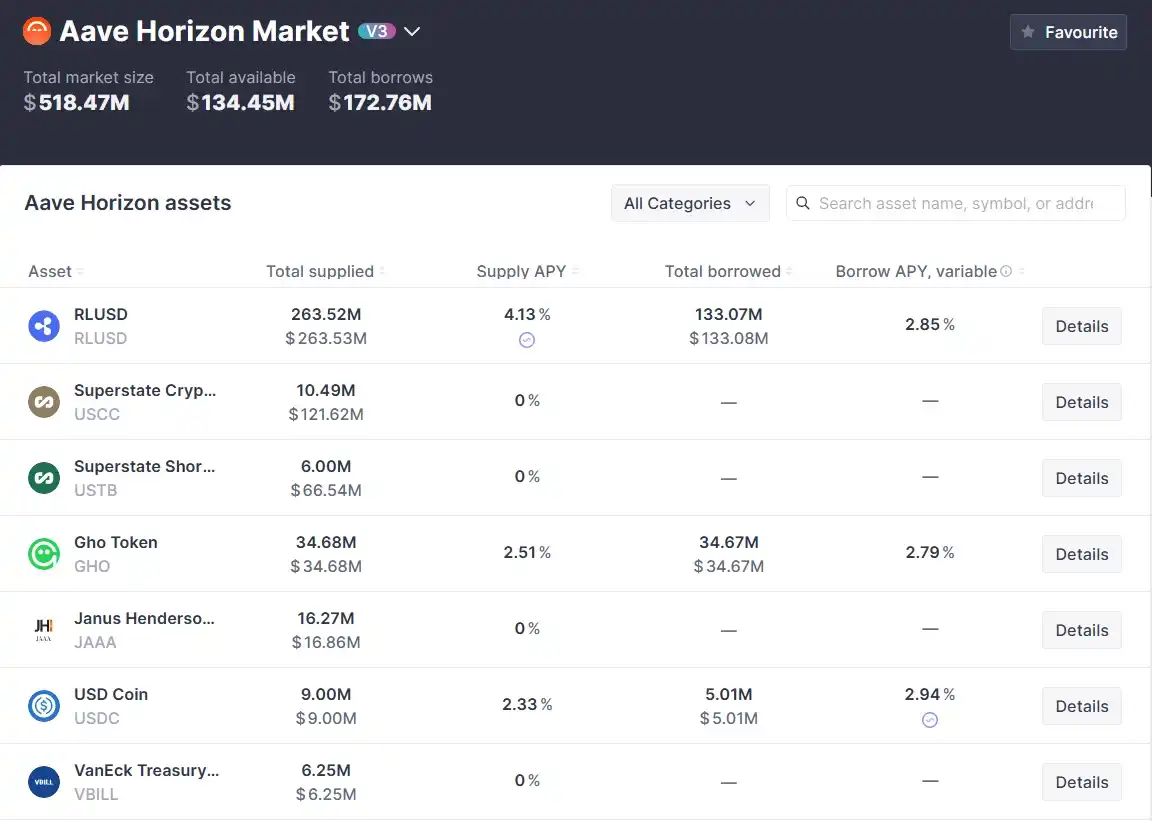
As of May 26, it has accumulated over $500 million in net deposits, aiming to surpass $1 billion by the end of 2026, with partners including BlackRock, Franklin Templeton, Circle, Ripple, and VanEck.

This route diverges from Morpho's vault management model. Morpho uses third-party institutions like Steakhouse and Gauntlet to curate vaults, capturing lending flows from retail institutions like Coinbase. Aave uses Horizon to directly connect with traditional finance asset managers for RWA.

The two paths target different institutional customer profiles. Morpho serves fintech companies that use on-chain lending as a tool, while Aave serves asset managers that treat the chain as an issuance venue.

The fund migration after the rsETH event primarily affected the first type of client. The migration cost is higher and the reaction slower for the second type. The compliance framework, KYC processes, and asset access audits Aave has accumulated on Horizon are not easily replicable by Morpho in the short term after the event.

This is the only incremental line for Aave not directly impacted by the rsETH event, but its growth depends on the pace at which traditional finance integrates with DeFi.

No Second DeFi United

Aave remains the largest protocol in the lending market, with $14.1 billion TVL still nearly double that of Morpho. The deployment depth accumulated over years is unmatched in the short term.

But the bill left by rsETH isn't on the balance sheet; it's in the column for institutions' default preference for lending protocols. Spark's TVL grew from $3.727 billion to $5.3 billion in a month; Morpho slowly climbed back to pre-incident levels after hitting bottom on April 21. These numbers won't automatically reverse and flow back just because Aave's markets have recovered.

The speed at which V4 delivers on heterogeneous scenarios, plus the progress of Horizon on institutional RWA, will determine whether Aave can recapture the lost market share. But the former is stuck in governance friction, and the latter depends on traditional finance's own integration pace. And for both these things, Aave can only wait.

DeFi United is not a permanent institution; it was a one-time mobilization.

Связанные с этим вопросы

QWhat was the final action taken by Kelp DAO regarding the rsETH tokens, and how did Aave respond?

AOn May 26th, Kelp DAO transferred the final batch of 20,373.72 rsETH tokens to the LayerZero OFT Adapter. Simultaneously, Aave announced that the rsETH market and all affected markets had returned to normal.

QAccording to DeFiLlama data, what was the financial impact on Aave's TVL in the month following the rsETH incident on April 18th?

AAccording to DeFiLlama data, Aave's TVL on April 18th was $26.396 billion. By May 25th, it had fallen to $14.181 billion. This represents a loss exceeding $12 billion in TVL over approximately one month.

QWhat major upcoming legal event is mentioned regarding the frozen 30,766 ETH, and who is the opposing party in this case?

AThe U.S. District Court for the Southern District of New York will hold a hearing on June 5th to determine the ownership of the 30,766 ETH frozen by the Arbitrum Security Council. The opposing party is the law firm Gerstein Harrow, representing families of victims of North Korean terrorism who are seeking to collect on an $877 million judgment.

QWhat are the three core product layers or 'battles' that Aave is currently engaged in, as outlined in the article?

AAave is currently operating on three fronts: 1) Aave V3, the primary cash cow and stable maintenance layer with the majority of TVL. 2) Aave V4, the new hub-and-spoke architecture designed for new, heterogeneous lending scenarios. 3) Horizon, a separate, permissioned fork of V3 designed specifically for institutional Real-World Assets (RWA).

QWhat does the article suggest is a key challenge for the success of Aave V4, despite its technical advantages?

AThe article suggests that a key challenge for Aave V4's success is governance infighting and delays within Aave's own governance layer. The speed at which V4's promised openness can be realized depends on the governance process keeping pace, which has been slowed by internal disputes over strategic proposals.

Похожее

Bloomberg Uncovered: How Do China's Wealthy Circumvent the Annual $50,000 Limit to Transfer Assets?

**Summary: How Wealthy Chinese Circumvent $50,000 Annual Foreign Exchange Limits** Despite China's strict capital controls, including an annual $50,000 per person foreign exchange quota, an estimated $150 billion in funds still leaves the country annually via various gray and underground channels. This report outlines the evolution of China's "capital wall" and the methods used to bypass it. **The Evolving Capital Controls:** * **Foundation (1994):** The system of "current account convertibility with strict capital account controls" was established. * **Quota Set (2007):** The $50,000 individual annual forex purchase limit was formalized. * **Crackdown Begins (2015-2017):** Following market volatility, enforcement tightened. Banks were required to scrutinize transactions, and channels like using UnionPay cards for Hong Kong insurance premiums or buying overseas property were blocked. * **Digital & Legal Upgrades (2024-2026):** Enhanced algorithms now flag suspicious patterns (e.g., "smurfing"). The Common Reporting Standard (CRS) provides Chinese tax authorities with data on citizens' offshore accounts. Unlicensed cross-border brokers have been targeted. **Five Primary Methods for Moving Capital:** 1. **Underground Banking / "Hawala" (Duiqiao):** The largest-scale method. No money crosses borders. Clients pay RMB to a domestic account; an overseas associate deposits equivalent foreign currency into the client's offshore account. Risks include high fees, account freezes, and legal penalties. 2. **"Smurfing" or "Ant Moving":** Using multiple individuals' $50,000 quotas to pool funds for one offshore recipient. Increasingly detected by anti-money laundering algorithms. 3. **Trade Invoice Manipulation:** Businesses over-invoice imports or under-invoice exports via offshore shell companies, creating a pretext to transfer excess funds abroad under the guise of trade. 4. **Channel Migration:** After a crackdown on internet brokers, funds flow toward more compliant but costly channels like major banks' cross-border wealth management services or Qualified Domestic Institutional Investor (QDII) quotas. 5. **Structural Arrangements:** High-net-worth individuals use complex, high-cost legal structures involving offshore trusts, insurance, and investment migration programs to transfer asset ownership. **Regulatory Response: Focusing on People, Not Just Money** The current strategy extends oversight from enterprises to **individual residents**. Tools like CRS allow retroactive visibility into offshore assets. Cryptocurrencies, once seen as a potential loophole, are now actively monitored and prosecuted as an illegal channel. The underlying driver remains: with significant wealth concentrated among millions of affluent households seeking diversification amid domestic economic shifts, the incentive to move assets offshore persists despite regulatory barriers.

marsbit22 мин. назад

Bloomberg Uncovered: How Do China's Wealthy Circumvent the Annual $50,000 Limit to Transfer Assets?

marsbit22 мин. назад

Ethereum's Ballmer Moment: As Everyone Is Bearish, the Circulating Supply Is Disappearing

"Ethereum's Ballmer Moment: Circulation Shrinks Amid Bearish Sentiment" Amid widespread bearish sentiment, with prominent figures like Bankless founder David Hoffman selling ETH and young developers flocking to Solana, some argue Ethereum is entering its "Ballmer era"—akin to Microsoft's perceived stagnation under Steve Ballmer. While surface-level criticisms about slow protocol development, cautious leadership, and competitive pressure are valid, underlying fundamentals tell a different story. Approximately 30% of ETH is staked, major holders like BitMine are accumulating, and spot ETFs continue to absorb supply. Regulatory clarity, including the SEC/CFTC's March ruling on staking rewards and the potential passage of the CLARITY Act, is transforming crypto from a regulatory threat into a legitimized framework. This institutionalization, alongside a shrinking circulating supply (with net issuance around 0.23% annually), creates significant buy-side pressure independent of fee-based value capture. The broader crypto total addressable market is expanding through regulated stablecoins, tokenized assets, and institutional adoption. While public chains face competition from permissioned alternatives, the winning model appears to be permissioned assets settling on public chains like Ethereum and Solana. The author advocates a non-maximalist, barbell strategy: holding ETH for its institutional role and supply squeeze, SOL for consumer/throughput trends, BTC as a macro hedge, and a basket of next-gen L1s. Key bullish drivers for ETH include rapid circulation shrinkage, potential Q2 staked ETF approvals, regulatory tailwinds solidifying its role as a default settlement layer, and the optionality of an eventual "Satya moment" leadership shift. Despite bearish consensus, the current setup—where crypto is "not hot" and regulatory groundwork is being laid—presents a compelling investment opportunity. The crypto cycle's focus may have shifted to AI, but blockchain infrastructure is gaining a legal and institutional foothold precisely while attention is elsewhere.

marsbit23 мин. назад

Ethereum's Ballmer Moment: As Everyone Is Bearish, the Circulating Supply Is Disappearing

marsbit23 мин. назад

Claude Code Introduces Dynamic Workflows: Enabling AI to Form Teams and Collaborate

Claude Code introduces dynamic workflows, enabling AI to coordinate teams of specialized agents for complex tasks. This transforms Claude from a code assistant into a programmable workbench. Workflows address key limitations of single-agent systems: agentic laziness (premature task completion), self-preferential bias (favoring own outputs), and goal drift (losing sight of original objectives). The system allows Claude to dynamically create execution frameworks using JavaScript. It can split tasks, dispatch parallel agents for isolated work (e.g., in separate worktrees), implement adversarial validation, run tournaments, and synthesize results. This multi-agent approach is valuable for tasks requiring deep research, factual verification, code migration, root cause analysis, large-scale triage, and qualitative sorting. Key patterns include: classify-and-route, fan-out-and-synthesize, adversarial verification, generate-and-filter, tournaments, and loop-until-done. While token usage is higher, workflows excel where tasks resemble programming—needing problem decomposition, isolated context, hypothesis testing, and handling many details. They extend Claude Code's utility beyond technical work to areas like business plan review, resume screening, and naming brainstorm. The feature is not a universal solution but points to a future where AI tool competitiveness depends on organizing reliable, reusable, and auditable execution flows for complex goals.

marsbit1 ч. назад

Claude Code Introduces Dynamic Workflows: Enabling AI to Form Teams and Collaborate

marsbit1 ч. назад

Торговля

Спот
Фьючерсы

Популярные статьи

Как купить DAO

Добро пожаловать на HTX.com! Мы сделали приобретение DAO Maker (DAO) простым и удобным. Следуйте нашему пошаговому руководству и отправляйтесь в свое крипто-путешествие.Шаг 1: Создайте аккаунт на HTXИспользуйте свой адрес электронной почты или номер телефона, чтобы зарегистрироваться и бесплатно создать аккаунт на HTX. Пройдите удобную регистрацию и откройте для себя весь функционал.Создать аккаунтШаг 2: Перейдите в Купить криптовалюту и выберите свой способ оплатыКредитная/Дебетовая Карта: Используйте свою карту Visa или Mastercard для мгновенной покупки DAO Maker (DAO).Баланс: Используйте средства с баланса вашего аккаунта HTX для простой торговли.Третьи Лица: Мы добавили популярные способы оплаты, такие как Google Pay и Apple Pay, для повышения удобства.P2P: Торгуйте напрямую с другими пользователями на HTX.Внебиржевая Торговля (OTC): Мы предлагаем индивидуальные услуги и конкурентоспособные обменные курсы для трейдеров.Шаг 3: Хранение DAO Maker (DAO)После приобретения вами DAO Maker (DAO) храните их в своем аккаунте на HTX. В качестве альтернативы вы можете отправить их куда-либо с помощью перевода в блокчейне или использовать для торговли с другими криптовалютами.Шаг 4: Торговля DAO Maker (DAO)С легкостью торгуйте DAO Maker (DAO) на спотовом рынке HTX. Просто зайдите в свой аккаунт, выберите торговую пару, совершайте сделки и следите за ними в режиме реального времени. Мы предлагаем удобный интерфейс как для начинающих, так и для опытных трейдеров.

532 просмотров всегоОпубликовано 2024.04.12Обновлено 2026.06.02

Как купить DAO

Объяснение Залога Ликвидности HTX DAO

"Залог ликвидности" - это инновационная стратегия управления токенами, представленная HTX DAO.

1.6k просмотров всегоОпубликовано 2024.08.09Обновлено 2024.08.09

Объяснение Залога Ликвидности HTX DAO

Обсуждения

Добро пожаловать в Сообщество HTX. Здесь вы сможете быть в курсе последних новостей о развитии платформы и получить доступ к профессиональной аналитической информации о рынке. Мнения пользователей о цене на DAO (DAO) представлены ниже.

活动图片