Karpathy's Latest Outburst: A Single Sentence That Silenced the Entire Agent Developer Community

marsbitОпубликовано 2026-07-06Обновлено 2026-07-06

Введение

Andrej Karpathy, a core researcher at Anthropic, recently critiqued the current AI agent development frenzy. He argues that the biggest mistake is forcing agents to perform tasks without first thoroughly understanding the underlying large language models. Drawing from his 2016 "World of Bits" project at OpenAI—an early attempt at web-based agents that ultimately failed due to premature technology—he emphasizes that foundational model work is crucial. Karpathy offers three key pieces of advice: First, focus on getting the base models right before pushing agents. Second, recognize that creating a demo is easy, but building a real product takes a decade, akin to the journeys of autonomous driving and VR. Third, the product is the core capability, not the agent shell; a robust foundation will naturally enable advanced agents. He also suggests looking to neuroscience for inspiration, comparing agent components to brain structures like the hippocampus and thalamus. Despite his caution, Karpathy concludes that independent developers and startups, not large labs like OpenAI, are at the forefront of agent innovation. This is because the agent field is new, with no entity having a five-year head start, leveling the playing field for agile experimenters. His core message is not to abandon agent work, but to build it on a solid, deeply understood foundation.

Karpathy Stirs Up a Storm Internally: Forcing Agents to Work is AI's Biggest Mistake! The Cutting Edge Isn't at OpenAI, It's in Your Hands.

One sentence poured a bucket of cold water over the entire Agent community.

Andrej Karpathy—now a core researcher on the pre-training team at Anthropic—recently dropped a bombshell during a live presentation for Agent developers, leaving the audience in stunned silence:

The biggest mistake in the current AI field is that people are in such a hurry to force Agents to work, without first truly understanding the underlying large models.
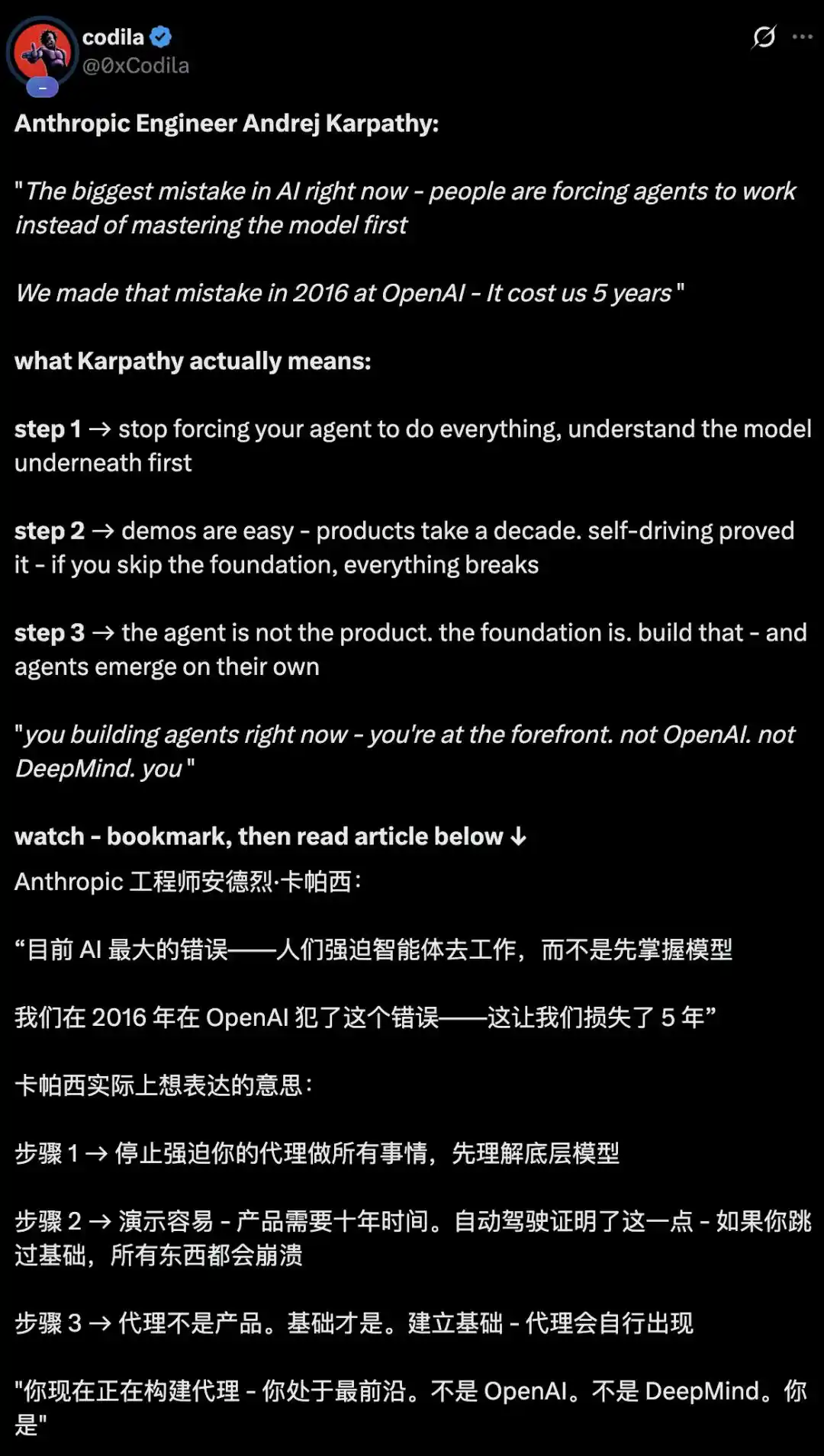
The clip was edited and thrown onto X, where it spread like wildfire in just a few days.

Because it precisely hit the nerve of the hottest, most crowded track that everyone is rushing into right now.

And the person saying this isn't an outsider throwing cold water; it's someone who has been through the trenches, reflecting on their own hard-earned lessons.

Lessons Learned with Real Money on the Line

Let's rewind to 2016.

Back then, Karpathy was working on a project at OpenAI called World of Bits. The goal sounded very "2026": Teach an Agent to use a keyboard and mouse to operate a computer, book flights, order food—basically, do your chores.

Sound familiar? That's almost the exact picture on the first slide of every Agent startup's pitch deck today.

The result? It didn't work out.

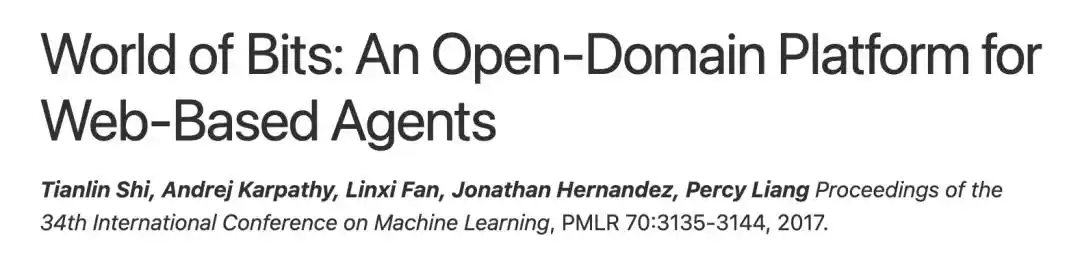
Karpathy put it bluntly: He, along with Tianlin Shi and Jim Fan, worked on it, frantically clicking on a few simple web pages, trying to book a flight or order some food. They even managed to publish a paper at ICML 2017.

The paper was titled "World of Bits: An Open-Domain Platform for Web-Based Agents"—a grand vision of a "world of bits" ultimately trapped on a few clunky web pages.
The technology wasn't ready. The only tool they had was reinforcement learning, and no matter how hard they hammered, it just wouldn't work.

Looking back, the truly correct approach back then would have been to completely forget about Agents and turn to working on language models instead.

Five years later, the toolbox is completely different—you folks building Agents today hardly use reinforcement learning at all. Back then, that was unimaginable.

Interestingly, Jim Fan, his co-author on that paper, is now a Senior Research Scientist at NVIDIA, creating explosive projects like Voyager and MineDojo, and winning an Outstanding Paper Award at NeurIPS.
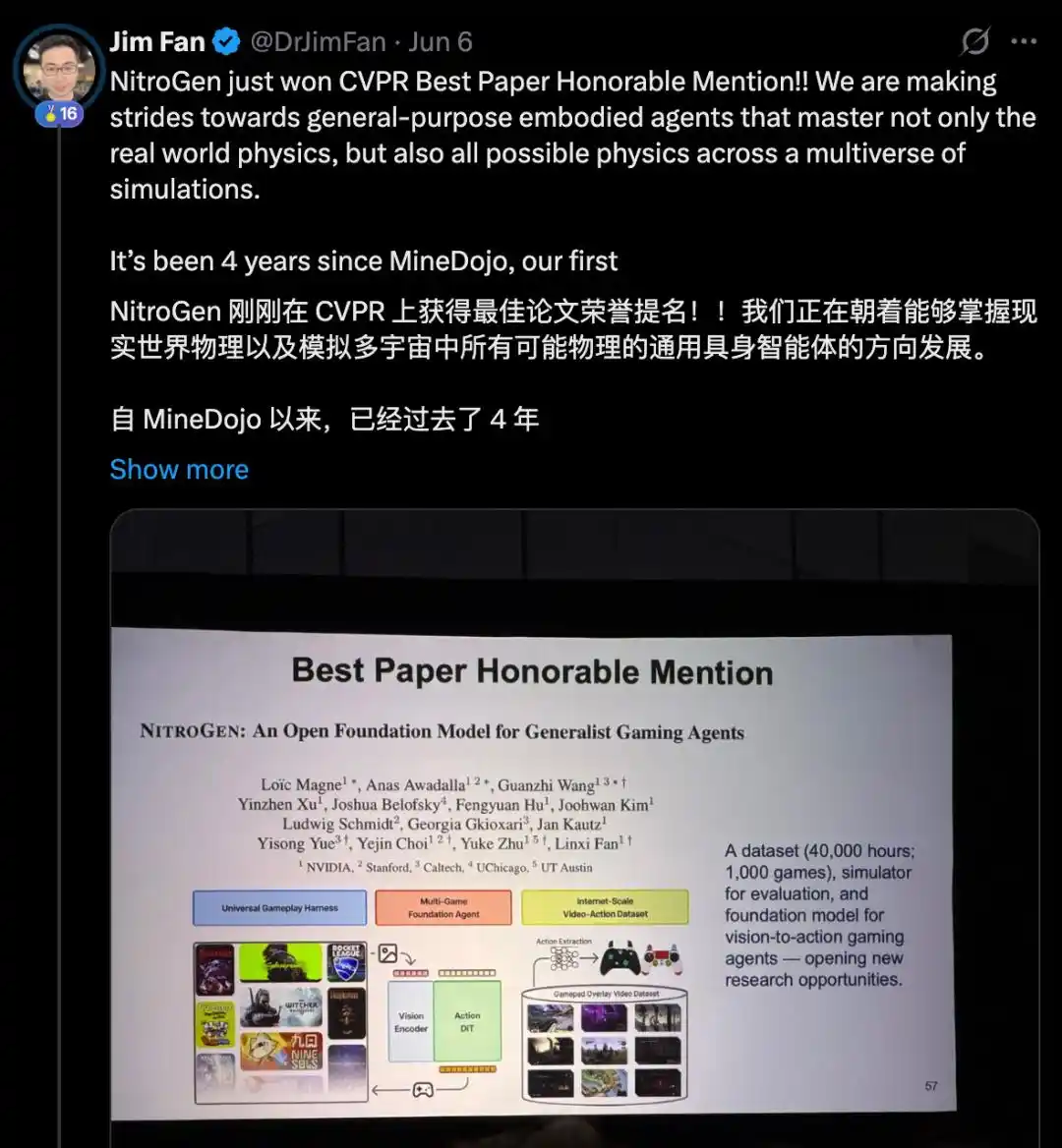
A young intern from a 2016 "failed project" has become a top player in the AI Agent field a decade later.

But the path taken wasn't the one from 2016.

Demos are Easy; Building a Product Takes a Decade

Following this lesson, Karpathy offered three pieces of advice, each directly contradicting the current hype.

First, stop forcing your Agent to do everything. First, get the underlying model right.

When he joined Anthropic's pre-training team this past May, the first thing he wrote on X was: I believe the work on the LLM frontier will be particularly critical in the coming years.
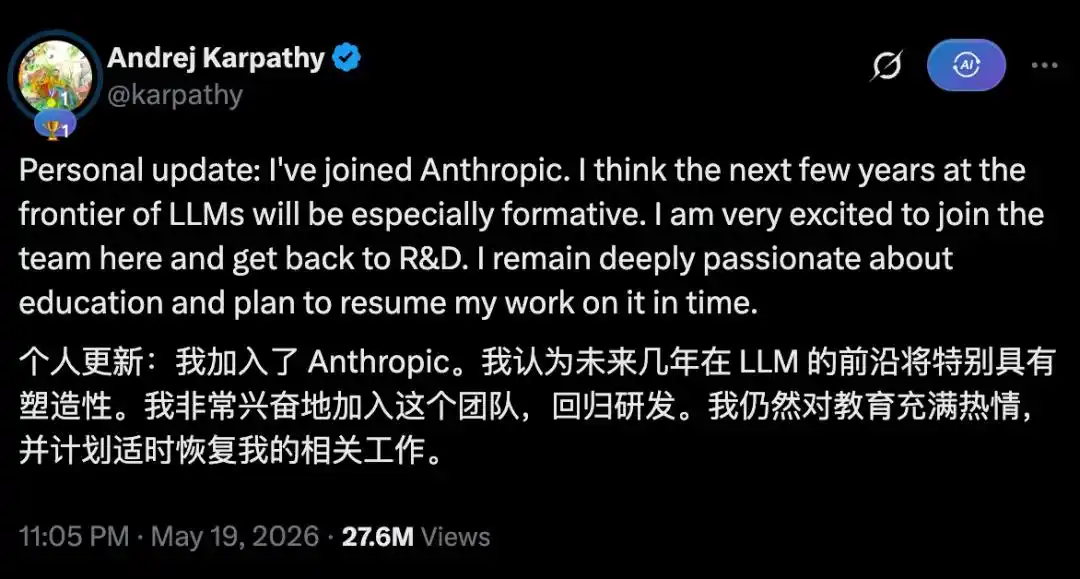
The person who "invented" vibe coding, which Collins Dictionary named its Word of the Year, is now choosing to return to the most foundational pre-training research—this in itself is a "behavioral vote" against the Agent hype.

Second, Demos are easy. Turning it into a product takes a decade.

He cited two examples everyone knows: Self-driving cars. Anyone can make a demo of a car driving around the block, but turning it into a real product took a full decade. He personally experienced that marathon at Tesla.

The same goes for VR. Impressive demos were everywhere, yet taking it to a product was also a decade-long journey.

Agents fall into this exact category.

Extremely easy to imagine, extremely easy to demo, but extremely difficult to turn into a real product.

If you're really getting into this field, you need to be prepared to work on it for ten years, not think you've made it after a flashy demo.

Third, an Agent is not the product. Foundational capabilities are the product. Build a solid foundation, and Agents will naturally emerge.

These three sentences almost completely negate the current playbook of "slap a shell on it, stack an Agent, and release it ASAP."

Karpathy's message is clear: If the foundation isn't solid, the faster you build the building, the harder it will collapse.

Self-driving cars have already validated this for everyone over the past decade. There's no reason Agents should skip this lesson.

Learning from the Brain

After the lesson, Karpathy pivoted, diving headfirst into neuroscience for inspiration.

On stage, he fired off a series of questions: In an Agent, what is equivalent to the hippocampus, responsible for memory, indexing, and retrieval?

What corresponds to the basal ganglia, controlling action selection and execution? What is the thalamus, that "seat of consciousness" where multiple thoughts fight for the microphone?

A top AI researcher is saying: What we lack most right now in building digital life isn't fancier features, but reverence for the root question of "what intelligence even is."

He even specifically brought a copy of David Eagleman's neuroscience book, "Brain and Behavior: A Cognitive Neuroscience Perspective," and recommended it to everyone in attendance.

In his view, building Agents today deserves the same approach as in the early days of deep learning—back then, we stole the inspiration for artificial neural networks from the structure of a single neuron; now, we can absolutely go steal from the brain again.

The Real Bombshell was This Last Sentence

If the earlier part was throwing cold water, Karpathy ended by lighting a fire for the audience.

He said to the room full of independent developers and entrepreneurs:

Those truly at the cutting edge of Agent capabilities are you. Not OpenAI, not DeepMind. It's you.

This wasn't just polite talk. He gave a particularly poignant explanation:

For a big lab like OpenAI, training large-scale Transformer language models is indeed unparalleled—when a new Transformer training paper comes out, the reaction inside their Slack is often, "Oh, someone tried this two and a half years ago, we know exactly why it didn't work."

But when a new Agent paper pops up, everyone's reaction is: "Oh, that's really cool, really novel."

Why? Because no major lab has five years of accumulated experience in the Agent field.

The big labs are not at the edge of capability here. You—entrepreneurs, hackers—you are the ones standing at that edge.

The logic isn't hard to grasp.

The big labs have been running on the language model track for so many years, they've already stepped in every pothole and marked every detour. But Agents are a newly opened frontier; no one has a five-year head start. Everyone is almost on the same starting line.

At this point, flexible, daring, and fast-moving independent developers actually have a better chance of stumbling upon something new than the giant, hard-to-turn ships of the major players.

Back to That Initial Bombshell

The cold water Karpathy wants to pour isn't "don't build Agents," but "don't skip the fundamentals to build Agents."

He himself is the best footnote—the person who invented vibe coding and used Agents to great effect made his most important career move in 2026: Returning to pre-training, returning to the most fundamental lab of large models.

The fire he wants to light isn't to make people anxious, but to tell everyone struggling on the front lines: In this battle, you're not behind. You're right at the front.

The hype will always fade, and demos will eventually lose their luster.

But those who truly master the underlying models and are willing to dive deep into something for ten years are the ones who deserve to stand on the shore a decade from now.

References: https://x.com/0xCodila/status/2073544407643496771

This article is from the WeChat public account "新智元" (Xin Zhi Yuan), author: ASI启示录, editor: Solomon


Трендовые криптовалюты

Связанные с этим вопросы

QWhat is Andrej Karpathy's main criticism of the current AI agent development trend?

AAndrej Karpathy criticizes the current trend of rushing to make AI agents perform tasks as the 'biggest mistake' in AI. He argues that developers are focusing on building agents without first fully understanding and solidifying the underlying large language models (LLMs), putting the cart before the horse.

QWhat historical project did Karpathy cite as a failed precursor to today's agent projects, and what was the key lesson?

AKarpathy cited the 'World of Bits' project from 2016 at OpenAI, which aimed to create an agent that could use a keyboard and mouse to perform tasks like booking flights. The project ultimately failed. The key lesson was that the technology (reinforcement learning at the time) wasn't ready, and the correct path would have been to focus on foundational language models instead.

QWhat are Karpathy's three pieces of advice for developers interested in AI agents?

A1. Focus on getting the underlying base model right before pushing the agent to do tasks. 2. Understand that a demo is easy, but turning it into a robust product takes about a decade of work (similar to autonomous driving or VR). 3. Recognize that the base capability (the model) is the real product; the agent functionality will naturally emerge from a solid foundation.

QWhy does Karpathy suggest that independent developers and startups are at the forefront of agent development, not major companies like OpenAI?

AKarpathy argues that while big companies have years of accumulated knowledge in training large-scale Transformer models, no one has a five-year head start in agent development. This new frontier levels the playing field. Independent developers and startups, being more agile, flexible, and willing to experiment quickly, are actually positioned at the cutting edge of discovering new agent capabilities.

QWhat analogy from neuroscience does Karpathy use to illustrate the current shortcomings in agent architecture?

AKarpathy draws an analogy to the human brain, asking what components in an agent correspond to key brain structures: the hippocampus (for memory, indexing, and retrieval), the basal ganglia (for action selection and execution), and the thalamus (the 'seat of consciousness' where multiple thoughts compete). He suggests current agent architectures lack this sophisticated, biologically-inspired design for core cognitive functions.

Похожее

Исследование: почему карта ликвидаций Solana определила ЭТИ ценовые цели

Анализ ликвидационной теплокарты Solana (SOL) указывает на вероятные краткосрочные ценовые цели. Несмотря на рост средней суммы спотовых сделок, что может сигнализировать о накоплении, интерес крупных держателей (китов) ослабевает: с мая количество кошельков-китов сократилось на 3.6%. Ценовое действие SOL остается вялым после отскока от уровня локального сопротивления в $84, который, как и зона $84-$90, представляет собой серьезную зону предложения. Данные теплокарты ликвидаций за последний месяц показывают высокую концентрацию коротких ликвидаций в районе $84-$86. Ближайшей и более вероятной целью движения вниз выглядит зона $70-$73. Однако стоит учитывать риск короткого сжатия, которое может привести к тестированию уровней $85 и даже $90. Таким образом, краткосрочные перспективы остаются медвежьими с целевым уровнем около $70.

ambcrypto6 мин. назад

Исследование: почему карта ликвидаций Solana определила ЭТИ ценовые цели

ambcrypto6 мин. назад

Оценка бокового движения Биткойна по мере того, как «спящий» кит на $290 млн BTC снова загружается

Биткоин продолжает торговаться в боковом диапазоне между $63 000 и $64 000. Несмотря на незначительный рост, объем торгов упал на 46%, что указывает на снижение активности участников рынка. На этом фоне один долгосрочный холдер, "кит", вернулся на рынок после года бездействия, пополнив свой кошелек на 1001 BTC (около $64 млн). Его покупка в условиях слабости рынка может свидетельствовать о восстановлении уверенности, однако это единичный случай. В целом активность крупных игроков снизилась: показатель Exchange Whale Ratio стагнирует, что говорит об их нерешительности. Чистый отток средств с бирж (Spot Netflow) остается отрицательным несколько дней подряд, что временно снижает давление продаж, но не подтверждает масштабного накопления. Технические индикаторы (ADX, +DI/-DI) сигнализируют о преобладании нисходящего давления. При сохранении слабого спроса со стороны "китов" Bitcoin может вновь протестировать уровень $63 000 и даже опуститься к $62 697. Для избежания дальнейшего падения ему необходимо закрепиться выше $63 906 и преодолеть сопротивление в $64 000.

ambcrypto1 ч. назад

Оценка бокового движения Биткойна по мере того, как «спящий» кит на $290 млн BTC снова загружается

ambcrypto1 ч. назад

EdgeX вырос на 11%, так как быки берут верх, но остается ОДИН риск

Криптовалюта EDGE продолжила рост, увеличившись на 11% на фоне возвращения оптимизма на рынке. Основную поддержку ралли оказал спотовый рынок: инвесторы вывели с бирж активы на сумму более 16 миллионов долларов за неделю, сократив доступное предложение. Ставка финансирования (Funding Rate) выросла, что указывает на активность покупателей. Уверенность инвесторов также повышается: количество держателей монеты увеличилось, а показатель настроений (sentiment score) остаётся позитивным. Это создаёт основу для дальнейшего накопления активов. Однако сохраняются и факторы неопределённости. Общая стоимость заблокированных средств (TVL) в протоколе EDGE практически не изменилась, что говорит об отсутствии притока нового капитала. Кроме того, коэффициент Long/Short Ratio упал ниже 1, что свидетельствует о преобладании коротких позиций среди трейдеров на деривативных рынках, несмотря на общий позитивный фон. Таким образом, хотя текущий рост EDGE имеет под собой фундамент в виде накопления на спотовом рынке и роста числа держателей, трейдеры деривативов проявляют осторожность, и для продолжения ралли может потребоваться приток средств в экосистему протокола.

ambcrypto2 ч. назад

EdgeX вырос на 11%, так как быки берут верх, но остается ОДИН риск

ambcrypto2 ч. назад

Почему аналитик ожидает, что биткойн-ETF повторит модель «триумфа и боли» золота

Аналитик Bloomberg Эрик Балчунас предполагает, что американские спотовые биткойн-ETF могут повторить путь золотых ETF: период впечатляющего роста, за которым последует болезненная коррекция и долгое восстановление, требующее терпения инвесторов. Золотые ETF, бывшие крупнейшими в мире в 2011 году, потратили около восьми лет на возврат к пиковым значениям, чего вновь достигли лишь в 2024 году. Несмотря на падение цены биткойна почти вдвое и отток средств из спотовых BTC-ETF на $7 млрд в мае-июне 2026 года, лишь 10% инвесторов остались в них, в сравнении с третью в золотых ETF. Устойчивость поддерживают долгосрочные держатели (LTH), которые пока не стали чистыми продавцами, хотя их позиции сокращаются. Ключевой риск — возможный переход LTH в статус чистых продавцов. Кроме того, несмотря на обострение конфликта между США и Ираном, ни золото, ни биткойн в последние три месяца не привлекли значительного капитала в качестве убежища. Рост цен на нефть выше $80 может ограничить потенциал роста биткойна, который торгуется ниже $65 тыс. В итоге будущее биткойн-ETF зависит от того, смогут ли они привлечь новый капитал и повторить путь золота к новым рекордам.

ambcrypto4 ч. назад

Почему аналитик ожидает, что биткойн-ETF повторит модель «триумфа и боли» золота

ambcrypto4 ч. назад

Санкции США заморозили $131 млн в стейблкоинах иранского ЦБ в сети TRON

Санкции США заблокировали 131 млн долларов в стейблкоинах USDT, принадлежащих Центральному банку Ирана, в сети TRON. Минфин США внес связанные с Ираном адреса кошельков TRON в санкционный список, что привело к заморозке средств. Этот случай демонстрирует ключевое противоречие: хотя стейблкоины перемещаются по публичным блокчейнам, их эмитенты (например, Tether) являются централизованными компаниями, которые могут замораживать токены по требованию властей для соблюдения санкций и законов. TRON стал одной из основных сетей для переводов USDT благодаря низким комиссиям и широкой поддержке на биржах. Однако именно это делает ее объектом внимания регуляторов. Инцидент подтверждает, что даже в децентрализованных сетях эмитенты долларовых стейблкоинов остаются точкой контроля, поскольку зависят от банковской системы и должны соблюдать регуляторные требования. Ситуация подчеркивает компромисс: пользователи получают быстрые глобальные платежи, но жертвуют полной цензуроустойчивостью. Рост adoption стейблкоинов, вероятно, будет сопровождаться усилением контроля со стороны государств.

bitcoinist6 ч. назад

Санкции США заморозили $131 млн в стейблкоинах иранского ЦБ в сети TRON

bitcoinist6 ч. назад

Торговля

Спот

Популярные статьи

Как купить S

Добро пожаловать на HTX.com! Мы сделали приобретение Sonic (S) простым и удобным. Следуйте нашему пошаговому руководству и отправляйтесь в свое крипто-путешествие.Шаг 1: Создайте аккаунт на HTXИспользуйте свой адрес электронной почты или номер телефона, чтобы зарегистрироваться и бесплатно создать аккаунт на HTX. Пройдите удобную регистрацию и откройте для себя весь функционал.Создать аккаунтШаг 2: Перейдите в Купить криптовалюту и выберите свой способ оплатыКредитная/Дебетовая Карта: Используйте свою карту Visa или Mastercard для мгновенной покупки Sonic (S).Баланс: Используйте средства с баланса вашего аккаунта HTX для простой торговли.Третьи Лица: Мы добавили популярные способы оплаты, такие как Google Pay и Apple Pay, для повышения удобства.P2P: Торгуйте напрямую с другими пользователями на HTX.Внебиржевая Торговля (OTC): Мы предлагаем индивидуальные услуги и конкурентоспособные обменные курсы для трейдеров.Шаг 3: Хранение Sonic (S)После приобретения вами Sonic (S) храните их в своем аккаунте на HTX. В качестве альтернативы вы можете отправить их куда-либо с помощью перевода в блокчейне или использовать для торговли с другими криптовалютами.Шаг 4: Торговля Sonic (S)С легкостью торгуйте Sonic (S) на спотовом рынке HTX. Просто зайдите в свой аккаунт, выберите торговую пару, совершайте сделки и следите за ними в режиме реального времени. Мы предлагаем удобный интерфейс как для начинающих, так и для опытных трейдеров.

1.6k просмотров всегоОпубликовано 2025.01.15Обновлено 2026.06.02

Как купить S

Sonic: Обновления под руководством Андре Кронье – новая звезда Layer-1 на фоне спада рынка

Он решает проблемы масштабируемости, совместимости между блокчейнами и стимулов для разработчиков с помощью технологических инноваций.

2.4k просмотров всегоОпубликовано 2025.04.09Обновлено 2025.04.09

Sonic: Обновления под руководством Андре Кронье – новая звезда Layer-1 на фоне спада рынка

HTX Learn: Пройдите обучение по "Sonic" и разделите 1000 USDT

HTX Learn — ваш проводник в мир перспективных проектов, и мы запускаем специальное мероприятие "Учитесь и Зарабатывайте", посвящённое этим проектам. Наше новое направление .

1.9k просмотров всегоОпубликовано 2025.04.10Обновлено 2025.04.10

HTX Learn: Пройдите обучение по "Sonic" и разделите 1000 USDT

Обсуждения

Добро пожаловать в Сообщество HTX. Здесь вы сможете быть в курсе последних новостей о развитии платформы и получить доступ к профессиональной аналитической информации о рынке. Мнения пользователей о цене на S (S) представлены ниже.

活动图片