JPMorgan: Saylor’s Strategy Could Buy $30 Billion In Bitcoin This Year

bitcoinistОпубликовано 2026-05-08Обновлено 2026-05-08

Введение

JPMorgan analysts estimate that Michael Saylor's MicroStrategy could purchase around $30 billion worth of Bitcoin in 2026 if its current acquisition pace continues, a significant acceleration from previous years. This follows the company's addition of 145,834 BTC worth approximately $11 billion so far in 2026, much of it bought below an estimated average cost of $75,000. JPMorgan notes the company has accelerated purchases again in April, pursuing an opportunity-driven strategy sensitive to market conditions. MicroStrategy's ability to raise capital is key to this strategy. Its stock trades at a ~26% premium to net asset value, facilitating equity or debt issuance to fund further Bitcoin buys. As of May 3, the company holds 818,334 BTC. Its CFO highlighted the success of its "Digital Credit" preferred equity platform, with over $13.5 billion outstanding, used to service dividends and fund Bitcoin acquisitions. However, this aggressive strategy increases obligations. The company reported a Q1 net loss of $12.54 billion, driven by an unrealized loss on digital assets. Its perpetual preferred stock dividends create a long-term payment commitment, with CEO Michael Saylor acknowledging the potential need to sell some Bitcoin for dividends, while emphasizing the core directive to "Buy more bitcoin than you sell."

Michael Saylor’s Strategy could buy roughly $30 billion worth of bitcoin this year if its current acquisition pace holds, according to JPMorgan analysts, marking a potential acceleration beyond the company’s already aggressive treasury playbook.

The estimate comes after Strategy added 145,834 BTC so far this year, worth around $11 billion, with JPMorgan noting that much of the buying occurred while BTC traded below the company’s estimated average cost of roughly $75,000. At the current annualized pace, the bank said Strategy’s 2026 purchases would exceed the approximately $22 billion it bought in each of 2024 and 2025.

JPMorgan Sees Bitcoin Buying Spree Reacceleration

The latest call centers on the speed of Strategy’s buying, not merely the size of its balance sheet. JPMorgan analysts led by Nikolaos Panigirtzoglou said the company “appears to have accelerated its Bitcoin purchases again in April,” extending what they described as an opportunity-driven pattern this year.

“Strategy appears to have accelerated its Bitcoin purchases again in April,” the analysts said, according to summaries of the note. “The company is pursuing an opportunity-driven buying strategy throughout 2026, sensitive to market conditions and funding opportunities.”

That framing is important. Strategy is not simply buying on a fixed schedule. JPMorgan’s read is that the company has been using price weakness and available financing windows to expand its bitcoin stack, while its stock-market premium gives it a capital-raising mechanism that most corporate bitcoin holders do not have.

Strategy’s premium to net asset value has expanded to around 26% over the past two months, according to reports citing JPMorgan. A larger premium can make equity or debt issuance more attractive, because the company can raise capital above the implied value of the bitcoin it already holds and recycle proceeds into additional BTC purchases.

Strategy’s Balance Sheet Keeps Growing

Strategy said on May 5 that it held 818,334 BTC as of May 3, representing 22% year-to-date growth. The company also reported $11.68 billion raised year to date, while STRC alone had raised $5.58 billion and cumulative dividends declared and paid on preferred stock had reached $692.5 million.

The company’s own commentary emphasizes the funding side of the model. CEO Phong Le said, “Adoption of Bitcoin continues to grow in 2026. Digital Credit, highlighted by STRC, has been a big success. STRC has shown strong demand, high liquidity, and low volatility.” He added that Strategy raised $5.6 billion in year-to-date STRC gross proceeds and cited growing bitcoin activity from major banks including Morgan Stanley, Goldman Sachs and Citi.

CFO Andrew Kang framed the preferred-equity platform as a core part of the company’s capital structure. “Strategy is the dominant issuer of Digital Credit in the world, with over $13.5 billion of preferred equity outstanding, supported by a fortress Bitcoin balance sheet,” he said. “We continue to extend our track record of servicing our dividends, having now met our payment obligations on time and in full across 23 consecutive distributions, totaling over $693 million since the launch of our preferred equity products in early 2025.”

The Trade-Off: Bigger Purchases, Bigger Obligations

The same structure that enables larger bitcoin purchases also increases Strategy’s ongoing obligations. The company reported a first-quarter net loss of $12.54 billion, or $38.25 per share, driven by a $14.46 billion unrealized loss on digital assets. Strategy’s filings also state that perpetual preferred stock dividends must be paid in perpetuity, and that future obligations could require the company to sell common stock or bitcoin.

That tension has become harder to ignore after Saylor signaled that Strategy could sell some bitcoin to pay preferred dividends, even as he later summarized the firm’s stance in a six-word post: “Buy more bitcoin than you sell.”

At press time, BTC traded at $79,934.
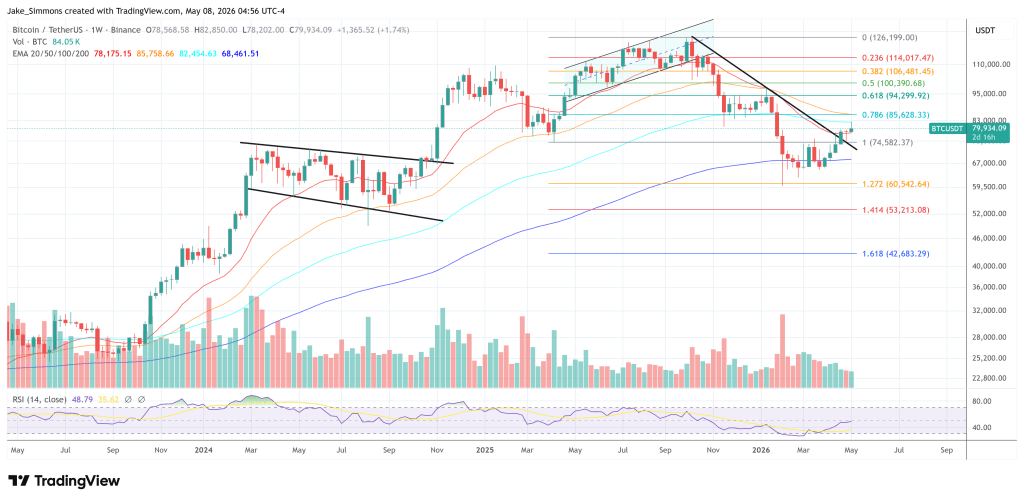
BTC bulls eye the 0.786 Fib, 1-week chart | Source: BTCUSDT on TradingView.com

Связанные с этим вопросы

QWhat is the total value of Bitcoin that JPMorgan analysts estimate MicroStrategy could potentially buy by the end of the year based on its current pace?

AJPMorgan analysts estimate MicroStrategy could buy roughly $30 billion worth of Bitcoin this year if its current acquisition pace holds.

QAccording to JPMorgan, what is a key characteristic of MicroStrategy's Bitcoin purchasing strategy in 2026?

AAccording to JPMorgan, MicroStrategy is pursuing an opportunity-driven buying strategy sensitive to market conditions and funding opportunities, rather than buying on a fixed schedule.

QHow does MicroStrategy's stock-market premium facilitate its Bitcoin acquisition strategy, according to the article?

AMicroStrategy's premium to its net asset value, which had expanded to around 26%, makes equity or debt issuance more attractive. This allows the company to raise capital above the implied value of its Bitcoin holdings and recycle the proceeds into additional purchases.

QWhat was the primary driver behind MicroStrategy's reported first-quarter net loss of $12.54 billion?

AThe primary driver behind MicroStrategy's reported first-quarter net loss of $12.54 billion was a $14.46 billion unrealized loss on digital assets.

QWhat potential trade-off does the article highlight regarding MicroStrategy's strategy for funding large Bitcoin purchases?

AThe trade-off is that the same structure (like issuing perpetual preferred stock) that enables larger Bitcoin purchases also increases MicroStrategy's ongoing obligations, such as perpetual dividend payments that may eventually require the sale of common stock or Bitcoin to meet.

Похожее

Standing in the Light: A Comprehensive Guide to the Optical Module and CPO Supply Chain

"Standing in the Light: Understanding the Optical Module and CPO Industry Chain" This article analyzes the critical role of optical communication technology, specifically optical modules and Co-Packaged Optics (CPO), as the "nervous system" for modern AI data centers. With exponential growth in AI computational demands (e.g., NVIDIA's Vera Rubin architecture), traditional electrical interconnects using copper cables face severe bottlenecks in bandwidth, power consumption, and signal integrity over distance. The core function of an optical module is to act as a "translator," converting electrical signals from chips into optical signals for transmission over fiber (and vice-versa). Key internal components include lasers, modulators, photodetectors, drivers, and DSP chips. The industry is currently transitioning from 800G to 1.6T modules. However, the future lies in CPO. This next-generation technology integrates the optical engine directly with the switch ASIC/XPU on the same package substrate, drastically reducing power consumption (by ~3.5x according to NVIDIA), overcoming bandwidth density limits, and minimizing signal attenuation compared to traditional pluggable modules. Key challenges for CPO include advanced packaging capacity (dominated by TSMC), thermal management, repairability, and standardization. The article details the broader technology landscape, including Near-Packaged Optics (NPO, a pragmatic intermediate step), Linear-drive Pluggable Optics (LPO), Optical I/O (OIO for chip-level integration), and Optical Circuit Switches (OCS). A comprehensive CPO industry chain is mapped, highlighting shifting power dynamics: * **Architecture Definers:** NVIDIA, Broadcom, and Marvell now hold greater influence. * **Advanced Packaging & Manufacturing:** TSMC is central; Fabrinet is a key EMS player. * **Lasers ("The Heart"):** A strategic bottleneck. EML lasers are led by Lumentum and Coherent (both receiving major NVIDIA investments). CW lasers, favored for CPO/silicon photonics, see strong Chinese players like Source Photonics and Sicoya. * **Silicon Photonics Chips:** The mainstream path for CPO engines, with key players like Broadcom, Intel, Marvell, and China's Accelink. * **Fiber Connectivity Components:** A major new, high-growth market created by CPO, including Fiber Array Units (FAU), Polarization-Maintaining Fiber (PMF), and MPO connectors. Companies like Tianfu Communication and US Conec are leaders. * **Fiber & Cable:** Experiencing a super-cycle (e.g., Corning, Yangtze Optical Fiber). * **PCB/Substrates:** Requiring advanced materials (e.g., Shengyi Tech). * **DSP & SerDes:** Functions are integrated into switch ASICs in the CPO era (e.g., Broadcom, Astera Labs). * **Optical Module Makers:** Transitioning from standalone module suppliers to providers of optical engines and NPO/LPO solutions while riding the current pluggable boom (e.g., Zhongji Innolight, Eoptolink). The investment timeline is segmented: Short-term (2026-2027) features the "last feast" for pluggable modules and CPO's initial rollout. Medium-term (2027-2029) will see CPO expand and NPO peak. Long-term (2029-2032+) involves CPO/OIO penetration into intra-rack scaling. In conclusion, optical interconnects are fundamental to AI infrastructure. The competitive landscape sees US firms leading in architecture and high-end chips, TSMC in advanced packaging, and Chinese firms holding strong positions in modules, connectivity components, CW lasers, and fiber/cable. The future belongs to companies that can navigate the technological shift from "selling shovels" (modules) to "building highways" (CPO/OIO infrastructure).

marsbit7 мин. назад

Standing in the Light: A Comprehensive Guide to the Optical Module and CPO Supply Chain

marsbit7 мин. назад

Торговля

Спот
Фьючерсы

Популярные статьи

Как купить S

Добро пожаловать на HTX.com! Мы сделали приобретение Sonic (S) простым и удобным. Следуйте нашему пошаговому руководству и отправляйтесь в свое крипто-путешествие.Шаг 1: Создайте аккаунт на HTXИспользуйте свой адрес электронной почты или номер телефона, чтобы зарегистрироваться и бесплатно создать аккаунт на HTX. Пройдите удобную регистрацию и откройте для себя весь функционал.Создать аккаунтШаг 2: Перейдите в Купить криптовалюту и выберите свой способ оплатыКредитная/Дебетовая Карта: Используйте свою карту Visa или Mastercard для мгновенной покупки Sonic (S).Баланс: Используйте средства с баланса вашего аккаунта HTX для простой торговли.Третьи Лица: Мы добавили популярные способы оплаты, такие как Google Pay и Apple Pay, для повышения удобства.P2P: Торгуйте напрямую с другими пользователями на HTX.Внебиржевая Торговля (OTC): Мы предлагаем индивидуальные услуги и конкурентоспособные обменные курсы для трейдеров.Шаг 3: Хранение Sonic (S)После приобретения вами Sonic (S) храните их в своем аккаунте на HTX. В качестве альтернативы вы можете отправить их куда-либо с помощью перевода в блокчейне или использовать для торговли с другими криптовалютами.Шаг 4: Торговля Sonic (S)С легкостью торгуйте Sonic (S) на спотовом рынке HTX. Просто зайдите в свой аккаунт, выберите торговую пару, совершайте сделки и следите за ними в режиме реального времени. Мы предлагаем удобный интерфейс как для начинающих, так и для опытных трейдеров.

1.4k просмотров всегоОпубликовано 2025.01.15Обновлено 2026.06.02

Как купить S

Sonic: Обновления под руководством Андре Кронье – новая звезда Layer-1 на фоне спада рынка

Он решает проблемы масштабируемости, совместимости между блокчейнами и стимулов для разработчиков с помощью технологических инноваций.

2.3k просмотров всегоОпубликовано 2025.04.09Обновлено 2025.04.09

Sonic: Обновления под руководством Андре Кронье – новая звезда Layer-1 на фоне спада рынка

HTX Learn: Пройдите обучение по "Sonic" и разделите 1000 USDT

HTX Learn — ваш проводник в мир перспективных проектов, и мы запускаем специальное мероприятие "Учитесь и Зарабатывайте", посвящённое этим проектам. Наше новое направление .

1.8k просмотров всегоОпубликовано 2025.04.10Обновлено 2025.04.10

HTX Learn: Пройдите обучение по "Sonic" и разделите 1000 USDT

Обсуждения

Добро пожаловать в Сообщество HTX. Здесь вы сможете быть в курсе последних новостей о развитии платформы и получить доступ к профессиональной аналитической информации о рынке. Мнения пользователей о цене на S (S) представлены ниже.

活动图片