It's 2026 Already, DAOs Should Have Matured by Now

比推Опубликовано 2026-01-29Обновлено 2026-01-29

Введение

By 2026, DAO governance is maturing beyond idealistic experiments. In 2025, major protocols shifted from pure community governance to hybrid models with clearer operational control, as seen with Arbitrum’s OpCo and Uniswap’s DUNI framework. Voting participation declined but became more concentrated among professional delegates, while token value accumulation gained prominence through buybacks, fee switches, and staking mechanisms. Key conflicts, like Gnosis terminating Karpatkey and Aave’s revenue dispute with Aave Labs, highlighted accountability gaps. Looking ahead, DAOs will formalize legal structures, prioritize risk management, and leverage AI for decision-making. Governance tokens must capture economic value to sustain engagement. The evolution reflects a balance between decentralized oversight and operational efficiency, signaling DAO’s maturation into more effective, accountable organizations.

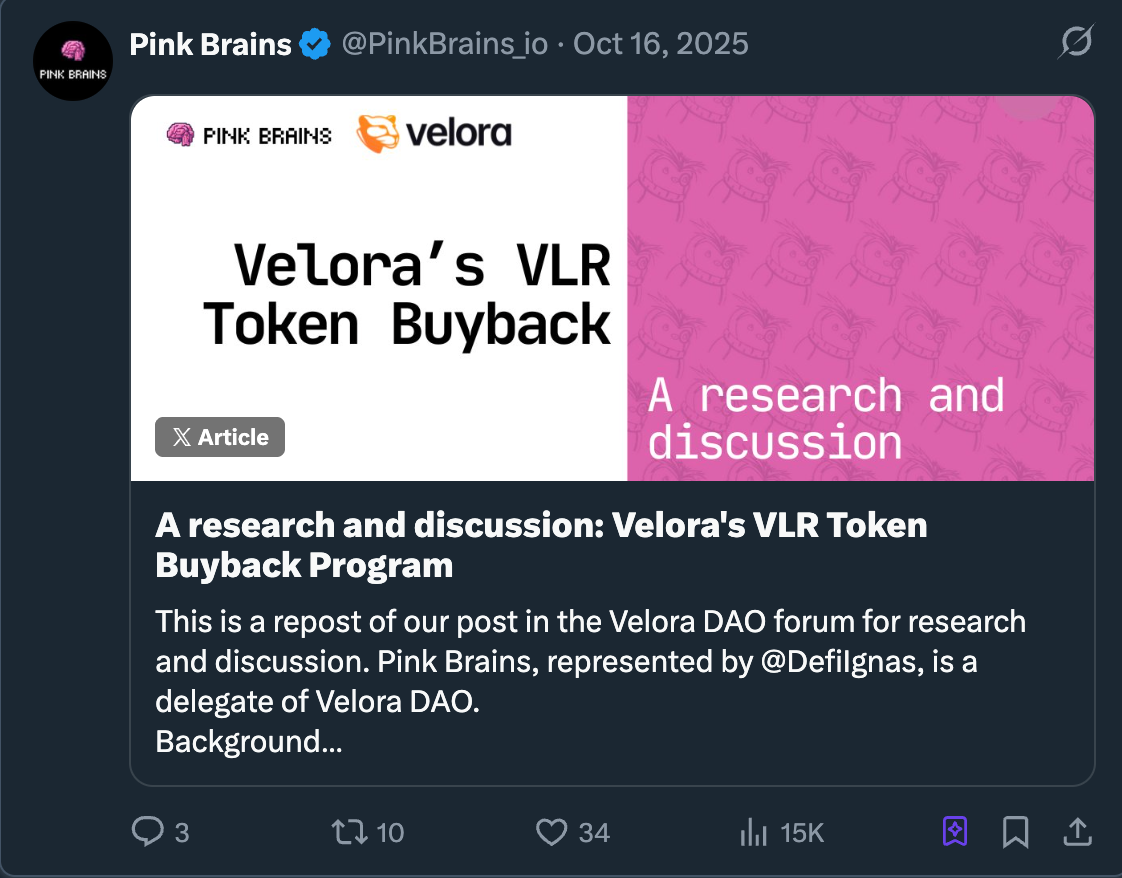
Author: Pink Brains

Compiled by: Deep Tide TechFlow

Original title: It's 2026 Already, DAOs Should Have Matured by Now


Deep Tide Guide: 2025 was a critical inflection point for decentralized governance (DAO). After years of idealistic experimentation, mainstream protocols began to seriously address core pain points such as power distribution, accountability mechanisms, and sustainability. This article is written by veteran DAO delegate Pink Brains, based on their practical experience of casting 725 votes in top protocols like Aave, Lido, and Gnosis. It provides an in-depth analysis of the shift in DAOs from "community autonomy" to a "hybrid operation" model.

The author points out that governance tokens alone are no longer sustainable. In the future, DAOs will evolve towards economic alignment, legal entity formation, and AI-assisted decision-making. This is not just a review of governance; it's a prophecy book for the evolution of Web3 organizational structures in 2026.

Full text below:

2025 marked a turning point for decentralized governance.

After years of experimentation, major protocols began confronting fundamental questions about power distribution, accountability, and sustainability.

The answers weren't always pleasant, but they were necessary.

What We Achieved in 2025

2025 was also the first year of our operation as an active DAO Delegate.

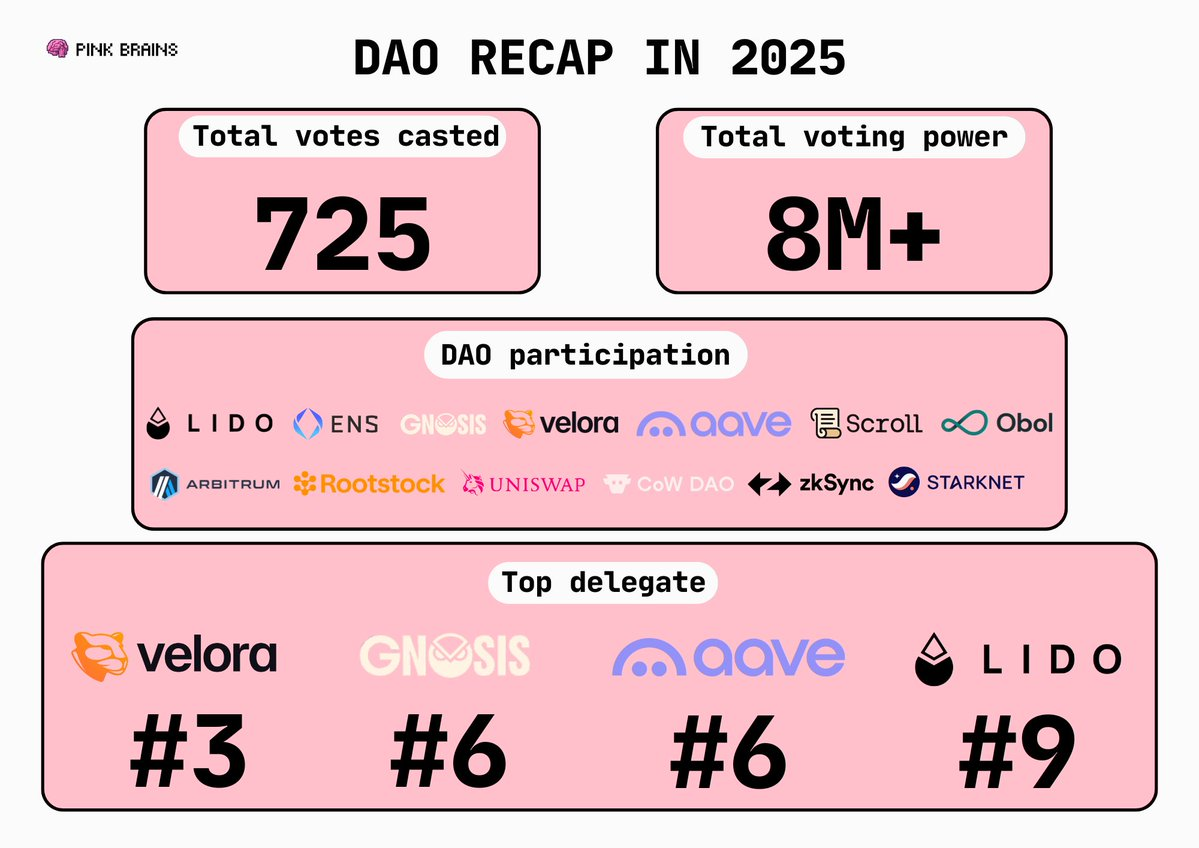
  • Casted 725 votes across 18 protocols

  • Held over 8 million in voting power

  • Top 10 delegate in Aave and Lido

  • Top 3 delegate in Velodrome

  • Top 6 delegate in Gnosis

This perspective, grounded in actual governance work, gave us clear insight into the patterns reshaping DAOs in 2025 and defined their trajectory entering 2026.

Changes in DAOs in 2025

Shift in Operational Model: From Pure Community Governance to Hybrid Control

The most notable change in 2025 was the shift from purely community-based governance towards hybrid models with clearer operational control.

  • @arbitrum introduced an Operating Company (OpCo), channeling all DAO operations through a unified structure.

  • @JupiterExchange completely paused governance for nearly six months to reassess its approach.

  • @Uniswap launched the DUNI framework, centralizing operational authority.

  • @Gnosis's DAO executed a hard fork amidst reduced community engagement. Scroll transitioned to a CEO-led structure.

  • @Scroll_ZKP suspended its DAO, shifting focus to centralized governance.

  • Recently, the Celo Foundation merged with @cLabs into a unified core contributor organization.
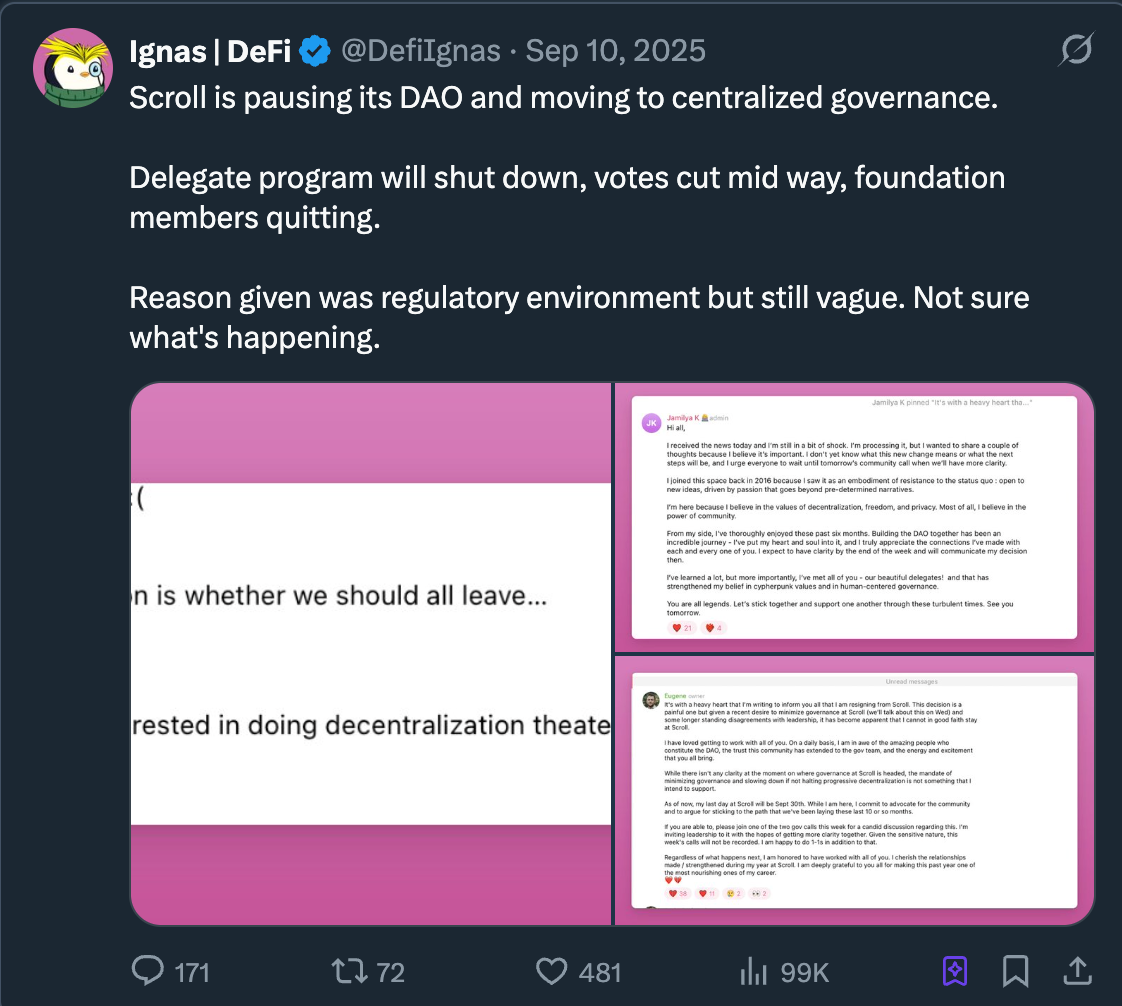
The motivation for this shift was DAOs hitting scaling limits. Execution became the bottleneck. Full-community votes were often too slow for operations, too noisy for technical nuances, and too vulnerable for security-sensitive actions.

Consequently, governance power concentrated towards smaller, high-context groups, while the broader community shifted towards oversight functions, as seen in the next section.

Fewer Voters, But More Concentrated Power

In 2025, the number of proposals and participating voters dropped significantly across major DAOs. However, the voting power behind each proposal remained strong.

  • Lido saw an increase in participation after adopting a dual governance framework.

  • Arbitrum and Uniswap still had the highest overall participation, but both saw a decrease in the number of voters.
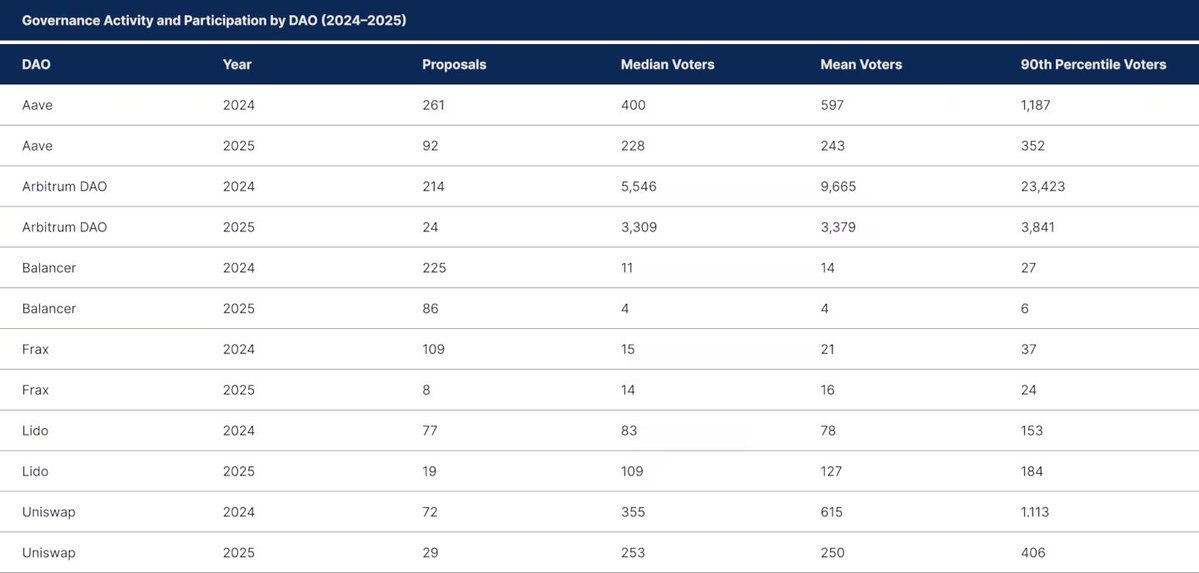
Caption: From DeFiLlama's State of DeFi 2025 Report

This does not signal the failure of governance. Instead, governance became more bundled, more operationally abstract, and less frequent.

Governance influence migrated to a small number of highly active Delegates and heavily capitalized participants.

Value Accrual for Token Holders

"Token buyback," "buyback and burn," and "fee switch" became central themes in 2025.
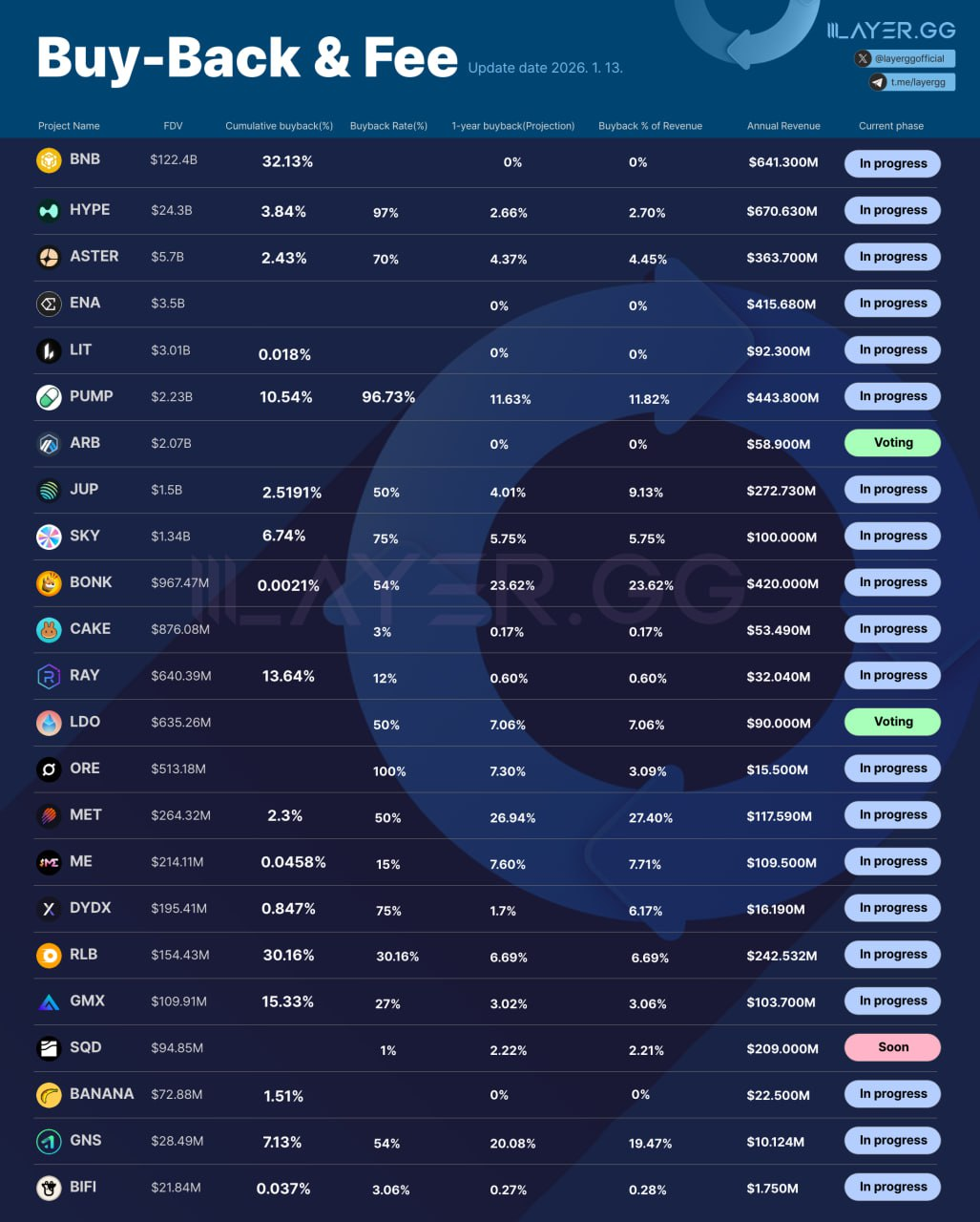
For years, token utility revolved around voting rights and incentive distribution, but offered minimal economic value to token holders. 2025 changed this equation.

  • Lido adopted a buyback framework.

  • Uniswap DAO activated the long-awaited fee switch, pledging to burn nearly $600 million worth of UNI tokens.

  • Aave implemented a token buyback mechanism. Optimism launched a buyback program.

  • CoW Protocol increased solver profitability in a way that benefits token holders.

This trend addresses a key challenge in tokenomics. Buybacks and burns reduce circulating supply, making the token more scarce. If demand holds steady, the price strengthens. When token holders can actually benefit from the protocol's success, they are more incentivized to buy, hold, and participate in governance decisions long-term.

Who Really Owns the DAO?

Two major controversies forced DAOs to confront structural flaws.

  • Gnosis voted to terminate Karpatkey's treasury mandate due to fee disputes, underperformance, and a ~$700k loss related to a liquidity issue.

  • Tensions between Aave DAO and Aave Labs escalated when it was discovered that ~$10 million annually in swap fees from the CoW Swap integration were flowing to Aave Labs instead of the DAO. A vote on brand ownership failed, and the controversy left a harder question: what does "DAO-owned" really mean when the core team controls development and distribution?

These conflicts forced protocols to fill the gaps in accountability and governance structures.

Legal Infrastructure is Adapting to DAOs

Despite DeFi's growth, most DAOs still lack clear legal structures, creating liability and regulatory risks as protocols scale.

While jurisdictions like Wyoming have introduced DAO LLC frameworks, and Switzerland offers mature legal pathways, most DAOs remain in a legal gray area.

2026 Trend Predictions

Centralized DAOs as a New Practice

Protocols will develop clear frameworks to delineate "community decisions" from "operational decisions," moving beyond the false binary of "fully decentralized" or "fully centralized."

  • Operational Execution: Will be handled by Labs teams, not foundations.

  • Community Oversight: DAO delegates and the community will be responsible for treasury strategy, long-term direction, and major structural decisions.

Governance Shifts Towards Risk Management Infrastructure

The DAO of the future will be less like a forum full of chatter. More teams will bifurcate decisions into concave decisions and convex decisions.

Concave problems require:

  • Pre-approved guardrails and automated execution.

  • Professional oversight (risk services, auditors, security teams).

  • Rapid response frameworks for emergencies and market shocks.

  • Fewer proposals, but each decision carries higher economic impact.

Convex problems (like product direction) require decisive leadership, where the DAO acts as a "brake" or "checkpoint," not a "steering wheel."

By 2026, this will be standard for lending, stablecoins, perps, and any protocol where financial risk can compound quickly.

The End of Governance Tokens? Value Capture is a Must

Continuing into 2026, tokens with only governance functions will struggle to maintain long-term engagement.

Delegates, whales, and strategic holders won't consistently provide protection for the system without seeing a return profile. Protocols will increasingly adopt at least one value accrual path:

  • Token buyback frameworks.

  • Fee diversion or revenue sharing.

  • Staking tied to protocol cash flows.

  • Treasury strategies aimed at supporting token value.

When holders gain economically from the protocol's success, they are incentivized to stay attentive, participate, and protect the system.
Legal Structures Shift from Optional to Necessary

Regulatory pressure and real-world legal challenges will push DAOs towards formal entity formation, seeking a balance between decentralized governance and legal clarity.

Professional Delegation

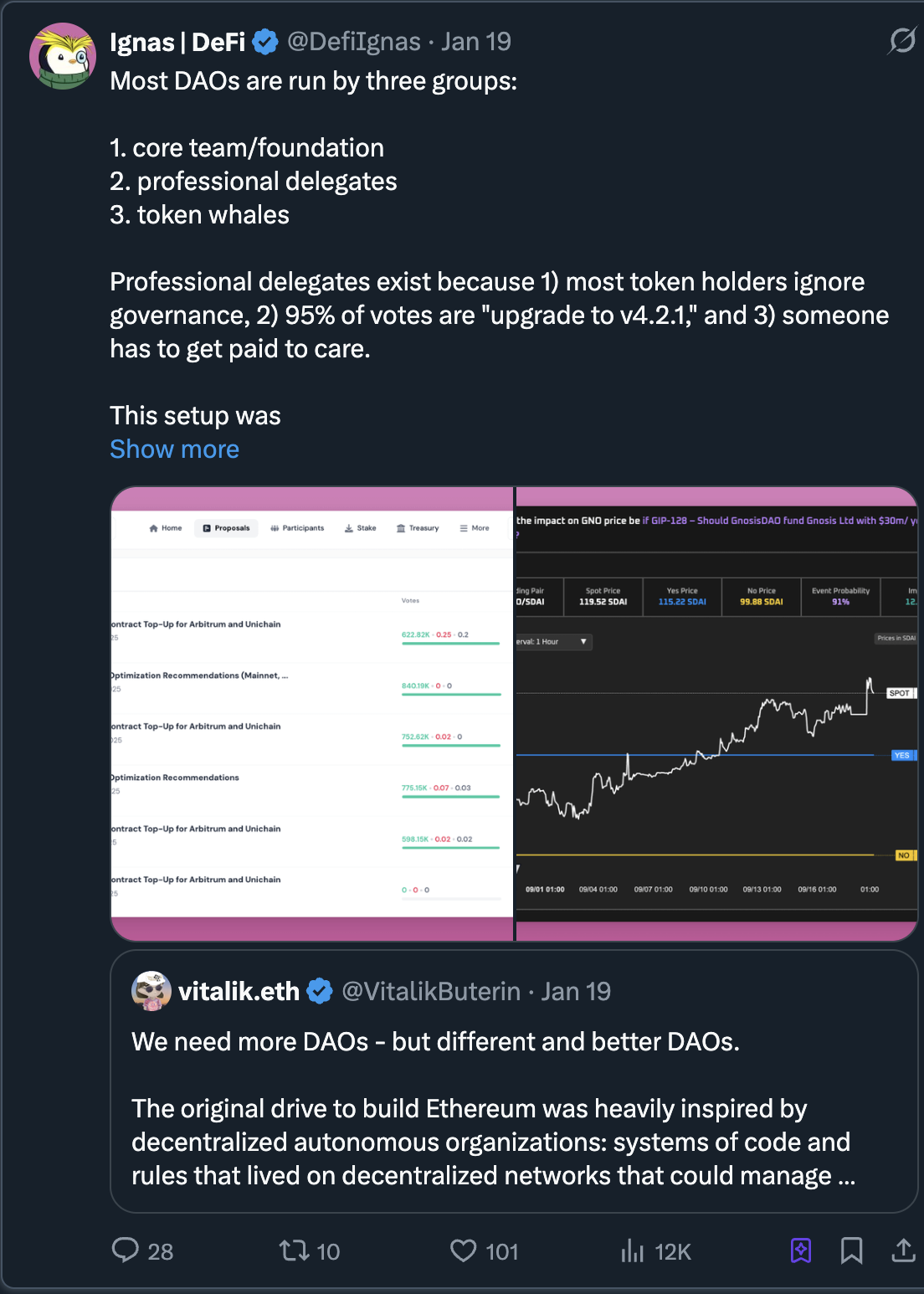
As governance complexity increases, token holders will increasingly delegate to full-time professional delegates. While this concentrates voting power, it may improve decision quality. Meanwhile, weaker delegate institutions that cannot financially sustain themselves will fold, as governance work becomes more professional, political, and costly.
Privacy, AI & Futarchy

Public governance is a social game. When every vote is publicly visible, decisions are influenced by reputation, pressure, and alliances, rather than purely the protocol's best interest. Therefore, governance privacy will become more important in the future.

AI will address decision fatigue. It can assist in analyzing proposals and auto-voting on routine upgrades based on user-defined preferences, requiring human intervention only for disputes or high-impact matters.

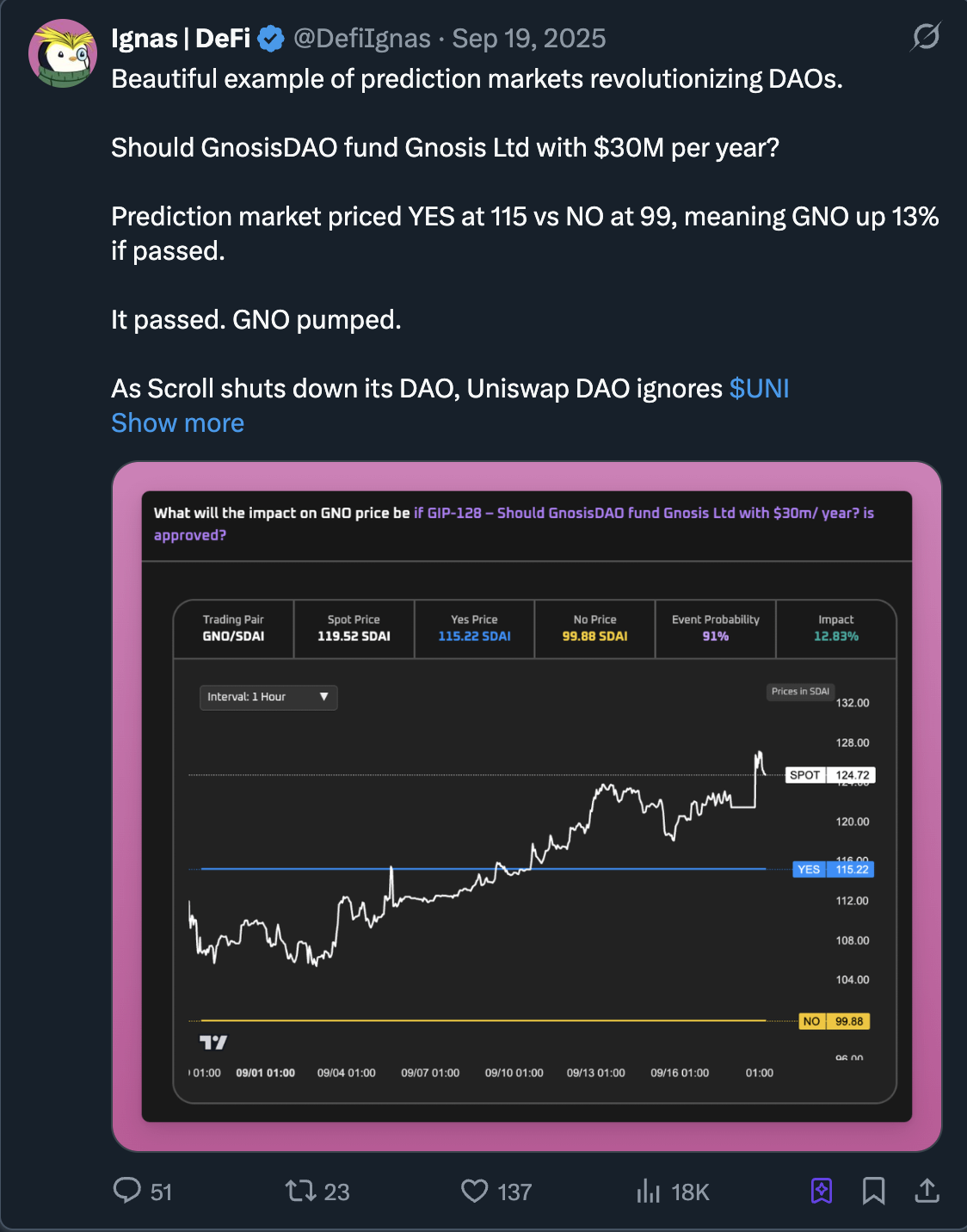
Futarchy markets will also play a larger role in DAOs. They let market signals predict which option might create value. Gnosis is testing this model, using retail prediction markets to reflect sentiment on proposals.
Crypto is Maturing, and So Are DAOs

The shifts we see in DAO operations, economic alignment, accountability conflicts, and professionalization represent maturation, not the end of DAOs.

DAOs are evolving from ideological experiment to organizational architecture that balances "decentralized oversight" with "proven operational efficiency." We believe DAO governance becomes meaningful if teams can align with community interests: moving fast when action is needed, letting growth benefit token holders, and holding all participants—core teams and delegates alike—accountable.

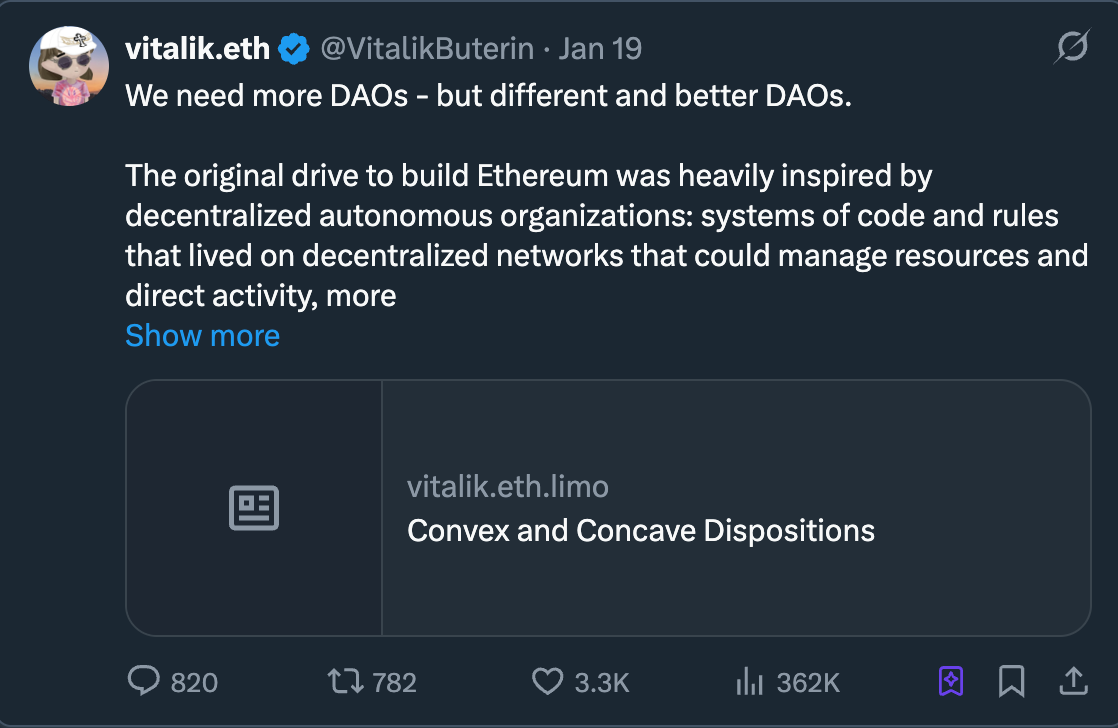
As Vitalik said: We need more DAOs, but different and better DAOs.
If you believe in the value of DAOs, we can be your voice.

Effective delegation is more than just casting a vote; it means doing the actual work: reading proposals, being active on forums, understanding risks, and voting against bad decisions, even when it's not the popular choice.

This is how we operate as delegates: through clear communication and educational content, helping the protocol grow while staying aligned with community incentives.


Twitter:https://twitter.com/BitpushNewsCN

BitPush TG Discussion Group:https://t.me/BitPushCommunity

BitPush TG Subscription: https://t.me/bitpush

Original link:https://www.bitpush.news/articles/7607064

Связанные с этим вопросы

QWhat was the most significant shift in DAO operational models in 2025, according to the article?

AThe most significant shift was the transition from pure community governance to hybrid control models with clearer operational authority, as seen with protocols like Arbitrum introducing operational companies (OpCo) and Uniswap launching the DUNI framework.

QHow did the trend of token buybacks and fee switches address a key challenge in tokenomics in 2025?

AIt addressed the challenge of providing minimal economic value to token holders. By implementing buyback frameworks, fee switches, and revenue-sharing mechanisms, protocols made tokens more scarce and valuable, aligning token holder incentives with the protocol's long-term success.

QWhat two major controversies in 2025 forced DAOs to confront structural flaws in accountability?

AThe two major controversies were: 1) Gnosis DAO voting to terminate Karpatkey's treasury mandate due to fee disputes and performance issues, and 2) The conflict between Aave DAO and Aave Labs over the misdirection of approximately $10 million in annual swap fees.

QWhat is the predicted role of AI in DAO governance for 2026, as outlined in the article?

AAI is predicted to help solve decision fatigue by analyzing proposals and automating votes on routine upgrades based on user-defined preferences, requiring human intervention only for contentious issues or decisions with significant impact.

QWhat does the article suggest is the future for governance tokens that only have voting utility?

AThe article suggests that governance tokens with only voting utility will struggle to maintain long-term engagement. They must incorporate value-capture mechanisms like buyback frameworks, fee sharing, or staking tied to protocol cash flows to be sustainable.

Похожее

AI PC Battle: Bet on the Toll Booth, Not the Camp

**Title:** The AI PC Battle: Don't Bet on Sides, Bet on the Tollbooth **Summary:** The AI PC competition is moving beyond simple "x86 vs. Arm" narratives. The core investment thesis should focus on identifying which players can sustain margins, cash flow, and pricing power throughout the upgrade cycle, rather than backing a particular architecture. The opportunity is analyzed in three layers: 1. **The Advanced Foundry Tollbooth:** TSMC is positioned to collect "tolls" regardless of which chip designer wins, due to its dominant ~70% share in advanced semiconductor manufacturing, which is essential for high-end AI PC chips. 2. **Compute & Platform Spillover:** AMD represents an offensive in the x86 CPU+GPU space, while NVIDIA leverages its GPU and CUDA software stack dominance. Both benefit from the demand for increased local AI compute. 3. **Architecture Diffusion & Turnaround Plays:** ARM and Intel offer potential for significant upside (elasticity), but investments here require stricter discipline due to higher execution risks and competitive challenges. The industry is transitioning from concept to shipment validation. While short-term forecasts for AI PC adoption have been revised down slightly due to tariffs and procurement delays, the long-term trend towards AI becoming a standard PC feature remains intact. The key driver for upgrade cycles will be whether compelling enterprise applications (e.g., privacy-sensitive computing, low-latency inference) emerge beyond consumer-focused features like meeting summarization. Investment strategy should prioritize companies with platform-level advantages and recurring revenue streams. TSMC offers high certainty as the foundational tollbooth. AMD presents a strong offensive play within the established ecosystem. ARM and Intel are higher-risk, higher-potential-reward turnaround bets. The report cautions against chasing short-term hype and emphasizes a disciplined, long-term approach focused on buying ecosystem strength and cash-flow certainty after market enthusiasm subsides. **Key Risks:** Underwhelming AI PC applications slowing upgrade cycles; slow improvement in Windows on Arm compatibility; macro/tariff impacts on PC demand; potential advanced node supply-demand mismatches affecting TSMC; high overall AI sector valuations making stocks vulnerable to a risk-off shift in markets.

marsbit3 мин. назад

AI PC Battle: Bet on the Toll Booth, Not the Camp

marsbit3 мин. назад

Ten-Thousand-Word Analysis: From $10 to $290, MRVL Wins the Entire AI Era by 'Not Making GPUs'

Marvell Technology's stock price surged from under $10 in 2016 to a record $290 in June 2026, fueled not by making GPUs, but by dominating AI infrastructure connectivity. This analysis argues the market misvalues MRVL as merely a smaller Broadcom in custom AI chips, overlooking its true, unique position. Marvell's core strength lies in enabling high-speed data flow for AI clusters through three interconnected businesses. First, it holds a commanding ~70% market share in high-speed optical DSPs (essential for data center light modules), a deep-moat business with accelerating growth. Second, its custom AI chip design business serves hyperscalers like AWS, Microsoft, and Google, with a significant revenue pipeline despite lower margins. Third, stable cash flows come from Ethernet switch chips and enterprise storage controllers. Together, they form a full-stack "AI data movement" platform. CEO Matt Murphy's transformative leadership since 2016, involving strategic divestments, key acquisitions (like Inphi for optical DSPs), and securing long-term agreements with major cloud providers, repositioned the company. A pivotal $2 billion strategic investment from NVIDIA in 2026 underscored Marvell's critical role in the AI ecosystem, particularly through collaborations like NVLink Fusion. While Marvell faces risks—including client concentration (losing the Amazon Trainium3 design), lower-margin business mix, competitive threats, insider selling, and complex supply chains—its fundamentals remain strong. The optical interconnect moat is widening with the acquisition of Celestial AI (photonics fabric), and financial metrics show accelerating revenue growth and operating leverage. With a PEG ratio suggesting undervaluation relative to its growth, the thesis is that the market undervalues Marvell's monopolistic position in AI "plumbing" while overemphasizing its competitive custom chip segment. The story transcends investing, symbolizing how in any complex system—from the internet to AI—the value of "connection" ultimately surpasses that of individual "nodes."

marsbit33 мин. назад

Ten-Thousand-Word Analysis: From $10 to $290, MRVL Wins the Entire AI Era by 'Not Making GPUs'

marsbit33 мин. назад

AI Relay Stations Spark Heated Debate on Zhihu: Behind Cheap Tokens, What Are Users Really Worried About?

A discussion on Zhihu about "AI relay stations" shifted the niche developer topic of "cheap tokens" into broader user awareness. Users moved beyond simply questioning the legitimacy of these services to focus on practical concerns: Where do cheap tokens truly come from? Is the model being accessed the real one? Can relay stations see prompts, code, and API keys? For occasional users, are the risks worth it? The core debate centered less on price and more on trust. A primary worry is model authenticity—the risk of "model swapping," where users paying for a premium model might be routed to a cheaper one, creating an information asymmetry. Others argued that cost comparisons matter; while cheaper than official pay-as-you-go APIs, relay stations may not be the lowest-cost option versus subscriptions, domestic models, or free tiers, making user needs assessment crucial. Speculation about token sources ranged from legitimate bulk discounts to gray-area methods like account sharing or exploiting regional pricing. This opacity makes risk assessment difficult for users. Data security emerged as a critical concern, especially for enterprise use. When processing sensitive information like code, contracts, or client data, the inability to verify a relay station's data handling, retention, or access policies poses significant compliance and confidentiality risks. The evolving consensus suggests relay stations can be used cautiously for low-sensitivity, disposable tasks (e.g., summarizing public info, simple translation). However, they should not be the default for sensitive, professional, or production workflows involving proprietary data, Agents, or automated systems. Recommendations include avoiding large prepayments, not relying on a single service, using test prompts to monitor quality, anonymizing data where possible, and keeping official channels as backups. Ultimately, the discussion framed tokens not just as a billing unit but as a measure of real cost encompassing price, model integrity, data security, and service stability. The popularity of relay stations highlights user demand for affordable access, but the debate underscores a key trade-off: the savings from cheap tokens may come at the price of trust, transparency, and control over one's data and AI experience.

marsbit1 ч. назад

AI Relay Stations Spark Heated Debate on Zhihu: Behind Cheap Tokens, What Are Users Really Worried About?

marsbit1 ч. назад

In-Depth Research Report on TradFi: The Convergence Wave of Crypto and Traditional Finance

In 2026, the crypto industry is undergoing a profound infrastructure-level transformation—TradFi assets are migrating on-chain at an unprecedented pace. According to CoinGecko's Q1 2026 report, the total value locked (TVL) of tokenized real-world assets (RWA) has surpassed $31 billion, a nearly 4x increase from $7.8 billion at the beginning of 2025, with the sector’s aggregate market capitalization reaching $19.3 billion. Among these, the market cap of tokenized stocks surged from $2 million to $486 million, with Q1 spot trading volume reaching $15.1 billion—a single quarter already surpassing the entire second half of 2025. RWA perpetual contract Q1 trading volume reached a staggering $524.8 billion, far exceeding the $313 billion for all of 2025. Meanwhile, BlackRock's BUIDL fund has reached $2.3 billion in scale and has filed for two new tokenized funds, signaling that the world's largest asset manager's tokenization strategy is evolving from pilot to product suite expansion. HTX, as a core participant in the crypto exchange sector, officially launched TradFi perpetual futures products including NVDA, AAPL, MSFT, META, and SPY in 2026, enabling crypto users to gain 24/7 trading access to core U.S. equities. Boston Consulting Group predicts that global tokenized asset scale could reach $16 trillion by 2030, while McKinsey offers a conservative estimate of approximately $2 trillion. The on-chain migration of TradFi assets is no longer a "future narrative" but a structural transformation unfolding in real time, as crypto exchanges evolve from single crypto asset trading platforms toward "multi-asset-class trading infrastructure."

HTX Learn1 ч. назад

In-Depth Research Report on TradFi: The Convergence Wave of Crypto and Traditional Finance

HTX Learn1 ч. назад

Торговля

Спот
Фьючерсы
活动图片