Israeli Military Catching Insiders on Polymarket

Odaily星球日报Опубликовано 2026-02-13Обновлено 2026-02-13

Введение

Israeli military and civilian prosecutors have charged a reservist soldier and a civilian with using classified military information to profit from bets on the prediction market platform Polymarket. The suspects allegedly leveraged insider knowledge on the timing of military operations to place winning bets, netting over $150,000. One user, identified as "Rundeep," reportedly achieved a 100% success rate in six Israel-related predictions, often betting when odds were below 50%. The case highlights concerns about insider trading on prediction markets, especially regarding sensitive areas like military actions, where such activities could compromise operational security and potentially influence real-world outcomes. Regulatory scrutiny may follow as these platforms face growing scrutiny over their role in public affairs betting.

Original | Odaily Planet Daily (@OdailyChina)

Author | Azuma (@azuma_eth)

Insider information providing an unfair competitive advantage has long been a controversial focus on prediction markets like Polymarket.

Previously, during the US military's operation to capture Venezuelan President Maduro, the odds for related events on Polymarket showed abnormal movements ahead of time (see "When War is Settled Before the News: How Prediction Markets 'Priced' the Maduro Capture Operation 6 Days Early"). If that suspected insider activity could still be explained away by fluctuations in the "Pizza Index," then this time, it can be said that there is definitely an insider on Polymarket, completely confirmed.

Israeli Military Catching "Insiders" Internally

On February 12, Israel's largest English-language newspaper, The Jerusalem Post, reported that the Tel Aviv District Court indicted an Israeli civilian and an Israel Defense Forces (IDF) reservist on Monday, accusing the two of using classified military information to place bets on Polymarket for profit. The court revealed on Thursday that Israeli authorities believe this behavior poses a serious operational security risk during wartime.

According to a statement approved for release by the prosecution, the suspects were arrested in a joint operation by the Israel Security Agency (Shin Bet), the investigation unit under the Ministry of Defense's security agency, and the Israeli police. Investigators suspect that some reservists are using the classified information they access through their military duties to bet on the timing of military operations and profit from it.

Following the investigation, the prosecution stated that it has obtained evidence of misconduct by the civilian and the reservist and has therefore decided to indict the two on charges of "serious security crimes" as well as bribery and obstruction of justice. Meanwhile, the prosecution requested the court to extend the suspects' detention until the conclusion of the trial.

Apart from the information released above, more details of the case remain under a legal gag order, including the identities of the defendants, the specific betting content, and the alleged information flow situation.

Tracing the Insider's Activities

Although we cannot learn the true identity and account information of this insider, the X community had already discovered an account on Polymarket with clearly abnormal behavior. The Jerusalem Post also included a screenshot of this account's profits in its report.
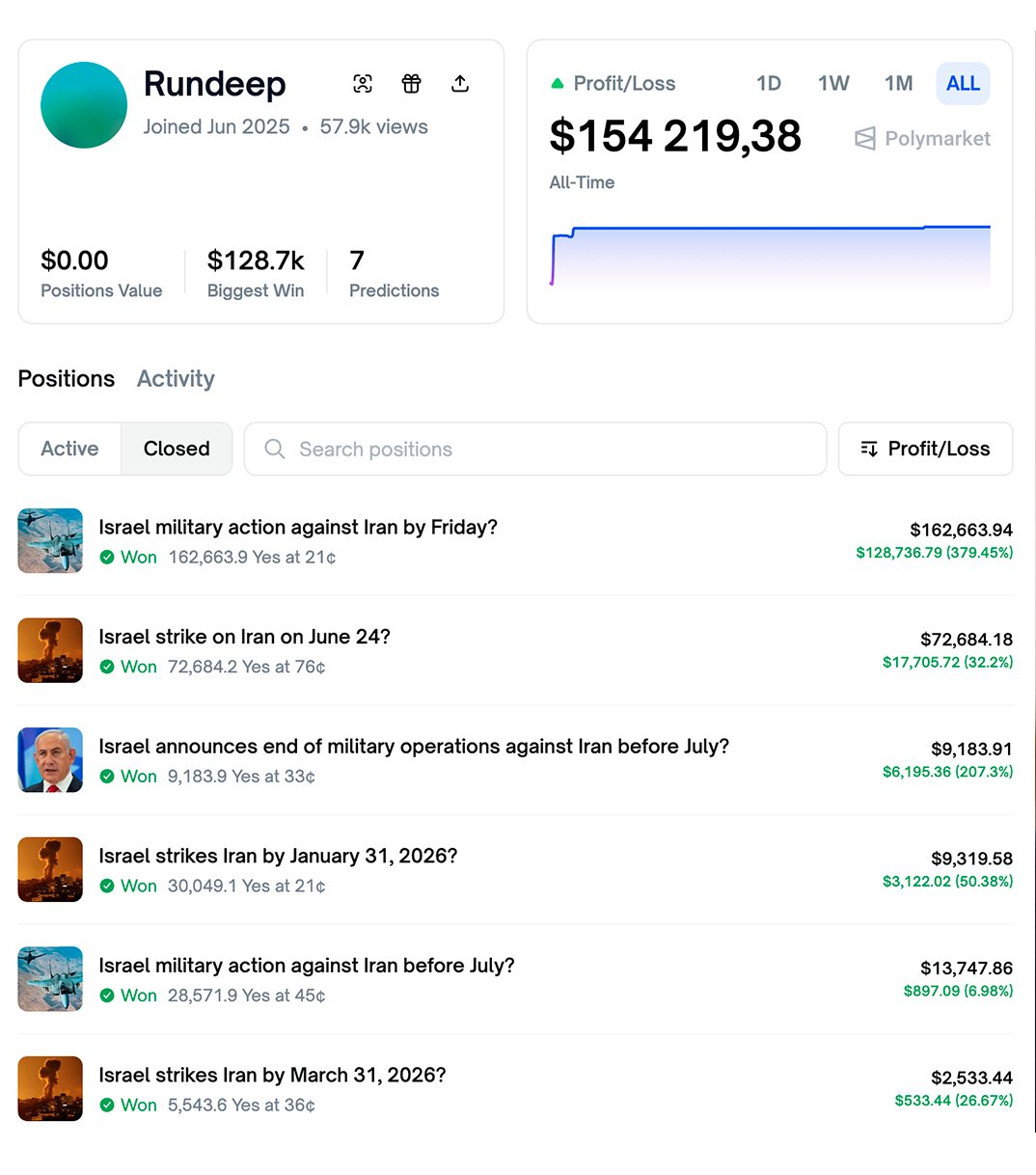
As shown in the image above, this user named Rundeep joined Polymarket in June 2025 and subsequently achieved a 100% win rate in six prediction markets related to Israeli military actions, with five of those bets placed when the probability was below 50%, ultimately profiting over $150,000.

It is worth mentioning that Odaily Planet Daily found that Rundeep had only one loss on Polymarket aside from these "six wins in six attempts." However, this failed prediction was not directly related to Israel but was about "whether the US military would take action against Iran before Saturday (June 21, 2025)"... It seems allied intelligence isn't very reliable after all.

The Real-World Repercussions of Prediction Markets, Truly Frightening to Ponder

Due to Polymarket's open, permissionless nature, anyone can freely place bets on the platform, which objectively provides a more convenient channel for "monetizing information" for those with intelligence advantages — driven by profit, those holding unequal information advantages find it hard to resist the temptation, making it inevitable that insiders will step in to make money.

If such things happened in conventional areas like sports or entertainment, the impact might still be somewhat controllable. But when similar insider betting events occur in sensitive areas like politics or even war, the potential连带 (liándài -连带 means连带, chain, related) terrifying consequences are hard to imagine.

Taking this article as an example, if opposing forces guessed the direction of an Israeli operation in advance through insider betting on Polymarket before the action took place, could it have a huge impact on the subsequent evolution of events? Most people might not easily sympathize with Israel, but in fact, such events could happen to any entity.

In traditional gambling, public affairs such as political elections, legislative outcomes, and wars are usually subject to clear restrictions. Whether prediction markets will face similar regulatory restrictions in the future may involve a long-term regulatory博弈 (bóyì -博弈 means game theory,博弈, struggle,博弈).


Связанные с этим вопросы

QWhat is the main subject of the article regarding the Israeli military and Polymarket?

AThe article reports that the Israeli military is prosecuting a civilian and an IDF reservist for allegedly using classified military information to place bets and profit on the prediction market platform Polymarket.

QWhich user on Polymarket was identified by the X community as having suspiciously successful betting activity related to Israeli military actions?

AA user named Rundeep was identified, who achieved a 100% win rate across six prediction markets related to Israeli military actions, with five of those bets placed when the probability was below 50%, earning over $150,000.

QWhat potential risk does the article suggest that insider betting on platforms like Polymarket could pose in the context of military operations?

AThe article suggests that insider betting could pose a severe operational security risk in wartime, as opposing forces might detect upcoming military actions by observing suspicious betting patterns on the prediction market, potentially altering the course of events.

QWhat was the outcome of the single bet that the user Rundeep lost on Polymarket, and what was it about?

ARundeep's only lost bet was on the prediction 'Will the US military take action against Iran by Saturday (June 21, 2025)?', which was not directly related to Israeli operations.

QHow does the article contrast the regulation of traditional betting markets with prediction markets like Polymarket concerning public affairs?

AThe article notes that traditional betting markets often have explicit restrictions on public affairs like political elections, legislation, and war, and it suggests that prediction markets may face a long-term regulatory battle over similar restrictions in the future.

Похожее

Only a 50% Chance of Passing This Year, Can the CLARITY Bill Succeed Before the Midterm Elections?

The CLARITY Act, which passed the House in July 2025 with strong bipartisan support (294-134), faces a critical juncture in the Senate. The Senate Banking Committee is expected to hold a markup soon, but key issues remain unresolved, including stablecoin yield provisions, DeFi regulations, and securing full Republican committee support. Other contentious points involve the Blockchain Regulatory Certainty Act (BRCA), ethics amendments for government officials, and SEC-related matters. The legislative calendar is tight, with limited time before the midterm elections. If the committee markup is delayed beyond mid-May, the chances of passage in 2026 drop significantly. Senator Cynthia Lummis has warned that failure this year could delay comprehensive crypto market structure legislation until 2030 or later. Galaxy estimates the probability of the CLARITY Act becoming law in 2026 is only about 50%. The bill provides crucial regulatory clarity by defining jurisdictional boundaries between the SEC and CFTC, establishing a path for decentralization, and bringing digital commodity intermediaries under federal regulation. Its passage is seen as vital before potential power shifts in the next Congress, which could bring less favorable leadership to key committees. The timeline is compressed, and the bill must compete for floor time with other priorities like Iran authorization and DHS appropriations. Key hurdles include finalizing the stablecoin yield compromise text, addressing law enforcement concerns about BRCA, and navigating political dynamics around SEC nominations. The outcome of the Banking Committee markup and the level of bipartisan support will be critical indicators of its future success.

marsbit32 мин. назад

Only a 50% Chance of Passing This Year, Can the CLARITY Bill Succeed Before the Midterm Elections?

marsbit32 мин. назад

Dialogue with Xinhuo Chief Economist Fu Peng: Macro Bear Market Expected to End This Year, Prioritize Allocation to Value Assets

Fu Peng, Chief Economist at New Huo Group, discusses the integration of crypto assets into traditional finance, marking a shift from a speculative phase to institutionalization. He highlights the current era as the second major fusion of finance and technology, driven by AI, data, and computing power, with crypto assets becoming part of the FICC+C (Fixed Income, Currencies, Commodities + Crypto) framework. Regulatory clarity in the U.S., such as the GENIUS and Clarity Acts, has paved the way for institutional adoption by defining digital assets as financial instruments. Fu views RWA (Real World Assets) as a tool for asset tokenization rather than a standalone asset class, noting that financial innovation differs between Eastern and Western markets due to cultural approaches to risk and regulation. He emphasizes that stablecoins are essential for future finance, but Asian markets, including Hong Kong, will adopt them cautiously. Macro liquidity now significantly influences crypto markets, as institutional participation increases correlation with traditional assets. Fu suggests the macro-driven bear market may end by year-end, reducing the relevance of Bitcoin’s four-year cycle. For asset allocation, he recommends value-oriented AI stocks for stability, Bitcoin for moderate certainty, and Ethereum for higher volatility.

marsbit39 мин. назад

Dialogue with Xinhuo Chief Economist Fu Peng: Macro Bear Market Expected to End This Year, Prioritize Allocation to Value Assets

marsbit39 мин. назад

Only a 50% Chance of Passing This Year, Can the CLARITY Bill Succeed Before the Midterm Elections?

The CLARITY Act, which passed the U.S. House in July 2025 with strong bipartisan support (294-134), faces a critical juncture in the Senate. The Senate Banking Committee is expected to hold a markup soon, but key issues remain unresolved, including stablecoin yield provisions, DeFi regulations, and securing full Republican committee support. Additional challenges involve the Blockchain Regulatory Certainty Act (BRCA), ethics amendments for government officials, and SEC-related concerns. Galaxy estimates only a 50% chance of the bill becoming law in 2026. The tight legislative calendar, competing priorities like Iran military authorization and DHS appropriations, and the impending midterm elections create significant time pressure. If the bill is not passed before the new Congress convenes in 2027, comprehensive crypto market structure legislation could be delayed until 2030 or later, especially if leadership changes result in less favorable committee chairs. The act provides crucial regulatory clarity by defining the jurisdictional boundaries between the SEC and CFTC, establishing a path for decentralized networks to be classified as non-securities, and bringing digital commodity intermediaries under federal regulation. The outcome of ongoing Senate negotiations, particularly the release of revised text on stablecoin yields, will be a key indicator of its future prospects.

Odaily星球日报42 мин. назад

Only a 50% Chance of Passing This Year, Can the CLARITY Bill Succeed Before the Midterm Elections?

Odaily星球日报42 мин. назад

Four-Dimensional Resonance: Hong Kong Web3 Carnival Sub-Forum Co-Creates Blueprint for Global Financial New Infrastructure

The "Four-Dimensional Resonance: 2026 Global Financial New Infrastructure" forum, a core event of the Hong Kong Web3 Festival, was successfully held at the Hong Kong Convention and Exhibition Centre. Co-hosted by Web3Labs and DeShang Singularity Tech, with joint support from Bitroot, Injective, Microsoft, and Z Oracle, the event gathered policymakers, industry leaders, and investors to explore the integration and innovation of global financial infrastructure, focusing on RWA, AI, DeFi, and compliant payments. Policy speakers, including Hong Kong Legislative Council Member Mr. Wu Jiezhuang, South Korean National Assembly Member Mr. Min Byung-duk, and ACED Chairman Mr. Yun Seok-hun, emphasized the importance of cross-border regulatory collaboration and an open policy environment for fintech innovation. Web3Labs CEO Caspar and DeShang Singularity Tech CEO Chang Shuai highlighted Hong Kong’s role as a financial innovation center and the approaching "singularity moment" for global financial infrastructure. Technical insights were shared by MagnetX, Bitroot, Microsoft, and Injective on topics including AI Agent economies, the evolution of public blockchains, and AI’s transformative role in finance. Key partnerships and initiatives were launched: - GWDC 2026 Korea collaboration between Hong Kong and South Korea. - A strategic agreement between Web3Labs and Microsoft. - The launch of a public anti-fraud alliance by Z Oracle and partners. - The "Injective Rising Star" program to support AI and Web3 projects. Panel discussions delved into AI-driven smart payments, compliant cross-border transactions, and the fusion of RWA and DeFi. Participants agreed that integrating RWA with DeFi is crucial for the next stage of financial infrastructure, enabling a shift from physical to digital finance. The forum underscored Hong Kong’s pivotal role in advancing a globalized and sustainable Asian fintech ecosystem.

marsbit50 мин. назад

Four-Dimensional Resonance: Hong Kong Web3 Carnival Sub-Forum Co-Creates Blueprint for Global Financial New Infrastructure

marsbit50 мин. назад

Торговля

Спот
Фьючерсы
活动图片