Is XRP Poised To Replace SWIFT As Global Payments Infrastructure?

bitcoinistОпубликовано 2026-02-08Обновлено 2026-02-08

Введение

The article examines the potential for XRP and Ripple's payment infrastructure to replace the SWIFT network as the global standard for cross-border payments. It highlights SWIFT's limitations in real-time settlement and discusses a significant shift towards faster, digital financial systems. Crypto analyst Archie suggests SWIFT is now testing integration with the XRP Ledger, mimicking Ripple's approach. Analysts speculate that if XRP captures even a small portion of SWIFT's massive annual transaction flow, its value could surge dramatically, with some predictions reaching over $3,000. The piece also draws parallels between XRP's current market cycle and its historic 2016-2018 breakout, noting similar price consolidation and indicator patterns that may signal another major bull run. The integration of Ripple's stablecoin, RLUSD, into core banking platforms is further bridging crypto and traditional finance.

For decades, SWIFT has served as the backbone of global payments, enabling banks to message one another across borders but not to settle value in real time. As global commerce becomes faster, more digital, and more interconnected, the limitations of legacy messaging-based systems are becoming increasingly visible. This has brought renewed attention to XRP and Ripple’s payment infrastructure that aims to enable near-instant, low-cost settlement of value.

From Bank Messaging To Real-Time Settlement Rails

A massive 1.5 quadrillion financial shift is quietly unfolding, and it’s already shaking the foundations of global banking. Crypto analyst Archie has mentioned on X that SWIFT, the decades-old backbone of cross-border payments, is copying Ripple’s playbook for a real-time transfer system and testing the XRP Ledger integration that could flip the script on slow, outdated cross-border payments.

Meanwhile, analysts are suggesting that if XRP captures even a fraction of SWIFT’s estimated $150 trillion annual flow by 2030, the upside could be enormous, while some stated that the altcoin might surge to $3,000+. With Ripple’s RLUSD stablecoin integrating directly into core banking and treasury platforms, the bridge between crypto rails and fiat liquidity is rapidly taking shape.

Currently, there’s a speculation that XRP is being reviewed as a full SWIFT replacement in the US document, and trillions are flowing into the XRP Ledger. Meanwhile, banks like Citi are tokenizing, and Ripple technology is capable of leading the charge. Archie believes that Citi is already somewhere running on Ripple technology.

How The Last Major XRP Breakout Took Shape

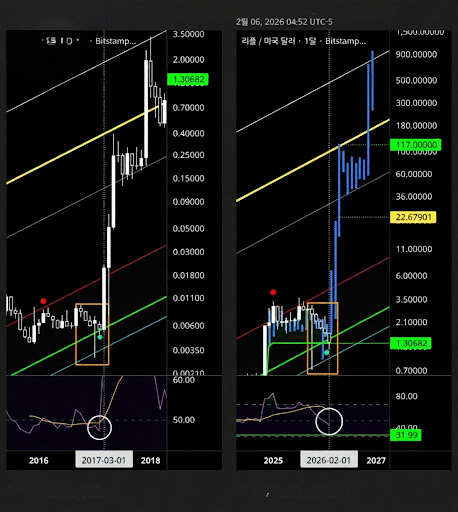
A side-by-side comparison chart of XRP’s historical and current market cycles suggests that history may be rhyming once again. Analyst Archie has also pointed out that in the 2016 to 2018 cycle, the price started trading at a low level around $0.003, gradually building along a rising trendline, then dipping in the orange box, before the price exploded to highs near $3.50.

During that period, the Relative Strength Index (RSI) formed a clear low around the 50 level, signaling a momentum reset rather than a breakdown. The current 2025 to 2027 cycle is showing a structurally similar pattern. XRP is consolidating around the dollar mark, following a similar trend line, with a dip marked in an orange box to $0.70, and the formed bottom closer to the 40 mark.

Source: Chart from Archie on X

Archie noted that the patterns in price action, the dips, and the indicator signals across cycles are repeating almost identically. While history never repeats perfectly, these recurring fractal patterns suggest that XRP may be priming for an epic bull run phase, from fractions to dollars, now potentially from dollars to triple digits, like the projected $117 range. Archie is bullish because the riddlers were right all along, and believes Phoenix will rise.

XRP trading at $1.40 on the 1D chart | Source: XRPUSDT on Tradingview.com

Связанные с этим вопросы

QWhat is the main limitation of the current SWIFT system that XRP and Ripple aim to address?

ASWIFT enables banks to message one another across borders but does not settle value in real time, whereas XRP and Ripple's payment infrastructure aims to enable near-instant, low-cost settlement of value.

QAccording to the analyst Archie, what significant development is SWIFT undertaking regarding the XRP Ledger?

ASWIFT is copying Ripple's playbook for a real-time transfer system and testing the XRP Ledger integration to improve slow, outdated cross-border payments.

QWhat potential price target for XRP is mentioned if it captures a fraction of SWIFT's annual flow by 2030?

ASome analysts suggest that if XRP captures a fraction of SWIFT's estimated $150 trillion annual flow by 2030, the altcoin might surge to $3,000 or more.

QHow does the current market cycle for XRP (2025-2027) compare to its 2016-2018 cycle, according to the analysis?

AThe current cycle is showing a structurally similar pattern: XRP is consolidating around the dollar mark, following a similar trend line, with a dip to $0.70, mirroring the previous cycle where the price built along a trendline before exploding to highs near $3.50.

QWhat role does Ripple's RLUSD stablecoin play in the broader financial ecosystem, as mentioned in the article?

ARipple's RLUSD stablecoin is integrating directly into core banking and treasury platforms, which is rapidly building a bridge between crypto rails and fiat liquidity.

Похожее

A 120,000 Yuan Tombstone or 399 Yuan AI Immortality: Which Would You Choose?

"The 'Deathcare Moutai' Fushouyuan, once a highly profitable cemetery operator, has halted trading amid a severe crisis, with its net profit plummeting by 52.8% in 2024. This reflects a broader trend of people rejecting expensive traditional burials, as average grave prices in China have soared to over ¥120,000. In response, the industry is pivoting to digital alternatives, with companies like Fushouyuan offering AI-powered memorial services, such as virtual farewell halls and AI-generated recreations of the deceased. Simultaneously, a low-cost, unregulated AI 'resurrection' industry has emerged online, with services priced as low as ¥399. These often use open-source tools to create crude digital avatars from photos and voice clips, exploiting vulnerable individuals, particularly bereaved parents who have lost their only child. However, these services raise significant ethical and legal concerns, including data privacy risks and potential use in scams. Academic studies warn that such AI companions may exacerbate grief, leading to prolonged mourning disorders and emotional dependency, rather than providing genuine comfort. While regulations are being drafted to manage digital human services, the deep emotional drive to 'reconnect' with loved ones often overshadows rational concerns. Ultimately, the article questions whether digital immortality truly preserves memory or merely offers a commercialized illusion, emphasizing that no technology can replace the real, irreplaceable loss of a human life."

marsbit4 мин. назад

A 120,000 Yuan Tombstone or 399 Yuan AI Immortality: Which Would You Choose?

marsbit4 мин. назад

Exploring Bitcoin Valuation in 2026 from Macro and On-Chain Structural Perspectives

Tiger Research analyzes Bitcoin's valuation outlook for 2026 from macro and on-chain perspectives. Despite a 27% price drop in Q1, the macro environment remains supportive. Global M2 hit a record $13.44 trillion, but Chinese liquidity, which contributed over 60% of M2 growth, has limited access to Bitcoin markets. The Iran conflict pushed oil prices higher, raising March CPI to 3.3% and narrowing the Fed's rate cut path. However, the easing direction remains intact. Bitcoin ETF flows turned positive in March after five months of outflows, and corporate accumulation continues. On-chain metrics show a shift from undervaluation to early equilibrium. Key indicators like MVRV-Z and NUPL have exited panic zones. The critical resistance is at $78k, the long-term holder cost basis, while the key support is at $54k. Although transaction counts increased, active addresses and average transfer size declined, indicating superficial growth rather than real network expansion. BTCFi ecosystem growth has weakened, leading to a -10% adjustment in fundamental metrics. The 12-month price target is set at $143k, based on a $132.5k neutral benchmark adjusted by -10% (fundamentals) and +20% (macro). This represents a 103% upside from current levels. Short-term catalysts include a break above $78k, sustained ETF inflows, and a Fed policy shift post-geopolitical de-escalation.

marsbit24 мин. назад

Exploring Bitcoin Valuation in 2026 from Macro and On-Chain Structural Perspectives

marsbit24 мин. назад

Anthropic Starts Poaching Scientists? $27K Weekly Onsite Stipend to Fix Claude's Expert-Level Errors

Anthropic has launched a new STEM Fellow program, offering $3,800 per week for a three-month, in-person residency in San Francisco. The role targets experts from science, technology, engineering, and mathematics (STEM) fields—machine learning experience is helpful but not required. Instead, Anthropic values scientific judgment and a willingness to learn quickly. Fellows will work with Claude models and internal tools under the guidance of an Anthropic researcher. Example projects include a materials scientist identifying errors in Claude’s reasoning or a climate scientist integrating atmospheric modeling software with Claude. The goal is to have experts "tell Claude where it's wrong" and improve its scientific capabilities. This initiative is part of Anthropic’s broader strategy to strengthen its scientific ecosystem, following earlier programs like the AI Safety Fellows and AI for Science programs. The company acknowledges that current AI models, while powerful, still produce high-confidence errors and lack end-to-end research autonomy. The program aims to embed domain expertise directly into model development, turning scientists into "high-level reviewers" for AI. Anthropic CEO Dario Amodei has previously emphasized AI’s potential to accelerate scientific breakthroughs, particularly in biology and healthcare. The company believes that the next phase of AI competition will depend not on scaling parameters, but on integrating human expertise to refine model accuracy and reliability.

marsbit54 мин. назад

Anthropic Starts Poaching Scientists? $27K Weekly Onsite Stipend to Fix Claude's Expert-Level Errors

marsbit54 мин. назад

Торговля

Спот
Фьючерсы
活动图片