Is the AI Bull Market in Jeopardy? Philadelphia Semiconductor Index Breaks Below Key Support at 11,200 Points

marsbitОпубликовано 2026-07-30Обновлено 2026-07-30

Введение

The Philadelphia Semiconductor Index (SOX) faces a critical technical and fundamental test. It recently breached a key short-term support level around 11,200 points—a level that held in mid-July—and closed below it. Technical indicators have deteriorated, with the 21-day moving average crossing below the 50-day, signaling bearish momentum. Should the 11,200 support fail, the next major support is the 200-day moving average. The sell-off, which saw memory chip stocks like Micron and Western Digital plunge over 10%, stems from growing concerns about the cyclicality and quality of AI demand. Market participants question the sustainability of the AI capital expenditure boom, highlighted by divergences between the capital expenditures of mega-cap tech firms and semiconductor index performance. However, some positive structural shifts are emerging. Institutional positioning has normalized, unwinding the previously crowded "long semiconductors, short Mag 7" trade, leaving cleaner positioning. Seasonal tailwinds are also approaching, as the NDX historically performs well after this period, potentially supporting a rebound if retail inflows resume. The core question is whether the SOX can hold the 11,200 support. A failure could trigger further declines toward the 200-day moving average, while a successful defense, combined with lighter positioning and seasonal support, could offer a recovery window for the sector.

The U.S. stock semiconductor sector stands at a dual crossroads of both technical and fundamental factors.

While the SOX Index teeters at a critical support level, multiple pressures including questions about the quality of AI demand have heightened market alertness regarding the next moves for tech stocks.

On Tuesday, July 28th, Eastern U.S. time, the SOX Index fell over 6.5% in early trading to drop below 10,800 points, hitting a fresh intraday low. Losses narrowed by the afternoon, with the index closing down approximately 4.5%. Memory chip stocks continued their heavy slide that day. SanDisk (SNDK) plunged over 10% intraday, while Micron (MU), SK Hynix ADR (SKHY), Western Digital (WDC), and Seagate Technology (STX) all saw declines exceeding 10%. Performance among AI chip giants was mixed, with AMD (AMD) also dropping over 10% intraday, while Nvidia (NVDA) fell nearly 2% in the morning before turning slightly positive.
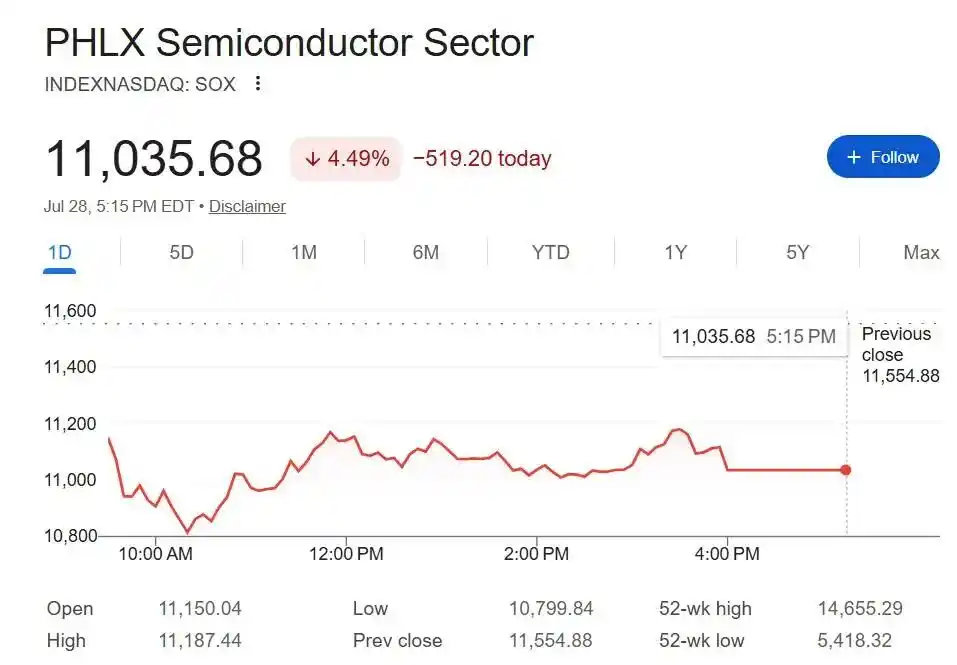
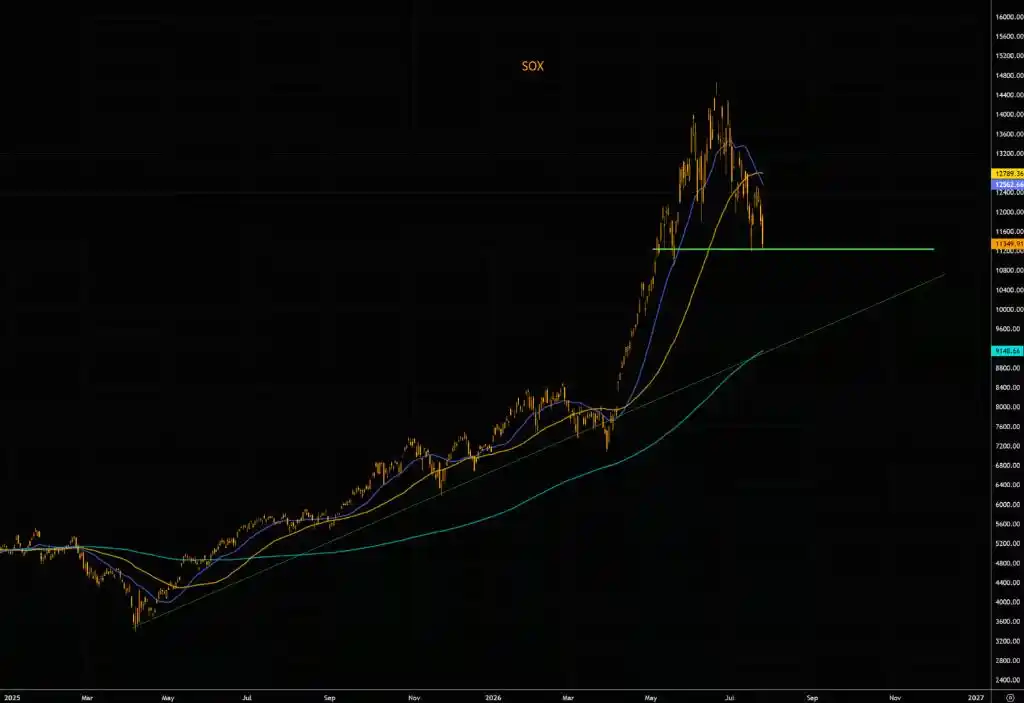
As chip stocks broadly continued to underperform the broader market, the SOX Index broke below the short-term key support near 11,200 points intraday and closed below this level. This level had successfully held during the sell-off on July 17th. However, technical indicators have continued to deteriorate since then—the 21-day moving average has crossed below the 50-day moving average, forming a short-term bearish signal. Concurrently, renewed concerns about the cyclicality of AI capital expenditures are weighing further on investor sentiment.
The semiconductor sector propelled global markets higher in the first half of this year, fueled by investor bets that it would be the primary beneficiary of the massive wave of AI spending. However, as many of these positions have been unwound, the sector has borne the brunt of the intense selling pressure in recent weeks.

Venu Krishna, Head of U.S. Equity Strategy at Barclays, commented: "Concerns around funding uncertainty, increased capital expenditures, and the free cash flow profiles of large tech companies have come into focus for the market."

Marija Veitmane, Head of Equity Research at State Street, described the sell-off as a "spiral." She noted, "The market is concerned about additional leverage and capex, and the sustainability of that spend. Negative momentum is building." However, she added, "Looking at the companies that have reported so far, demand is still incredibly strong... For us, this is a good opportunity to buy the dip."

From a market structure perspective, institutional positioning has normalized. The previously crowded 'long semiconductors, short Mag 7' trade has largely been cleared out, resulting in cleaner positioning. Seasonal factors are also turning favorable, as historically the NDX tends to perform strongly after the current point in time. However, technical fragility and fundamental uncertainty mean that whether this potential support can translate into a substantial rebound remains highly uncertain.

01 Critical Support Teetering, Technicals Continue to Deteriorate

The SOX Index is currently testing the significant short-term support level of 11,200 points. This level served as key support during the sharp sell-off on July 17th, but the technical picture has noticeably weakened since that rebound.

The 21-day moving average crossing below the 50-day moving average constitutes a short-term bearish signal.

More concerning, if the 11,200-point level is decisively breached, there is virtually no meaningful support until the 200-day moving average, which currently coincides with the longer-term uptrend line. This suggests the index could face significant downside risk if support fails.

02 Positioning Unwinding Coupled with Seasonal Support, Prerequisites for a Rebound Emerging

Despite technical pressure, some positive shifts are occurring in market structure.

According to Vanda data, institutional positioning has returned to normal levels, and retail participation has also cooled significantly compared to earlier this summer. The previously highly crowded "long semiconductors, short Mag 7" trade has been largely digested and unwound, resulting in a clearer overall positioning structure.
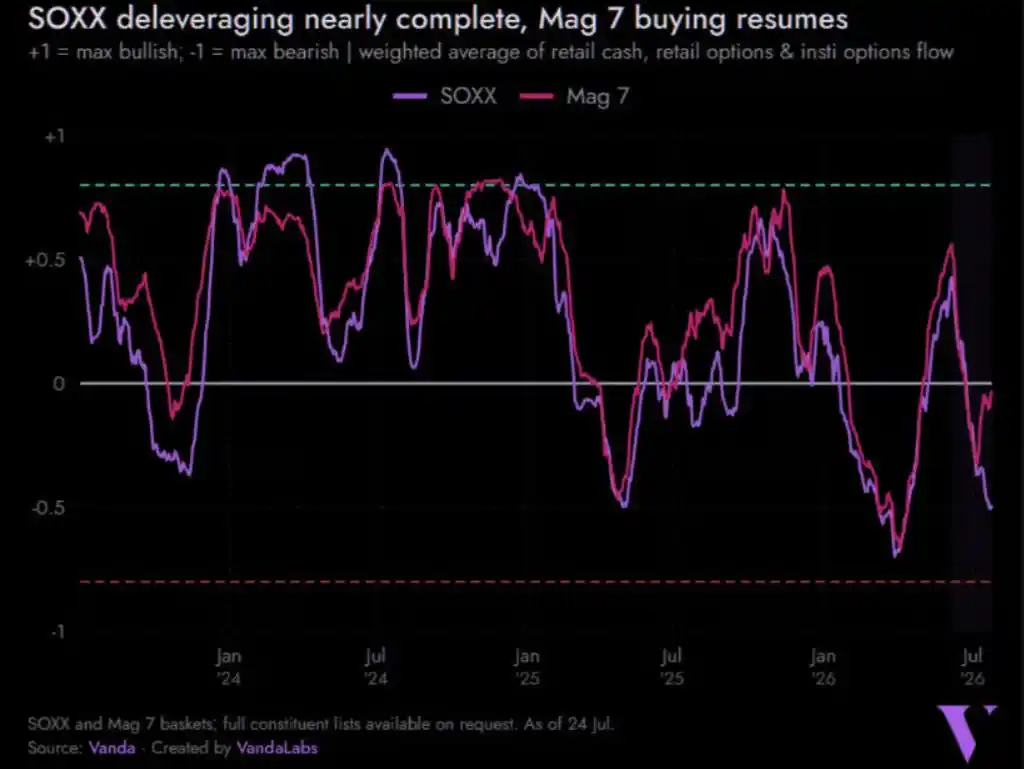
At the same time, seasonal factors are turning favorable. Historical data shows the NDX tends to perform well after this point in the calendar, with July often being a month prone to short squeezes. If seasonal inflows from retail capital begin to pick up in the coming weeks, the overall environment for tech stocks could gradually improve.

03 AI Demand Quality Questioned, Capital Cyclicality Raises Alarms

Technical fragility and fundamental uncertainty are reinforcing each other. According to Bloomberg, Nvidia's latest financing discussions and strategic investment moves have reignited market concerns about the cyclicality of the AI build-out cycle—namely, that capital is funding the customers buying AI hardware, creating a self-perpetuating financial loop.

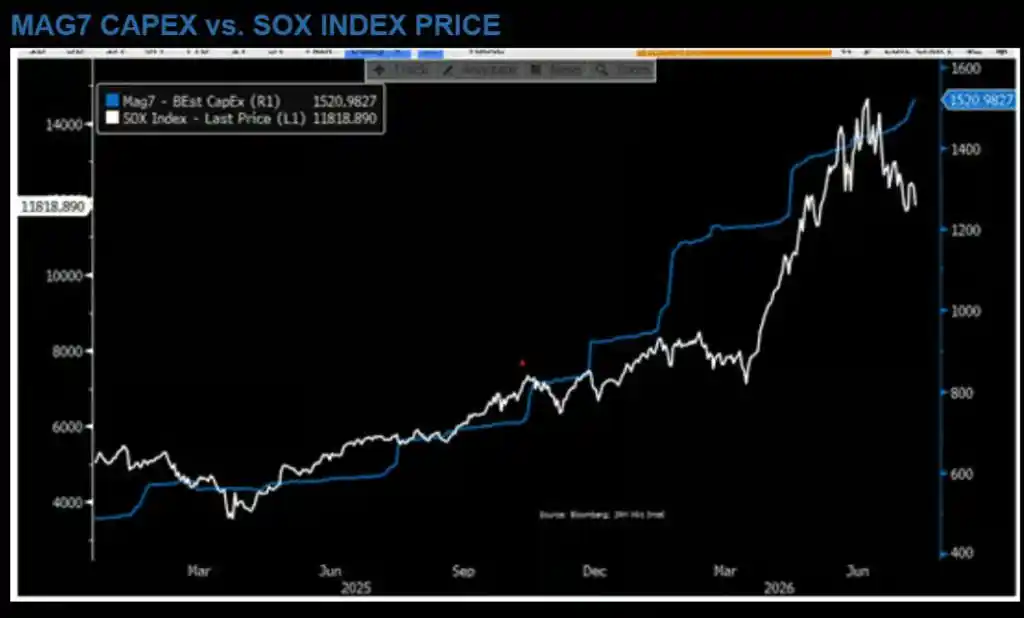
Concurrently, the performance of hyperscale cloud providers relative to the Nasdaq 100 Index has significantly lagged. According to Goldman Sachs data, this relative weakness has reached historically extreme levels. Data from Bloomberg and JPMorgan also show that the short-term divergence between Mag 7 capital expenditures and the SOX Index has widened to an abnormal degree. This growing gap is raising more questions about the sustainability of demand for AI hardware.
04 South Korea's KOSPI Rally Sparks Historical Comparisons, but Fundamental Support Differs

In surrounding markets, the strong rally in the KOSPI has raised caution among some market participants.

A key distinction is that the current rally has a firmer earnings foundation—the recovery in the memory cycle provides substantive performance support for South Korean tech companies.

However, if market sentiment runs too far ahead of fundamentals, the risks highlighted by historical experience should not be ignored.

05 Multiple Variables Intertwined, Whether SOX Holds Support is Key

In summary, the semiconductor sector currently faces a complex situation with mixed signals: weakening technicals, questions over AI demand quality, and accelerated Chinese competition coexist with positioning unwinding, seasonal support, and potential attractiveness after valuation corrections.

Regarding tech volatility, while the VXN/VIX ratio has retreated from recent highs, it remains in a range indicating elevated pressure on tech stocks.

The core variable in the current situation is whether the SOX can hold the 11,200-point support. If this level is lost, the next meaningful support will be the 200-day moving average. If it holds and stabilizes, seasonal capital inflows and the leaner structure following the positioning unwinding could provide a window for tech stocks to recover.

This article does not constitute personal investment advice and does not represent the platform's views. The market carries risks; investment requires caution. Please make independent judgments and decisions.

This article is from the WeChat public account "Wall Street Insights Max," by authors: Bu Shuqing and Li Dan.


Связанные с этим вопросы

QWhat is the current situation with the Philadelphia Semiconductor Index (SOX) in terms of a key technical support level?

AThe SOX index has breached and closed below a key short-term technical support level near 11,200 points, a level that previously held during the sell-off on July 17.

QWhich specific companies in the semiconductor sector were mentioned as being hit particularly hard in the recent sell-off?

AStorage chip stocks were severely hit: SanDisk (SNDK) fell over 10% intraday, while Micron (MU), SK Hynix ADR (SKHY), Western Digital (WDC), and Seagate Technology (STX) all saw declines exceeding 10% at one point. AMD also dropped over 10% intraday.

QAccording to the article, what are two main concerns from a fundamental perspective that are pressuring the semiconductor/AI sector?

AThe two main fundamental concerns are: 1) Questions about the quality and sustainability of AI hardware demand, and 2) Renewed worries about the cyclicality of the AI capital expenditure cycle, fueled by news of Nvidia's financing discussions which suggest a potential self-funding loop for AI hardware purchases.

QWhat positive factors does the article mention that could potentially support a rebound in the sector?

AThe article mentions two potential positive factors for a rebound: 1) Market positioning has become cleaner as the crowded 'long semiconductors, short Mag 7' trade has largely been unwound, and 2) Seasonal factors are turning favorable, with historical data showing the NDX often performs strongly after this point, and July is typically a month prone to short squeezes.

QWhat is identified as the critical variable for the near-term direction of the semiconductor sector?

AThe critical variable is whether the SOX index can hold the 11,200-point support level. If it fails, the next meaningful support is the 200-day moving average. If it holds and stabilizes, seasonal fund inflows and the cleaner market structure could provide a window for recovery.

Похожее

Как стать человеком, которого искусственный интеллект никогда не сможет заменить

В статье рассматривается вопрос о том, как остаться незаменимым в эпоху искусственного интеллекта. Автор утверждает, что вместо страха перед ИИ следует сосредоточиться на развитии качеств, которые машины не смогут заменить. Он критикует «зарплатное рабство» — зависимость от работы, не приносящей удовлетворения, и предлагает путь к финансовой независимости через создание собственного дела. Ключ к успеху — развитие пяти элементов: самостоятельности (агентности), вкуса, умения убеждать, упорства и способности к итерациям. Главное — не просто создавать что-либо (сегодня это может каждый), а создавать что-то ценное, востребованное и уметь это продвигать. Автор считает, что наиболее важным навыком будущего является создание контента (медиа), а не просто написание кода, поскольку ценность контента субъективна и требует уникального человеческого вкуса и суждения. ИИ может помочь в производстве, но не заменит оригинальность мысли и связь с аудиторией. В качестве практического шага предлагается упражнение: за 15 минут ответить на вопросы, чтобы обнаружить свои уникальные знания, опыт и точку зрения, которые станут основой для личного бренда и дела жизни. Первый шаг — немедленно опубликовать свою основную идею, чтобы получить обратную связь от реального мира и начать процесс роста. Цель — стать «непригодным для найма», построив жизнь вокруг собственного творчества и экспертизы.

marsbit37 мин. назад

Как стать человеком, которого искусственный интеллект никогда не сможет заменить

marsbit37 мин. назад

Благодаря броскам кубиков ключи от биткоинов хранятся в автономном режиме, но не все будут этим заниматься

Статья посвящена практике генерации сид-фраз для биткоин-кошельков с помощью бросков кубиков в свете уязвимости, обнаруженной в аппаратных кошельках Coldcard. Подчеркивается, что физический бросок кубика (дающий около 2.6 бит энтропии за бросок) создает высококачественную случайность, поскольку предсказать результат практически невозможно из-за множества переменных. Для создания стандартной сид-фразы из 12 слов (128 бит энтропии) требуется около 50 бросков, а для повышенной безопасности рекомендуется 99 и более. В связи с инцидентом Coldcard, когда неисправный генератор случайных чисел в прошивке (2021-2026 гг.) мог создавать предсказуемые ключи, выяснилось, что сид-фразы, сгенерированные вручную через кубики, были защищены от этой уязвимости. Однако исследование показало, что другие функции устройства (создание бумажных кошельков, ключей для мультиподписи, паролей и т.д.) по-прежнему использовали скомпрометированный генератор, подвергая риску владельцев даже с безопасной основной сид-фразой. Автор отмечает, что, хотя метод с кубиками криптографически надежен, он непрактичен для массового использования из-за трудоемкости, высокой вероятности ошибок при вводе и необходимости строгой дисциплины для сохранения секретности процесса. Делается вывод, что будущее безопасности лежит в создании надежных аппаратных генераторов случайных чисел и понятных интерфейсов, а ручные методы остаются нишевым инструментом для опытных пользователей. Владельцам Coldcard рекомендуется обновить прошивку и проверить/заменить все ключи, сгенерированные уязвимыми функциями.

cryptonews.ru3 ч. назад

Благодаря броскам кубиков ключи от биткоинов хранятся в автономном режиме, но не все будут этим заниматься

cryptonews.ru3 ч. назад

Майкл Сэйлор заявил, что стало невозможно принять обновление биткойна, против которого он выступал!

Майкл Сэйлор заявил, что обновление BIP-110 для Bitcoin не сможет достичь необходимого порога в 55% добровольной поддержки майнеров в текущем цикле сложности. Согласно его данным, из 946 блоков, сгенерированных к настоящему моменту, только 24 содержали сигнал поддержки этого предложения, и все они исходили от майнеров DATUM через пул OCEAN. Сэйлор подчеркивает, что отсутствие сигналов от других майнеров означает отсутствие общего консенсуса. BIP-110 — это предложение, направленное на ограничение внесения в блокчейн Bitcoin данных, не связанных непосредственно с денежными переводами (например, изображений или текста). Сэйлор выступает против него, считая, что сеть не должна решать, какие транзакции являются «нужными», а правила не должны меняться по желанию небольшой группы. Он также утверждает, что заявленный уровень поддержки может быть искусственно завышен из-за автоматизированных процессов сигнализации.

cryptonews.ru4 ч. назад

Майкл Сэйлор заявил, что стало невозможно принять обновление биткойна, против которого он выступал!

cryptonews.ru4 ч. назад

Количество негативных комментариев о биткоине достигло исторического максимума: что это значит?

Аналитическая компания Santiment сообщает, что негативные комментарии о биткоине в социальных сетях достигли исторического максимума. Соотношение позитивных и негативных упоминаний упало до рекордно низкого уровня: на каждый негативный комментарий приходится лишь 0,58 позитивных. Основной причиной роста негатива стала уязвимость в прошивке аппаратных кошельков Coldcard, что подорвало доверие к системам холодного хранения, традиционно считающимся наиболее безопасными. В отличие от прошлых кризисов (таких как крах FTX или Mt. Gox), текущие обсуждения сфокусированы на безопасности аппаратных решений, а не на централизованных биржах. По данным Santiment, текущий уровень паники в социальных сетях даже превышает пики, зафиксированные во время событий этого года, связанных с геополитической напряженностью, и во время прошлых крупных криптовалютных кризисов. Таким образом, страх на рынке исторически значительно превосходит жадность. Компания подчеркивает, что данные пока отражают ситуацию лишь за один день.

cryptonews.ru5 ч. назад

Количество негативных комментариев о биткоине достигло исторического максимума: что это значит?

cryptonews.ru5 ч. назад

Торговля

Спот
活动图片




