Intraday Quantitative Sentiment Fluctuation Analysis Report — December 26, 2025

marsbitОпубликовано 2025-12-26Обновлено 2025-12-26

Введение

BTC Market Sentiment Analysis Report — 2025.12.26 Over the past 24 hours, BTC market sentiment exhibited a V-shaped pattern, starting stable, then declining, before rebounding. Overall sentiment was negative, with the CED (Crypto Emotion Index) dropping from an initial 12.27 to a low of -15.14, with a slight recovery to -13.05 by the end of the session. Key情绪时段 (Emotional Phases): - Morning (09:45–12:00): High volatility in sentiment (CED 12.27 → 7.12) with narrow price fluctuations. - Afternoon to Evening (12:00–20:00): Sustained weakening of sentiment (CED 7.12 → -5.64), accompanied by a gradual price decline. - Night (20:00–04:00): Intense sentiment swings (CED -5.64 ↔ 4.28) alongside significant price oscillations. - Early Morning to Open (04:00–09:45): Sentiment plunged deeply (CED 1.86 → -13.05), resulting in a breakdown in price. Extreme Sentiment and Price Correlation: - Periods of extreme negative sentiment (CED < -10) showed a significantly higher probability of price declines, with an average drop of 0.12%. - Neutral sentiment ranges (|CED| ≤ 10) showed minimal directional bias, with a slight average increase of 0.03%. - Extreme sentiment phases often signal potential price reversals, particularly rebounds following intense negative sentiment. Summary and Conclusions: - Market sentiment remains deeply negative (CED = -13.05), reflecting severe lack of investor confidence. - Emotional momentum has noticeably weakened, suggesting a possible consolidation or botto...

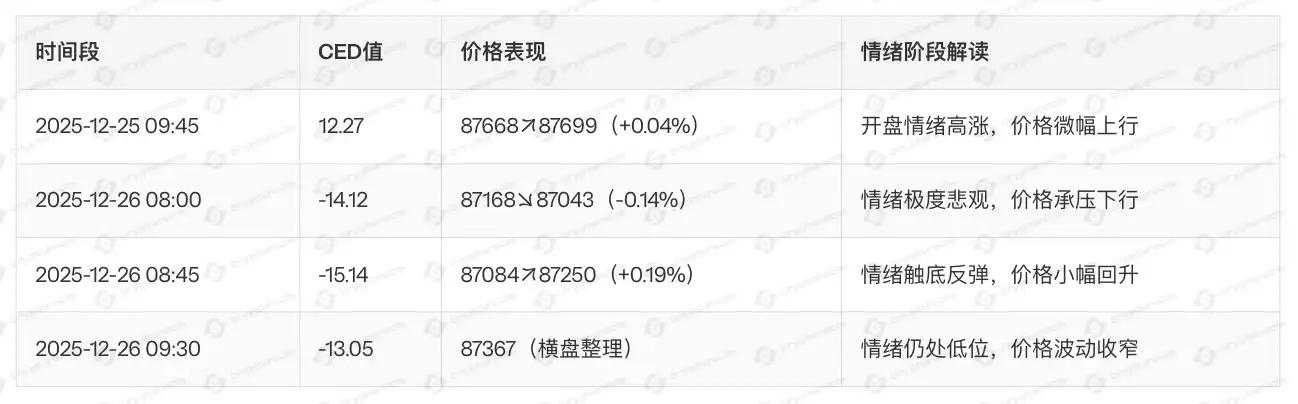
Over the past 24 hours, the BTC market sentiment exhibited a V-shaped pattern of initial stability followed by a decline and then a rebound. The overall sentiment was negative, with the CED dropping continuously from an initial 12.27 to a low of -15.14, before slightly recovering to -13.05 by the end of the session.

Analysis of Extreme Sentiment Periods (|CED| > 10)

Intraday Sentiment Rhythm

  • Morning (09:45-12:00): High sentiment volatility (CED 12.27→7.12) with narrow price fluctuations
  • Afternoon to Evening (12:00-20:00): Sentiment continued to weaken (CED 7.12→-5.64) with a gradual price decline
  • Night (20:00-04:00): Intense sentiment fluctuations (CED -5.64↔4.28) accompanied by significant price volatility
  • Early Morning to Opening (04:00-09:45): Sentiment plunged deeply (CED 1.86→-13.05) with a breakout price drop

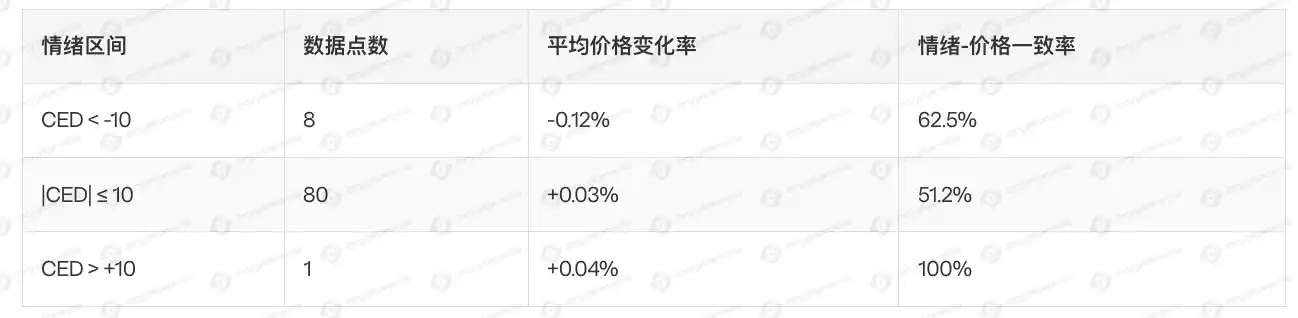
II. Relationship Between Extreme Sentiment Zones and Market Trends

Trend Conclusions:

  • Extreme negative sentiment zones (CED<-10) show significantly higher probability of price decline, with an average drop of 0.12%
  • Neutral sentiment zones (|CED|≤10) show unclear price directionality, with a slight overall increase of 0.03%
  • Periods of extreme sentiment often indicate potential price reversal opportunities, particularly rebounds after extreme negative sentiment

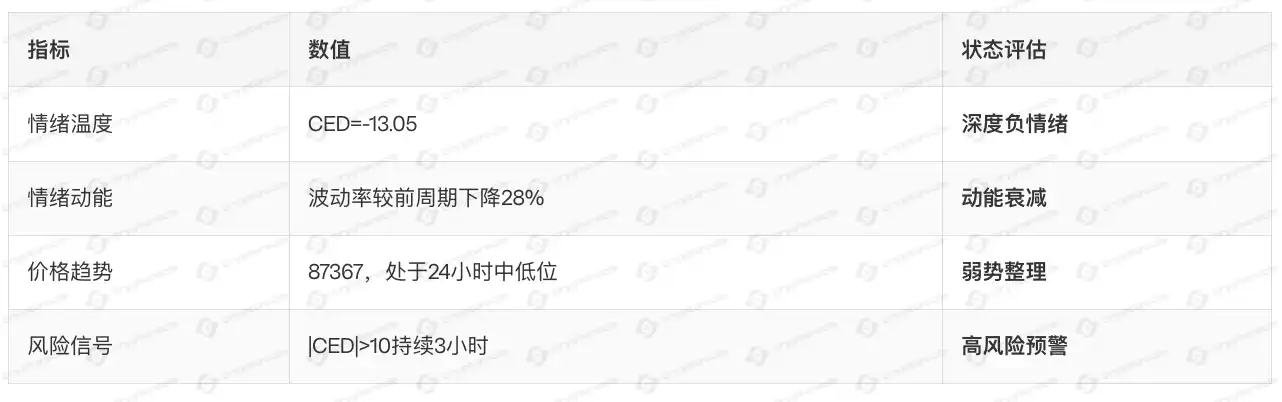
III. Summary of Current Market Conditions

IV. Key Conclusions

  • Market sentiment is in a deeply negative zone (CED=-13.05), reflecting severely insufficient investor confidence
  • Sentiment momentum has noticeably weakened, suggesting a possible short-term consolidation and bottoming phase
  • Prices have formed short-term support in the 87000-87400 range; the strength of sentiment recovery needs monitoring
  • The prolonged duration of extreme negative sentiment warrants caution against further downside risks

Связанные с этим вопросы

QWhat was the overall pattern of BTC market sentiment over the past 24 hours according to the report?

AThe BTC market sentiment showed a V-shaped pattern, starting stable, then declining, and finally rebounding. The overall trend was negative, with the CED dropping from an initial 12.27 to a low of -15.14, with a slight recovery to -13.05 by the end of the session.

QDuring which time period did the most significant emotional fluctuations and large price swings occur?

AThe most significant emotional fluctuations and large price swings occurred during the night session, from 20:00 to 04:00.

QWhat is the reported relationship between extreme negative sentiment (CED < -10) and price movement?

AThe report states that the extreme negative sentiment interval (CED < -10) has a significantly higher probability of price decline, with an average drop of 0.12%.

QWhat is the core conclusion regarding the current state of the market sentiment?

AThe core conclusion is that market sentiment is in a deep negative zone (CED = -13.05), reflecting severely insufficient investor confidence, and it may be entering a phase of volatile bottoming.

QWhat potential risk is highlighted due to the prolonged period of extreme negative sentiment?

AThe prolonged period of extreme negative sentiment highlights the risk of a further price breakdown.

Похожее

Institutional Adoption of Prediction Markets Stuck at the Third Stage

Prediction markets are transitioning from niche platforms focused on elections and sports to mainstream financial tools, as highlighted at Kalshi Research's inaugural conference. While sports still dominate trading volume (around 80%), non-sports categories like macroeconomics, politics, and entertainment are growing faster, signaling a shift from entertainment-based trading to information and risk management tools. Institutions, including Wall Street firms, are increasingly using prediction markets for data reference (Stage 1 adoption), with some progressing to system integration (Stage 2). However, full-scale trading (Stage 3) is limited due to the lack of margin trading, requiring full collateral for positions—a barrier for leverage-dependent entities. Kalshi is working with regulators to introduce margin mechanisms. Key insights from participants like Goldman Sachs and CNBC emphasize the value of real-time pricing for events (e.g., Fed decisions, tariffs), providing benchmarks previously unavailable. The path to maturity mirrors historical financial instruments like options, with expectations that prediction markets will become institutional staples within five years. Political leaders, including Trump and Schumer, now cite Kalshi odds, underscoring its growing influence. The platform rewards domain expertise over traditional finance backgrounds, attracting diverse participants from fields like music and poker. Ultimately, prediction markets are evolving into critical infrastructure for pricing uncertainty.

marsbitТолько что

Institutional Adoption of Prediction Markets Stuck at the Third Stage

marsbitТолько что

The First Year of Computing Power Inflation: The Cheaper DeepSeek Gets, the Harder It Is to Stop This Round of Price Hikes

The year 2026 marks the beginning of "computing power inflation." While AI inference costs have dropped by over 80% in 18 months globally, China's three major cloud providers—Alibaba Cloud, Baidu AI Cloud, and Tencent Cloud—simultaneously announced price hikes of 20–30%. This reflects a deeper structural shift driven by Jevons Paradox: as unit costs fall (e.g., via models like DeepSeek-R1), demand explodes, especially with the rise of reasoning models and AI agents that consume 10–50x more tokens per task. Although DeepSeek open-sourced its model weights, it did not release its inference optimization stack, leaving a significant engineering efficiency gap between cloud providers and smaller players. The big three are leveraging this advantage to reposition: Alibaba focuses on high-margin premium clients, Baidu filters out low-value users, and Tencent capitalizes on ecosystem lock-in. Meanwhile, ByteDance’s Volcano Engine adopts a more moderate pricing strategy to capture displaced customers. Unexpectedly, the price surge is pushing large enterprises toward self-built computing solutions once their cloud bills exceed a certain threshold. While cloud providers aim to boost profitability, they risk driving away innovative startups and accelerating competition from GPU leasing and domestic hardware providers like Huawei. The涨价 trend is expected to persist for 2–3 years, fueled by rising token consumption from reasoning models, AI agent adoption, and NVIDIA export restrictions. The inflection point depends on whether domestic chips can match NVIDIA’s efficiency, likely around 2027–2028. Until then, cloud providers will maintain pricing power, and the key for AI companies is to optimize token usage—the real moat in this era.

marsbit1 ч. назад

The First Year of Computing Power Inflation: The Cheaper DeepSeek Gets, the Harder It Is to Stop This Round of Price Hikes

marsbit1 ч. назад

Торговля

Спот
Фьючерсы

Популярные статьи

Как купить BASED

Добро пожаловать на HTX.com! Мы сделали приобретение Based (BASED) простым и удобным. Следуйте нашему пошаговому руководству и отправляйтесь в свое крипто-путешествие.Шаг 1: Создайте аккаунт на HTXИспользуйте свой адрес электронной почты или номер телефона, чтобы зарегистрироваться и бесплатно создать аккаунт на HTX. Пройдите удобную регистрацию и откройте для себя весь функционал.Создать аккаунтШаг 2: Перейдите в Купить криптовалюту и выберите свой способ оплатыКредитная/Дебетовая Карта: Используйте свою карту Visa или Mastercard для мгновенной покупки Based (BASED).Баланс: Используйте средства с баланса вашего аккаунта HTX для простой торговли.Третьи Лица: Мы добавили популярные способы оплаты, такие как Google Pay и Apple Pay, для повышения удобства.P2P: Торгуйте напрямую с другими пользователями на HTX.Внебиржевая Торговля (OTC): Мы предлагаем индивидуальные услуги и конкурентоспособные обменные курсы для трейдеров.Шаг 3: Хранение Based (BASED)После приобретения вами Based (BASED) храните их в своем аккаунте на HTX. В качестве альтернативы вы можете отправить их куда-либо с помощью перевода в блокчейне или использовать для торговли с другими криптовалютами.Шаг 4: Торговля Based (BASED)С легкостью торгуйте Based (BASED) на спотовом рынке HTX. Просто зайдите в свой аккаунт, выберите торговую пару, совершайте сделки и следите за ними в режиме реального времени. Мы предлагаем удобный интерфейс как для начинающих, так и для опытных трейдеров.

230 просмотров всегоОпубликовано 2026.03.30Обновлено 2026.03.30

Как купить BASED

Неделя обучения по популярным токенам 10: Обновление Alpenglow ожидается в первой половине 2026 года, долгосрочный прогноз по XAUT и XAG остается позитивным

Ожидается, что в первой половине 2026 года начнется развертывание масштабного обновления Alpenglow SOL.

1.1k просмотров всегоОпубликовано 2026.03.31Обновлено 2026.03.31

Неделя обучения по популярным токенам 10: Обновление Alpenglow ожидается в первой половине 2026 года, долгосрочный прогноз по XAUT и XAG остается позитивным

Обсуждения

Добро пожаловать в Сообщество HTX. Здесь вы сможете быть в курсе последних новостей о развитии платформы и получить доступ к профессиональной аналитической информации о рынке. Мнения пользователей о цене на A (A) представлены ниже.

活动图片