Insider Trading Might Be the Most Valuable Part of Prediction Markets

marsbitОпубликовано 2026-01-07Обновлено 2026-01-07

Введение

The article "Insider Trading Might Be the Most Valuable Part of Prediction Markets" examines a controversial case on Polymarket where an account achieved a 1242% return by accurately predicting the arrest of Venezuelan leader Maduro before mainstream media coverage. This event sparked debates about insider trading in decentralized prediction markets and led U.S. Representative Ritchie Torres to propose the "2026 Financial Prediction Markets Public Integrity Act," aiming to regulate such activities. The piece argues that while traditional finance bans insider trading to protect retail investors, prediction markets fundamentally serve as "truth discovery" mechanisms. Their core value lies in aggregating fragmented information into accurate price signals, even if it involves informed participants. Preventing insiders from trading could render markets less accurate, as prices would reflect public speculation rather than genuine probabilities. The article concludes that prediction markets should be viewed as tools for uncovering truth through decentralized information aggregation, not as fair trading venues. Blockchain transparency allows hidden information to become public signals through market activity, enabling rapid price correction and collective intelligence. Regulatory attempts to enforce fairness might undermine the predictive efficiency that makes these markets valuable.

Author: Chloe, ChainCatcher

Recently, Venezuelan leader Maduro was arrested. Before mainstream media released the news, a Polymarket account created in late December had already exited the market with a 1242% return. This incident prompted U.S. Representative Ritchie Torres to propose the "Public Integrity in Financial Prediction Markets Act of 2026," attempting to introduce traditional financial "insider trading" regulations into the crypto market.

This article will use the Maduro incident as a core case study to delve into the controversial issue of insider trading in prediction markets, re-examining whether we need an absolutely level playing field or a precise truth engine in decentralized prediction platforms.

Polymarket's "Prophet" Moment: Accurately Predicting Maduro's Downfall

In January 2026, Venezuelan leader Maduro was confirmed to have been arrested. While global mainstream media was still verifying sources, the data on the decentralized prediction market Polymarket had already provided the answer.

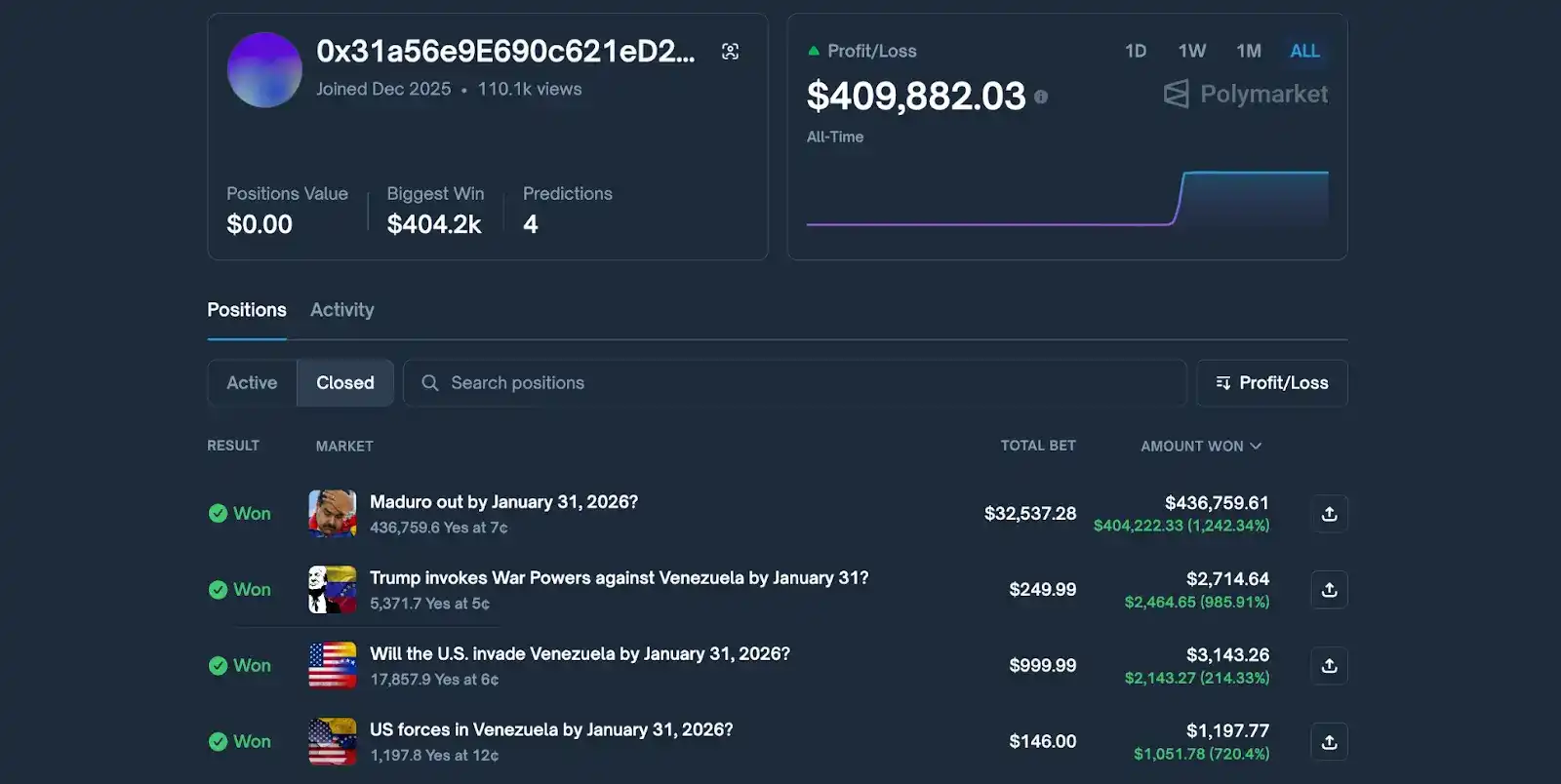
A new account created on Polymarket in late December 2025 seemed to have a god's-eye view, accurately predicting the event. The account made four predictions, all related to whether the U.S. would intervene in Venezuela, with the largest being a bet of $32,537 that "Maduro will step down by January 31." At the time, the market's expected probability for such an extreme event was in the single digits, and the account swept up contracts at the extremely low price of 7 cents.

As news of Trump confirming military action emerged early Saturday morning, these contracts instantly surged to near the $1 settlement price. The account profited over $400,000 in less than 24 hours, with a return rate of 1242%. This was not ordinary speculation but a precise snipe.

Mysterious Prophet or Insider Trading?

This god's-eye view of massive profits quickly became a focal point in the community. As discussions heated up, accusations of insider trading followed:

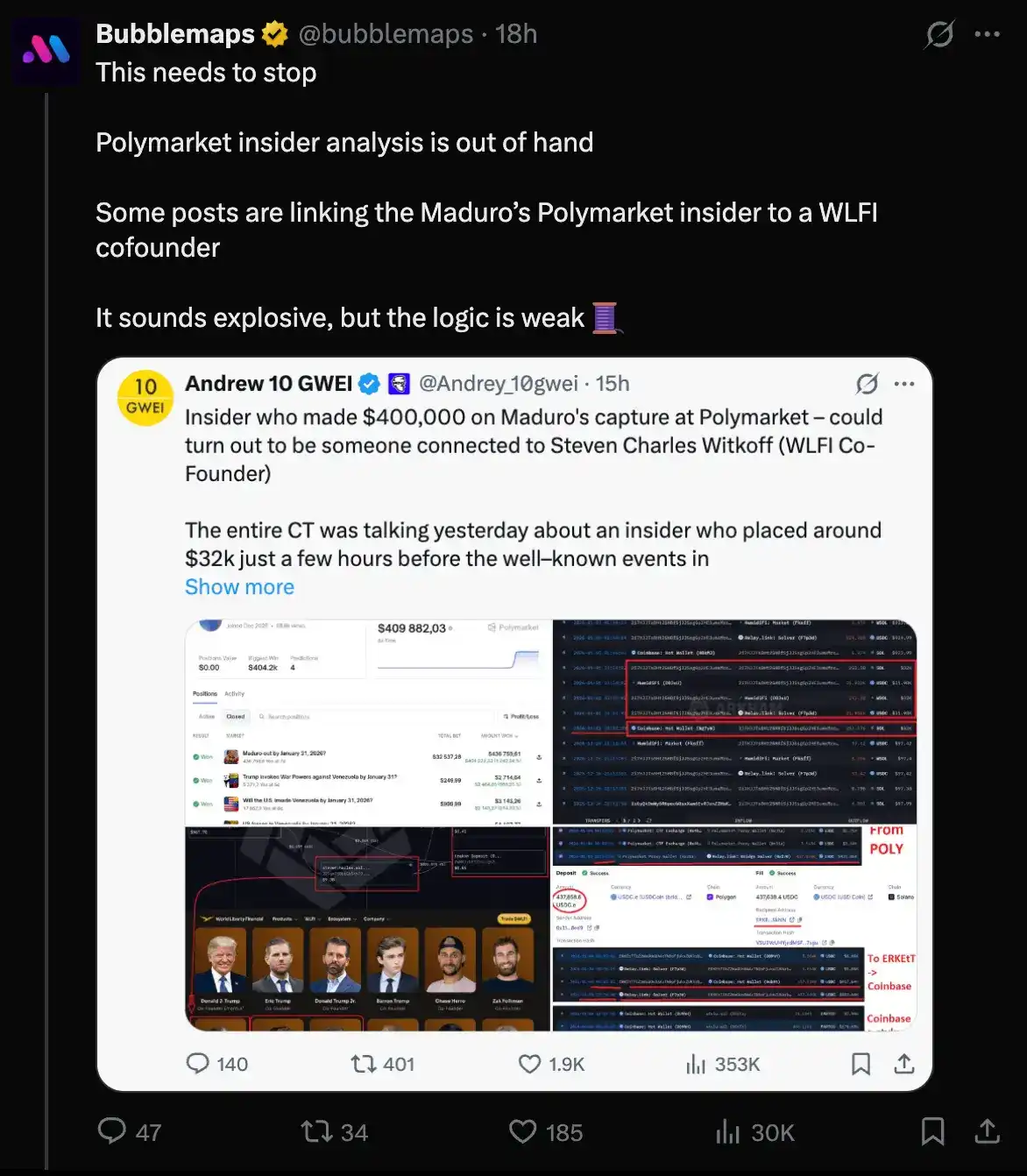
On-chain analyst Andrew 10 GWEI pointed out that the account's funding path showed high similarity: 252.39 SOL withdrawn from Coinbase on January 1 closely matched 252.91 SOL deposited by another wallet the previous day (23 hours apart),疑似通过交易所进行中转断链. More controversially, the associated wallet registered domains like StCharles.sol and had significant interactions with an address疑似 belonging to Steven Charles Witkoff, co-founder of World Liberty Finance (WLFI). Given WLFI's close ties to the Trump family, this raised strong suspicions: Was this insider trading using information from inside the White House?

On-chain analysis platform BubbleMaps later offered a different perspective. They argued that the "time and amount similarity" inference was too superficial, noting that there were at least 20 wallets on-chain that fit this pattern. They also pointed out that Andrew's argument lacked direct on-chain evidence of fund movement, so there was no reliable evidence linking the Polymarket account to the WLFI co-founder.

Congressman Proposes Integrity Act: Aiming to Regulate Insider Trading in Prediction Markets

This incident also led U.S. Representative Ritchie Torres to propose the "Public Integrity in Financial Prediction Markets Act of 2026." The core of the bill is to prohibit federally elected officials, politically appointed officials, and executive branch employees from trading in government policy-related prediction markets using "material non-public information" obtained through their official positions.

However, this bill faces a dual challenge in reality. First, the lengthy and uncertain legislative process; in the complex power dynamics of U.S. politics, such bills often undergo lengthy hearings and interest negotiations, ultimately easily becoming texts with more political posturing than substantive impact.

Second, there is an enforcement blind spot in the decentralized environment, where fund flows on-chain can easily be obscured through various privacy protocols or complex transfer mechanisms. Although the bill symbolizes the formal entry of traditional financial values into prediction markets, attempting to protect retail investors from information harvesting and maintain fair participation rights, we must consider: Will this regulatory logic, directly applied to decentralized prediction markets, conflict with core values and even cause prediction markets to fail?

The Core Value of Prediction Markets and the Paradox of Insider Trading

Returning to first principles, what is the purpose of prediction markets? Is it to give everyone a fair chance to profit, or to obtain the most accurate prediction results?

Traditional finance prohibits insider trading to protect retail investors' confidence and prevent capital markets from becoming a cash machine for the powerful. But in prediction markets, the core value may be "truth discovery."

Prediction markets are machines that aggregate fragmented information into price signals. If a market about "whether Maduro will step down" prohibits informed participants, then the market's price reflection will always be "outsiders' guesses" rather than "real probability," which would render prediction markets inaccurate.

In the Maduro incident,假设 the profiteer was not an insider but a top information analysis expert. He might have tracked abnormal radio signals at the Venezuelan border, private jet takeoffs and landings, or even the U.S. Department of Defense's public procurement lists, piecing together through model inference that military action would occur. This behavior might be highly controversial in the eyes of traditional regulation, but in the logic of prediction markets, it is an extremely valuable "information pricing behavior."

One mission of prediction markets is to break information monopolies. While各方 are interpreting ambiguous, delayed government diplomatic rhetoric, price fluctuations on prediction markets are already sending early warnings of the truth to the world. Therefore, rather than calling this insider trading, it is more accurate to say it is a博弈 that rewards hidden information surfacing through trading, thereby providing real-time risk guidance to the public.

Prediction Markets Are Tools Born from the Pursuit of Truth, Not Fair Trading Venues

The emergence of the "Public Integrity in Financial Prediction Markets Act of 2026" may reflect regulators' cognitive bias towards decentralized prediction platforms. If we pursue a "completely fair" prediction market, we will ultimately get a "completely ineffective" prediction market.

The Maduro incident profoundly reveals the true value of prediction markets: they allow hidden truths to be transformed into on-chain signals visible to all through the traces of fund flow. Blockchain transparency breaks the black box; even if we cannot immediately identify the幕后推手, when mysterious accounts heavily build positions and probabilities fluctuate剧烈, the market is actually sending a signal. This can attract smart money to quickly follow, rapidly leveling the originally unequal information gap, thereby transforming "insider information" into "public probability."

Prediction markets are not stock markets; they are essentially radars of collective human intelligence. To keep this radar accurate, it is necessary to allow the friction cost brought by information arbitrage to a certain extent. Therefore, rather than trying to block signals with bans, should we not position prediction markets as tools born from the pursuit of truth, rather than fair trading venues?

Связанные с этим вопросы

QWhat was the core event that sparked the debate around insider trading in prediction markets, as described in the article?

AThe core event was a Polymarket user who, in late December 2025, made a highly profitable bet predicting the arrest of Venezuelan leader Maduro before it was publicly reported, earning a 1242% return.

QWhat was the name of the bill proposed by U.S. Representative Ritchie Torres in response to the incident, and what was its primary goal?

AThe bill was called the 'Financial Prediction Market Public Integrity Act of 2026'. Its primary goal was to prohibit federal officials and employees from using 'material non-public information' obtained through their positions to trade in prediction markets related to government policy.

QAccording to the article, what is the fundamental paradox or conflict regarding insider trading in prediction markets?

AThe paradox is the conflict between the goal of a 'fair' market that protects all participants and the goal of an 'accurate' market that serves as a 'truth discovery' engine. Banning insiders could make the market fairer but less accurate, while allowing their information to be incorporated through trading makes the market more accurate but less fair.

QHow does the article argue that the transparency of blockchain technology changes the nature of so-called 'insider trading' in prediction markets?

AThe article argues that blockchain transparency turns hidden information into a public signal. Even if the identity of a trader is unknown, their large bets and the resulting market probability shifts act as an early warning system, allowing 'smart money' to follow and quickly incorporate the 'inside' information into a public price, thus flattening the information asymmetry.

QWhat is the article's concluding stance on the primary purpose of a prediction market?

AThe article concludes that the primary purpose of a prediction market is to be a tool for pursuing truth and accurate collective forecasting ('a radar for collective human wisdom'), rather than a perfectly fair trading venue. It argues that some level of information arbitrage is a necessary cost for maintaining the market's accuracy.

Похожее

a16z Crypto Partner: Cash Flow is the Moat

Cash Flow as the Moat: A Playbook for Crypto Founders Historically, the most enduring businesses have been built by positioning themselves within the "flow of funds"—facilitating the creation and transfer of value in a network and extracting a portion of it. Cryptocurrency is the first modern technology natively built for this purpose. For startups, failing to architect products and businesses to leverage these principles means missing a major opportunity. Blockchains are inherently network businesses. Each transaction settles on a shared ledger, and every new participant strengthens the underlying network for all. Well-designed network tokens amplify this by aligning users, developers, and validators around growing the network, with value flowing back to contributors in a transparent feedback loop. This model is not new; companies from railroads and Standard Oil to Google, Meta, and AWS have thrived by inserting themselves into critical flows of value (goods, attention, compute). Financial markets make it even clearer: firms like Visa and major market makers generate immense revenue not by predicting markets but by being in the path of transactions. The combination of fund flow and network effects creates one of the most durable business structures. The high margins in traditional finance (payments, custody, lending, FX) represent prime targets. Crypto founders have the opportunity to build the next version—programmable, instant, global, and natively in the flow of funds. The frontier extends beyond finance to areas like computing/GPUs, AI training data, energy, robotics, and space—markets without entrenched intermediaries, ripe for building new, efficient value rails on programmable infrastructure. Founders should ask: Are you in the flow of funds today? Does your revenue scale 10x with the value of activity on your platform? Where in your target market are profit margins highest relative to value created? The opportunity is clear: embed your startup into the new flows of value and let the network effects accumulate.

marsbit5 мин. назад

a16z Crypto Partner: Cash Flow is the Moat

marsbit5 мин. назад

a16z Crypto Partner: Cash Flow is the Moat

Title: a16z Crypto Partner: Cash Flow Is the Moat Summary: Historically, many of the best businesses were built by positioning themselves within the "flow of funds"—facilitating the creation and transfer of value within a network and taking a cut. The more value flows through, the larger the business grows. Cryptocurrency is the first modern technology natively built for this purpose. If a startup hasn't architected its product and business to benefit from these principles, it's missing a major opportunity. Thanks to stablecoins, capital and value now move at internet speed—globally settled, 24/7, with end-to-end programmability. Blockchains are inherently network businesses. Each transaction settles on a shared ledger, and every new participant strengthens the same underlying network. Network tokens amplify this effect. A well-designed token aligns all participants—users, developers, suppliers, validators, the protocol—around a single goal: growing the network. Participants are paid proportionally to their contributions, creating a transparent feedback loop between value flowing in the system and value accumulating to those building it. This model isn't new; crypto simply makes it more accessible and scalable for startups. The pattern is consistent: find where value flows and position yourself in the middle. Examples range from railroads (earning from freight) and Standard Oil to Google, Meta, and AWS (earning from attention, commerce, and compute flows, respectively). Financial markets make this even clearer. Visa's net income stems from its position in the $15.7 trillion payment flow. Major market makers profit from being in the flow of every order. This combination of fund flow and network effects creates one of the most durable business structures. Jeff Bezos's adage "your margin is my opportunity" applies perfectly here, especially to traditional finance—a massive pool of profit extraction. Crypto founders have the chance to build the next version: programmable, instant, global, and natively in the flow of funds. The frontier extends beyond finance to areas like compute/GPUs, memory chips, AI training data, energy, robotics, space, and rare earth metals—all domains where global value can flow at unprecedented scale on new, programmable infrastructure. Founders should ask: Are you currently in the flow of funds? Does your revenue scale 10x if the value of activity on your product grows 10x? Where in your target market is profit extraction highest relative to value created? The opportunity is there. Seize it, integrate into the new flow, and let the network effects accumulate.

链捕手10 мин. назад

a16z Crypto Partner: Cash Flow is the Moat

链捕手10 мин. назад

RWA First Stock's Major Acquisition: Why Buy a 'Traditional' Mortgage Company?

On June 10th, Figure Technology Solutions (Nasdaq: FIGR), a blockchain-native capital markets firm, announced a $717 million acquisition of Kiavi, a leading non-bank lender for residential real estate investors. The deal involves Figure acquiring Kiavi's technology and operations for approximately $538 million, while forming a joint venture with alternative asset manager Sixth Street to purchase Kiavi's existing loan portfolio. Sixth Street also provided a $3 billion forward purchase commitment. This acquisition marks a strategic shift for Figure, known as the "RWA (Real World Asset) first stock," allowing it to expand significantly into the larger market of first-lien mortgages. Kiavi specializes in non-qualified mortgage (Non-QM) loans, such as short-term fix-and-flip (RTL) and rental property (DSCR) loans—a segment traditionally underserved by major banks. The move is expected to increase Figure's first-lien loan origination to over $7 billion annually, aiming for these to constitute about 40% of its business by 2027. Both companies leverage AI for underwriting: Kiavi uses proprietary models to value renovated properties and automate document processing, dominating the fix-and-flip lending space. Figure plans to integrate these assets onto its blockchain platform, Provenance, using its new 'Adaptor' product to standardize and tokenize the loans for institutional investors on its Democratized Prime marketplace. While the integration poses challenges—including merging different asset types, interest rate sensitivity of Kiavi's loans, and post-IPO execution risks—Figure projects the deal to be accretive to earnings with a cash payback period under four years. The transaction is seen as a major step in scaling blockchain-based capital markets, moving RWA tokenization from concept validation toward large-scale operation.

Foresight News38 мин. назад

RWA First Stock's Major Acquisition: Why Buy a 'Traditional' Mortgage Company?

Foresight News38 мин. назад

Торговля

Спот
Фьючерсы
活动图片